Exporters trading with Central Asia almost all run into similar problems:
When you ask for a quote, the logistics company pounds its chest and says "we can ship anywhere"; once the cargo is sent, you ask "where is it," and the only answer is always "on the way"; when it's inspected, no one notifies you — by the time you find out yourself, two days are already lost; at the destination port, the last-mile delivery throws another curveball.
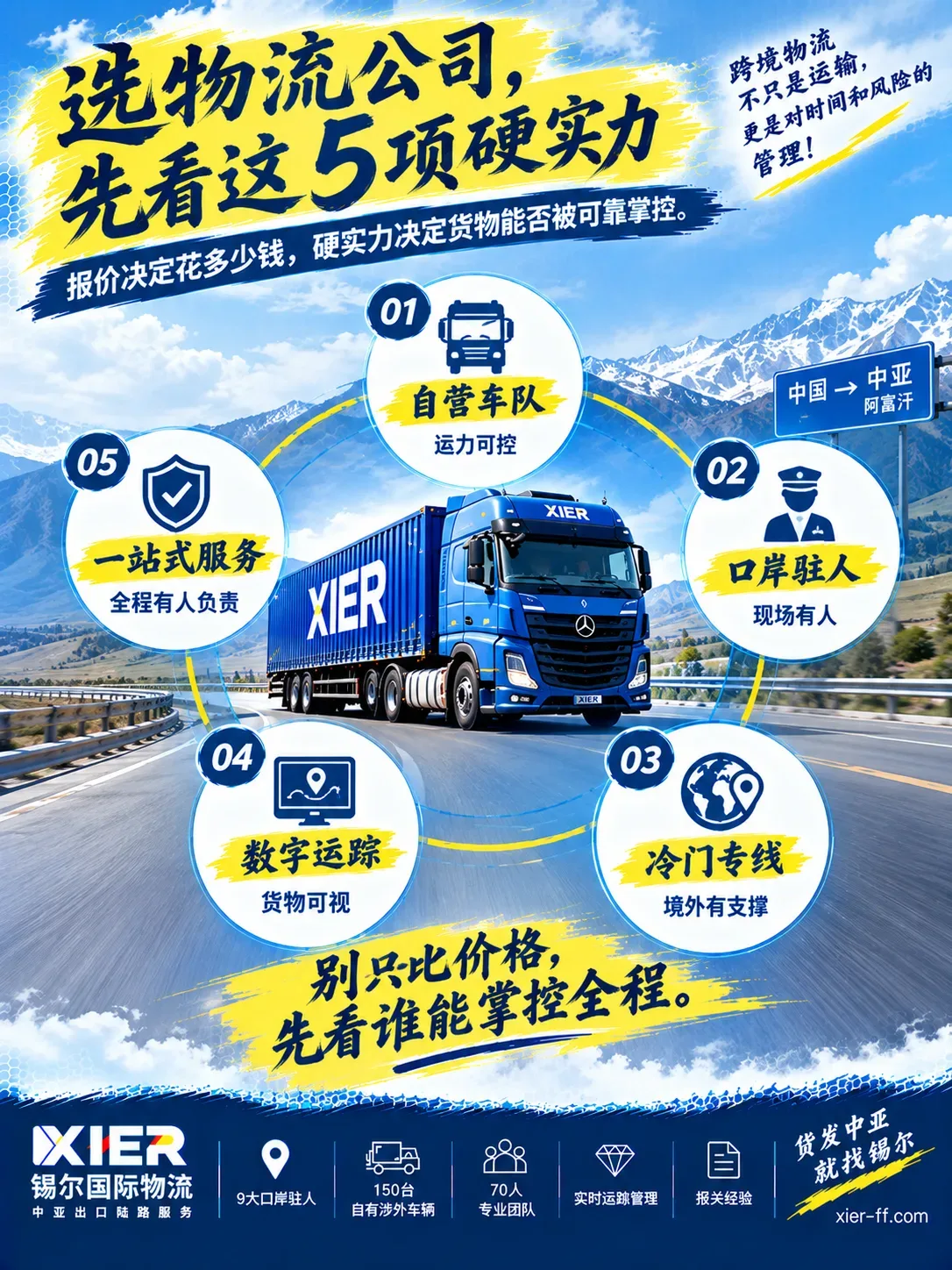
Price matters when choosing a logistics company, but what truly decides whether cargo arrives safely and on time is the company's "hard strength" — which isn't on the quote sheet but directly determines your cargo experience.
Drawing on years of hands-on experience at Xinjiang ports, this article organizes 5 hard metrics for evaluating a logistics company. Whether you export machinery, consumer goods, or chemicals, this standard applies.
Metric 1: Is the fleet owned or dispatched? An owned fleet is real security
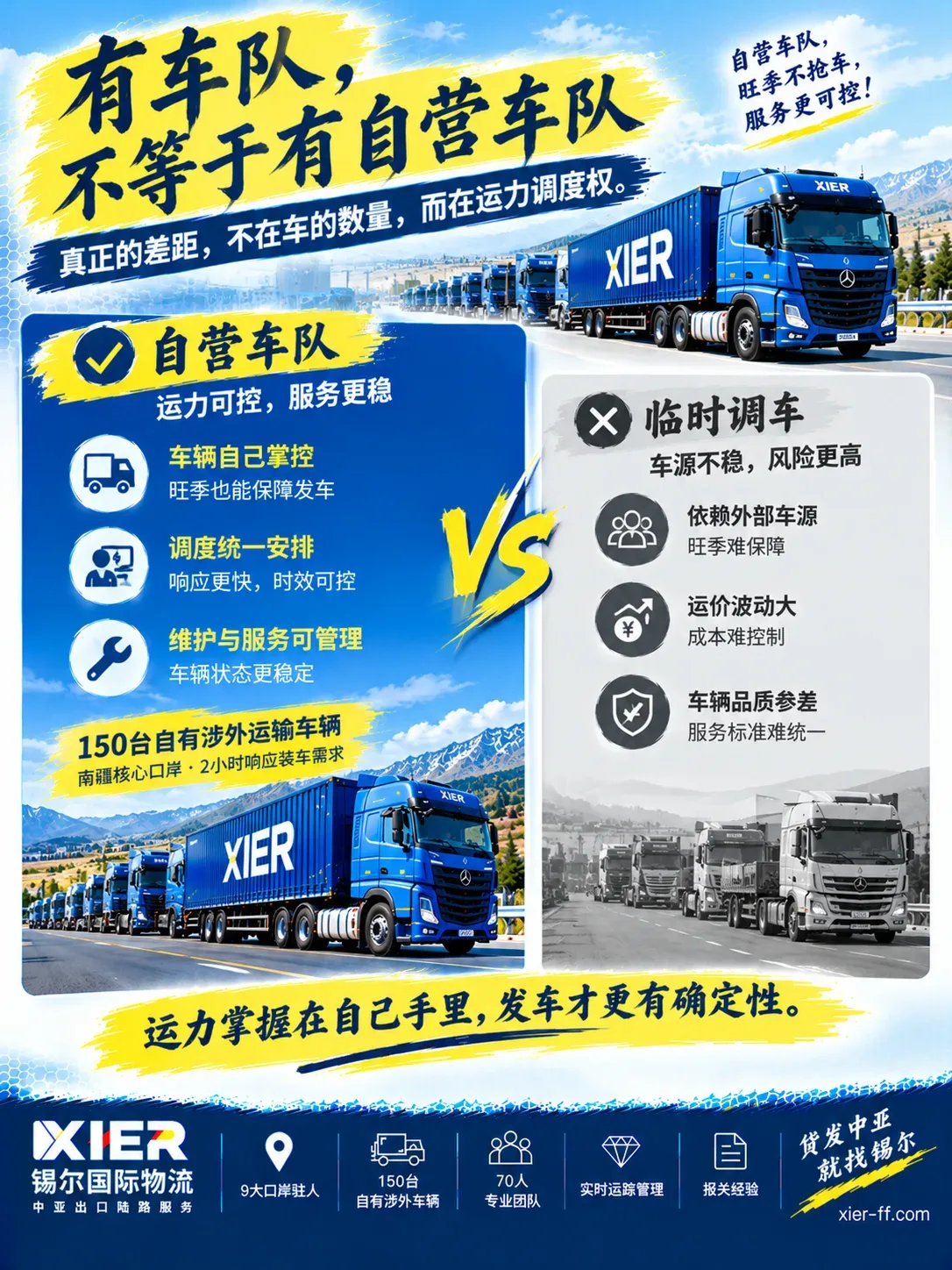
Many logistics companies tell you "we have a fleet," but "having a fleet" and "having our own fleet" are two different things.
A common industry model is the "dispatch model" — after receiving an order, they temporarily find a carrier vehicle. The upside is light assets, but the downside is obvious: in peak season when capacity is tight, rates fluctuate sharply, dispatch is out of their control, and vehicle quality varies.
An owned fleet means drivers, vehicles, and dispatch are all inside the company system. Same cargo, but an owned fleet delivers: guaranteed on-time departure even in peak season; drivers trained to company standards, controllable service quality; regularly maintained vehicles, lower chance of breakdown on the road.
Take Xinjiang ports as an example: the core southern Xinjiang ports are equipped with 150 own foreign-trade transport vehicles — a scale that temporary dispatch cannot build. The advantage of owned vehicles is "respond to loading requests within 2 hours" — say you ship today, and it's loaded the same day. For time-sensitive cargo, this difference can decide a deal.
💡 Selection tip: ask whether the vehicles are registered to the company and whether the same carrier is directly liable for loss or damage.
Metric 2: Does the company have its own people at the port? This decides inspection efficiency by several times
What is cross-border freight most afraid of? Most afraid that cargo gets stuck at the port but no one knows why or handles it.
A company with resident staff: after cargo arrives at the port, someone is on-site to coordinate — inspection follow-up, transload coordination, transshipment handling, all watched throughout. When customs inspects, the field team arrives immediately, photographs and records, liaises with customs, coordinates handling; a normal inspection finishes in 2–4 hours.
A company without resident staff? They can only call a local agent, who says "it's being handled," but how far along and how long it will take is completely uncontrollable. A simple inspection can drag on all day.
For logistics companies deep in the Xinjiang–Central Asia corridor, the 9 major core ports — Irkeshtam, Torugart, Kashgar, Karasu, Khunjerab, etc. — all have resident service teams, with field staff familiar with local customs operations, and business nodes in Urumqi, Khorgos, and Alashankou. This means at every key node from exit to entry, there are own people watching.
💡 Selection tip: ask at which ports the company has resident staff, not just which ports it "can ship to."
Metric 3: Will they take unpopular routes? The Afghanistan line is the best touchstone
Most logistics companies only run popular routes — Almaty, Tashkent, the mainstream cargo. What really tests a company's strength is the unpopular routes.
Take Afghanistan-bound freight. Afghanistan's post-war reconstruction has driven huge import demand — building materials, machinery, auto parts — but the logistics companies that can run an Afghanistan dedicated line are few. The reason is simple: Afghanistan's complex situation requires a stable local agent network, clearance capability, and emergency plans. Very few logistics companies at southern Xinjiang ports hold Afghanistan-direction operating qualifications.
Whether a logistics company runs the Afghanistan line as a regular business line — not "just along the way" — is an important reference for judging its overall strength. The Afghanistan dedicated lines currently in continuous operation have formed a complete transport chain from Chinese factories to Afghan destinations — declaration, transshipment, port transload, overseas delivery, all inclusive, with cargo insurance covering the whole journey.
Similarly, whether a Central Asia logistics company covers 11 countries — Uzbekistan, Kyrgyzstan, Tajikistan, Kazakhstan, Pakistan, Russia, Turkmenistan, Iran, Azerbaijan, Belarus — is also a key metric for evaluating its network coverage.
💡 Selection tip: if your cargo goes to Afghanistan or Iran, this single metric filters out most forwarders.
Metric 4: When you ask "where is my cargo," will they open the system and show you?
In 2026, a logistics company's digital capability has gone from "bonus" to "must-have."
But the word "digital" is overused. Some logistics companies claim "full tracking," but actually just give you a tracking number and let you check each step yourself. What is truly qualified digital tracking?
From warehousing to sign-off, every node updates in real time — warehouse-in time, exit time, transit time, port-arrival time, clearance status, position en route — every node is clear. When exceptions like inspection or delay occur, the system proactively pushes notifications, no need to call and ask. Customs declarations, bills of lading, insurance policies, and other documents can be viewed and downloaded online anytime.
Companies with self-developed logistics platforms can deliver real-time cargo-status queries, online document download, and full visibility. This capability is not just a "display" — it directly determines your sense of control over your cargo, no more anxiously waiting for an "on the way" answer.
💡 Selection tip: ask for a live demo of the tracking system, not just a tracking number.
Metric 5: Is it passed hand to hand, or one-stop to the end?
Cross-border logistics has a long chain and many links — domestic transport, port customs declaration, cross-border transport, destination-country clearance, overseas delivery — any broken link affects the whole.
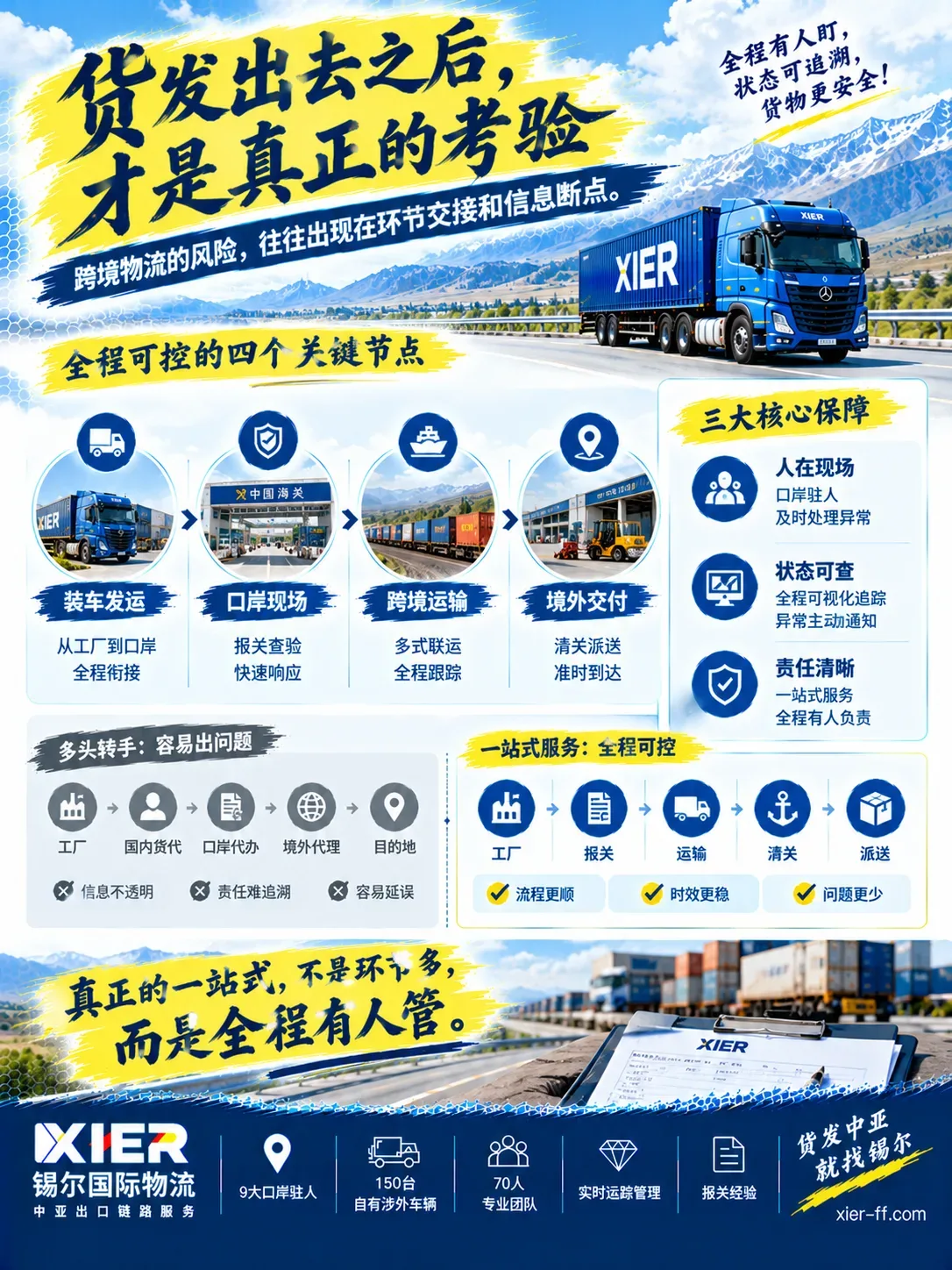
A good logistics company achieves "one-stop to the end": customs brokerage, cross-border transport, warehousing and delivery, cargo tracking, fully integrated. You only need to interface with one window to control the entire shipment's transport status.
Specifically: from export declaration to cross-border transport, from warehousing and delivery to cargo tracking, the company deeply integrates the whole-process resources — direct port customs declaration at road ports, integrated declaration, rail-road multimodal, transit transshipment, in-zone international transfer, cross-border e-commerce B2B declaration, all doable. Different needs — general cargo, oversize cargo, dangerous goods, container transport, full truckload direct — are all met.
Warehousing capability is also key — storage near the port means cargo can be temporarily stored, consolidated, transloaded, without finding a warehouse on the spot. A company with 50,000 m² of own port-adjacent warehousing has far more control over cargo than one renting temporarily.
💡 Selection tip: count how many windows you must deal with — fewer is better.
In conclusion
Choosing a logistics company is like choosing a business partner — the number on the quote is just a start; the real value shows after the cargo departs.
Owned fleet, resident port staff, deep unpopular-route coverage, digital tracking, one-stop full process — these 5 metrics help you build a practical evaluation framework. You don't need to become a logistics expert; just ask a few more questions when quoting, and you can filter out most unreliable options.
Every link of cross-border freight can go wrong, but choosing a logistics company with solid hard strength can minimize the probability of problems.
Frequently Asked Questions
Q1: How to judge whether a logistics company has real strength?
Look at five dimensions: whether it has an owned fleet (outsourced vs owned differ greatly in risk and efficiency); whether it has resident staff at the port (dispatch vs resident efficiency gap is obvious); whether it dares take unpopular routes (Afghanistan, Pakistan, etc.); whether it has a digital tracking system (not just a tracking number); whether it can provide one-stop full-process service (fewer handoffs). These five standards basically filter out most unqualified forwarders.
Q2: In peak season when capacity is tight, how big is the difference between owned fleet and dispatch model?
A company with an owned fleet prioritizes its own customers in peak season — stable rates, controllable transit time. A dispatch-model company must bid up for vehicles in peak season; rates may change daily, and vehicle sources are mixed with no quality guarantee. For trading companies shipping on schedule, an owned fleet means certainty — precious in peak season.
Q3: What special attention for shipping to Afghanistan?
Three points: whether the forwarder has long-term experience operating that route (not a temporary add-on); whether it has a stable local agent network in Afghanistan (directly decides clearance and delivery efficiency); whether full cargo insurance is included. Prefer forwarders that run Afghanistan as a regular line with real case records.
Q4: To what extent is a logistics company's digital tracking qualified?
Qualified digital tracking is more than a tracking number. It should: update every transport node in real time (warehouse-in → exit → transit → sign-off); proactively push notifications on exceptions; let customs declarations, bills of lading, and insurance be viewed and downloaded online. The core is "the system tells you, you don't have to call." If your forwarder does this, it has sustained IT investment and more stable service.
Q5: For Xinjiang port exports to Central Asia, what's the minimum operation time to reserve?
Recommended: 1 day after cargo is ready for loading and declaration prep; 1–2 days port clearance (including inspection); 3–7 days cross-border transport (depending on destination). Overall, factory to destination usually takes 5–10 working days. For special cargo (e.g., dangerous goods), reserve an extra 3–5 working days for filing and approval. Choosing a forwarder with resident port teams saves substantial time at inspection.
About the Author: Xier International Logistics specializes in Central Asia logistics market analysis and digital solutions. This article is based on Xier International Logistics' 10 years of frontline data and industry research and is for reference only; specific plans should be tailored to cargo characteristics.