💡 Shipping to Samarkand — have you hit these headaches?
- Too many routes, not sure which transport mode fits your cargo?
- Incomplete customs documents causing cargo to stall at the port?
- Unstable transit time — peak season can't find trucks, tight block-train space?
- Unfamiliar with Uzbekistan's tariff policy and inspection process?
Based on industry public data and Xier International Logistics' actual operating experience, this article systematically reviews logistics corridor choices and customs practice from China to Samarkand, helping you make a clearer decision.
📊 Key data at a glance:
1. Samarkand: Why is it a key hub of Central Asian commerce?
Samarkand is the second-largest city in Uzbekistan, with a population of about 570,000, located in the central-east of the country. It is an important node on the ancient Silk Road. This ancient city with over 2,700 years of history is now playing a new role — a regional trade and logistics hub of Central Asia.
1.1 Strategic location: crossroads from western China to the heart of Central Asia
Geographically, Samarkand sits right on the overland route from Xinjiang, China to Uzbekistan, and further radiating to the whole of Central Asia, even Afghanistan and Iran. From Kashgar, enter Kyrgyzstan via the Irkeshtam port, then drive northwest along the Osh–Andijan–Tashkent highway to reach Samarkand directly, about 1,400 km in total — one of the shortest overland routes for Xinjiang cargo into Uzbekistan.
Uzbekistan itself is double-landlocked, but its geographic position makes Samarkand a natural node for cargo distribution to surrounding countries:
- Northward
- Eastward
- Southward
- Westward
1.2 Economic hinterland: Samarkand's industry support
Samarkand is not only a famous tourist city, but also an important industrial and trade city in Uzbekistan. Its surrounding economic hinterland covers agriculture (cotton, grain, fruit), light industry (textiles, food processing), tourism, and emerging services. According to Uzbekistan's State Statistics Committee, Samarkand region's foreign trade exceeded $2.5 billion in 2024, with main exports including dried fruit, textiles, chemical products, and auto parts.
In recent years, the structure of Chinese goods shipped to Samarkand has changed significantly:
- Machinery and equipment
- Electronic products and accessories
- Textiles and raw materials
- Chemical products
- Others
The sources of goods are mainly Zhejiang, Guangdong, Shandong, and Xinjiang, with Zhejiang goods dominating, mostly Yiwu small commodities and textiles.
1.3 Policy environment: China–Uzbekistan trade facilitation keeps advancing
Since the signing of multiple cooperation documents at the September 2022 Samarkand Summit (SCO), China–Uzbekistan trade facilitation has kept improving. Uzbekistan levies import duties on Chinese goods at MFN rates (most industrial goods 5%–15%, some essentials lower), and has China–Uzbekistan chamber of commerce liaison offices in major cities like Tashkent and Samarkand to help resolve trade disputes and customs difficulties. In 2025, Uzbekistan launched a "Digital Customs" reform — some goods can submit documents via an electronic pre-declaration system before arrival, shortening clearance by about 1–2 working days.
Xier's view:
2. Three main corridors: road, rail, or road-rail multimodal — which to choose?
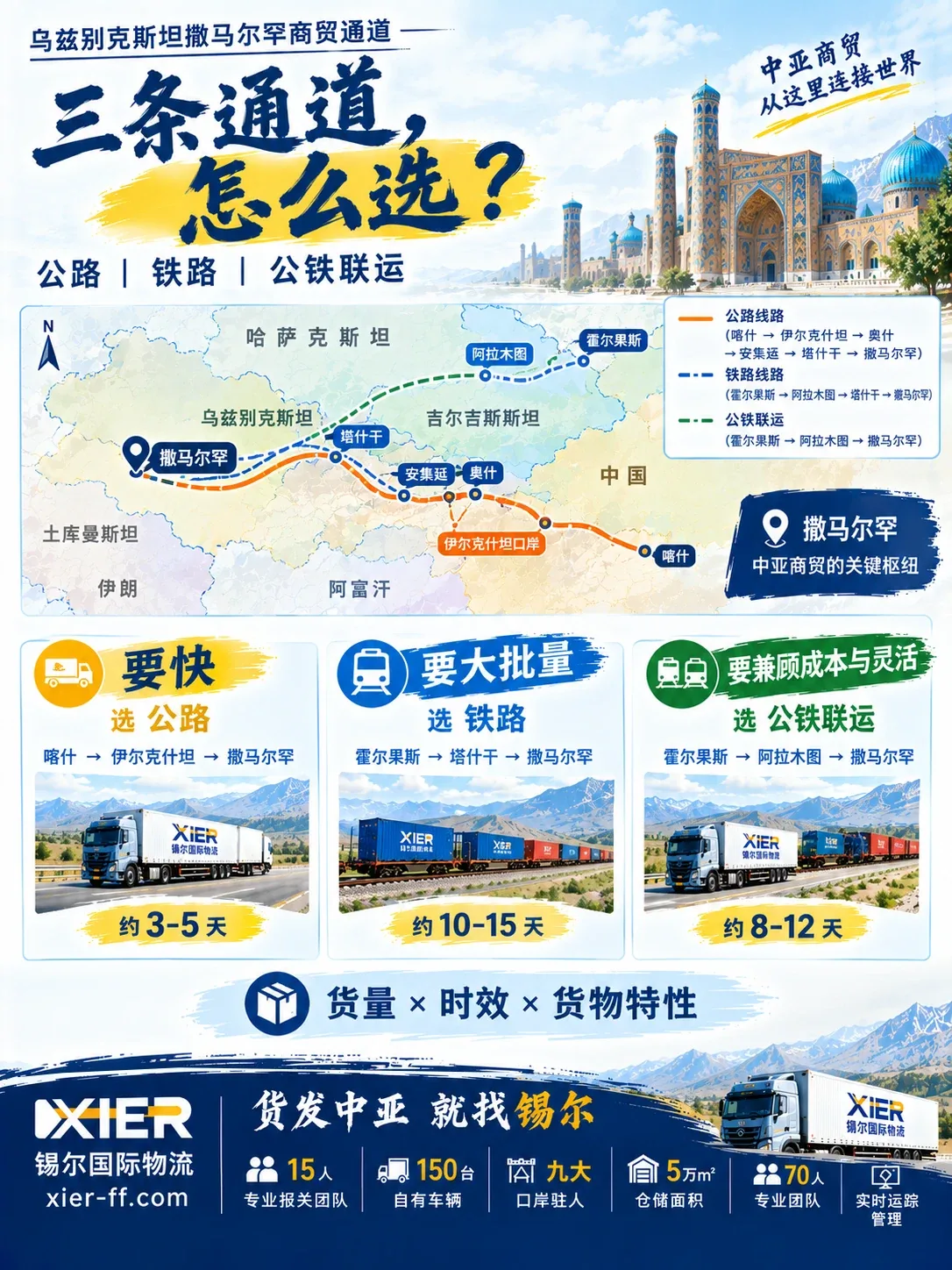
From China to Samarkand, there are three mainstream logistics corridors, each suited to different scenarios. The comparison below covers transit time, cost, and suitable cargo.
2.1 Road transport: Kashgar → Irkeshtam → Samarkand
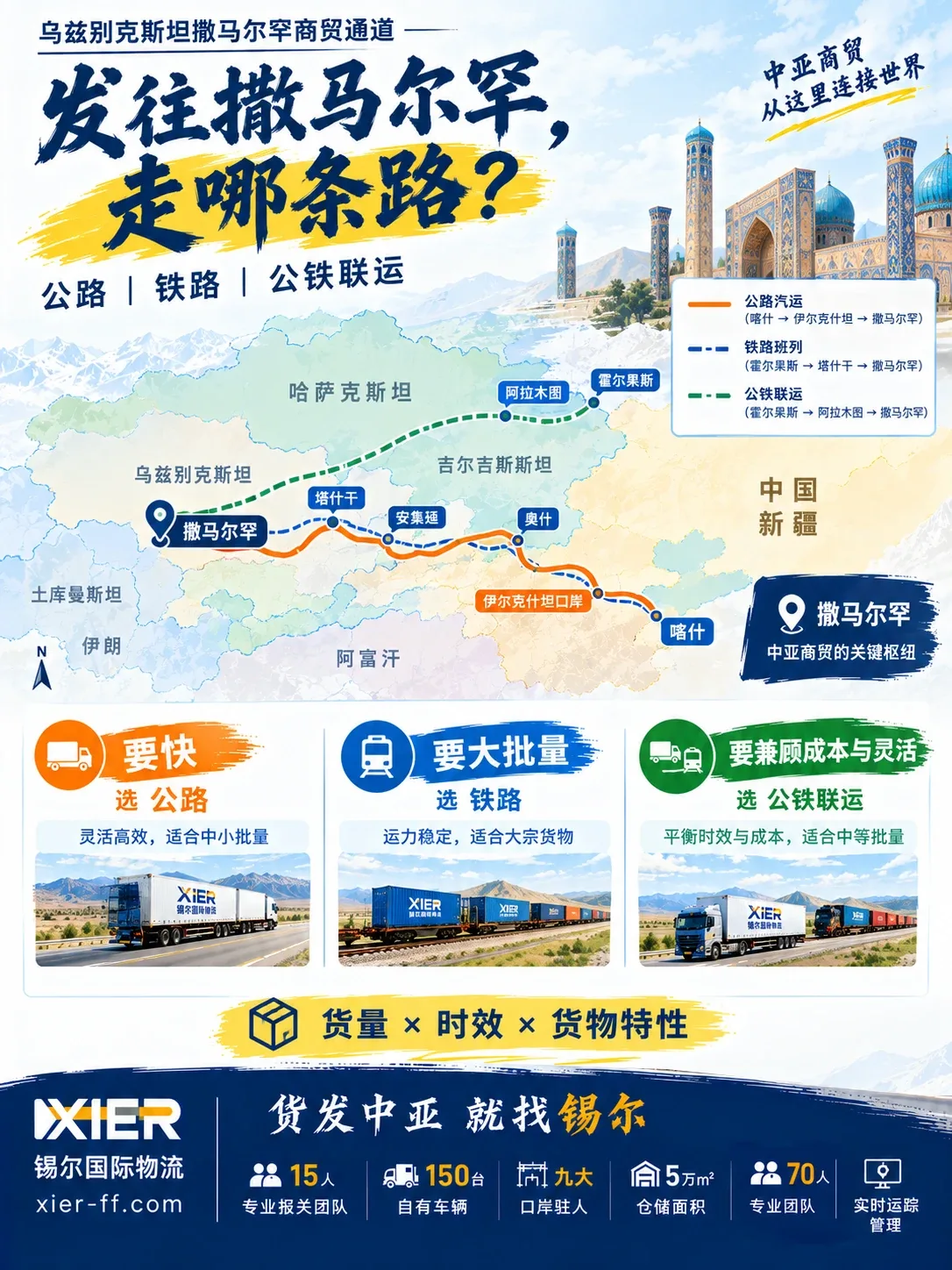
Route:
Total distance:
Transit time:
Transport cost:
Suitable cargo:
- Full truckload or shared truck: for 1–20 ton small-batch cargo, high flexibility
- Time-sensitive cargo: machinery parts, electronics that can't wait for block-train schedules
- Oversized cargo: extra-long, extra-wide, overweight engineering equipment (need oversize transport permit in advance)
- Multi-batch small cargo: suitable for Yiwu small commodities shared export
Notes:
- Irkeshtam port is at high altitude (~2,800 m); in winter (Nov–Mar) it may close occasionally — watch port open/close status in advance
- The Kyrgyzstan section has many mountain roads with strict speed limits — choose carriers with plateau transport experience
- Dangerous-goods transport needs HS Code and destination-country import permit confirmed in advance
Xier's actual case:
2.2 Rail block-train: China–Europe block-train (Khorgos) → Tashkent → Samarkand
Route:
Total distance:
Transit time:
Transport cost:
Suitable cargo:
- Large-volume cargo: single shipment over 21 tons (40HC high cube) or volume over 67 m³
- Low-value, stable-plan bulk cargo: building materials, raw materials, industrial semi-finished goods
- Cargo with medium time requirements (10–15 days acceptable)
- High-precision equipment that can't bear road jolts
Notes:
- China–Europe block-train capacity fluctuates seasonally; book space 15–20 days ahead in peak season
- Railway Bill of Lading differs from ocean Bill of Lading — no document of title, not transferable
- Tashkent gauge change (Central Asia uses 1520 mm broad gauge, vs China's 1435 mm standard gauge) needs transloading in Kazakhstan, wait ~1–2 days
- Rail block-train requires full container, not suited to small shared cargo
2.3 Road-rail multimodal: flexible combination to cut cost and boost efficiency
Route:
Transit time:
Transport cost:
Road-rail multimodal makes full use of rail's bulk advantage, switching to road delivery after reaching Almaty or Tashkent — controlling cost while keeping flexibility. This route has grown fast in recent years, especially for companies whose volume doesn't fill a full container but don't want LCL.
2.4 Horizontal comparison of three routes
| Comparison dimension | Main route | Reference transit time | Reference cost | Minimum shipment | Suitable cargo | Peak-season price fluctuation | Stability |
|---|
Note: the above cost data are reference ranges for H1 2026; actual prices fluctuate with the market. Transit times are normal-case estimates; peak season, weather, and port policy may cause delays. Source: Xier International Logistics operating database and industry public data.
3. Customs practice: Uzbekistan import clearance process and document guide
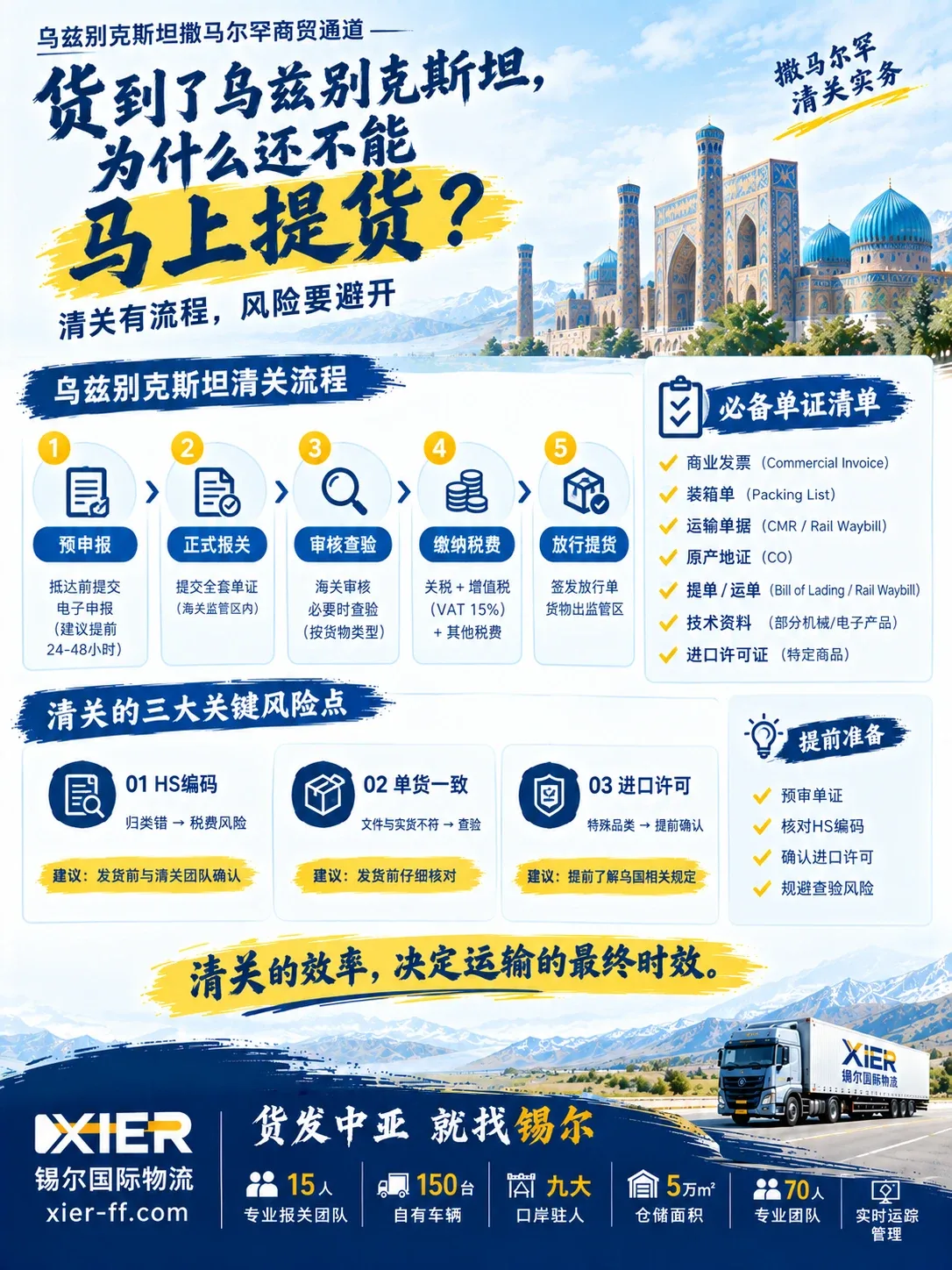
Uzbekistan's customs management system has kept reforming in recent years, gradually transitioning from traditional paper declaration to digitalization. Understanding its clearance process is a necessary prerequisite for smooth cargo entry.
Understanding the institutional framework of Uzbekistan customs clearance is key to avoiding delays. The following process is based on 2026 current rules; please follow the customs' requirements on the day for specific execution.
3.1 Five-step clearance process
Uzbekistan clearance generally follows this process (at Tashkent/Samarkand main clearance points):
- Cargo pre-declaration
- Submit formal Customs Declaration
- Customs review and inspection
- Pay duties and taxes
- Release and pick-up
3.2 Required document checklist
Regardless of transport mode, the following documents are the "standard kit" for Uzbekistan customs clearance:
- Commercial Invoice
- Packing List
- Transport document
- Certificate of Origin
- Bill of Lading / Rail Waybill
- Cargo description report (technical specification)
- Import license
3.3 Common inspection points and pitfall guide
Based on years of frontline experience of Xier's clearance team, the following are the most common inspection reasons for Chinese cargo at Uzbekistan customs:
- Declared price too low
- Wrong HS Code classification
- Goods inconsistent with documents
- Missing import license
- Non-standard dangerous-goods labeling
Xier's advice:
Further reading:
4. Xier International Logistics' Samarkand service advantages
The Samarkand corridor has many competitors, but few operators can truly integrate route, clearance, and last-mile delivery into one-stop service. Xier International Logistics has built substantial advantages on these dimensions:
4.1 Own vehicles, controllable capacity
Xier International Logistics has invested in own vehicles and long-term partner fleets for Central Asia road transport, mainly covering Kashgar–Tashkent and Samarkand. Compared with ad-hoc dispatch, own vehicles mean:
- No space scramble in peak season — lock capacity ahead (Xier can usually confirm vehicles 30 days ahead)
- Full GPS tracking, visible transit (customers can view vehicle position in real time via the order system)
- Same carrier directly liable for cargo loss/damage, clear traceability
4.2 On-site port staff, less waiting
Xier has resident dispatchers at the Irkeshtam port, coordinating exit declaration and vehicle transloading. On the Uzbekistan side, it has built long-term partnerships with local clearance agents; clearance specialists reside in Samarkand and Tashkent to handle inspection exceptions at once. This greatly reduces cargo port waiting time — per Xier operating data, in H1 2026 the average customer cargo port waiting time was 0.8 days, better than the industry average (~1.5 days).
4.3 Digital tracking, transparent and checkable
Xier's own order management system (order.xier-ff.com) supports full-chain tracking queries:
- From Kashgar loading → port exit → overseas segment driving → Uzbekistan clearance → arrival at Samarkand, all nodes updated in real time
- Exception events (port congestion, customs inspection) pushed automatically by the system
- Waybill numbers precisely traceable: XE2026031501 (equipment), XE2026042802 (building materials), etc., all queryable in the system
4.4 Multi-category cargo experience
Xier has accumulated extensive multi-category cargo experience on the Samarkand corridor:
- Machinery and equipment
- Dangerous goods / battery-containing cargo
- Cross-border e-commerce parcels
- Afghanistan transit cargo
4.5 Tariff planning and compliance consulting
Xier's clearance team can provide tariff planning advice:
- Assist with general Certificate of Origin (CO), accurately declare Uzbekistan import tax rate
- Provide HS Code pre-review service to avoid supplementary tax and delay from classification errors
- Specific goods (e.g. Afghanistan transit cargo) can get help applying for Uzbekistan Transit Permit
Xier's view:
The logistics choices for the Samarkand corridor may seem complex, but once you grasp three core variables — transit time, cost, and cargo characteristics — you can decide quickly. This section summarizes the five most-asked questions from Xier International Logistics' customers for your quick reference. For specific shipping needs, contact Xier customer service for a tailored plan.
5. Frequently Asked Questions
Q1: What documents and materials should I prepare before shipping?
The most core documents include: Commercial Invoice, Packing List, transport document (CMR or Rail Waybill), Certificate of Origin (CO, general certificate of origin). In addition, machinery needs product manuals and technical specs; chemicals need Uzbekistan import license confirmed in advance. It is recommended to send document scans to the logistics provider for pre-review at least 5 working days before shipment to ensure goods-document consistency.
Q2: Can electronic devices with lithium batteries be shipped to Samarkand? What special documents are needed?
Yes, but they must meet international dangerous-goods rules (IATA DGR / IMDG Code). Battery-containing cargo must have UN3481 (lithium-ion) or UN3091 (lithium-metal) marks and labels on the outer packaging, with MSDS (Material Safety Data Sheet) and battery declaration accompanying the cargo. Uzbekistan customs has specific declaration requirements for lithium-battery cargo; confirm with your logistics provider in advance. Xier International Logistics holds Xinjiang customs-certified dangerous-goods transport qualifications and can provide specialized solutions for battery-containing cargo.
Q3: How is Uzbekistan import duty calculated? Any preferential rates?
Uzbekistan import duty is based on the cargo HS Code and CIF value. The basic rate ranges from 0% to 30%, with most industrial goods at 5%–15%. VAT is uniformly 15% (some essentials enjoy preferential rates). China and Uzbekistan have no bilateral FTA yet; goods clear at MFN rates. The general Certificate of Origin (CO) is used for tariff classification and clearance compliance; qualifying goods can apply lower base rates under MFN treatment. Confirm your applicable rate with Xier's clearance team before shipment.
Q4: What if my cargo is inspected during clearance? Any way to speed up release?
Inspection is normal — don't panic. Step one: cooperate with customs by providing supplementary materials (invoice, contract, product manual). Step two: the clearance agent communicates directly with customs officers on site, explaining cargo attributes and declaration basis. The key to faster release is "prevention" not "remedy": truthful declaration, accurate HS Code, goods-document consistency, and advance pre-declaration are the most effective ways to avoid inspection. Xier's clearance team resides in Samarkand and can be on site immediately when inspection occurs, avoiding delays from language barriers and information asymmetry.
Q5: How to buy international cargo insurance? Any special risks on the Samarkand corridor to note?
It is recommended to buy ICC (C) or ICC (A) clause cargo insurance, covering the whole transport (including transit and storage). The insured amount is usually 110% of cargo value, premium about 0.1%–0.3% of cargo value (depending on cargo type and route). Special risks on the Samarkand corridor include: mountain road jolts (high-value machinery should be reinforced), occasional winter port closure (recommend delay insurance), and border clearance uncertainty (inspection risk). Xier's insurance broker can provide a package cargo insurance plan with a dedicated quote for the Samarkand route.
Shipping to Uzbekistan? Xier is all you need
From Kashgar to Tashkent and Samarkand, Xier International Logistics offers road, rail, and road-rail multimodal options, dual-port dispatch via Irkeshtam/Khorgos, resident clearance staff in Uzbekistan, and full-chain GPS tracking.
Xinjiang Xier International Logistics Co., Ltd. — a professional Central Asia cross-border logistics integrator. Based in Xinjiang, connecting Central Asia, committed to providing efficient, safe, and transparent cross-border logistics solutions for foreign-trade enterprises.
Xinjiang Xier International Logistics Co., Ltd. — a professional Central Asia cross-border logistics integrator.
About the Author: Xier International Logistics specializes in Central Asia logistics market analysis and digital solutions. This article is based on Xier International Logistics' 10 years of frontline data and industry research and is for reference only; specific plans should be tailored to cargo characteristics.