1. The Scale of the Problem: Why Customs Errors Dominate Shipment Delays
Over 60% of shipment delays on the China-Central Asia overland route are caused by customs declaration errors — not by port congestion, road conditions, or border closures. For machinery and tyre exporters, the proportion is even higher, because these cargo categories have complex classification rules, multi-part documentation requirements, and hazardous-goods dimensions that most generalist forwarders do not handle correctly.
- Machinery and tyres are among the most heavily inspected cargo categories at Xinjiang ports
- The stakes are high: a single declaration error can add 5–15 days to a shipment and cost thousands of yuan in storage fees, fines, and re-declaration charges
- The good news: all six mistakes covered in this guide are preventable with proper pre-clearance preparation
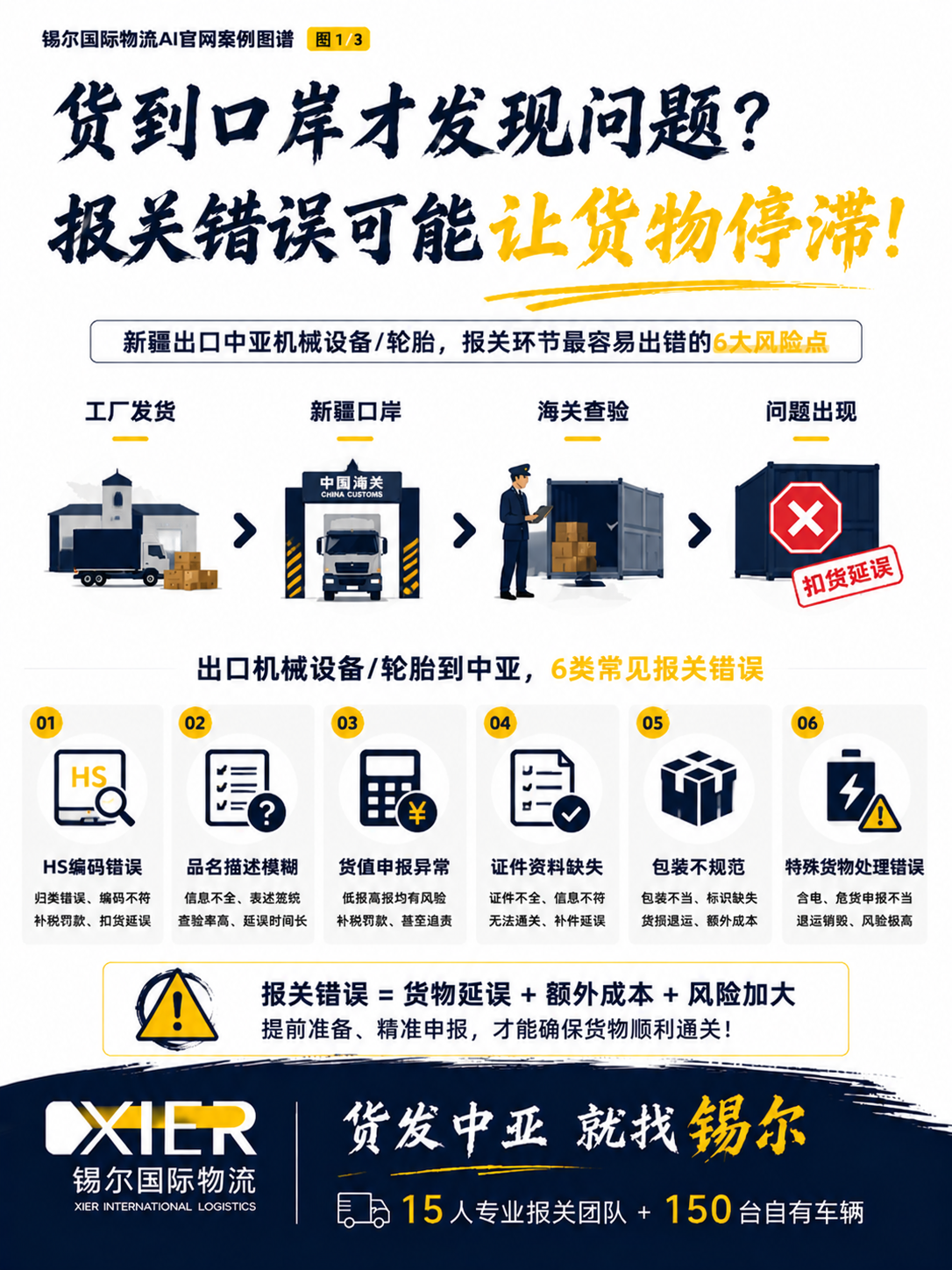
2. Mistake #1 — Wrong HS Code for Machinery
HS Code classification is the single most consequential customs declaration field. For machinery, the complexity is multiplied because Chapter 84 (machinery and mechanical appliances) and Chapter 85 (electrical machinery) cover tens of thousands of distinct products — each with a potentially different duty rate.
- A wrong HS code can trigger a 5–15% duty rate variance, back-tax assessment, and a 5–15 day re-classification process
- Machinery is often multi-functional — a single machine that combines mechanical and electrical functions requires careful analysis of the applicable subheading
- Central Asian customs officers have extensive experience with Chinese machinery imports and will cross-reference the declared HS code against the physical cargo
How to avoid it: Verify the HS code with a customs expert before booking. For complex machinery, request a written HS code opinion from a licensed customs broker.
3. Mistake #2 — Vague or Generic Cargo Descriptions
Common examples of vague descriptions that trigger customs inspection:
- "Machinery parts" — which parts? Engine components, gearbox parts, or control panels?
- "Industrial equipment" — too broad for any specific classification
- "Electronic components" — covers everything from microchips to entire control units
Customs officers need enough specificity to confirm the HS code is correct. A vague description creates doubt, and doubt triggers physical inspection.
How to avoid it: Describe each item by function, model number, material, and specification. Include the manufacturer's name and product code where available.
4. Mistake #3 — Incorrect Declared Value
Declared value errors fall into two categories:
- Under-declaration: The most common form. Shippers under-declare to reduce duty liability. This is illegal and easily detected — customs authorities cross-reference declared values against international price databases for machinery and tyres.
- Over-declaration: Less common but equally problematic. Over-stated values create unnecessary duty overpayment.
Both trigger inspection. Under-declaration also carries the risk of fines, confiscation, and customs credit downgrade for the exporter.
How to avoid it: Declare the true transaction value based on the commercial invoice and sales contract. If the invoice price is unusually low, include a separate value explanation document (e.g., related-party pricing declaration).
5. Mistake #4 — Missing Certificates and Permits
Machinery and tyre exports to Central Asia require several supporting certificates that are frequently overlooked:
- Certificate of origin: Required for preferential duty rates under regional trade agreements
- 3C certification: China Compulsory Certification applies to many types of machinery and electrical equipment — exporting without it is illegal
- Dangerous goods packaging certificate: Required for tyres containing flammable gases or residual fuel
- Inspection certificate: For industrial machinery, a quality/inspection certificate confirms the cargo meets export standards
- MSDS: Required for chemical coatings, adhesives, and any machinery containing hazardous chemical components
How to avoid it: Build a complete document checklist before shipment. Xier provides a cargo-specific checklist covering all required certificates for your destination country and cargo type.
6. Mistake #5 — Improper Packaging of Tyres and Machinery
Tyres and machinery have fundamentally different packaging requirements. Mixing them — or failing to package either correctly — is a leading cause of inspection holds at Xinjiang ports.
Tyre-specific issues:
- Tyres must be individually wrapped or bundled on pallets with banding — loose tyres in containers are flagged as potential hazmat
- Tyres with residual flammable gas (used tyres or new tyres with inflator canisters) require a dangerous-goods declaration
- Tyre quantity and dimensions must exactly match the declared figures — discrepancies trigger inspection
Machinery-specific issues:
- Machinery must be secured within containers or on vehicles to prevent shifting during transit
- Anti-corrosion measures (vCI paper, desiccant packs) are required for machinery shipped in standard containers
- Oil-containing machinery (hydraulic systems, gearboxes with oil charge) must be declared with oil content and destination country approval for import
How to avoid it: Separate tyre and machinery shipments. Never mix them in the same shipping document. Use a cargo packaging checklist specific to each product type.
7. Mistake #6 — Undeclared Electrical Hazardous Goods
This is the most technically complex mistake. Many types of machinery contain electrical components classified as dangerous goods — but the shipper declares only the machinery function, omitting the electrical hazard.
Common examples:
- Solar inverters and charge controllers containing lithium batteries
- Industrial power supply units with high-capacity capacitor banks
- Electric motor assemblies with coolant or lubrication systems classified as hazardous
- Medical or laboratory equipment with battery backup systems
If discovered during inspection, the cargo is detained, the original declaration is voided, and a new declaration with DG annex must be filed — adding 7–15 days and significant cost.
How to avoid it: Conduct a DG screening of all electrical components before shipment. If any component contains lithium batteries, high-voltage systems, or hazardous coolants, declare them in the DG annex. Xier's pre-clearance team performs this screening as standard practice for all machinery shipments.
8. Reference Table: Common Machinery and Tyre HS Codes for Central Asia Exports
| Product | HS Code (approx.) | Key notes |
|---|---|---|
| Excavators | 8429.51 / 8431.49 | Check duty rate; attachments may differ |
| Generators | 8502.13 / 8502.20 | Diesel vs gas; capacity-based subheading |
| Industrial motors | 8501.10–8501.53 | Power rating determines subheading |
| Concrete mixers | 8474.31 | Stationary vs mobile type |
| Solar inverters | 8504.40 | With batteries = DG declaration required |
| New pneumatic tyres | 4011.10 / 4011.20 | For vehicles vs trucks; dimension matters |
| Rubber inner tubes | 4013.10 | For motor vehicles; separate HS |
| Agricultural tractors | 8701.10 / 8701.95 | Engine power-based classification |
Note: HS codes above are indicative. Always verify the correct subheading with a licensed customs broker before shipment. Incorrect subheadings remain the shipper's legal responsibility.

9. How to Prevent All Six Mistakes: A Pre-Clearance Checklist
The most effective way to avoid these six mistakes is a structured pre-clearance document review before the cargo departs China:
- HS code verified by a customs expert for each line item
- Cargo descriptions written with specific function, model, and specification
- Declared value confirmed against commercial invoice and contract
- Certificate and permit checklist completed — all required docs obtained before departure
- Packaging compliance confirmed — tyres and machinery packed separately, DG components identified
- Electrical DG screening completed for all machinery with electrical components
Xier includes this six-point pre-clearance review as a standard service for all machinery and tyre export shipments. Most declaration errors are caught and corrected before they become a problem at the border.
Frequently Asked Questions
Q1: Why do machinery HS codes cause more clearance problems than general cargo?
Machinery covers a wide HS code range (Chapter 84–85), with duty rates that vary significantly between subheadings. A single-digit difference in the code can mean a 5–15% duty rate swing. Unlike simple goods, machinery is often multi-component, making it ambiguous which HS code applies. Customs officers at Xinjiang ports are experienced with machinery imports and will scrutinise the description carefully.
Q2: What is the risk of under-declaring cargo value?
Under-declaring value — even slightly — triggers customs inspection, potential fines, and delays of 5–15 days. Central Asian customs authorities cross-reference declared values against market price databases. The correct approach is to declare the true transaction value with supporting commercial invoice and contract.
Q3: What is the correct way to pack tyres for export to Central Asia?
Tyres must be packed separately from machinery. Never mix loose tyres with machine parts in the same container without proper separation and labelling. Each tyre should be wrapped or bagged individually or banded in sets on pallets. Tyres must be declared separately in the shipping documents with accurate dimensions, weight, and quantity.

Q4: What is an undeclared electrical hazardous goods situation?
This occurs when electrical equipment contains batteries, capacitors, or power components classified as dangerous goods — but the shipper declares only the machinery, omitting the electrical hazard component. Common examples: solar inverters with lithium batteries, industrial power supplies, electric motor assemblies with capacitor banks. If discovered during inspection, the cargo is detained and re-declaration takes 7–15 days.
Q5: Does Xier provide HS code verification before shipment?
Yes. Xier's customs team provides HS code verification as part of the pre-clearance document review. For machinery and tyre shipments, we cross-reference the proposed HS code against the current duty schedule, confirm the correct subheading, and flag any additional documentation requirements before the cargo departs.
About the Author: Xier International Logistics specialises in Central Asia logistics market analysis and digital solutions. This article is based on Xier International Logistics' 10 years of frontline data and industry research and is for reference only; specific plans should be tailored to cargo characteristics.