Friends in foreign trade know that the Central Asia market offers high value and strong demand, but the moment "dangerous goods" is mentioned, many are at a loss: they ask many freight forwarders, and either hear "can't ship it" or get an absurdly high quote. What's really going on?
The reality: at the southern Xinjiang ports, very few forwarders can handle dangerous-goods exports to Central Asia.
In this article, drawing on Xier International Logistics' years of hands-on experience, we explain clearly what dangerous goods you can ship to Central Asia, how to ship them, and what pitfalls to avoid. If you're worried about not finding a channel for your dangerous goods, you'll have a direction after reading this.
1. First, clarify: what counts as "dangerous goods"? Classification in the Central Asia export context
Many customers think "dangerous goods" means "things that explode" — not true. In cross-border transport to Central Asia, the goods that commonly need special handling go far beyond explosives.
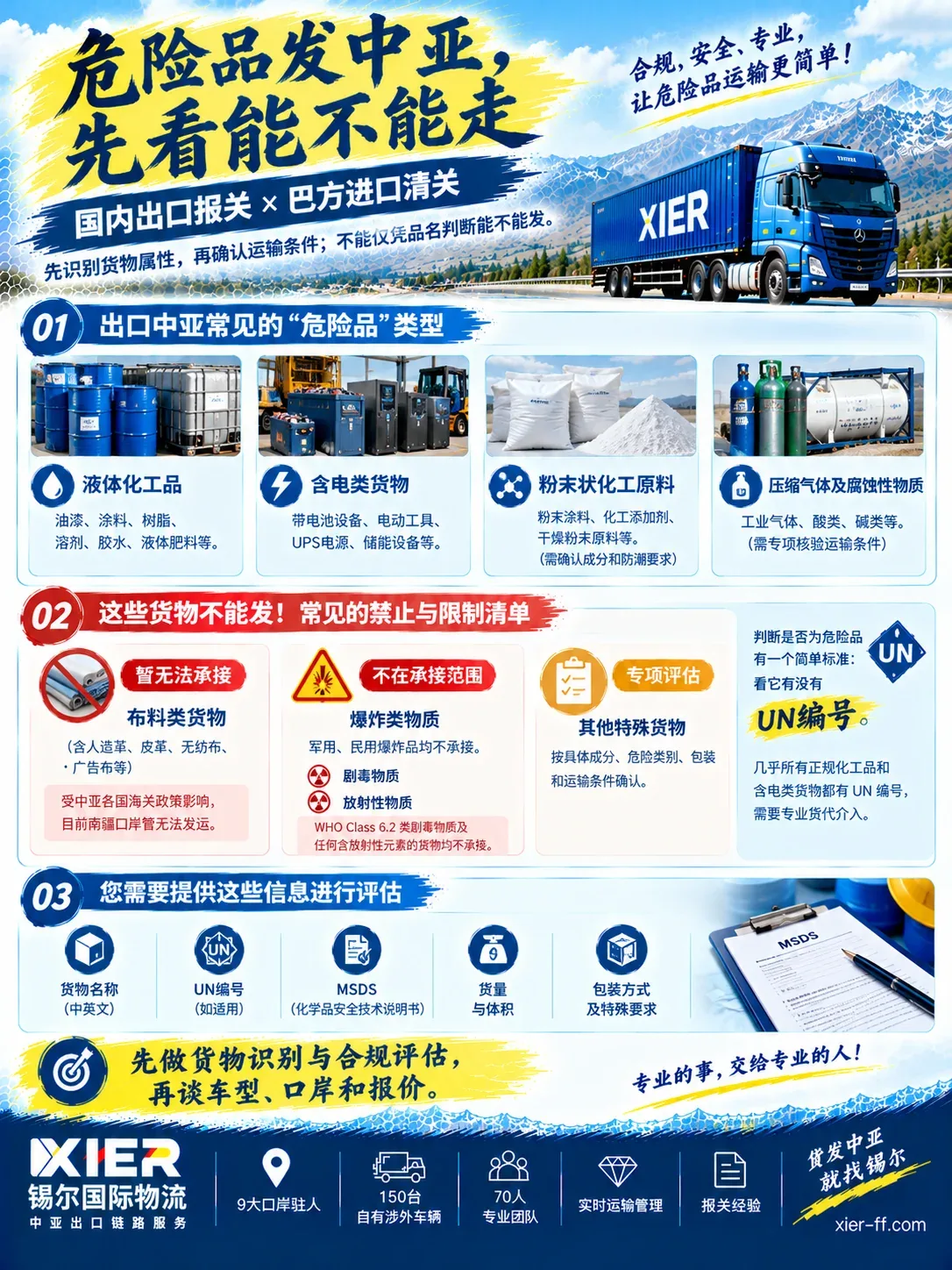
📌 Common "dangerous goods" types exported to Central Asia
- Liquid chemicals
- Battery-containing cargo
- Powdered chemical raw materials
- Compressed gases
- Corrosive substances
There is a simple standard to judge whether goods are dangerous: check whether they have a UN number.
2. These dangerous goods CANNOT be shipped! Common prohibited and restricted list
Before knowing what can be shipped, learn what cannot — it saves a lot of communication cost and time.
⛔ Goods types temporarily not shippable
- Fabric-type cargo (including artificial leather, leather, non-woven fabric, advertising banner cloth, etc.)
- Explosive substances
- Highly toxic substances
- Radioactive substances
A special note on fabric-type cargo — this is a category many garment and textile exporters care about. Currently, the fabric export channel through southern Xinjiang ports such as Irkeshtam is temporarily closed. Customers with such needs should confirm the latest policy with Xier International Logistics; we will give alternative advice based on real-time port policy.
3. Full dangerous-goods export process: from document preparation to cargo sign-off
Dangerous-goods export is more complex than ordinary cargo, mainly in the two steps of "documents" and "customs clearance." Below is the standardized process Xier International Logistics has refined over years of practice:
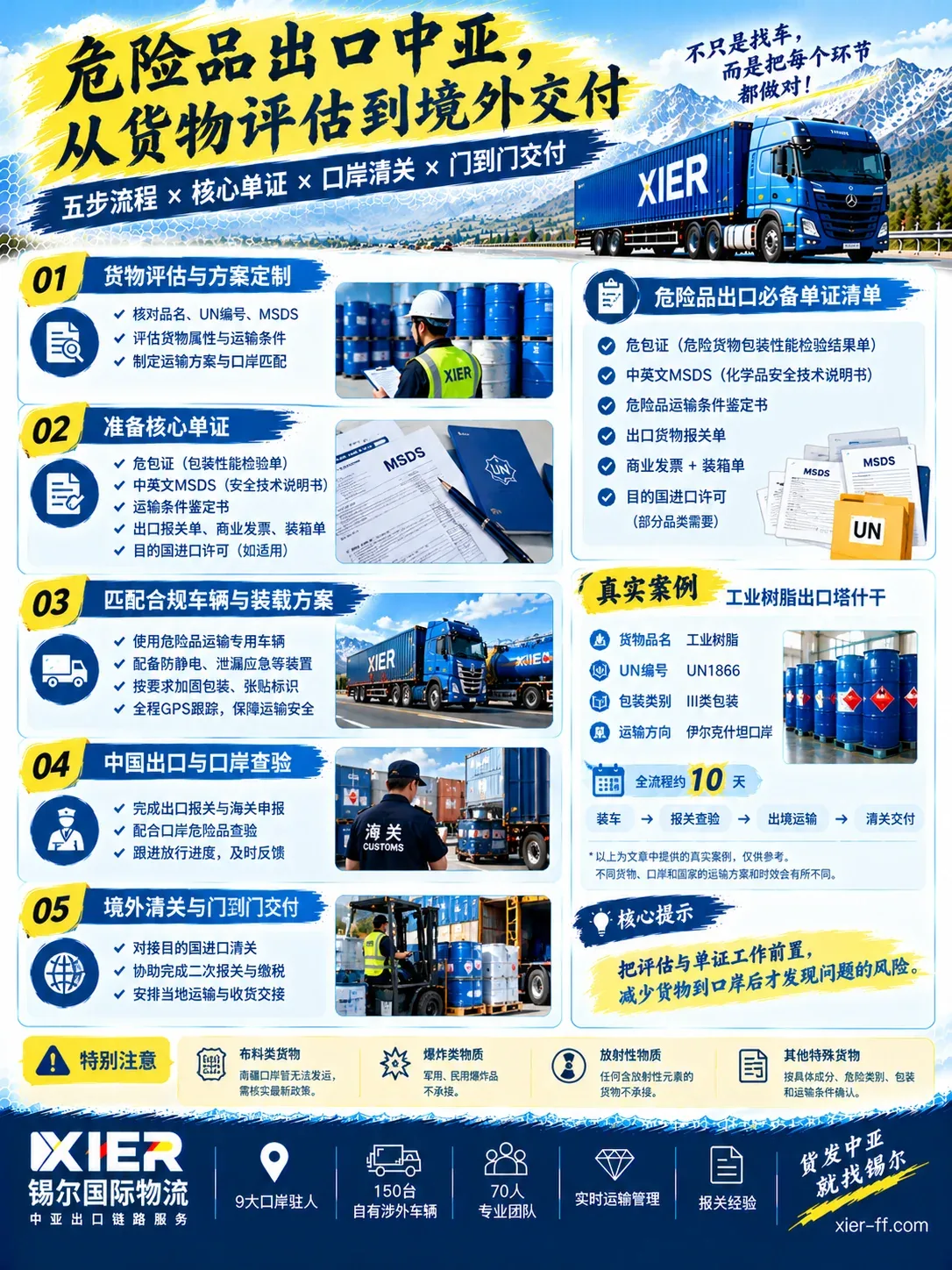
Step 1: Cargo assessment and solution design
Before shipping, provide the forwarder with: the cargo's Chinese and English names, UN number, MSDS (Material Safety Data Sheet), and estimated weight and volume. A professional team will use this information to judge: whether the packaging is compliant, which transport vehicle type to use (dangerous-goods vehicles have special requirements), and whether the clearance port matches.
Step 2: Prepare core documents
📄 Mandatory document checklist for dangerous-goods export
- Dangerous Goods Packaging Certificate (DG Packaging Performance Inspection)
- Chinese-English MSDS
- Dangerous Goods Transport Condition Identification Report
- Export cargo customs declaration
- Commercial invoice + packing list
- Importer's dangerous-goods import permit
Step 3: Loading and transport
Dangerous-goods transport must use compliant dangerous-goods vehicles, equipped with: anti-static devices, emergency leak-handling kits, dangerous-goods placards, and full GPS tracking. Among Xier International Logistics' own foreign-trade vehicles, the dedicated dangerous-goods vehicles are fully equipped; in peak season and for urgent shipments, owned capacity is the key to guaranteeing transit time.
Step 4: Port clearance (southern Xinjiang ports)
After cargo arrives at southern Xinjiang ports such as Irkeshtam and Torugart, dangerous-goods clearance has one more step than ordinary cargo: customs verifies the DG Packaging Certificate and MSDS. Normally, clearance takes 2–3 working days.
Xier International Logistics has resident field teams at all southern Xinjiang ports, following up throughout clearance: submitting documents, tracking verification progress, and coordinating on-site if inspection occurs. During inspection, the field team sends live photos and videos of the inspection site, so customers always know the cargo's status.
Step 5: Overseas transport and destination clearance
After the cargo leaves the Chinese port and enters Kazakhstan, Uzbekistan, and other countries, it requires secondary clearance in the destination country. Xier International Logistics' overseas agent network covers major Central Asian cities and can assist with destination clearance and delivery to the consignee's warehouse, achieving door-to-door service.
4. Why is a local forwarder more reliable than a big platform for shipping dangerous goods to Central Asia?
Here is a pitfall many customers have hit: they ask a national big platform for a quote; the platform says "we can ship it" and gives a price, but when the cargo reaches the port they find the platform never warned them about the operation difficulty — missing DG Packaging Certificate, mismatch in vehicle type, or a clearance team that simply doesn't understand the dangerous-goods process.
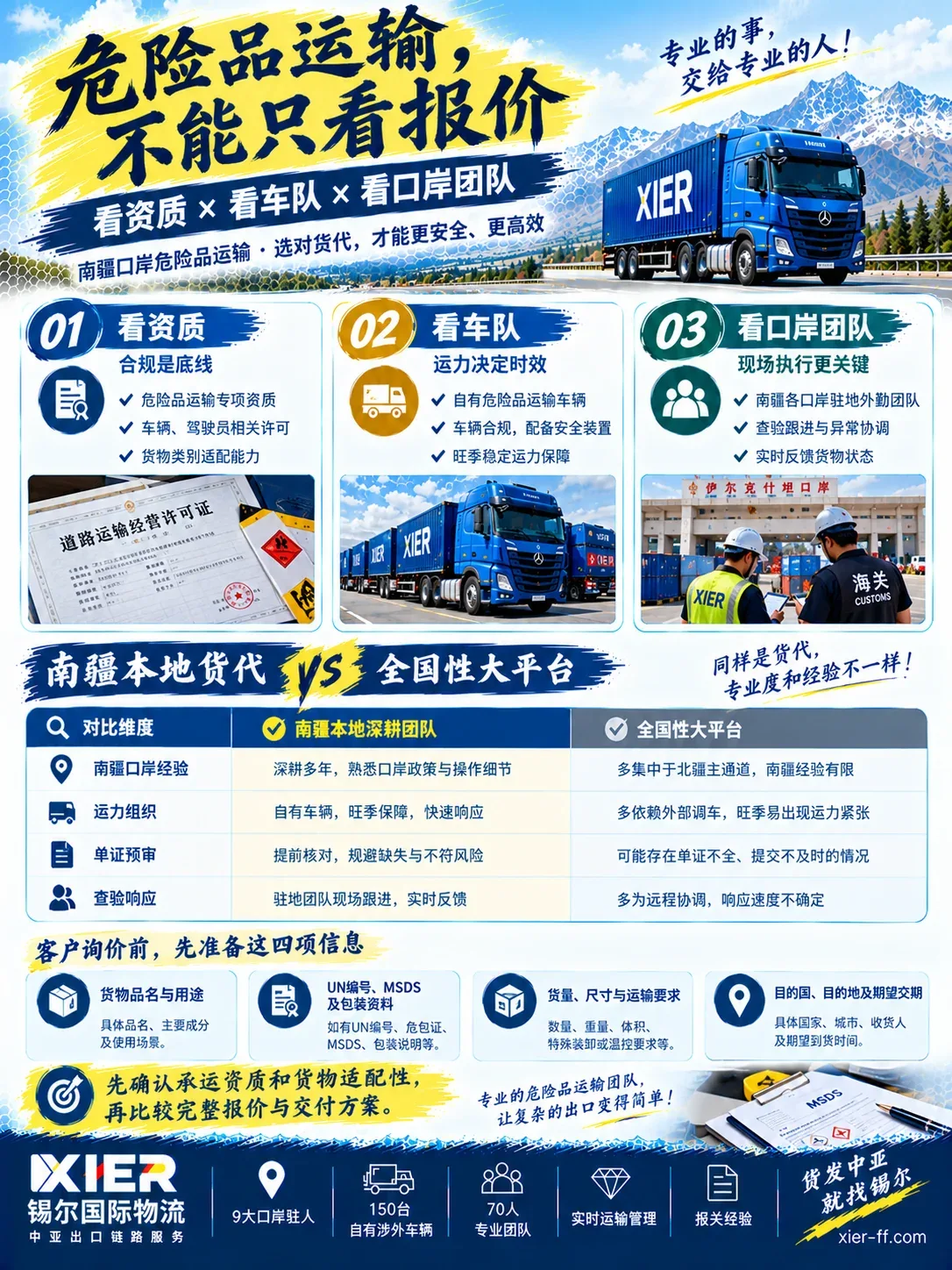
Xier International Logistics has worked deeply in southern Xinjiang dangerous-goods transport for years, and has distilled three core criteria to help you identify a truly reliable supplier:
✅ Three criteria are enough to choose a dangerous-goods forwarder
- Check qualifications
- Check the fleet
- Check the port team
Xier International Logistics has resident field teams at the four major southern Xinjiang ports — Irkeshtam, Torugart, Karasu, and Khunjerab — with dedicated dangerous-goods vehicles on standby, guaranteeing transit time in peak season and fast inspection response. This is the local barrier that big national platforms cannot easily replicate in southern Xinjiang.
5. A real case: liquid chemicals from Urumqi to Tashkent, end to end
Let's share a recent case: cargo name: industrial resin (UN1866, Packing Group III), volume: 23 tons, via Irkeshtam port.
Day 1 — cargo picked up in Urumqi, packaging and placarding checked against the MSDS, loaded onto a dedicated dangerous-goods vehicle.
Day 2–3 — arrives at Irkeshtam port, DG Packaging Certificate and MSDS submitted for verification, clearance in progress.
Day 4–6 — customs release, cross-border transport to Tashkent begins.
Day 7–10 — arrives in Tashkent, secondary clearance and delivery to the consignee's warehouse.
From loading to sign-off, the whole process took about 10 days — 2–3 days faster than the market average — with real-time progress updates at key nodes. This case is representative of Xier International Logistics' actual shipments.
Frequently Asked Questions
Q1: Which dangerous goods can be shipped to Central Asian countries?
Based on Xier International Logistics' experience, commonly accepted categories include: liquid chemicals (paint, coating, resin), battery-containing cargo (machinery/equipment with batteries), powdered chemical raw materials (needs drying treatment), compressed gases (small quantities need special approval). Specifically, provide the UN number and MSDS, and our professional team will evaluate and confirm. Fabric-type cargo is currently not shippable.
Q2: What documents are needed to export dangerous goods to Central Asia?
Core documents include: Dangerous Goods Packaging Performance Inspection Certificate (DG Packaging Certificate), Chinese-English MSDS, Dangerous Goods Transport Condition Identification Report, export cargo customs declaration, commercial invoice, and packing list. In addition, some dangerous goods also need: the importer's dangerous-goods import permit and a packaging certificate complying with UN labeling rules. Xier International Logistics' professional team assists in preparing all the above documents throughout.
Q3: How long does dangerous-goods clearance take at Xinjiang ports?
Taking Irkeshtam port as an example, ordinary cargo clearance is usually 1–2 working days; dangerous goods, because the DG Packaging Certificate and MSDS must be verified, normally take about 2–3 working days. Xier International Logistics has resident field teams at all southern Xinjiang ports, following up on inspection progress on the front line, syncing photos and videos in real time during inspection, and coordinating priority handling of exceptions to minimize port dwell time.
Q4: Why are there so few dangerous-goods forwarders at southern Xinjiang ports?
The southern Xinjiang ports (Irkeshtam, Torugart, Karasu, Khunjerab) are deep at the border, with higher requirements for dangerous-goods vehicle qualifications, driver training, and customs supervision. Most national big forwarders concentrate resources at northern Xinjiang main ports such as Khorgos, leaving the southern Xinjiang dangerous-goods transport market severely under-supplied. Xier International Logistics has worked deeply in southern Xinjiang for years, holds special dangerous-goods transport qualifications, and is equipped with compliant transport vehicles and resident teams at all major southern Xinjiang ports.
Q5: What special restrictions apply to battery-containing equipment exported to Central Asia?
Battery-containing cargo belongs to a special dangerous-goods category; restrictions mainly come from: battery type (lithium batteries are most strictly limited), battery capacity (over WHr needs special approval), and packaging (must prevent short circuit and crushing). Exporting battery-containing cargo to Central Asia requires a battery test report (UN38.3) and a description of the battery-containing equipment. Xier International Logistics has mature experience in battery-containing equipment export and can customize transport solutions based on the cargo's specific parameters.
About the Author: Xier International Logistics specializes in Central Asia logistics market analysis and digital solutions. This article is based on Xier International Logistics' 10 years of frontline data and industry research and is for reference only; specific plans should be tailored to cargo characteristics.