1. Why Xinjiang's North-South Divide Matters for Your Supply Chain
Xinjiang handles over 90% of China's overland trade with Central Asia. But not all ports are created equal. The 1,500-kilometre divide between the southern and northern gateway corridors determines route feasibility, cargo eligibility, clearance speed, and total logistics cost.
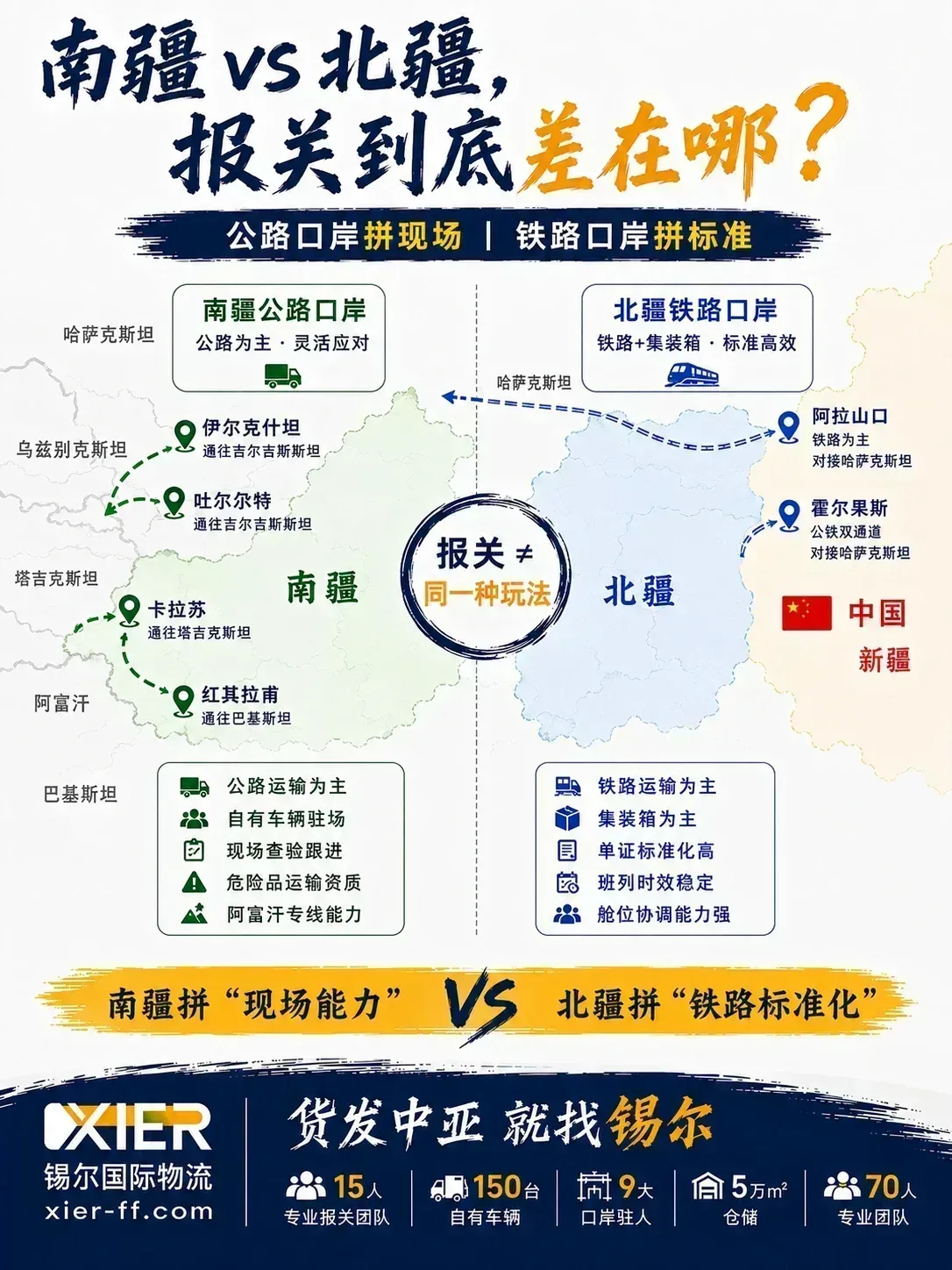
- Southern Xinjiang ports connect to Kyrgyzstan, Tajikistan, and Afghanistan — primarily via road
- Northern Xinjiang ports connect to Kazakhstan, Russia, and Europe — primarily via rail and container
Choosing the wrong port for your cargo type is one of the most expensive mistakes in cross-border logistics. This guide compares six ports across the dimensions that matter most.
2. The Six Ports: Who They Serve and What They Move
Southern Xinjiang — Road Corridors
- Irkeshtam — Primary southern gateway, specialises in chemicals, dangerous goods, and general cargo to Kyrgyzstan and beyond
- Torugart — Tighter seasonal window, preferred for machinery and industrial equipment
- Karamay — Growing road port, shorter connection to northern Kazakhstan
- Khunjerab — Pakistan corridor only; FORM P issuance available on-site
Northern Xinjiang — Rail and Container
- Khorgos — Dry port and rail-road combined gateway; primary China-Europe Express gateway
- Alashankou — Railway port for China-Russia and China-Europe freight trains; dominant for containerised bulk cargo
3. Six-Dimension Comparison Table
| Dimension | Irkeshtam | Torugart | Khorgos | Alashankou |
|---|---|---|---|---|
| Transport mode | Road | Road | Rail + Road | Rail |
| Best cargo type | Chemicals, DG, general | Machinery, equipment | Containers, mixed | Bulk, containers |
| Afghanistan route | ✅ Yes | ✅ Via Kyrgyzstan | ❌ No | ❌ No |
| Dangerous goods | ✅ Supported | ⚠️ Limited | ⚠️ Restricted | ⚠️ Restricted |
| China-Europe Express | ❌ No | ❌ No | ✅ Primary hub | ✅ Rail hub |
| Avg clearance time | 0.5–1 day | 1–1.5 days | 1–2 days | 1–2 days |
4. Dangerous Goods: Southern Ports Are the Clear Choice
Transporting dangerous goods through Xinjiang requires more than a standard customs declaration. Each port has different inspection capacity, DG storage facilities, and Hazmat documentation requirements.
- Irkeshtam has the most mature dangerous-goods clearance process among southern ports, with dedicated inspection lanes and trained personnel
- Torugart accepts DG with pre-approved manifests and MSDS, but the approval window is longer
- Northern ports restrict DG to specific categories and require additional rail-safety certifications that do not apply to road transport
Key takeaway: if your cargo falls under ADR classes 3, 6, 8, or 9, route it through Irkeshtam or Torugart — not through the northern rail ports.
5. Bulk Commodities and Containers: Use the North
Northern Xinjiang ports handle the volume that keeps China's railway trade with Europe and Russia moving.
- Alashankou processes 70+ China-Europe Express trains per month; containerised cargo transfers without road deconsolidation
- Khorgos serves as a dry port for both rail-to-road transloading and road-to-rail consolidation
- Northern ports handle oversize cargo within rail gauge limits, but oversize loads beyond rail dimensions must use southern road ports
6. Afghanistan Corridor: Only Southern Ports Apply
Afghanistan-bound cargo cannot enter via northern ports. The Hairatan corridor requires departure from southern Xinjiang — specifically Irkeshtam, with transit through Kyrgyzstan or direct road routing depending on the cargo profile.
- Afghanistan requires specific import documentation including ATA Carnet alternatives, commercial invoices with Dari translations, and pre-clearance at Hairatan
- Northern ports have no transit agreement for Afghanistan-bound cargo — attempting entry from Khorgos or Alashankou creates compliance violations

Xier operates a dedicated Afghanistan route with risk management protocols covering cargo insurance, route security assessment, and local agent coordination in Kabul and Mazar-i-Sharif.
7. Clearance Speed: What to Expect at Each Port
Clearance times vary by port, cargo type, and documentation quality. Here are benchmarks based on Xier's operational data:
- Irkeshtam: 0.5–1 day standard; 1–2 days for dangerous goods with full pre-approved docs
- Torugart: 1–1.5 days; seasonal delays add 0.5–1 day during winter road closures
- Khorgos: 1–2 days for containerised cargo; express lane available for pre-cleared shipments
- Alashankou: 1–2 days; train scheduling adds coordination overhead vs pure road ports
8. How Xier Operates Across All Six Ports
Xier maintains permanent on-site staff at 9 major Xinjiang ports, including all six covered here. Our clearance team of 15+ professionals handles:

- Pre-clearance document review before shipment departure
- On-site coordination at each port with advance appointment scheduling
- Dangerous-goods declaration and MSDS management
- Emergency handling for inspection holds and document amendments
- Real-time cargo tracking from departure to final destination
9. Port Selection Decision Framework
Use this quick-reference framework to select the right port:
- Dangerous goods → Irkeshtam (preferred) or Torugart
- Bulk containers, China-Europe Express → Khorgos or Alashankou
- Afghanistan-bound → Irkeshtam only
- Road urgency, smaller lots → Southern road ports (Irkeshtam, Torugart)
- Rail efficiency, large volumes → Northern rail ports (Khorgos, Alashankou)
Still uncertain? Xier's logistics team provides port-specific feasibility assessments within 24 hours.
Frequently Asked Questions
Q1: Which port should I use for dangerous goods transport?
Southern Xinjiang ports — Irkeshtam and Torugart — are preferred for dangerous goods. They have dedicated inspection lanes and experienced dangerous-goods clearance teams. Always confirm the specific cargo class is accepted before booking.
Q2: Can I use Khorgos or Alashankou for Afghanistan cargo?
No. Afghanistan-bound cargo requires entry through southern border ports. Khorgos and Alashankou serve Kazakhstan, Russia and Europe routes. Attempting to reroute from the north creates major compliance and transit complications.
Q3: What documents are required for railway clearance at Alashankou?
Railway clearance at Alashankou requires: rail bill of lading (CIM/SMGS), commercial invoice, packing list, cargo description, HS Code, and origin certificate. Dangerous-goods shipments also need MSDS and dangerous-goods declaration.
Q4: How long does customs clearance take at Irkeshtam vs Khorgos?
At Irkeshtam (road): 0.5–1 day for standard cargo, 1–2 days for dangerous goods with full documentation. At Khorgos (rail/road combined): 1–2 days for containerised cargo. Peak seasons add 0.5–1 day to both.
Q5: Does Xier have staff at all six ports?
Yes. Xier has permanent on-site staff at 9 ports including all six mentioned here. Our team of 15+ customs clearance professionals covers road, rail, and combined inspection workflows across the entire Xinjiang gateway corridor.
About the Author: Xier International Logistics specialises in Central Asia logistics market analysis and digital solutions. This article is based on Xier International Logistics' 10 years of frontline data and industry research and is for reference only; specific plans should be tailored to cargo characteristics.