1. Afghanistan's Reconstruction Economy and the Logistics Opportunity
Afghanistan's post-conflict reconstruction effort has sustained strong demand for imported building materials, machinery, and industrial equipment since the early 2000s. Despite ongoing security challenges, international development projects and infrastructure contracts continue to move cargo through Central Asian overland corridors.
- The reconstruction supply chain is dominated by Chinese manufactured goods: steel, cement, glass, aluminium, generators, and construction equipment
- Key procurement buyers include international aid agencies, Afghan government contractors, and private sector importers
- The Hairatan corridor remains the primary and most reliable entry point for northern Afghanistan, despite competition from southern and Iranian routes
2. The Hairatan Corridor: Route Profile
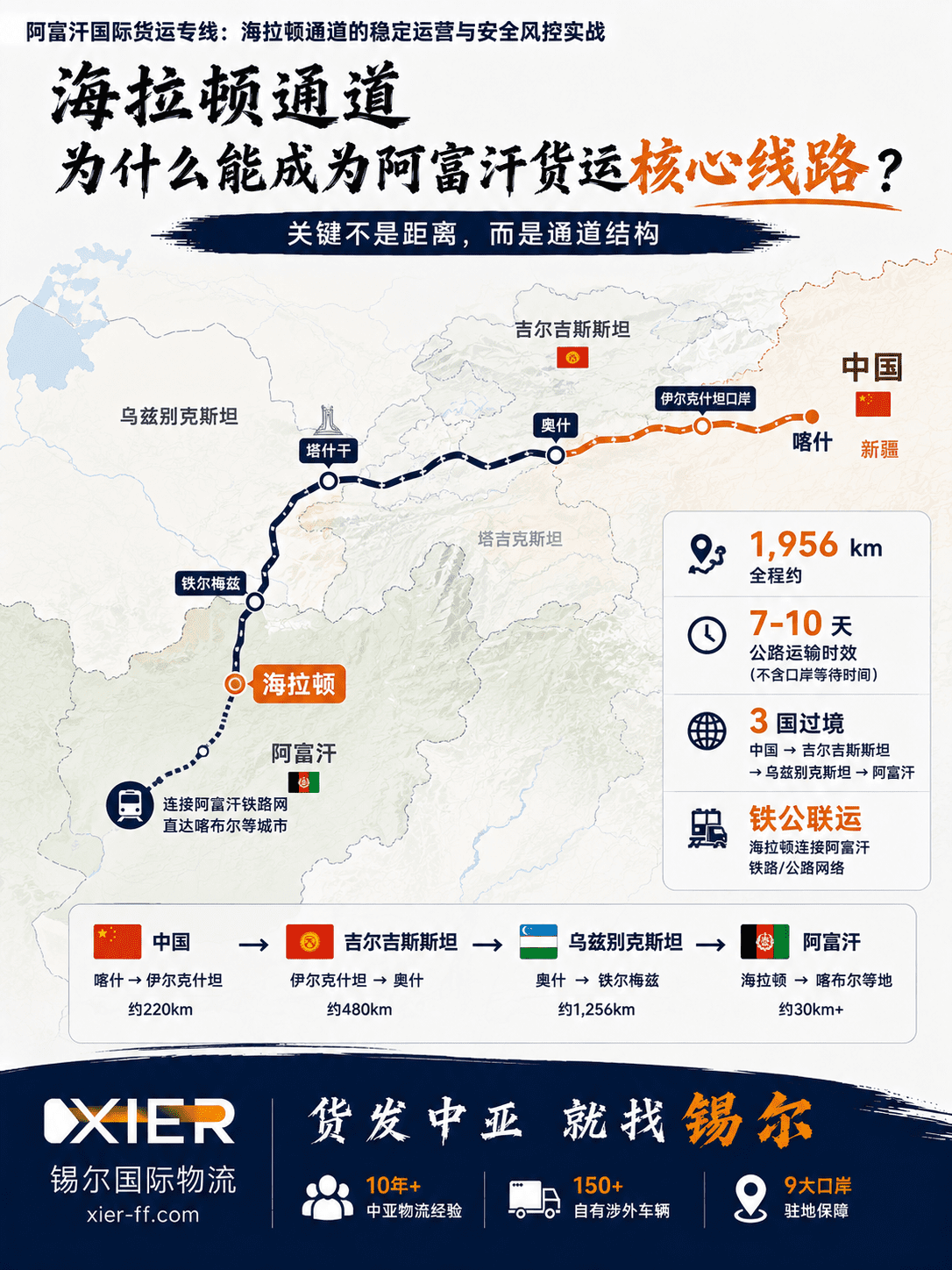
The Hairatan corridor spans approximately 1,956 kilometres from the China-Kyrgyzstan border to Hairatan Port on the Afghanistan-Uzbekistan border.
- Stage 1: China border (Irkeshtam) → Kyrgyzstan road network → Osh
- Stage 2: Osh → Uzbekistan road/rail network → Hairatan border crossing
- Stage 3: Hairatan Port customs clearance → Mazar-i-Sharif and onward to Kabul
The corridor's northern segment through Kyrgyzstan and Uzbekistan is the most stable portion — both countries have functioning transit agreements and established road infrastructure. The segment within Afghanistan from Hairatan to Mazar-i-Sharif and south to Kabul is the portion requiring active security monitoring.
3. Hairatan Port: Afghanistan's Northern Logistics Hub
Hairatan Port is the northernmost major border crossing in Afghanistan and the primary import gateway for goods arriving from Central Asia.
- Hairatan handles over 80% of Afghanistan's overland imports from the north
- The port operates under Afghan customs administration with Uzbek border agency coordination
- Clearance at Hairatan requires documentation in Dari or pre-arranged Dari translation; commercial invoices with English alone are not sufficient
- Pre-clearance coordination with local Afghan customs agents is strongly recommended — it reduces Hairatan dwell time from 5–7 days to 1–2 days
4. What Cargo Types Move on the Afghanistan Route
Building materials (highest volume)
- Cement, steel rebar, structural steel, glass panels, aluminium profiles
- These cargo types are typically packed in 1-tonne or 2-tonne bags/pallets and move in standard 20ft or 40ft containers
Mechanical and construction equipment
- Excavators, concrete mixers, generators, water pumps, compressors
- Often oversized or overweight, requiring special transport permits and route planning
Electrical equipment
- Power transformers, solar panels, HV cables, switchgear
- Solar panel demand has grown significantly as Afghanistan expands off-grid power infrastructure
Dangerous goods
- Fuel additives, industrial solvents, coating materials, adhesives — handled under ADR with MSDS and DG declaration
- Not all forwarders are certified for DG transport into Afghanistan; Xier holds the necessary qualifications and coordinates with Hairatan DG inspection officers
5. Xier's Afghanistan Dedicated Route: Key Features
Xier has operated a dedicated Afghanistan logistics route for multiple years with a stable track record. Key service components:
- Dedicated route management: A dedicated operations team handles Afghanistan shipments — not a general-purpose route with occasional Afghanistan cargo
- Door-to-door service: From China origin through Hairatan clearance to final delivery address in Afghanistan
- Dangerous-goods certification: ADR-certified vehicles, trained DG declaration staff, coordinated Hairatan DG inspection
- Transit time: 15–20 days from China border to destination; consistent and predictable
- Local agent network: On-ground agents in Mazar-i-Sharif and Kabul handle customs liaison, last-mile delivery, and incident response
6. Risk Management System for the Afghanistan Route
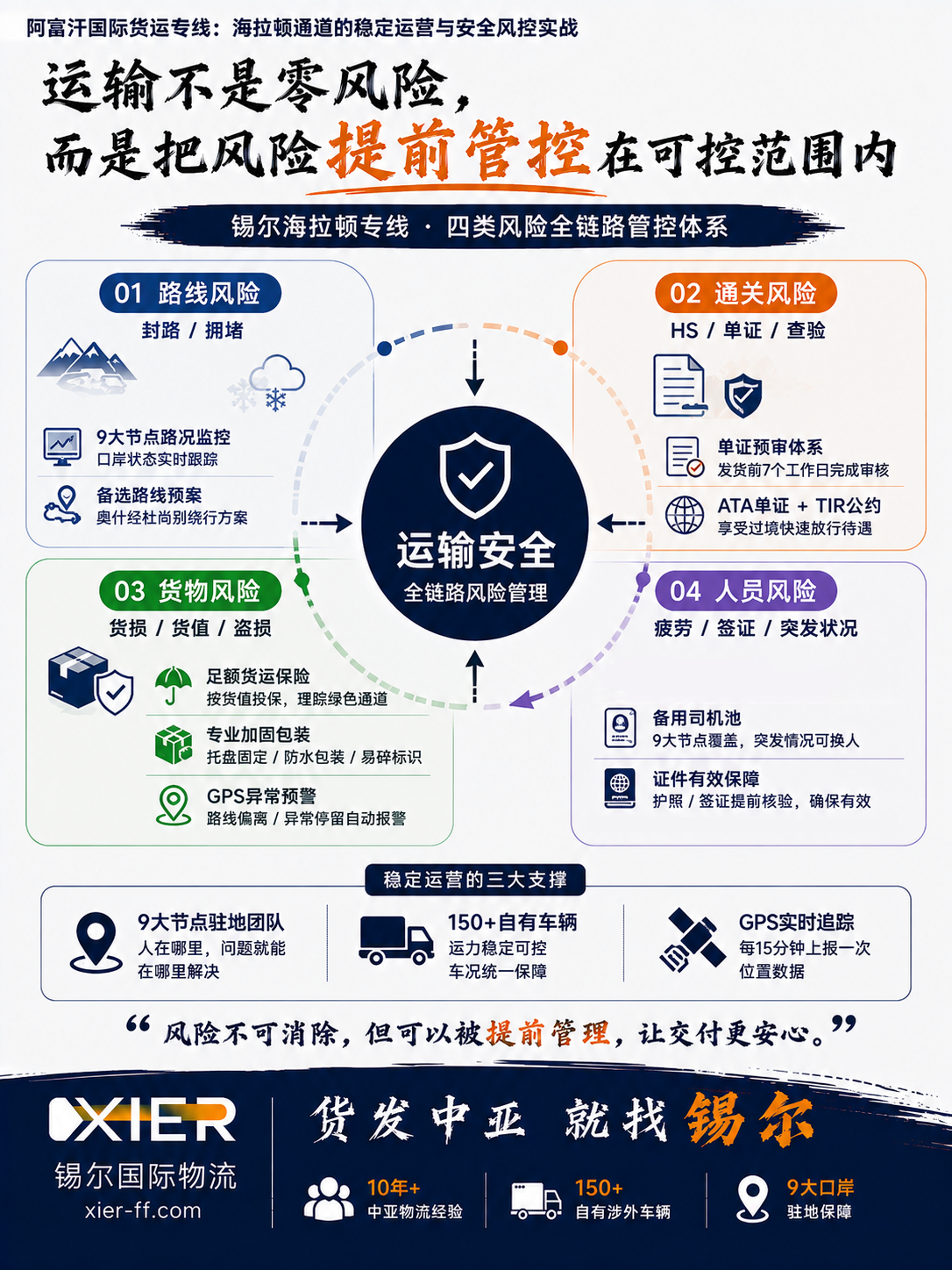
Operating on the Hairatan corridor requires a structured risk management approach. Xier's system covers four dimensions:
Route security assessment
- Security conditions on the Hairatan–Mazar-i-Sharif–Kabul corridor are reviewed before each shipment departure
- Assessments draw on ground agent reports, regional political risk intelligence, and historical incident data
- If security conditions deteriorate significantly, contingency routing or temporary suspension of shipments is activated
Cargo insurance
- All Afghanistan shipments are covered by transit insurance including theft, damage, and delay compensation
- Insurance coverage levels are tailored to cargo value — high-value equipment shipments receive full replacement-value coverage
GPS tracking and communication protocol
- GPS trackers on all vehicles provide real-time location data throughout the corridor
- Communication check-ins at each border crossing and at Hairatan Port
- Automatic alert triggers if a vehicle deviates from planned route or stops unexpectedly
Contingency rerouting
- If the Hairatan corridor is temporarily disrupted, alternative routing via western corridors is pre-planned
- Alternative entry points and Afghan customs pre-notification procedures are maintained in ready-to-deploy condition
7. Documentation Requirements for Afghanistan Imports
Complete documentation is the single most important factor in smooth Hairatan clearance. Common causes of delay:
- Missing Dari-language commercial invoice or packing list translation
- Incomplete HS Code declaration or misclassification
- Absent ATA Carnet equivalent or proper commercial invoice documentation for temporary imports
- Failure to pre-notify Afghan customs before cargo arrives at Hairatan
Xier's documentation team prepares all paperwork — including Dari translations and Afghan customs pre-notification — before cargo leaves China.
8. Afghanistan vs Other Central Asian Destinations: Why a Dedicated Route Matters
- Not a standard Central Asian route: Afghanistan-bound cargo requires different documentation (Dari language, Hairatan-specific forms), different clearance agents, and different risk management protocols than Kyrgyzstan or Uzbekistan shipments
- Security environment is distinct: The security situation within Afghanistan requires active monitoring and a different risk management framework than stable Central Asian countries
- Local networks are critical: Effective clearance at Hairatan and reliable last-mile delivery require trusted local agents — not generic forwarding partners
- Transit time is longer: 15–20 days vs 5–10 days to neighbouring countries; scheduling and inventory planning must account for this difference
Frequently Asked Questions
Q1: What is the Hairatan corridor and why is it important?

The Hairatan corridor is a 1,956 km overland route from the Xinjiang border through Kyrgyzstan and Uzbekistan to Hairatan Port in northern Afghanistan. It is Afghanistan's primary northern logistics gateway, handling the bulk of international cargo imports entering from Central Asia. The corridor connects to the national road network serving Kabul, Mazar-i-Sharif, and northern provinces.
Q2: What cargo types are most in demand for Afghanistan reconstruction?
Post-conflict reconstruction drives demand across several categories: building materials (cement, steel, glass, aluminium profiles), mechanical equipment (construction machinery, generators, water pumps), electrical equipment (transformers, cables, solar panels), and vehicle parts. Dangerous goods including fuel additives and industrial chemicals also move regularly under proper documentation.
Q3: What transit time can I expect on the Afghanistan dedicated route?
Xier's dedicated Afghanistan route operates on a 15–20 day transit schedule from China border to final Afghan destination. Actual transit time depends on documentation readiness, customs clearance speed at Hairatan, and seasonal conditions. Pre-cleared shipments with complete documentation are consistently at the faster end of this range.
Q4: Does Xier handle dangerous goods transport to Afghanistan?
Yes. Xier's Afghanistan dedicated route supports dangerous goods transport including fuel additives, industrial solvents, and chemical products. All DG shipments are handled with proper ADR documentation, MSDS declarations, and coordinated clearance through Hairatan. Not all forwarders can handle DG into Afghanistan due to the documentation complexity — Xier's team has the certification and on-ground agents to manage it.
Q5: What risk management measures does Xier provide on the Afghanistan route?
Xier's Afghanistan risk management system covers: route security assessment updated before each shipment, cargo insurance covering theft, damage, and transit delays, local agent coordination in Mazar-i-Sharif and Kabul, GPS tracking throughout the corridor, and contingency rerouting protocols if security conditions change mid-transit. The system is reviewed and updated on a per-shipment basis.
About the Author: Xier International Logistics specialises in Central Asia logistics market analysis and digital solutions. This article is based on Xier International Logistics' 10 years of frontline data and industry research and is for reference only; specific plans should be tailored to cargo characteristics.