I. Why the China-Kyrgyzstan-Uzbekistan Railway Deserves Continued Attention
The China-Kyrgyzstan-Uzbekistan Railway, a transnational railway starting from Kashgar, Xinjiang, China, passing through Kyrgyzstan and finally reaching the Uzbekistan border, is one of the most strategically significant railway infrastructure projects in the Central Asia direction since the Belt and Road Initiative was proposed a decade ago. The total length is about 577 km, of which about 210 km is in China, about 310 km in Kyrgyzstan, and about 57 km in Uzbekistan. Although the line is short, it is a key node connecting China with Central Asia and radiating to Europe.
There are three reasons why this railway continues to maintain high attention in the logistics circle:
First, it is a new channel bypassing Russian transit.The traditional China-Europe block train western corridor mainly passes through Kazakhstan and Russian railways; influenced by geopolitical factors, shippers and logistics enterprises have been seeking alternative routes. After the China-Kyrgyzstan-Uzbekistan Railway is fully connected, China-Central Asia-Europe goods can directly go south to Turkey via Kyrgyzstan without passing through Russia.
Second, it is the last piece of the southern Xinjiang railway network puzzle.Currently, the northern Xinjiang corridor for Xinjiang railway exit (Alashankou, Khorgos) capacity has approached saturation, and the Kashgar direction has only road. The China-Kyrgyzstan-Uzbekistan Railway will open a railway exit channel for southern Xinjiang, driving industrial and logistics development in the Kashgar, Shule, and Artux area.
Third, it will reshape the Central Asia railway freight pattern.After the China-Kyrgyzstan-Uzbekistan Railway connects to Uzbekistan's existing railway network, it can continue to extend to Turkmenistan, Iran, and Turkey, forming a third railway corridor of China-Central Asia-Middle East-Europe. Countries along the route will all benefit, and the demand is real.
II. Key Progress 2024-2026: From Planning to Construction
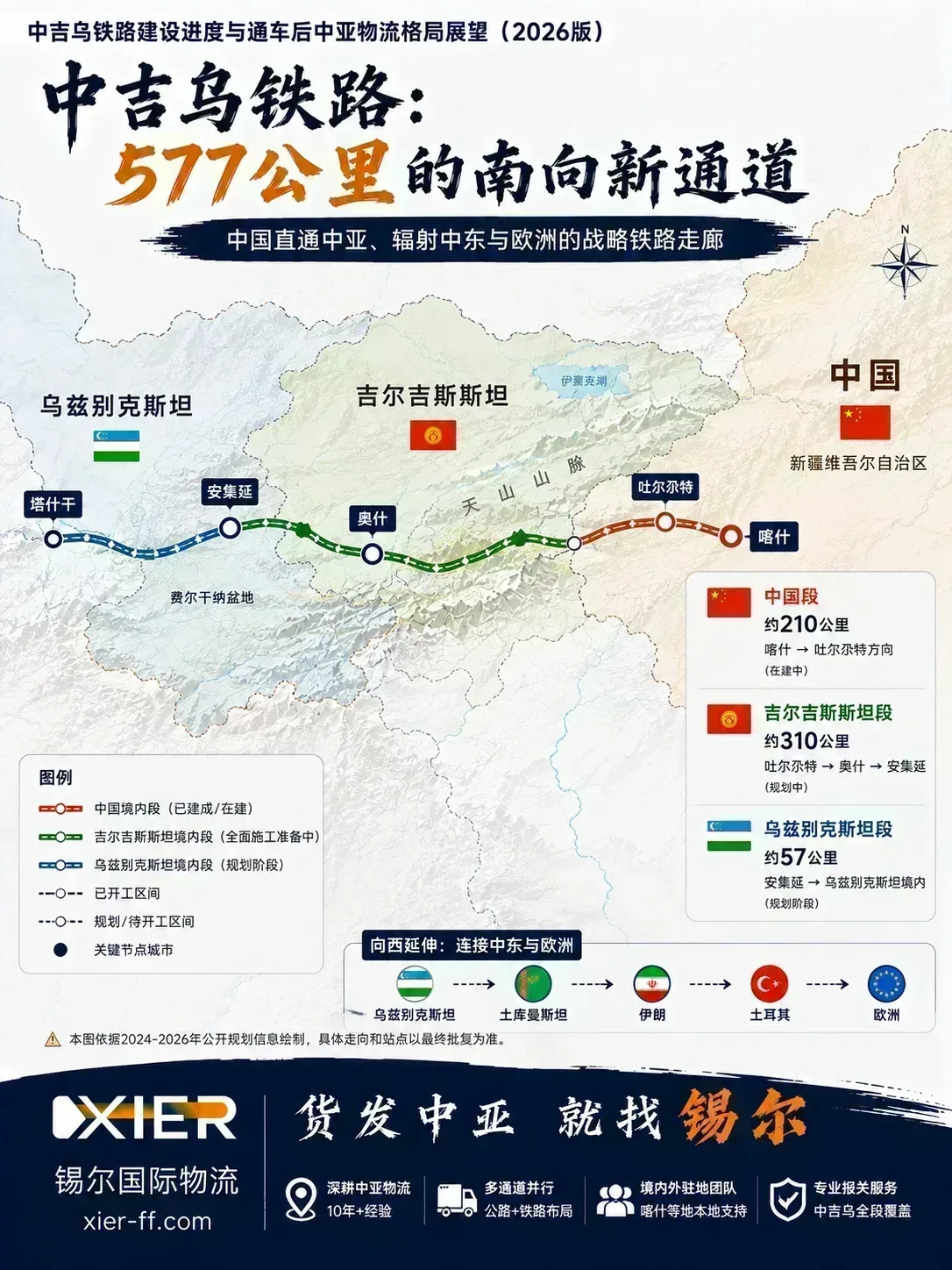 图1:中吉乌铁路三国走向与关键节点城市(2026年规划参考版)
From concept to landing, the China-Kyrgyzstan-Uzbekistan Railway has gone through nearly 30 years. The following nodes mark the project's move from "discussion" to "implementation":
- September 2022, the heads of state of China, Kyrgyzstan, and Uzbekistan formally signed the "Framework Agreement on Deepening China-Kyrgyzstan-Uzbekistan Railway Cooperation" during their meeting in Samarkand, Uzbekistan, bringing project advancement into the intergovernmental cooperation agenda.
- June 2024, China's National Development and Reform Commission and Kyrgyzstan's Ministry of Transport jointly announced that the technical and economic demonstration of the Kyrgyzstan section of the China-Kyrgyzstan-Uzbekistan Railway was completed, and the line alignment was basically locked. Nine stations will be set up in Kyrgyzstan, with the maximum traction section located in the Tianshan mountain-crossing section, with engineering difficulty comparable to some sections of the Qinghai-Tibet Railway.
- October 2024, the Kashgar-to-border section (Torugart direction) in China launched construction bidding, with some sections entering construction. Uzbekistan's section completed feasibility study.
- 2025The financing plan for the Kyrgyzstan section was determined, adopting a hybrid model of "Chinese investment + Kyrgyz government guarantee + Asian Infrastructure Investment Bank (AIIB) loan" to reduce unilateral risk.
- 2026, the whole line entered the comprehensive construction stage. The most difficult Andijan-to-Osh mountain-crossing section in Kyrgyzstan (bridge-tunnel ratio exceeding 70%) began tunnel boring, with the main project expected to be completed by 2029.
Based on comprehensive information, optimistically, the China-Kyrgyzstan-Uzbekistan Railway willhave sectional opening conditions in 2029-2030, and achieve full-line through operation in 2031. Actual progress still depends on the construction progress and funding in Kyrgyzstan.
III. After Opening: Who Benefits, How the Pattern Changes
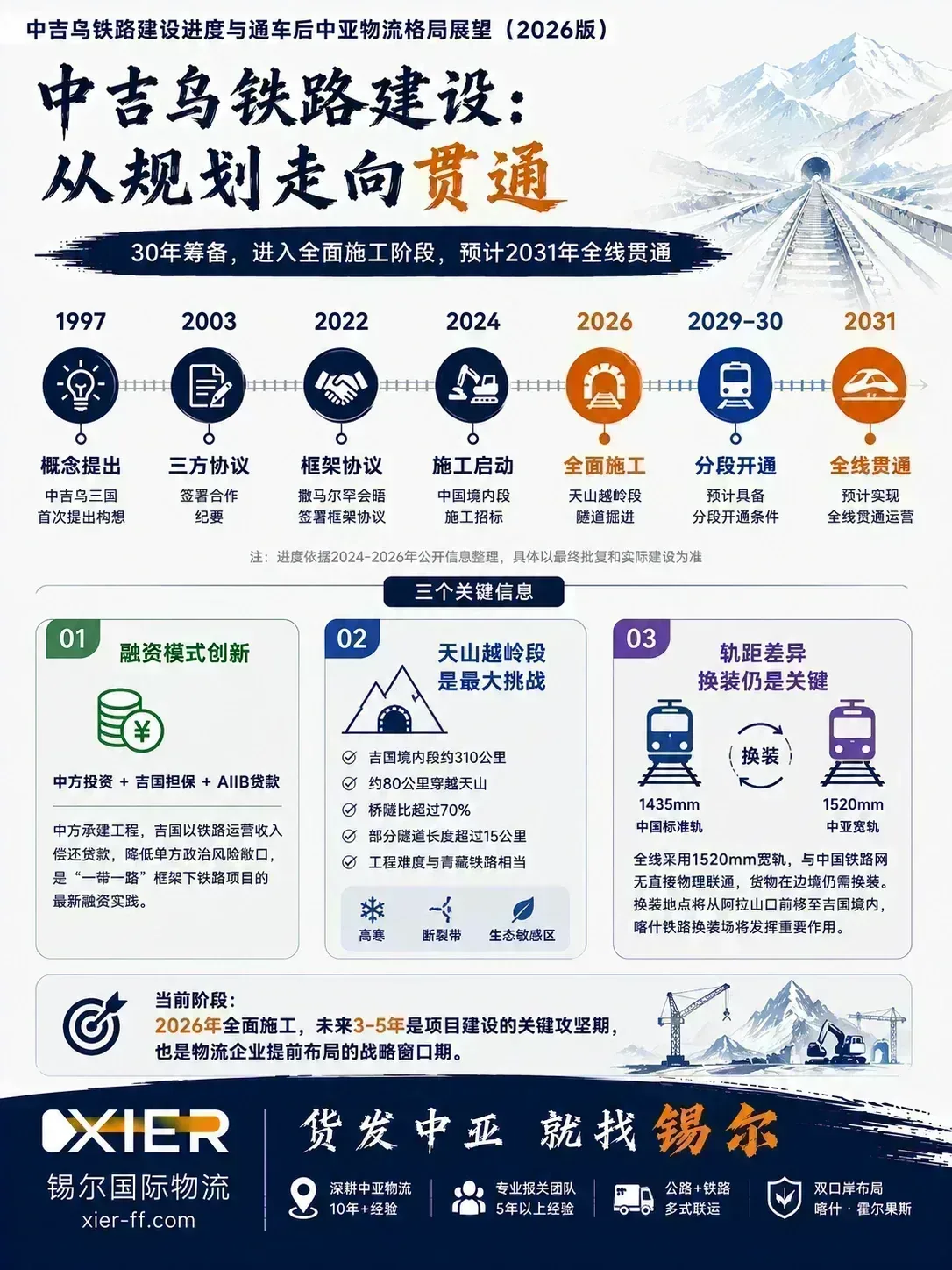 图2:中吉乌铁路建设里程碑时间轴(1997-2030预判)及三个关键信息
The opening of the China-Kyrgyzstan-Uzbekistan Railway will trigger a chain reaction in the Central Asia logistics pattern. Here are the five most direct changes:
Change 1: Northern Xinjiang Port Pressure Eases, Southern Xinjiang Strategic Value Rises
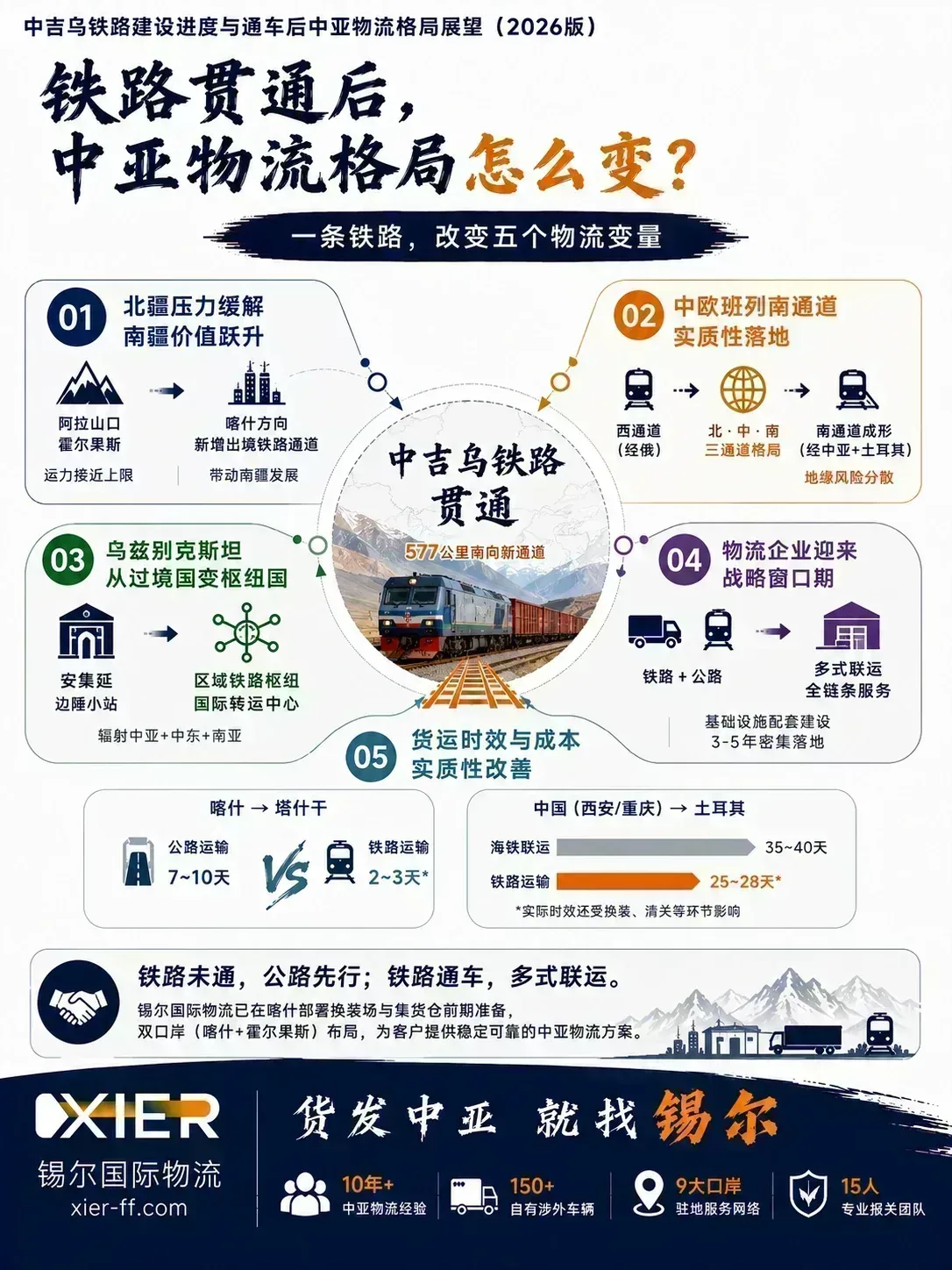 图3:铁路贯通后,中亚物流格局的五大变量与锡尔国际物流布局
Currently, China-Central Asia railway freight almost entirely relies on the two northern Xinjiang ports of Alashankou and Khorgos. The two channels have a combined annual capacity of about 50 million tons, close to the upper limit. After the China-Kyrgyzstan-Uzbekistan Railway opens, the Kashgar direction in southern Xinjiang will form a third railway exit channel, effectively diverting northern Xinjiang pressure and driving industrial and logistics infrastructure investment in southern Xinjiang.
Change 2: Substantive Landing of the China-Europe Block Train Southern Corridor
China-Europe block trains currently have three corridors: west, middle, and east; the west corridor (via Alashankou/Khorgos) accounts for over 80% of traffic. The China-Kyrgyzstan-Uzbekistan Railway is the core infrastructure of the southern corridor; after opening, China-Europe block trains will form a true "north-central-south" three-corridor pattern, and the southern corridor can bypass Russia directly to Turkey, with significant geopolitical risk diversification effect.
Change 3: Uzbekistan Transforms from "Transit Country" to "Hub Country"
Uzbekistan is the most populous country in Central Asia (36 million) and a major exporter of natural gas and cotton. After the China-Kyrgyzstan-Uzbekistan Railway connects to Uzbekistan's railway network, Uzbekistan will become a key hub for China-Central Asia goods going south to the Indian Ocean direction, and Andijan will be upgraded from a border small station to an international railway transfer center.
Change 4: Local Xinjiang Logistics Enterprises Usher in a Strategic Window
Infrastructure supporting the China-Kyrgyzstan-Uzbekistan Railway (transshipment yards, warehouses, customs supervision zones) will be intensively built in the next 3-5 years, providing a window for Xinjiang local logistics enterprises to position themselves in advance. Xier International Logistics has a resident team and consolidation warehouse in Kashgar, ready for future railway transport connection.
Change 5: Substantive Improvement in Freight Timeliness and Cost
Referring to the China-Kyrgyzstan-Uzbekistan Railway's design speed (passenger-freight mixed, freight 80-120 km/h) and total length, after opening, the railway transport time from Kashgar to Tashkent is expected to be compressed from the current road's 7-10 days to 2-3 days, with transshipment and clearance time counted separately. The full railway freight timeliness from central and western China (Xi'an, Chongqing) to Turkey is expected to be compressed from the sea-rail multimodal's 35-40 days to 25-28 days.
IV. Logistics Enterprises' Response: Opportunities and Challenges Coexist
The China-Kyrgyzstan-Uzbekistan Railway brings not only opportunities but also challenges. Logistics enterprises need to lay out the following capabilities starting now:
Challenge 1: Supporting Capacity of Transshipment Yards
The China-Kyrgyzstan-Uzbekistan Railway uses 1520mm broad gauge throughout, incompatible with China's standard gauge; goods must be transshipped at the border. Currently, the transshipment yard planning in the Kashgar direction is still under demonstration; logistics enterprises need to understand the transshipment yard site selection, equipment, and operation capacity in advance to quickly connect upon opening.
Challenge 2: Integration of Multimodal Transport Capability
Rail is good at large-volume, long-distance transport, but the distribution at both ends still requires road. Logistics enterprises need to integrate "rail + road" multimodal capability in advance and establish a full-chain service system from factory to railway and from railway to end customers.
Challenge 3: Upgrade of Cross-Border Customs and Declaration Capability
The China-Kyrgyzstan-Uzbekistan Railway involves the customs and quarantine procedures of three countries; the clearance and document requirements within Kyrgyzstan and Uzbekistan are more complex than domestic railways. Xier International Logistics has a professional customs team in Xinjiang with over 5 years of experience, providing clients with full-section customs declaration and inspection services for the China-Kyrgyzstan-Uzbekistan route.
For Xier International Logistics, the advancement of the China-Kyrgyzstan-Uzbekistan Railway is a significant strategic opportunity for company development. The company has deployed preliminary research on transshipment yards and consolidation warehouses in Kashgar, and the dual-port layout of Khorgos and Kashgar also prepares for future parallel multi-channel operations. Before the railway opens, the parallel road and rail dual-channel service will continue as the core business, providing clients with stable and reliable Central Asia logistics solutions.
V. Frequently Asked Questions
1. When is the China-Kyrgyzstan-Uzbekistan Railway expected to open?
According to the latest progress from 2024-2026, the China-Kyrgyzstan-Uzbekistan Railway is expected to have sectional opening conditions in 2029-2030 and achieve full-line through operation in 2031. Actual progress depends on the tunnel construction progress and funding in Kyrgyzstan.
2. What impact does the China-Kyrgyzstan-Uzbekistan Railway have on existing China-Europe block trains?
The China-Kyrgyzstan-Uzbekistan Railway is a supplement rather than a replacement for existing China-Europe block trains. It will provide a third corridor (southern corridor) for China-Europe block trains, bypassing Russia directly to Turkey, effectively diversifying geopolitical risk, and is expected to divert some northern corridor volume.
3. After the railway opens, will all goods currently going by road transfer to rail?
No. Rail suits large-volume goods with medium timeliness requirements; high-timeliness, door-to-door, small-batch goods still mainly use road. After the China-Kyrgyzstan-Uzbekistan Railway opens, road and rail will form a complementary relationship, and customers can choose the optimal channel based on cargo characteristics.
4. How is the gauge problem of the China-Kyrgyzstan-Uzbekistan Railway solved?
The China-Kyrgyzstan-Uzbekistan Railway uses 1520mm broad gauge throughout (different from China's 1435mm standard gauge); goods need transshipment at the border. Currently, a transshipment yard is planned within Kyrgyzstan, and the railway transshipment yard planning in the Kashgar direction is under demonstration.
5. What can Xinjiang logistics enterprises do in the China-Kyrgyzstan-Uzbekistan Railway opportunity?
Xinjiang logistics enterprises (especially southern Xinjiang enterprises) can start laying out three things now: first, connect in advance with railway transshipment yard and consolidation warehouse planning; second, integrate road + rail multimodal capability; third, upgrade cross-border customs capability. Xier International Logistics has deployed preliminary preparation in Kashgar; interested enterprises can contact for exchange.
About the Author: Xier International Logistics — focused on Central Asia logistics market analysis and digital solutions. Based on a decade of Xier's operational data and industry research, this article is for reference only; specific solutions must be tailored to your cargo.