I. On the Eve of the Blowout: China-Uzbekistan Live Cattle Trade Enters the "Super Large Order" Era
Before the end of 2025, China's live cattle export to Central Asia was only sporadic trial. In 2026, this number is expanding at an alarming rate.
Up to now, three major export routes have been fully activated: Ningxia Wuzhong has cumulatively exported over 1,100 head, Gansu Jiuquan launched a 100,000-head long-term agreement, and Xinjiang Kashgar Yecheng has just completed the historic first shipment of 200 head — all three projects exited via the Irkeshtam port in Xinjiang, marking that this southern Xinjiang road port has quietly become the core hub for China's live cattle advancing into Central Asia.
A representative quote from Uzbekistani merchant Faziliddin in an interview: "Previously we mainly imported breeding cattle from Western Europe and Russia; this time we chose beef and dairy cattle from Ningxia, China, because of the obvious meat yield advantage, considerable milk yield of dairy cows, and fresh milk quality reaching and exceeding EU standards."
This is not accidental. Behind the three major export projects is the deep binding of agricultural capacity cooperation between China and Uzbekistan under the Belt and Road Initiative framework, and more importantly, a landmark event marking the international recognition of the standardized breeding capability of western China's animal husbandry.
II. Why Must We Go via Irkeshtam?
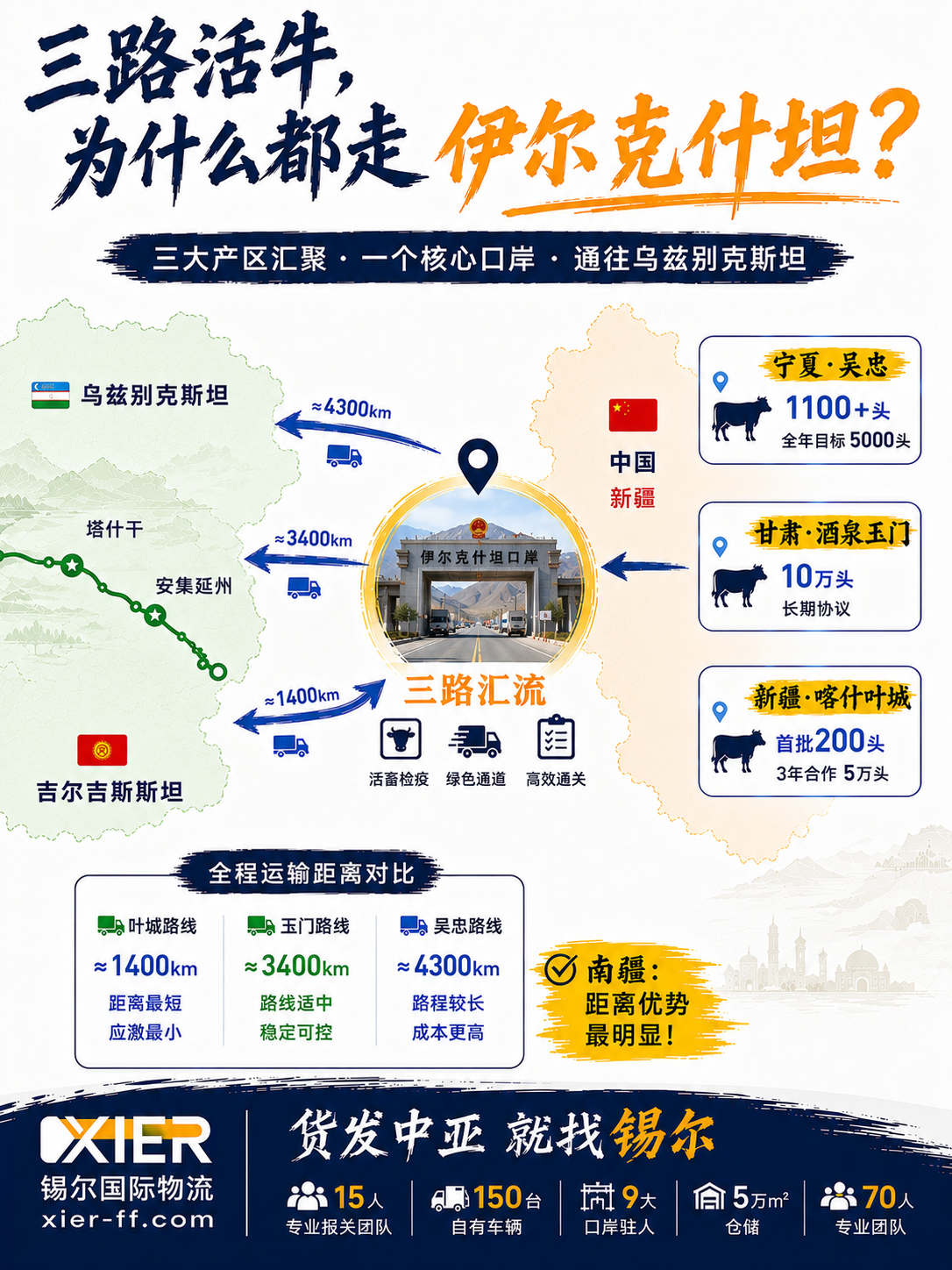 图1:三路活牛为什么都走伊尔克什坦?三大产区汇聚·一个核心口岸·通往乌兹别克斯坦
Three routes, different destinations, but only one exit location — Irkeshtam. This is no coincidence.
The Irkeshtam port is located in Wuqia County, Kizilsu Kirghiz Autonomous Prefecture, Xinjiang, one of China's westernmost land ports, and an important channel for China to reach Kyrgyzstan and further radiate to Central Asian countries. Compared with Khorgos and Alashankou, Irkeshtam has three unique advantages in the field of live animal transport:
First, the port's functional positioning matches live animal export needs. Currently, Irkeshtam has established supporting facilities for live animal export quarantine isolation yards; Kashgar Customs has set up a dedicated green channel here; Yinchuan Customs and Jiuquan Customs have established a territorial coordination mechanism with Irkeshtam Customs, achieving "arrive, inspect, release immediately".
Second, shortest route and optimal cost. Starting from Ningxia Wuzhong, via Irkeshtam to Tashkent is about 4,300 km; starting from Gansu Yumen is about 3,600 km; starting from Xinjiang Kashgar Yecheng is only about 1,100 km — the Yecheng base export goes all by road, with the shortest transport distance and minimal cattle stress response.
Third, southern Xinjiang logistics support is gradually improving. Represented by the Hualing Cattle Yecheng base, southern Xinjiang has formed a full-chain localized operation model of "in-Xinjiang breeding + in-Xinjiang isolation + in-Xinjiang clearance", minimizing live animal transit links and reducing transport loss and disease risk.
III. Decomposition of the Full Process of Three Batches of Live Cattle Export
A complete live cattle export, from contract signing to cattle delivery, goes through seven key steps; the full process usually takes 40-60 days:
Step 1, Overseas Order Confirmation. China and Uzbekistan sign an export contract specifying breed (Simmental or Holstein), quantity, price, and delivery time. Uzbek importers usually visit China to inspect cattle source bases on-site; Ningxia Wuzhong, Gansu Yumen, and Xinjiang Yecheng are the main inspection destinations.
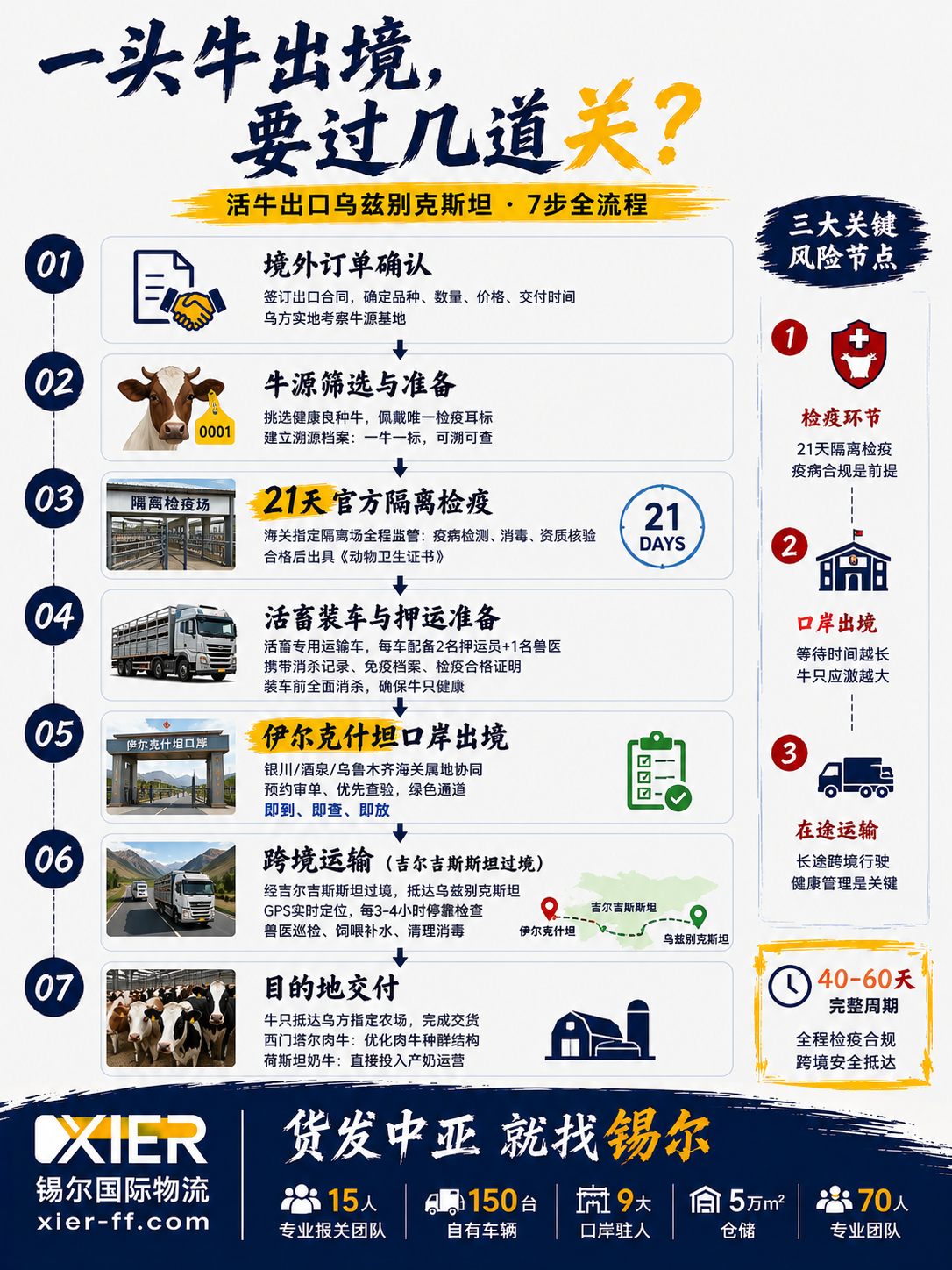 图2:活牛出口乌兹别克斯坦全流程七步(境外订单→牛源筛选→21天隔离检疫→装车押运→口岸出境→跨境运输→目的地交付)
Step 2, Cattle Source Screening and Preparation. Select healthy, quarantine-qualified breeding cattle according to contract standards; equip each head with a unique quarantine ear tag, establish a dedicated traceability file, achieving "one tag per head, traceable and checkable".
Step 3, 21-Day Official Isolation Quarantine. This is the most core compliance link of live animal export. Cattle enter the customs-designated isolation yard, with customs supervising disease testing, vehicle disinfection, and qualification verification throughout. After the isolation period expires and all indicators pass, the customs issues the "Animal Health Certificate", which is the "passport" for cattle entry and exit. Taking Ningxia as an example, the Xingqing Customs under Yinchuan Customs has built a full closed-loop supervision system of "source control — isolation quarantine — clearance connection — in-transit monitoring".
Step 4, Live Animal Loading and Escort Preparation. Use live animal dedicated transport vehicles, each equipped with 2 full-time escorts and 1 professional veterinarian. Carry disinfection records, immunization files, and quarantine certificates on board. Thoroughly disinfect the carriage before loading to ensure cattle health during transport.
Step 5, Irkeshtam Port Exit. This is the last checkpoint of the China segment. Yinchuan/Jiuquan/Urumqi Customs coordinate with Irkeshtam Customs territorially, promoting appointment document review and priority inspection; the port's "green channel" greatly compresses waiting time, achieving live animal "arrive, inspect, release immediately".
Step 6, Cross-Border Transport. After the fleet exits via Irkeshtam, it transits through Kyrgyzstan and finally arrives at Tashkent or Andijan region, Uzbekistan. The whole journey is equipped with real-time GPS positioning tracking; the fleet stops at service areas every 3-4 hours, and the veterinarian checks the health status of each head one by one, conducting feeding, water replenishment, manure cleaning, and disinfection.
Step 7, Destination Delivery. Cattle arrive at the Uzbek-designated farm to complete delivery. Simmental beef cattle are used to optimize the local beef cattle population structure, and Holstein dairy cows are directly put into milk production operations.
IV. Overview of Three Major Export Projects
Ningxia Wuzhong:From November 2025 to July 2026, cumulative live cattle exports exceeded 1,100 head, shipped in three batches (325 + 274 Simmental + 51 Holstein + a new batch of 535 under inspection). The export breeds are mainly Simmental beef cattle and Holstein dairy cows, with the client being Uzbekistani merchant Faziliddin, purchased from Ningxia Niuxingrui International Trade Co., Ltd. and Ningxia Xingrui Agriculture and Animal Husbandry Co., Ltd. The responsible customs is Xingqing Customs under Yinchuan Customs. The exporter plans to continue at a pace of one batch per month, with an annual target of 5,000 head.
Gansu Jiuquan Yumen:Formally launched on June 11, 2026, the first batch of 72 head of the 100,000-head live cattle export project was shipped, arriving at Andijan region, Uzbekistan via the Irkeshtam port. The export breed is Simmental cattle, operated by Gansu Saiyuan International Trade Co., Ltd., with Jiuquan Customs supervising throughout. The 100,000 head is a long-term agreement executed in phases and batches.
Xinjiang Kashgar Yecheng (latest):In August 2026, Hualing Cattle Yecheng Co., Ltd. and Uzbekistan Ortakala Cattle Co., Ltd. formally signed, reaching a 3-year cooperation to export 50,000 head of live cattle; the first batch of 200 head completed Kashgar Customs territorial inspection on August 4 and was shipped from the Irkeshtam port. This is the first cross-border live cattle export business in Xinjiang; Xinjiang Commercial Trade Logistics Group participated in coordination, Kashgar Customs provided full support, and achieved full-chain localization of "cattle breeding in Xinjiang, isolation quarantine in Xinjiang, clearance export in Xinjiang".
V. What Can Xier International Logistics Do?
Live cattle export is a systems engineering, and logistics transport is one of the highest-risk and highest-threshold links. Xier International Logistics has deeply cultivated the Irkeshtam port in southern Xinjiang for many years and has the following core capabilities in the field of live animal cross-border transport:
Port-Exclusive Green Channel Resources:Xier has a resident field team at the Irkeshtam port and has established a normalized communication mechanism with port customs, able to help export enterprises coordinate inspection time in advance and book the green channel, minimizing port stay time and reducing cattle stress risk.
Professional Live Animal Transport Vehicles and Escort Team:Xier owns 150 foreign-related transport vehicles, some of which have live animal transport qualifications, with carriages equipped with anti-escape, anti-leakage, temperature control, and ventilation facilities. The escort team is familiar with Central Asia road conditions, and stopping at service areas every 3-4 hours for inspection has become a standard operating procedure.
Coordination Capability for Transiting Kyrgyzstan:Live cattle from Irkeshtam to Tashkent must transit through Kyrgyzstan; Xier has a mature agency network locally, able to coordinate transit permits, transshipment, and transfer matters, ensuring smooth fleet transit.
Stable Capacity for Multi-Batch Export:The three major projects are all long-term multi-batch orders — Ningxia's annual target of 5,000 head, Jiuquan's 100,000-head big order, Kashgar's 3-year 50,000 head — which means exporters need stable and sustainable transport guarantees. Xier's own capacity and southern Xinjiang stationing layout are exactly able to undertake this scale and periodic transport demand.
Frequently Asked Questions (FAQ)
 图3:活牛跨境运输四大难点与锡尔国际物流核心能力
What qualifications are needed for live cattle export to Uzbekistan?
Export enterprises need to hold the "Registration Certificate for Customs Declaration Units of the People's Republic of China"; live cattle must come from customs-registered breeding farms and pass official isolation quarantine. Uzbek importers usually inspect the cattle source base on-site, confirming the breeding standardization level and quarantine capability before signing the contract.
What procedures are needed for live cattle transport?
Core procedures include: Animal Health Certificate (issued by customs), immunization file, disinfection record, quarantine certificate, and quarantine ear tag for each head. Vehicles must use live animal dedicated transport trucks, carry complete quarantine documents on board, and can be released only after port customs verification.
How long does it take from Irkeshtam to Uzbekistan?
From the Irkeshtam port to Tashkent, Uzbekistan is about 916 km, transiting Kyrgyzstan, with the whole journey including clearance waiting time about 3-5 days. Starting from Kashgar Yecheng is the closest, about 1,100 km; from Gansu Jiuquan Yumen about 3,600 km; from Ningxia Wuzhong about 4,300 km.
What breeds of Chinese live cattle does Uzbekistan mainly import?
Currently, imported breeds are mainly Simmental beef cattle (high meat yield, strong adaptability) and Holstein dairy cows (high milk yield, milk quality exceeding EU standards). Uzbekistan's introduction purposes are twofold: first, to optimize the local beef cattle population structure, and second, to supplement the dairy cow capacity gap.
Can Xier undertake live cattle transport starting from other ports?
Xier's core advantage lies in Irkeshtam and the four major southern Xinjiang road ports (Irkeshtam, Torugart, Karasu, Khunjerab). If departure from Khorgos or Alashankou is needed, Xier can coordinate the northern Xinjiang cooperation network to provide supporting services.
About the Author: Xier International Logistics, focused on Central Asia logistics market analysis and digital solutions. This article is based on Xier International Logistics' years of practical accumulation and industry research at southern Xinjiang ports, for reference only; specific solutions need to be customized according to cargo characteristics.