Many companies stumble on logistics the first time they export to Central Asia. Cargo stuck at the port for half a month; a promised 7-day delivery stretched to 20. Peak season arrives and the forwarder says "trucks are tight, you will have to wait." Something goes wrong, you call, they say "we will coordinate," and then nothing. Worse, some forwarders cannot even get the declaration documents right — one shipment inspected three or four times, each time needing supplementary paperwork. These traps could have been avoided — the key is asking the right questions when choosing a logistics company.
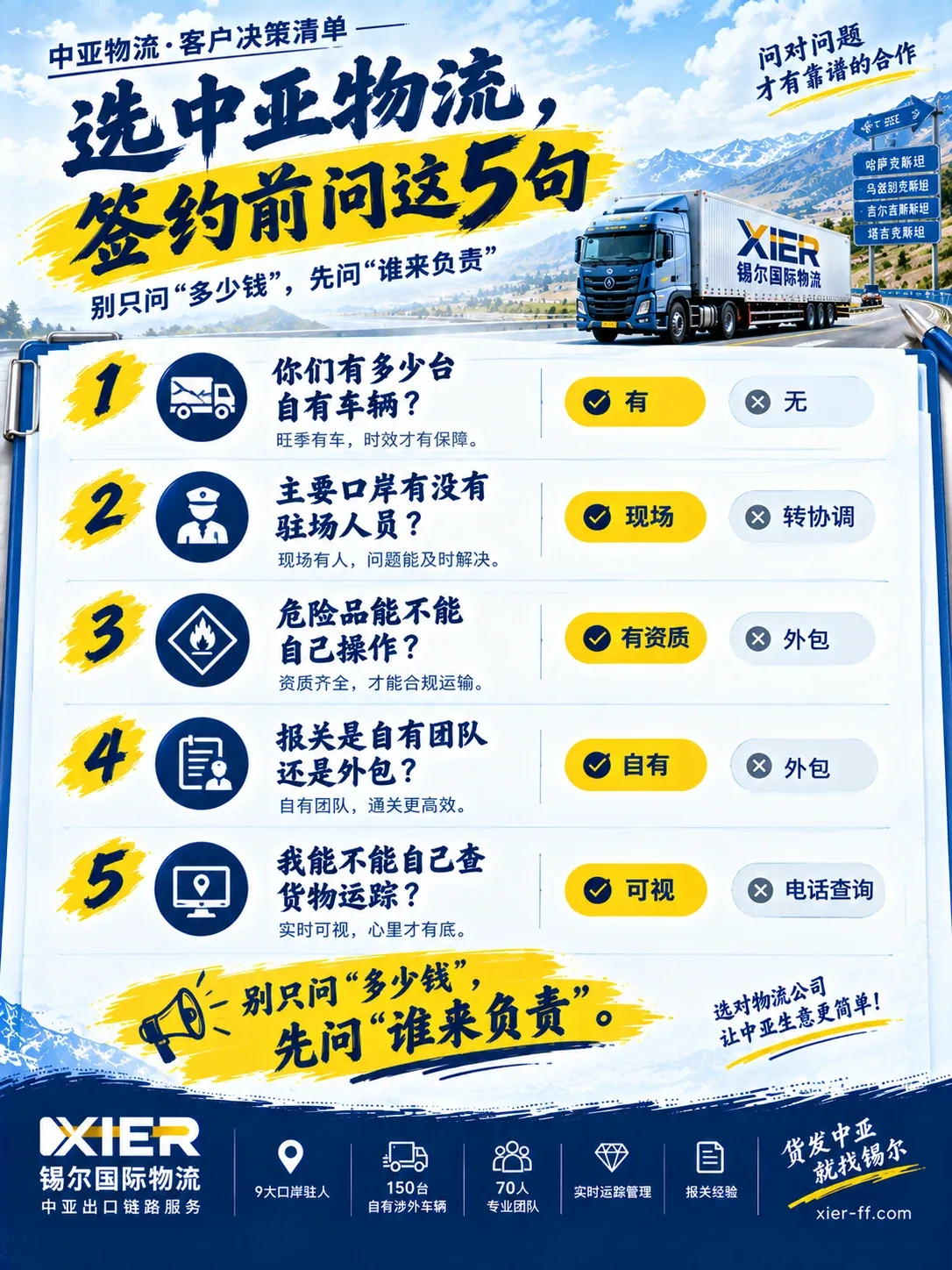
To pick the right Central Asia logistics partner, look at these five points.
1. Own Fleet: The Hard Guarantee for Peak-Season Timing
Many forwarders claim "rich resources" but own not a single truck — everything is outsourced. Normally fine, but in peak season outsourced trucks are tight and prices double, or simply unavailable. Your cargo just waits.
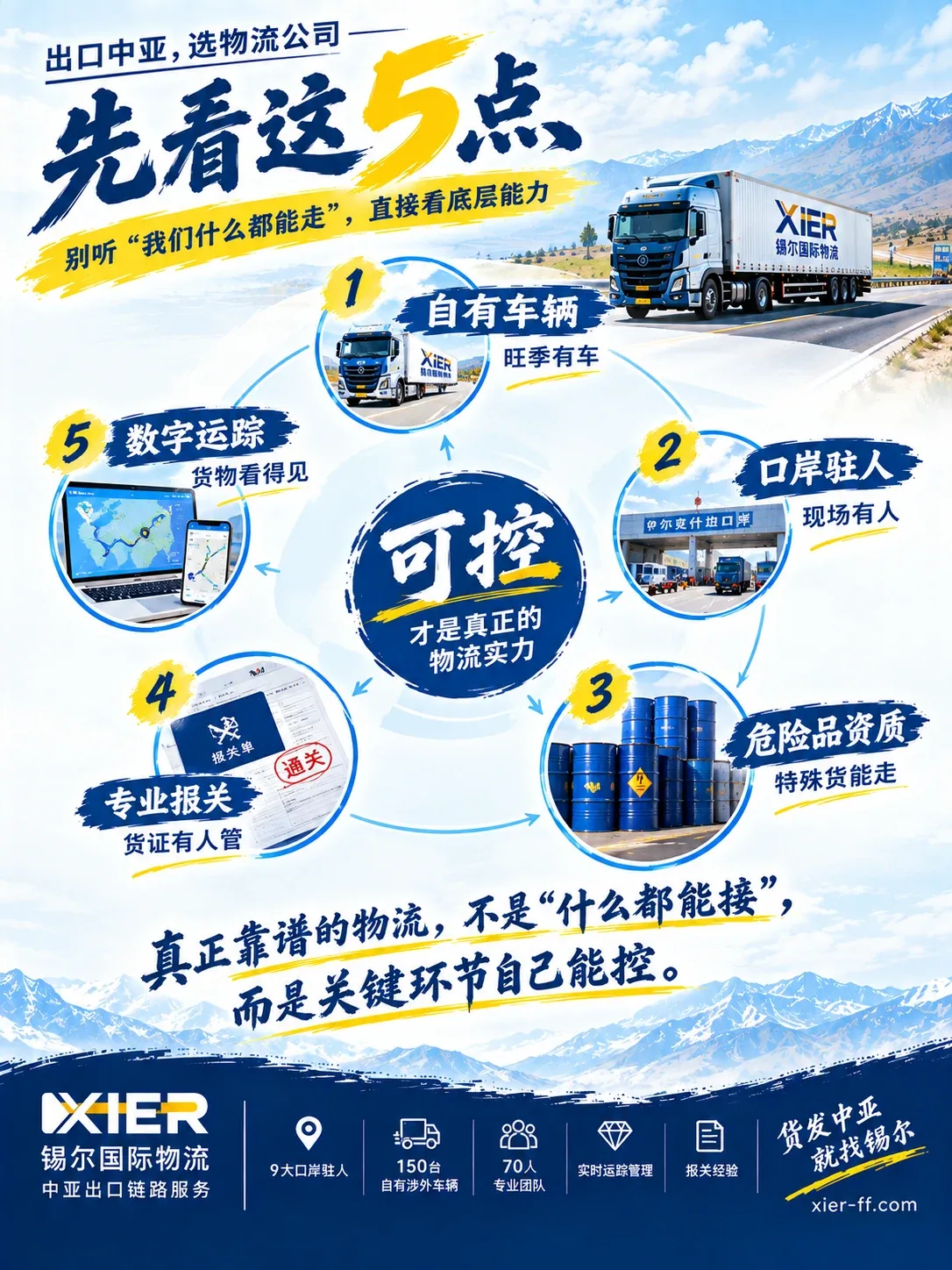
Why does an own fleet matter so much? Central Asia export peak seasons cluster in March-May and September-November, when truck supply is extremely tight. A forwarder without its own fleet can only hunt for trucks on the market — high price and, crucially, unable to ship at all. Last year a client told us his forwarder said in peak season "trucks are queuing, expect a two-week wait," and the cargo sat in the warehouse while the client's customer called daily.
How to judge a company's strength? Ask directly: how many trucks do you own? What types? Which routes can they run? A reliable company gives clear numbers, not vague answers.
💡 Xier International Logistics runs its own fleet across the major southern-Xinjiang ports.
2. Resident Port Staff: Someone On-Site the Moment Something Happens
The port stage of a Central Asia export is where problems are most likely. Inspection, transshipment, document checking, exception handling — if any link stalls, the cargo does not move. Many forwarders keep no staff at the port; when something happens they can only coordinate by phone, extremely inefficiently.
Why does resident port staff matter? During a port inspection, customs may ask for supplementary documents, re-classify the HS code, or clarify declaration elements. If nobody is on-site, you send documents to the forwarder, who forwards them to the port — half a day gone. Some inspections have time limits; past the limit the cargo is detained and later handling is worse. The transshipment stage too: Central Asia transport requires changing trucks or reloading at the port; poor on-site coordination drags out loading time and delays the whole schedule.
How to judge? Ask: do you keep resident field staff at the major ports? Can they be on-site immediately to handle an inspection? If they say "we have a partner port agent," that basically means no resident staff.
💡 Xier International Logistics keeps resident coordinators at all major ports.
3. Dangerous-Goods Certification: A Scarce Skill in Southern Xinjiang
Batteries, chemicals, pressure vessels, lubricants, paint — many companies export these to Central Asia, but many do not realize dangerous-goods transport requires special certification. Very few forwarders in southern Xinjiang can handle dangerous goods; many take an order, then find they cannot move it, and scramble for a partner — either at an absurd price or simply unable to ship.
Why does dangerous-goods certification matter? It is not just about trucks. Certification, driver training, vehicle configuration, packaging requirements, and declaration procedure all have strict rules. A company without certification either cannot take the order or outsources it, adding cost and leaving responsibility unclear.
How to judge? Simply ask for the dangerous-goods transport certification. A proper company has the documents; if they cannot produce them, they do not have it.
💡 Xier International Logistics holds dangerous-goods transport certification and has years of experience on the southern-Xinjiang routes.
4. Clearance Team: The Core Guarantee for Clearance Timing
In Central Asia exports, clearance problems are the most common cause of delay. Inaccurate declaration elements, wrong HS classification, incomplete documents, wrong attachment formats — any of these details can stall cargo at the port. Many forwarders outsource clearance, and when something goes wrong it is relayed layer by layer, very inefficiently.
Why does an in-house clearance team matter? Clearance is not just filling out and submitting forms; more important is understanding policy, accurately grasping the HS code, and anticipating the port's inspection focus. An experienced clearance team checks your documents for problems before shipment, avoiding surprises at the port.
How to judge? Ask two questions: do you have an in-house clearance team? What is the team's average years of experience? If they say "we have a partner clearing agent," that is outsourcing. Outsourcing is not unprofessional, but when problems arise coordination is slower than with an in-house team.
💡 Xier International Logistics runs its own clearance team averaging 5+ years.
5. Digital Tracking: End the Anxiety of "Where Is My Cargo"
Traditional cargo checking is basically by phone. You ask the forwarder, the forwarder asks the driver, the driver says "almost there," and three days later the cargo is still in place. Information lags; when the client chases, you have no confidence, and the experience is poor.
Why does digital tracking matter? Exporting to Central Asia, cargo passes through a dozen stages from warehouse-in to signing: pickup, warehouse-in, clearance, port inspection, transshipment, cross-border transport, destination clearance, last-mile delivery. Traditional methods only tell you the stage by phone, and not always accurately. A digital tracking platform makes every step visible in real time, so clients can check status anytime.
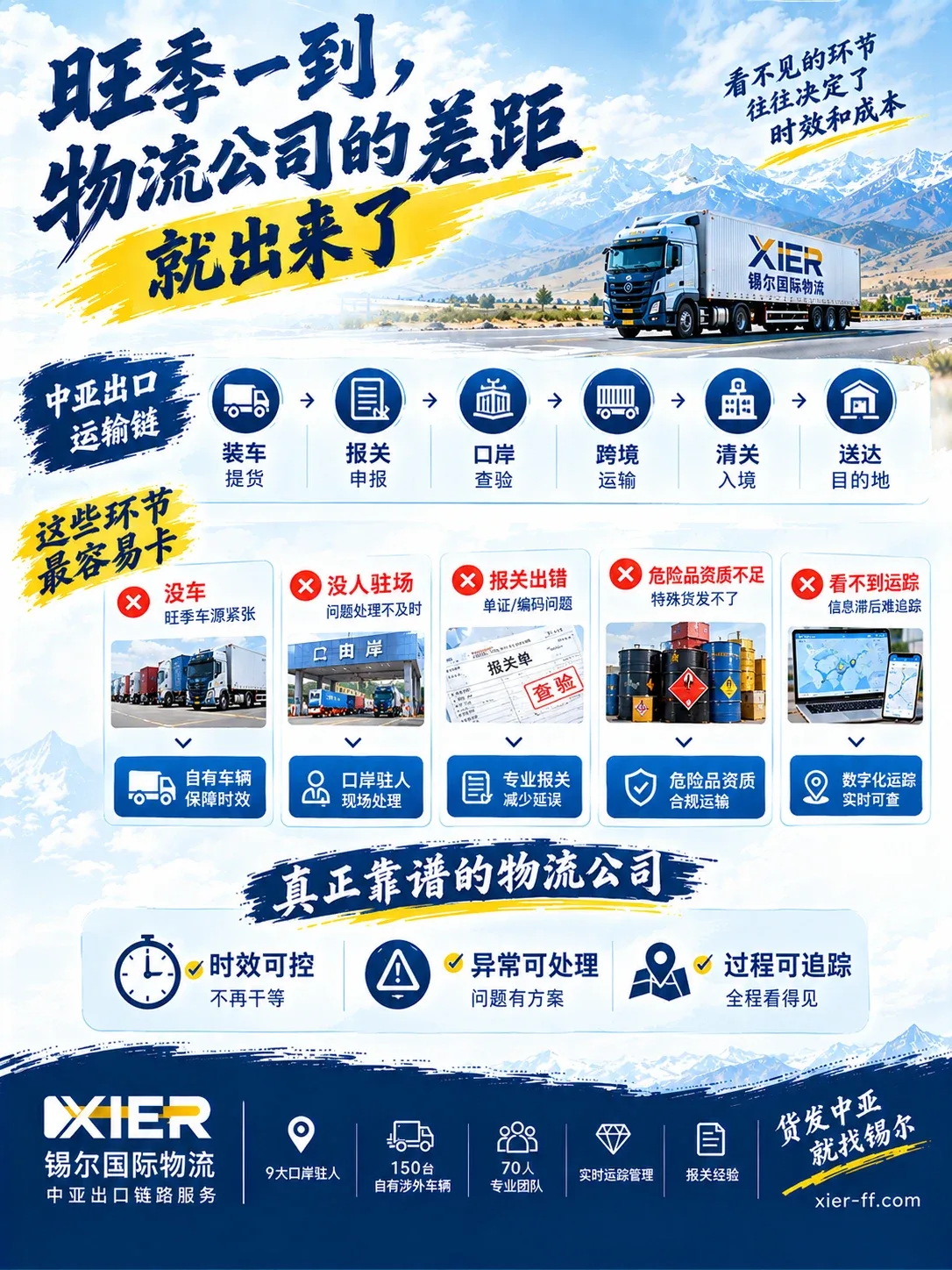
How to judge? Ask: do you have a tracking platform? Can I check my cargo myself? Which nodes can I see? If they say "just call us," that is the traditional model.
💡 Xier International Logistics provides a self-developed digital tracking platform covering every node.
Frequently Asked Questions
Q: Which countries can Xier serve?
A: Core routes cover Uzbekistan (Tashkent, Samarkand, Bukhara, etc.), Kyrgyzstan, Tajikistan, Kazakhstan, Turkmenistan, and the Afghanistan dedicated line. Tashkent is the most common destination — 916 km from Irkeshtam port, 3-5 days by road.
Q: How long does road transport to Central Asia take?
A: Depends on the destination. Kashgar to Irkeshtam is 240 km; after crossing to Tashkent 916 km, 3-5 days total. To Samarkand 1,294 km, 5-7 days. To Bukhara 1,586 km, about 7 days. May be slightly longer in peak season or with frequent inspections.
Q: How do I confirm whether dangerous goods can ship?
A: Send us the cargo's MSDS (Material Safety Data Sheet) or dangerous-goods classification certificate and we will assess it. Different dangerous-goods classes have different requirements for vehicle, packaging, and declaration; we will communicate them clearly in advance.
Q: What documents does clearance require?
A: Basic documents include contract, invoice, packing list, and declaration elements. Some cargo needs permits, inspection certificates, etc. We will give you a checklist before shipment; just prepare per the list.
Q: How do I get a quote?
A: Provide the cargo name, weight, volume, origin, and destination, and we quote the same day. Tel: +86 +86 18195891000, Email: xegjlog@163.com, or leave a message on our website https://www.xier-ff.com.
Conclusion
Exporting to Central Asia, choose the logistics right and everything flows; choose wrong and problems pile up. An own fleet secures peak-season timing; resident port staff handle on-site issues; dangerous-goods certification covers special cargo; a professional clearance team controls clearance efficiency; a digital platform keeps you informed of cargo status at all times — these five points are the key criteria for judging whether a Central Asia logistics company is reliable.
If you are looking for a reliable Xinjiang international logistics partner, contact us.
Xinjiang Xier International Logistics Co., Ltd.
Web: https://www.xier-ff.com · Tel: +86 +86 18195891000 · Email: xegjlog@163.com.
About the Author: Xier International Logistics specializes in Central Asia logistics market analysis and digital solutions. This article is based on Xier International Logistics' 10 years of frontline data and industry research and is for reference only; specific plans should be tailored to cargo characteristics.