Many companies exporting to Central Asia for the first time willinspectionandcustoms declarationtreat as the same thing—after all, both are "declaring to customs," just hand it to the freight forwarder. But only after actually loading the truck do they find out: some goods need advance inspection and quarantine, some can go directly with customs declaration; some have complete documents but get stuck on "no electronic ledger," some are released by customs but held at the port for re-inspection. Inspection and customs declaration are actually two processes, two nodes, two consequences; confusing them costs at least half a day of document revision, or at worst goods detained at the port for days. This article clarifies the difference between the two, when inspection is needed, and how the two processes connect, helping you get the sequence right before shipment.
I. Where Exactly Do Inspection and Customs Declaration Differ
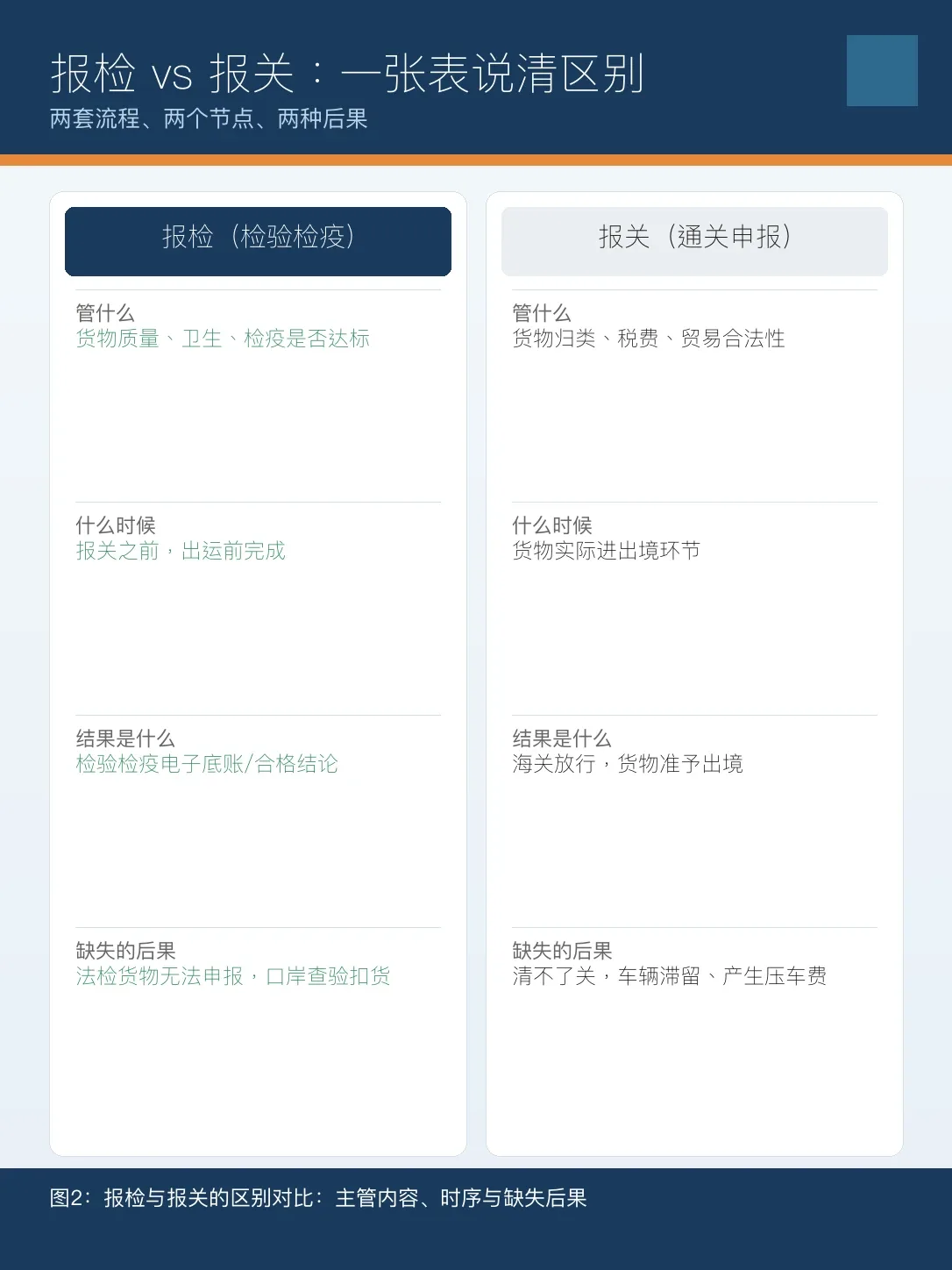
Simply put:Customs declaration governs "legal exit," inspection governs "quality compliance". Customs declaration is the declaration to customs; its core is the HS code for cargo classification, declared price, origin, and trade nature, on which customs levies tax and releases; inspection (more precisely inspection and quarantine) is the check on the cargo's own status, its core is whether this batch can safely exit—whether there are pests and diseases, whether packaging is qualified, whether health and safety indicators meet standards.
The two differ in authority, sequence, and consequences: inspection happens before customs declaration; legally inspected goods must obtain an inspection and quarantine conclusion (electronic ledger) before entering customs declaration; goods can only be loaded and exited after customs release. Miss customs declaration and the goods can't move; miss inspection and legally inspected goods can't even enter the customs declaration door, or get directly detained after port inspection.
II. When Is Inspection Needed: Look at Regulatory Conditions, Not Feelings
Do all export goods need inspection? No. Whether inspection is needed depends on thecustoms regulatory conditions. Codes in the regulatory conditions containing "A" (inbound cargo clearance sheet) or "B" (outbound cargo clearance sheet) fall under the legal inspection catalog and must be declared for inspection and quarantine before export. Common legally inspected categories include:
Food and agricultural products.Frozen products, fruits, grain products, etc., involving food safety and plant quarantine, are basically legally inspected goods; some destination countries also require an official sanitary certificate.
Animal and plant products.Leather, fur, bone products, seeds and seedlings, etc., have high quarantine requirements and must be quarantined and concluded before exit.
Chemicals and dangerous goods.Some chemical raw materials fall under legal inspection; dangerous goods also require an additional dangerous goods packaging certificate, and the packaging performance sheet is indispensable.
Electromechanical products containing lithium batteries or motors.Some electromechanical products involving safety standards are in the legal inspection catalog, and lithium-battery goods have additional hard requirements for packaging and transport conditions.
An easy pitfall: for the same type of goods, different uses or compositions can lead to different HS codes and thus changed regulatory conditions. Judging "it worked last time" to mean it will work this time is a common source of port inspection accidents. The correct approach is to check regulatory conditions item by item by code before shipment, rather than discovering at the port that inspection is needed.
III. How Export Inspection Works: Four Steps and Three Types of Documents
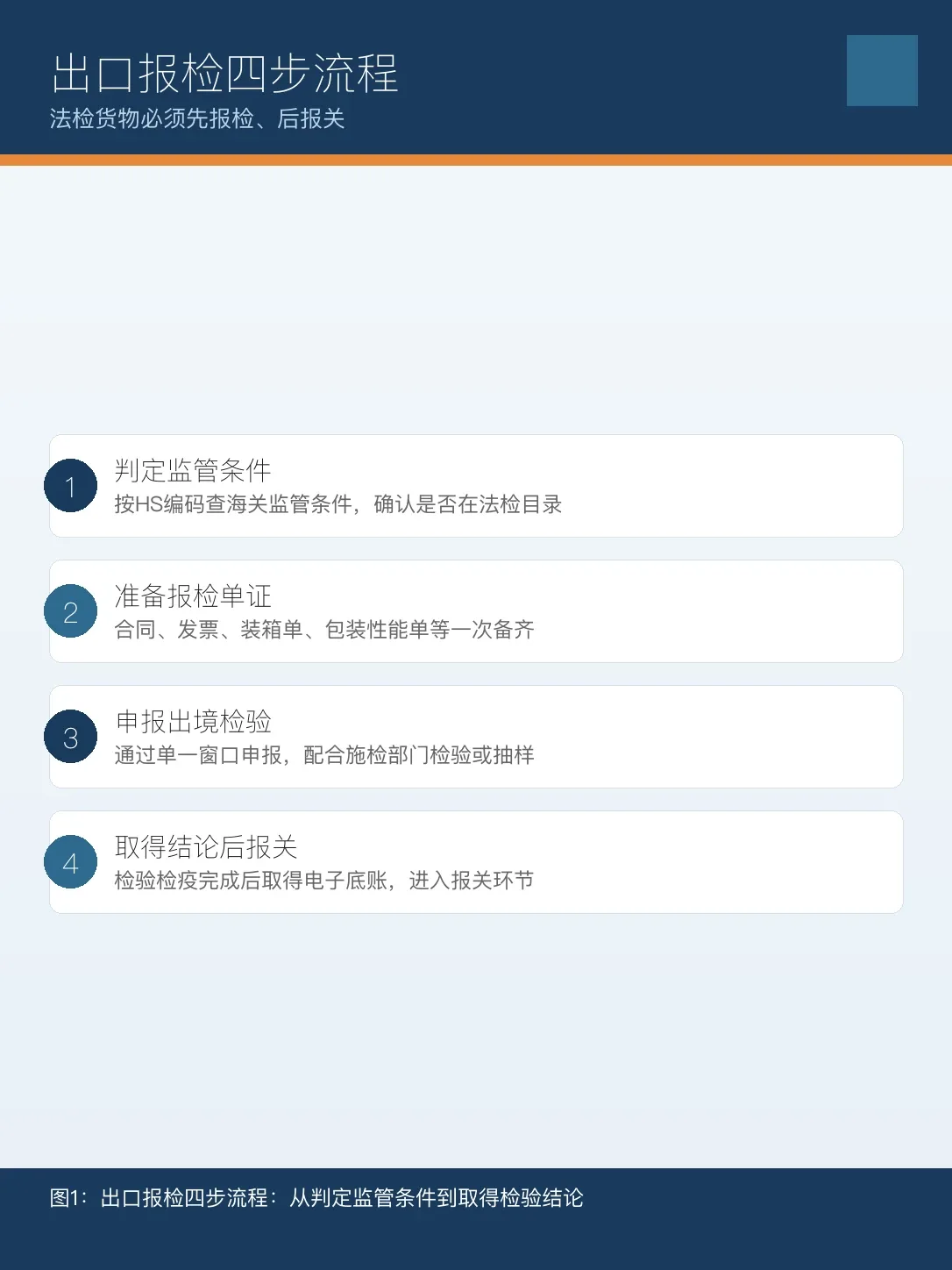
The inspection process can be summarized in four steps:Determine regulatory conditions → Prepare documents → Declare inspection → Customs declaration after obtaining conclusion. The first two steps determine the rhythm of the whole shipment, the last two determine whether it can be shipped on time.
In terms of documents, outbound inspection usually requires three types: first,trade documents, including contract, commercial invoice, packing list; second,packaging documents, wooden packaging must have IPPC marking and fumigation certificate, dangerous goods must have dangerous goods packaging performance sheet and use sheet; third,product documents, food categories need hygiene indicators and ingredient descriptions, animal and plant products need certificate of origin, and some destination countries require official certificates in advance.
The most common problem in practice is "consistency" between documents: the quantity, weight, and marks on the invoice must fully correspond to the packing list, inspection declaration, and customs declaration. Consolidated (LCL) cargo especially often has "several shipments in one box"; once one shipment's packing list doesn't match the actual goods, the whole container may be delayed by inspection.
IV. How Inspection and Customs Declaration Connect: Get the Sequence Right to Reduce Detention
The two processes are not series-waiting but can be prepared in parallel. Before shipment, prepare the trade and product documents needed for inspection first, and advance the inspection and quarantine declaration and customs pre-entry simultaneously; once the inspection conclusion (electronic ledger) is out, immediately following with the customs declaration is a more efficient rhythm. For large-volume planned cargo, the inspection conclusion also affects booking and consolidation time; it is recommended to confirm regulatory conditions at the production scheduling stage rather than starting only when goods arrive at the regulatory site.
Also note the destination country's cooperation requirements: for Central Asia exports, countries like Uzbekistan and Kyrgyzstan have additional certificate or label requirements for some categories; these are not reflected in Chinese customs regulatory conditions but take effect at destination-country clearance. Aligning "what's needed for exit" and "what's needed for entry" before shipment saves a lot of trouble at the destination.
If you can find a customs declaration team with port experience to determine this in advance at this step, the rhythm will be much steadier—for example, a team familiar withon-site service at nine major portswill clarify regulatory conditions, port qualifications, and destination-country requirements together at the quotation stage, rather than telling you after loading "this cargo needs inspection, wait two days."Central Asia Cross-Border Logisticsdocument preparation for the direction, the key is the word "in advance."
V. Three High-Frequency Misconceptions, Check Before Departure
Misconception 1: "Customs declared means it can go."For legally inspected goods without an inspection and quarantine conclusion, the customs declaration will be rejected; even if some ports release first, subsequent audits will hold accountable—not worth the loss.
Misconception 2: "Inspection is just a formality."Inspection and quarantine check the actual cargo status; unqualified packaging, missing labels, and document-goods mismatch will all require rectification, during which vehicles and goods are detained.
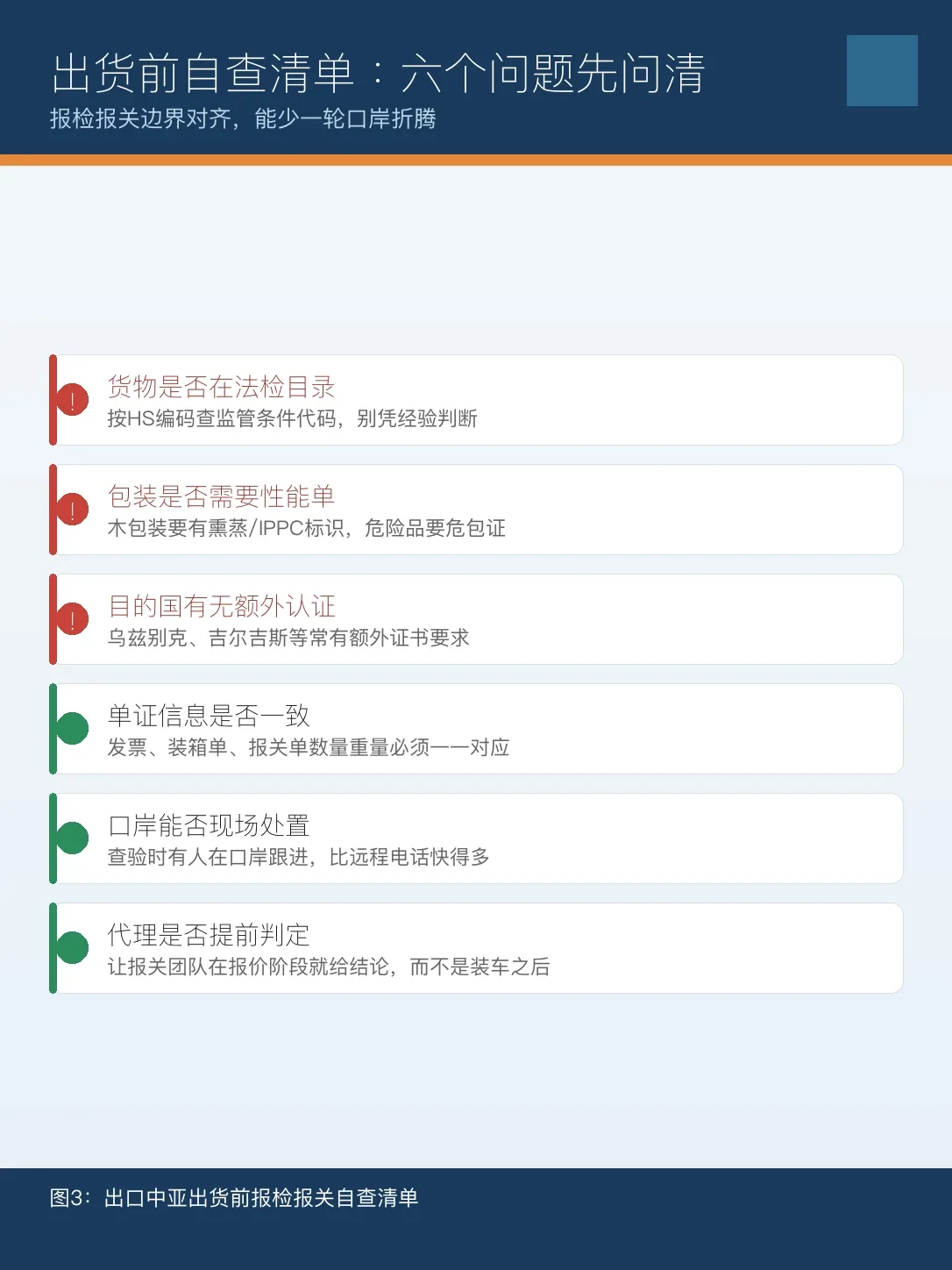
Misconception 3: "No inspection last time means none this time."Regulatory conditions change with policy adjustments, and the same code may differ by use; checking by batch is the safe approach. Going through the checklist below before shipment can block most problems.
Frequently Asked Questions
Can export inspection and customs declaration be done simultaneously?
They can be prepared in parallel, but the conclusion sequence cannot be reversed. Legally inspected goods must obtain the inspection and quarantine conclusion (electronic ledger) before the customs declaration can pass. In practice, document preparation and declaration pre-entry are usually advanced in parallel, and customs declaration is filed immediately upon conclusion, making the overall rhythm fast without rejection due to sequence errors.
How do I check whether my goods need inspection?
Check customs regulatory conditions by the goods' HS code: codes containing "B" are outbound legally inspected goods requiring inspection; those without "B" are non-legally-inspected goods entering the customs declaration stage directly. When unsure, tell the customs team the product name, use, and composition, and have them verify regulatory conditions by code and give a conclusion at the quotation stage.
How long does inspection take? Will it affect shipment timeliness?
Under normal conditions, legally inspected goods with complete documents can be completed within 1–2 working days after inspection declaration; those involving sampling or laboratory testing will take longer. For time-sensitive cargo, it is recommended to start inspection preparation at the production scheduling stage rather than only when goods arrive at the regulatory site—with the sequence right, inspection basically won't be a reason for detention.
If one shipment in consolidated (LCL) cargo needs inspection, must the whole container wait?
Inspection and quarantine are conducted by declared batch; if one shipment is required for inspection or rectification, it usually only affects that shipment's conclusion issuance; but when the whole container is shipped, customs inspection may target the entire truck, so the compliance level of your LCL partners directly affects your timeliness. When choosing LCL partners, document standardization matters more than price differences.
Do agricultural products exported to Central Asia also need destination-country certificates?
Common requirements include phytosanitary certificate, sanitary certificate, and certificate of origin; some countries also have language and content requirements for packaging labels. These are not reflected in Chinese customs regulatory conditions but take effect at destination clearance; before shipment, check them once with the destination clearance agent to avoid "can exit but can't enter."
About the Author: Xier International Logistics — focused on Central Asia logistics market analysis and digital solutions. Based on a decade of Xier's operational data and industry research, this article is for reference only; specific solutions must be tailored to your cargo.