I. Where is Alashankou?
Arasan is located in the Bortala Mongolian Autonomous Prefecture of Xinjiang, serving as a railway port of entry between China and Kazakhstan, corresponding to the Kazakh side's Dostyk (Dostyk) port. It is the western starting point of the Chinese section of the New Eurasian Land Bridge and one of the main exit ports for the China-Europe Railway Express (the other being Khorgos). Starting from Urumqi, traveling via the Northern Xinjiang Railway to Arasan, after crossing the border, it connects to the Kazakh railway network, allowing direct access to Almaty, Astana, and further extension to Central Asia and Europe. For destinations in Almaty and beyond in Central Asia, Arasan is one of the most mature railway exit nodes. If your destination is Kazakhstan, with transit through Uzbekistan, Kyrgyzstan, and other Central Asian countries, Arasan is usually the default preferred railway option; if the goods are destined for South Asia's Pakistan, the Khunjerab Pass road port is more convenient.
Why must railway transit involve 'transloading'?
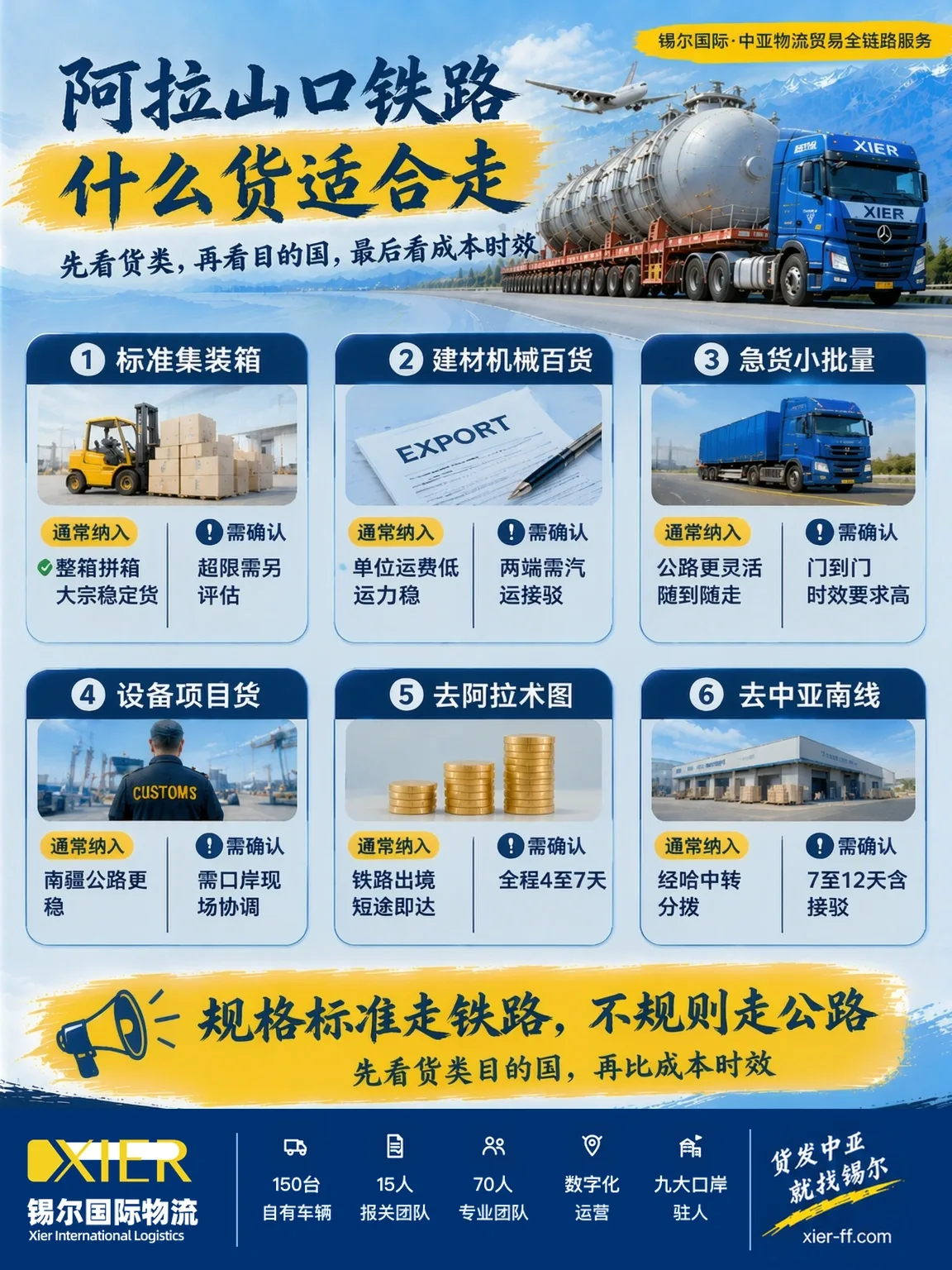 图:规格标准走铁路,不规则走公路——先看货类目的国,再比成本时效
The core reason lies in the difference in gauge: China uses standard gauge (1435mm), while Kazakhstan and the majority of CIS countries use broad gauge (1520mm). The same train cannot cross borders directly and must undergo 'transloading' at the border - transferring goods from standard gauge wagons to broad gauge wagons. In practice, there are two methods: containers are transloaded using cranes, lifting the boxes from the standard gauge wagon deck to the broad gauge wagon deck, which is efficient and has minimal loss; whole train of loose goods or oversized bulk cargo may require wheel change (replacement of bogies), which takes longer. This is also the main reason why railway border operations are more complex and take longer than road transport. For shippers, the transloading process means a 'non-compressible' border stay time, and preparing the packing list and customs documents in advance can significantly shorten this waiting period.
III. What kind of goods are suitable for the Alashankou railway
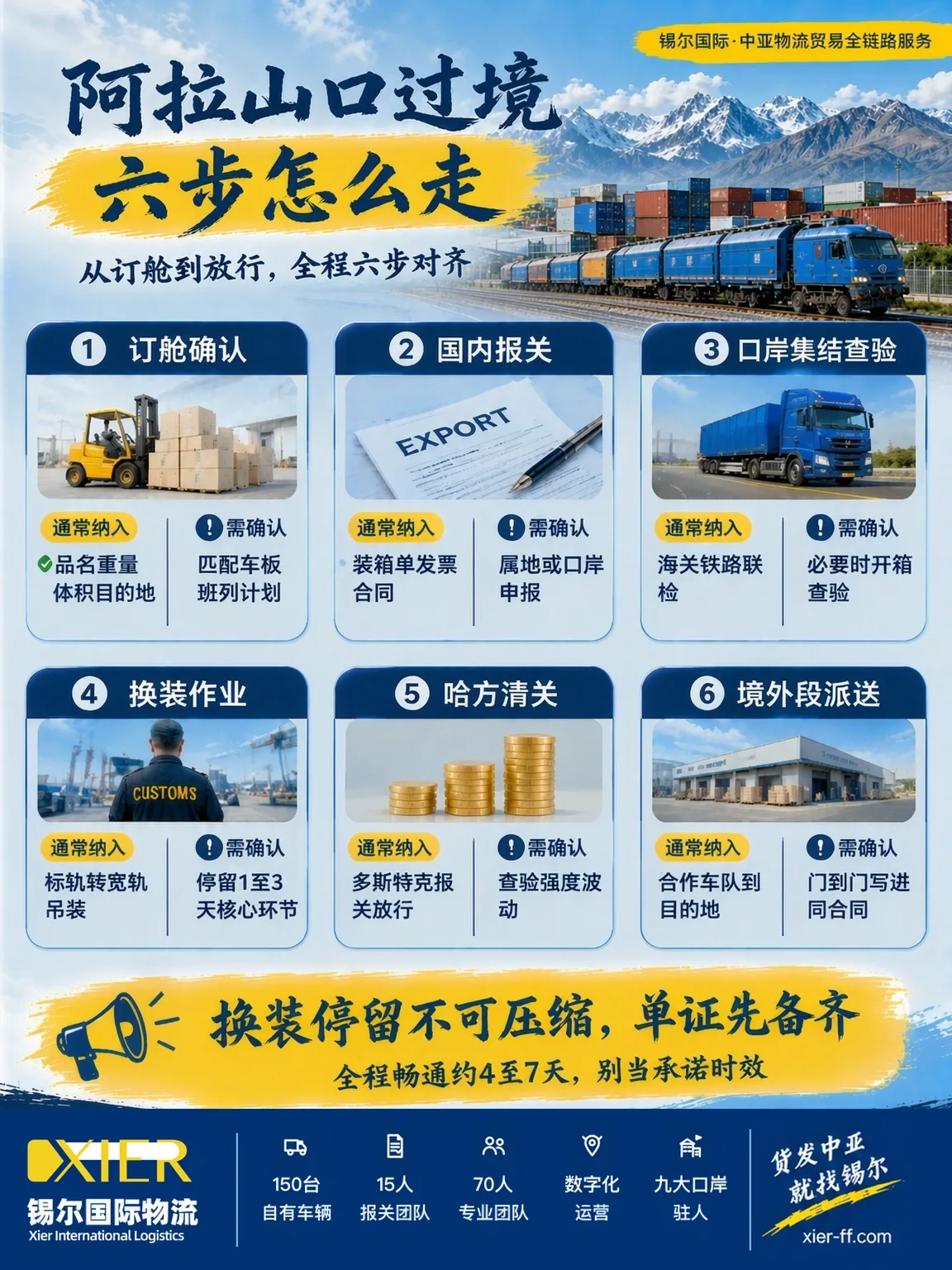 图:换装停留不可压缩,单证先备齐——全程畅通约4至7天,别当承诺时效
Railway transport is suitable for containerized full container loads (FCL) and less than container loads (LCL), bulk stable sources (such as building materials, machinery and equipment, daily necessities), and shipments with predictable time requirements and a pursuit of unit cost advantages. Compared to road transportation, railway transportation has lower unit freight rates, is less affected by weather and port congestion, and has more stable capacity; the drawback is that it is less flexible than road transportation, and door-to-door service requires two-way road transportation connections (such as collection in Ürümqi/Kashgar + delivery in Almaty). For destinations in Almaty and westward in Central Asia, railway transportation is often the preferred choice for cost-effectiveness. For small quantities, urgent shipments, or shipments with extremely high requirements for 'door-to-door' timeliness and the need to change routes at any time, road transportation is more flexible. The suggested judgment sequence is: first consider the type of goods, then the destination country, and finally the trade-off between cost and timeliness.
Four, complete transshipment process and reference timeliness
1. Booking and Confirmation: Provide product name, weight and volume, destination, and time limit. The logistics provider matches the container deck with the train schedule. 2. Domestic Customs Clearance: Declare at the originating port or local customs, prepare the bill of lading, invoice, contract, and customs declaration. 3. Port Assembly and Inspection: Upon arrival at the Alashankou port, the train undergoes customs and railway joint inspection, and necessary unpacking inspections are conducted. 4. Transloading Operations: The container is lifted and transloaded onto wide-gauge train decks, which is the core link of the port stay. 5.Kazakhstan Customs Clearance and Release: Upon departure to Dostyk, the customs declaration, inspection, and release are handled by the Kazakhstan side. 6. International Segment Transportation: Completed by the Kazakhstan railway or cooperative fleet to the final destination delivery. Overall Time Efficiency: Under normal circumstances, the Alashankou port operations (including transloading and customs clearance) typically take 1-3 days, and the entire journey to Almaty takes about 4-7 days, subject to train schedule, inspections, and seasonal fluctuations. 'Days' here is a comprehensive estimate of working days and transportation days, and closures, holidays, and extreme weather conditions will extend the actual cycle.
V. How to match rail and road transportation
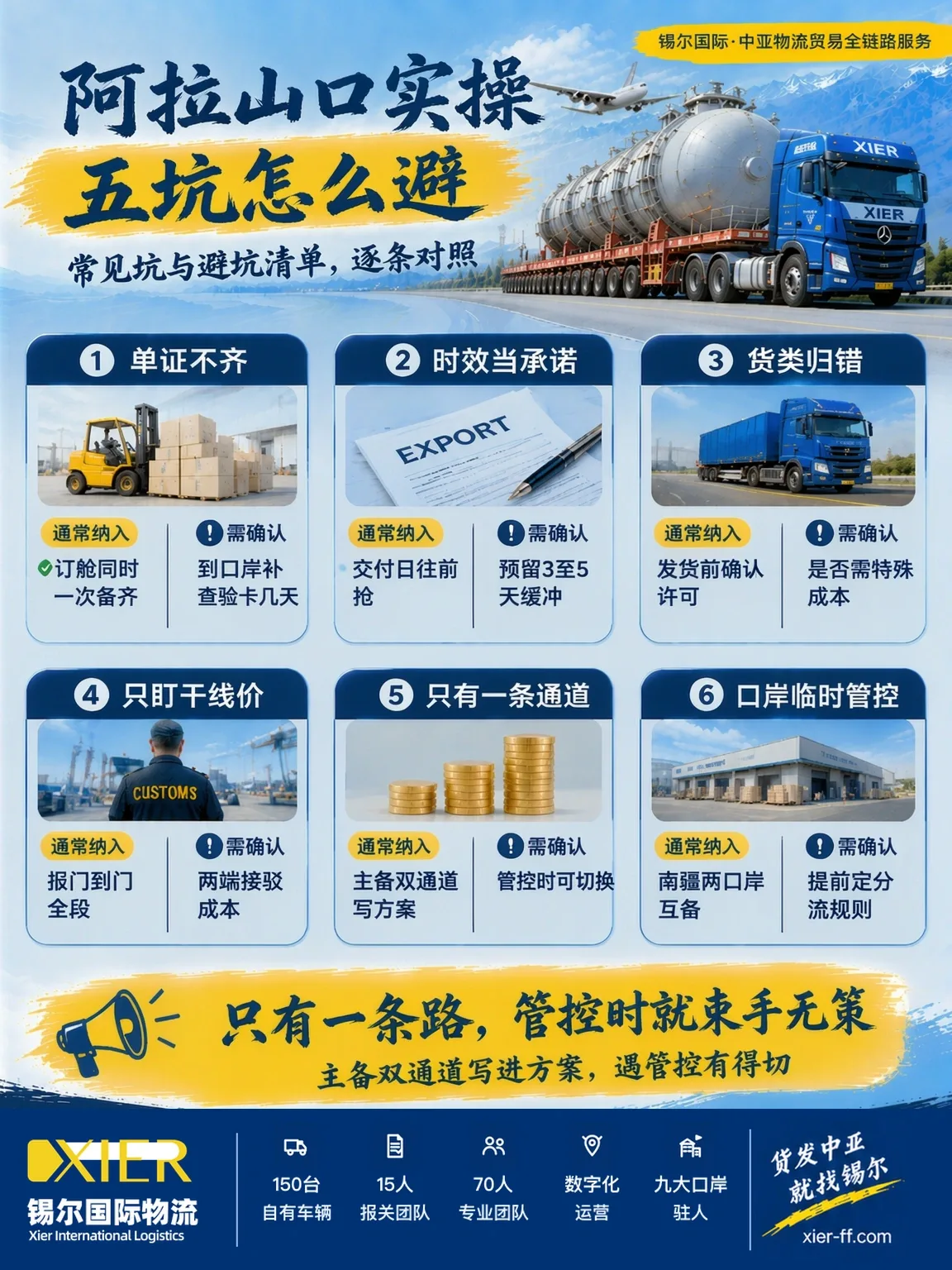 图:只有一条路,管控时就束手无策——主备双通道写进方案,遇管控有得切
No need to choose between routes to Central Asia. For large volumes and stable cargo, rail transportation is cost-effective; for urgent cargo, small batches, and door-to-door services with high requirements, road transportation is preferred. In actual business operations, a combination of 'railway trunk line + two-end road transportation' (combined transportation) is often used to cover door-to-door services, with a single team coordinating to reduce multiple interfaces. Xier International Logistics has a permanent operation and customs declaration team in the Wulumuqi and Alashankou areas, which can complete booking, customs declaration, transfer connection, and overseas segment delivery in one-stop, transferring the waiting time and document risk of railway transit to professional teams. For shippers, the value of combined transportation does not lie in 'which section is cheaper', but in 'a unified subject of responsibility throughout the journey' — if there is a problem at one end, there is no need to argue between the train company and the road transportation company.
Six, how to estimate the time for different destinations
The same route through the Alashankou Pass, but with different destinations, the time difference is very large: the closest to Almaty (Kazakhstan), after the railway exit, it takes a short distance to reach, about 4-7 days in total; to Astana, it needs to continue northwest, an additional 1-2 days; if Almaty is used as a transit point and then distributed to Bishkek (Kyrgyzstan) or Tashkent (Uzbekistan), it requires additional overseas road transportation, and the overall time may reach 7-12 days. This is a reference interval under "unimpeded conditions", not a guaranteed delivery time - the actual cycle will fluctuate with the frequency of the train, the intensity of port inspections, and the efficiency of customs clearance at the destination. It is recommended that shippers book the "planned delivery date" earlier rather than later, leaving buffer time for port stays and overseas connections.
7. Southern Xinjiang Highway Port vs. Alashankou Railway: How to choose for different goods
Many customers ask: Should my goods be transported through the Alashankou Railway or the Southern Xinjiang Irkeshtam and Turgar Pass highway ports? They are not substitutes but complementary. Below are several dimensions for comparison:
🚆 Alashankou Railway
- Suitable goods: Standard containers, bulk stable sources
- Time characteristics: Mainline stable, port loading and unloading stay 1-3 days
- Cost characteristics: Low unit freight, suitable for large quantities
- Applicable destinations: Almaty and west of the Kyrgyz Republic, via Kazakhstan for Central Asia transit
- On-site capabilities: Dependent on train schedule and railway operations
🚛 Southern Xinjiang Highway Port (Irkeshtam/Tulgaite)
- Suitable cargo types: Full truckload, equipment cargo, project cargo, irregular oversized cargo
- Time characteristics: Short door-to-door chain, fast on-site coordination, can leave as soon as it arrives
- Cost characteristics: Slightly higher per ticket but flexible, saves two-end connections
- Applicable destinations: Kyrgyzstan, southern Uzbekistan, and surrounding areas of Kashgar
- On-site capabilities: Strong presence at the southern Xinjiang headquarters, more stable coordination for full truckload, equipment, and project cargo
In simple terms: Standard specifications, stable batches, sensitive to unit cost, it is more economical to use the Alashankou railway; irregular, time-sensitive, and requires on-site coordination at the port for full truckload, equipment, and project cargo, the Irkeshtam and Tulgaite line in southern Xinjiang is often more stable. Xier has permanent resources at both southern and northern Xinjiang ports and can plan main and backup channels for the same scheme according to cargo types.
8. Common pitfalls and avoidance list in practice
- Pitfall 1: Documents are not complete until they reach the port——Inspection can take several days. Avoidance: Prepare the packing list, invoice, contract, and customs declaration elements all at once when booking a舱.
- Pitfall 2: Treat railway time as promised time——Ignore the fluctuations in closure and inspection. Avoid pitfalls: Plan for delivery days in advance and reserve 3-5 days of buffer.
- Pitfall 3: Incorrect classification of goods——Equipment goods reported as general cargo, on-site requirement for additional permits. Avoid pitfalls: Confirm HS classification and whether special permits are required before shipment.
- Pitfall 4: Only focusing on trunk line prices——Forgot the cost of road transportation at both ends. Avoid pitfalls: Quote the full door-to-door segment, not just the rail segment.
- Pitfall 5: Only one channel——Handcuffed when the port is temporarily controlled. Avoid pitfalls: Write a plan with both main and backup channels, as the South Xinjiang Irkeshtam and Turgart already have mutual backup conditions.
9. Common Questions
1. What is the difference between the Alashankou Railway and the Khorgos Railway?
Both are major exit ports of the China-Europe Railway Express on the western route, with consistent gauge and transshipment logic. The main differences are in the destination and the distribution of transport capacity: Alashankou connects to Dostyk, which is more convenient for destinations to Almaty and beyond; Khorgos connects to Atamkuli, with differentiated train schedules for some directions. The specific choice depends on the destination and the train schedule of the week.
2. How much time difference is there between container and loose cargo transshipment?
Container lifting and transshipment efficiency is high, single-box operations are measured by hours; for loose or oversized cargo that requires wheel change (replacement of bogies), the time consumption is significantly longer, possibly reaching days. Therefore, the form of cargo directly determines the duration of stay at the port.
3. After the railway leaves the country, who is responsible for the delivery in the overseas section?
Generally, the logistics party completes the delivery to the final destination through the cooperative railway and fleet in theKazakhstan or the destination country. In the door-to-door scheme, this section should be included in the same contract and responsibility division to avoid the situation of 'letting go as soon as leaving the country'.
4. Is my cargo suitable for railway or Southern Xinjiang highway?
Standard specifications, stable batches, pursuing unit cost - choose the Alashankou Railway; irregular, time-sensitive, and cargo requiring on-site port coordination such as whole vehicles, equipment, or projects - choose Southern Xinjiang Irkeshtam and Turghart. If unsure, first lay out the cargo parameters and the destination country for a channel rehearsal.
5. What to do in case of temporary port control?
A more reliable approach is not to rely on only one route. The main and backup channels and分流 rules should be clearly written in the plan, as the two ports in Southern Xinjiang already have mutual backup conditions. This allows for switching in case of actual control, rather than looking for vehicles on the spot.
6. What quotation scope should be used for railway freight to avoid being deceived?
Always calculate the full door-to-door segment: railway section + domestic pick-up/customs declaration + overseas handover/customs clearance + possible warehousing. Only reporting the single price of the railway section may lead to additional costs at the ends later on.
Alashankou
Railway port
Transloading
Central Asia
About the author: Xier International Logistics, focusing on Central Asia logistics market analysis and digital solutions. This article is based on 10 years of practical data and industry research from Xier International Logistics and is for reference only; specific plans need to be customized according to the characteristics of the goods.