In simple terms: Railways are good at transporting standard containers to bulk destinations at a lower unit cost; road transport is skilled at delivering whole vehicles, equipment, project cargo, and small, urgent shipments with greater flexibility to the door.
Reference mileage: About 378 kilometers from Khorgos to Almaty, road 6-10 hours; about 916 kilometers from Kashgar to Almaty. Rail transport requires first collecting goods and waiting for the train schedule, followed by transshipment, making the chain longer.
Experience inflection point: A single ticket can fill 1 standard container (20 feet or 40 feet) and go to the railway沿线 (Almaty, Astana) west of Xinjiang; for scattered, half-container cargo going to the southern Xinjiang, corresponding to the southern lines of Kyrgyzstan or Uzbekistan, road transport is more flexible and also more cost-effective for transshipment.
| Destination | Recommended Channels | Why |
|---|
| Almaty / Central and Western Kazakhstan (Northern Xinjiang) | Khorgos Highway or Alashankou Railway comparison | Bulk goods by rail, urgent goods or full truckloads by road |
| Bishkek / Southern Xinjiang | Irkeshtam port highway is the main route | Railway needs to detour through Northern Xinjiang for transshipment, road is more direct and cost-effective |
| Tashkent / Central and Western Uzbekistan | Alashankou Railway via Kazakhstan or Kashgar motor transport via Irkeshtam | Choose based on cargo volume and delivery time |
| Afghanistan | Roaddedicated line is the main route | Railway is not direct, roaddedicated line is more stable |
Judgment sequence: first look at the type of goods, then the destination country, and finally consider timeliness and cost. Xier has permanent resources at both the southern and northern Xinjiang ports and can plan main and backup channels within the same plan.
Six, three real cargo examples, see how to choose
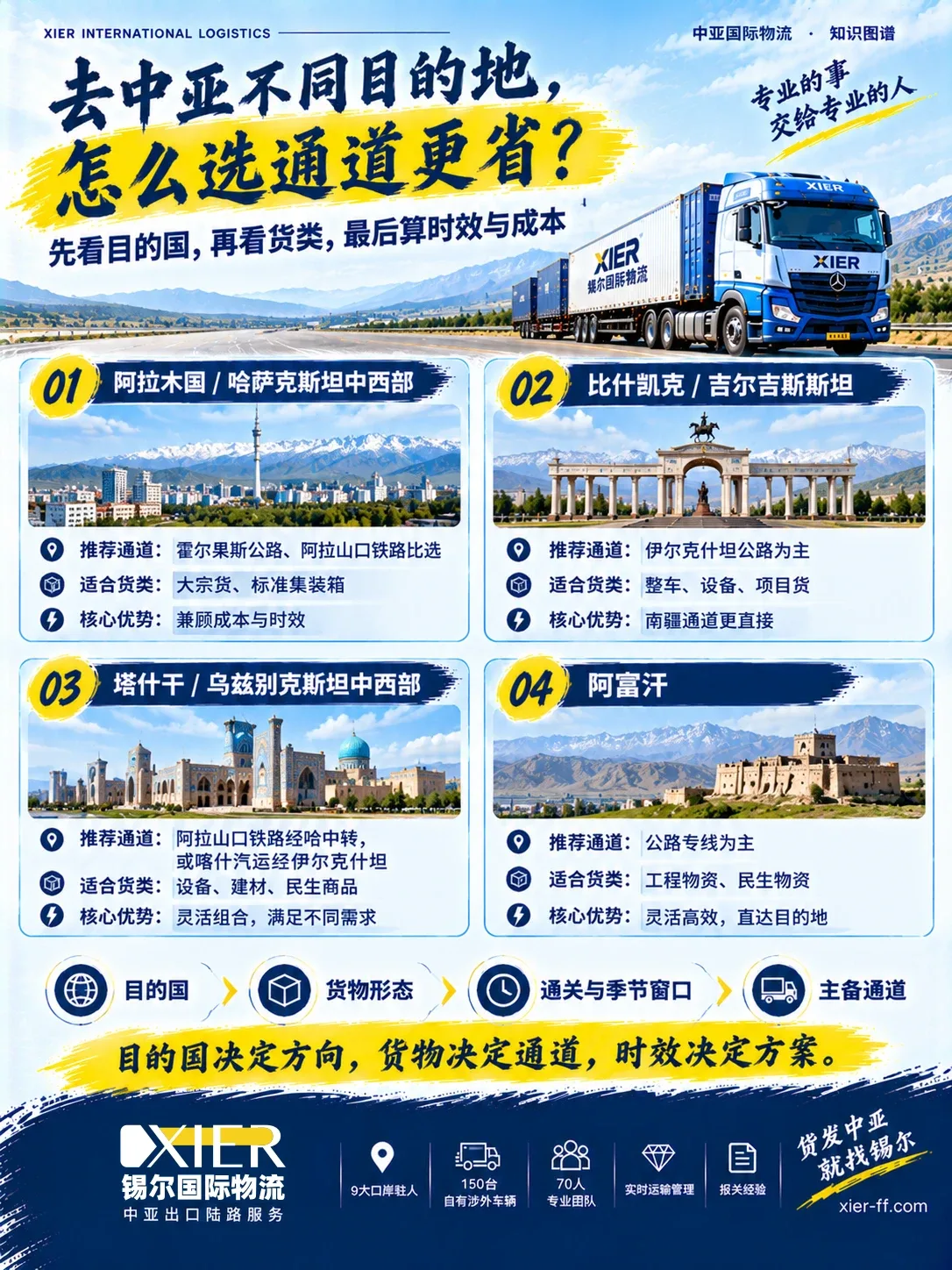 图2:按目的地选通道——阿拉木图、比什凯克、塔什干、阿富汗怎么走更省
Cargo Example 1: 20 tons of building materials to Almaty, not urgent
Can be consolidated into a full container, heading to the railway along the northern Xinjiang, no strict deadline required.Railway full container is more cost-effectiveJust book it into the next available train schedule.
Example of goods 2: 1 container of electronic products to Tashkent, 12 days for delivery
Comparison: The collection and transshipment cycle of rail freight versus the door-to-door cycle of road transport. Choose rail if the cycle is sufficient and the unit cost is lower; choose road door-to-door for better control if 12 days for delivery is urgent.
Example of goods 3: Over-sized and overweight construction machinery to Bishkek
Single items that are oversized or overweight are restricted by rail dimensions and transshipment limitations,Road flatbed or lowboyThe most direct and stable way to exit from Kashgar via Irkeshtam.
Seven, don't just compare the trunk line price: five hidden costs
- End-to-end connection: Domestic pick-up plus overseas distribution, often overlooked;
- Customs declaration and inspection waiting time: Higher inspection rates for hazardous and sensitive goods;
- Transshipment or wheel change: Exclusive to rail, the CIS wide gauge must be changed;
- Collection waiting time: The lead time caused by the rail schedule;
- Port temporary control: Buffer space needs to be left between the main and backup channels.
Avoid pitfalls: the quote must includeDoor-to-door full segment; Plan ahead for the delivery date, not push it back.
Eight, common questions
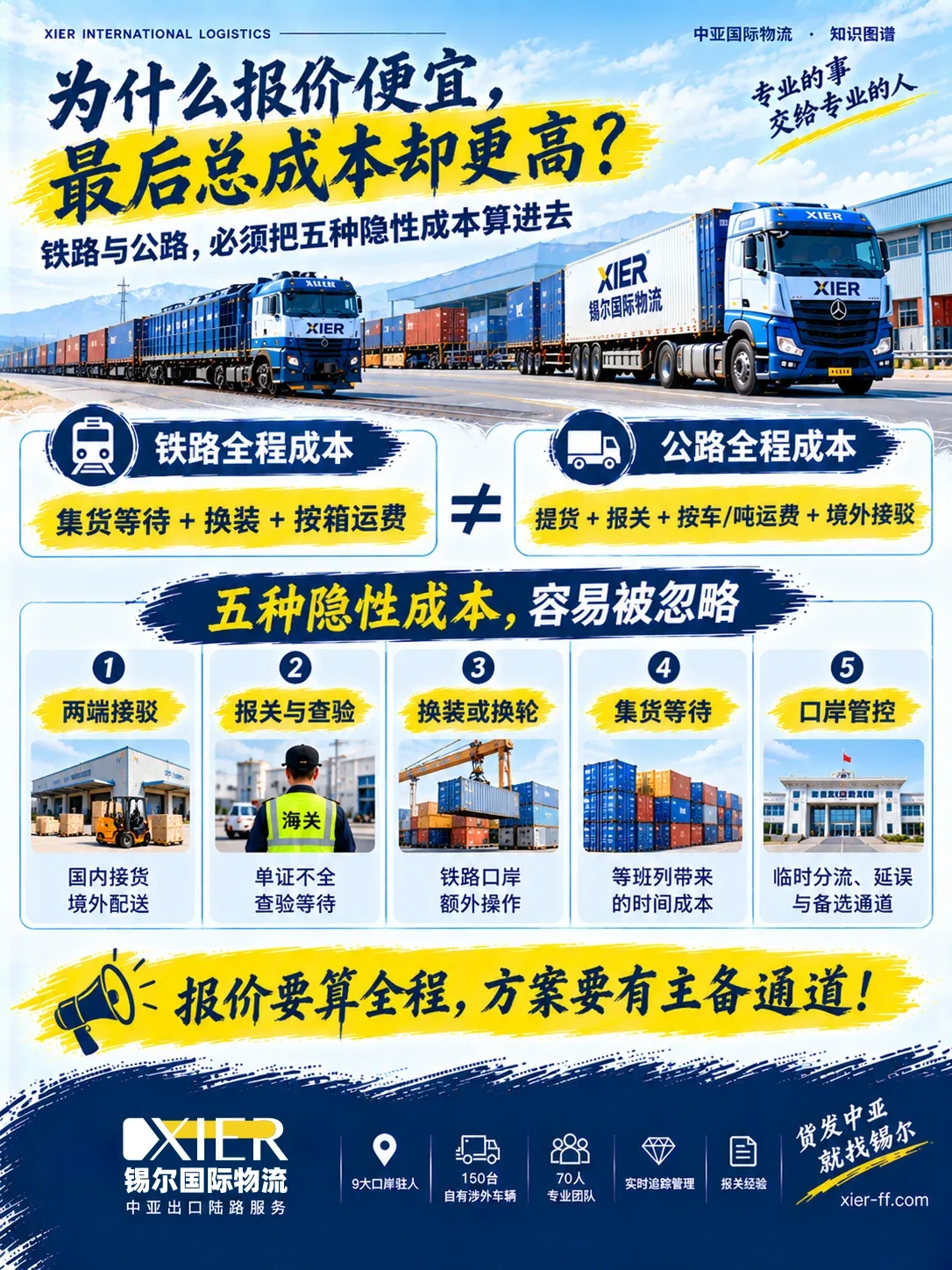 图3:别只比干线价——容易被忽略的五种隐性成本
1. How to choose between rail and road transport?
Inspection goods, batch, destination, and timeliness: specifications and standards, stable batch, pursuing unit cost, prioritize rail or Khorgos highway full truck; irregular, time-sensitive, full truck, equipment, and project cargo requiring on-site port coordination, road transport is more flexible.
2. Can small batch urgent goods be transported by road?
Yes. When there is no need to wait for a full container, no waiting time, and high door-to-door requirements, the flexibility of road transport is most evident, more controllable than waiting for train schedules.
3. Which channel should equipment and oversized cargo take?
For single-piece oversized or overweight engineering equipment, agricultural machinery, and production lines, road transport with flatbeds or low-bed trailers is the most direct; if the cargo volume can be made up and is heading west of Xinjiang, rail transport can also be considered. It depends on the shape of the individual item and the destination road network.
4. How to save on transportation to the southern line of Kyrgyzstan and Uzbekistan?
The South Xinjiang Irkeshtam and Turghart road border ports correspond to the southern line of Kyrgyzstan (Bishkek direction) and the western line of Uzbekistan, which is more direct and cost-effective than detouring through the northern Xinjiang railway for transshipment and connection. Xier has strong presence in the southern Xinjiang line, ensuring stability for full truck, equipment, and project cargo.
5. How to get a fair quote and avoid being scammed?
Always calculate the full door-to-door segment: mainline plus domestic pick-up and customs declaration, plus overseas connection and customs clearance, plus possible warehousing. Only reporting the mainline unit price can easily lead to additional costs at both ends. Clearly state the main and backup dual channels in the proposal.
6. How to estimate time reliability properly?
Calculate the entire route and leave a buffer for port stay and overseas connection. Plan the delivery date in advance, don't treat railway schedules or inspection waiting as zero cost.
Central Asia Railway Express
Central Asia Highway Motor Transport
Route Selection
Central Asia Logistics Costs
Door-to-Door Logistics
About the Author: Xier International Logistics, focusing on Central Asia logistics market analysis and digital solutions. This article is based on 10 years of practical data and industry research of Xier International Logistics and is for reference only; specific plans need to be customized according to the characteristics of the goods.