1. Three things to ask for Kazakhstan dedicated line
In the consultation of cross-border logistics in Central Asia, shipping to Kazakhstan is one of the most frequent directions. E-commerce goods in Almaty, project materials in Astana, and machinery and equipment from Xinjiang to Kazakhstan all fall on this line. However, many cargo owners start with 'how much is the freight, how many days will it take', and after answering, they often have to do extra work - because what really determines whether this shipment can be smoothly completed are three more preliminary matters: which port to choose, how to estimate the transit time, and how to break down the costs.
These three matters are interconnected. Choosing the wrong port is meaningless to discuss timeliness and costs later; if the cost is only considered in total without looking at the items, it is impossible to determine if there are any omissions; if timeliness is only based on a single number without considering the port schedule and customs clearance methods, the delivery time will be affected. Therefore, this article does not pile up route names but explains the port, timeliness, and costs in a linear manner according to the decision-making sequence of the cargo owner.
It is necessary to clarify the scope: the time intervals and cost structures involved in the following text are common reference frameworks for this line, not commitments for a specific shipment. The logisticsdedicated line to Kazakhstan is greatly affected by port access, train schedule, transshipment efficiency, and customs clearance. The accurate figures should be based on the actual quotation on the day of inquiry. The channels and subjects mentioned in the text are all used to help you establish a judgment framework.
II. How to choose the port: the corresponding channels between the north and south Xinjiang and the cargo types
For shipments to Kazakhstan, there are two main ports in the northern Xinjiang, namely Khorgos and Alashankou, while in the southern Xinjiang, it is possible to exit through the Irkeshtam port and connect to the direction of Kyrgyzstan. The choice is not based on which port is more famous, but on whether the cargo type, destination, and origin match.
The Khorgos highway and railway conditions are both mature, with complete facilities and strong passage capabilities. Large container loads or goods requiring both road and rail transportation often pass through here; the Alashankou area mainly handles railway express trains, suitable for bulk, containerized goods, and those sensitive to costs. For large equipment or door-to-door direct delivery requirements, road transportation is often more flexible than rail. If the goods are in the southern Xinjiang region, or if there is a need to transfer to Kyrgyzstan or Uzbekistan, using the Irkeshtam port of entry is usually more cost-effective - this is a common practice for logistics from southern Xinjiang to Central Asia.
| Passage | Main method | Suitable goods | Judgment points |
|---|
| Khorgos | Road + Rail | Large container loads, road-rail dual-use | Mature facilities, strong passage capabilities |
| Alashankou | Railway express trains as the main mode | Bulk, containerized, cost-sensitive | Check train schedule and transshipment |
| Irkeshtam (Southern Xinjiang) | Road transportation as the main mode | Departure from southern Xinjiang, transfer to Kyrgyzstan/Uzbekistan direction | Save mileage, check port passage |
Many shippers may ignore the variable of the origin. The same shipment to Almaty, whether organized from southern Xinjiang or northern Xinjiang, the appropriate passage may be completely different. Incorporating 'where the goods come from' into the judgment is more cost and time-saving than simply comparing port names.
Three, how to estimate timeliness: road, rail, and combined rail-road transportation
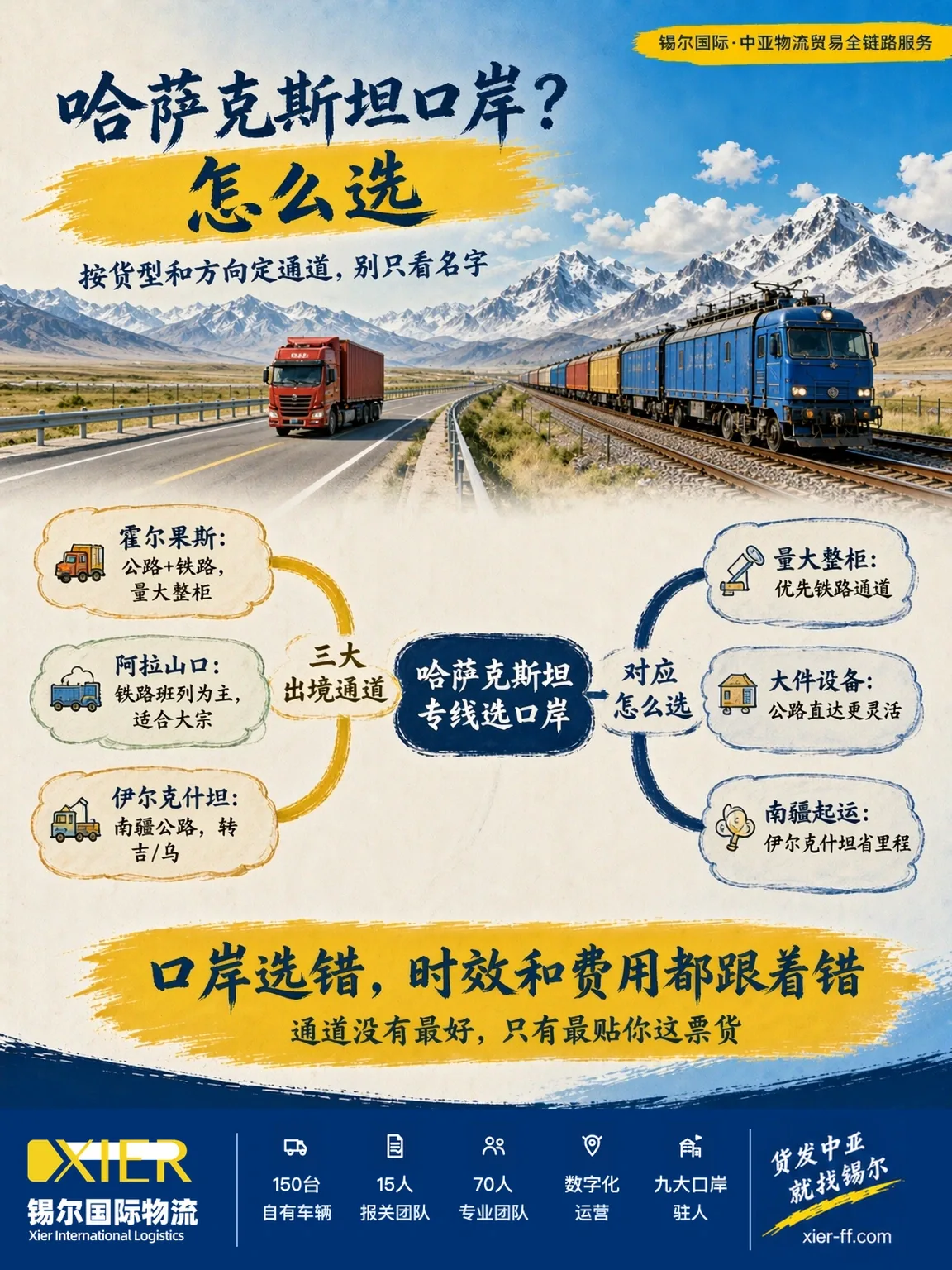 图:口岸没有较,只有最贴这票货——按货型和方向定通道,别只看名字
Timeliness is the most concerned aspect for shippers and also the most easily mislead by a single number. There are three common ways to deliver to Kazakhstan, each with a different rhythm: road transportation is usually the fastest and highly mobile, suitable for urgent goods and door-to-door services; the railway Central Asia train has a lower cost, suitable for bulk goods, but with a longer cycle; combined rail and road transportation is in the middle, using the railway for the main line and the road for the two ends of the connection.
To accurately estimate timeliness, it needs to be broken down to see which periods it consists of: domestic collection and delivery, export customs declaration, port queuing and transshipment, cross-border mainline transportation, destination country customs clearance, and final delivery. Any segment that is blocked will accumulate backward. Especially the port transshipment (due to different rail gauges, it needs to be transshipped) and customs clearance are the two most fluctuating segments. Asking about how these two segments are arranged during the quotation is more useful than just asking 'how many days in total'.
| Methods | Timeliness Characteristics | Cost Characteristics | Suitable Goods Type |
|---|
| Road Transportation | Generally fast, mobile | Unit price is higher | Urgent goods, large items, door-to-door |
| Railway Train | Longer cycle | Lower cost for bulk goods | Full container, bulk goods, cost-sensitive |
| Combined Rail and Road Transportation | Between the two | Compromise | Long mainline, both ends need to be connected |
Therefore, when checking the time-sensitive quotation, it is recommended to ask three questions: whether it is a train or a fleet, how the port loading and unloading is arranged, and who is responsible for customs clearance. Only when these three questions are clarified does a day count; otherwise, the value obtained is just an ideal one, which is easy to fall short upon arrival. The following is a framework of intervals, and the specific number of days is subject to the train and fleet schedule on the day of inquiry.
Four, how to break down the cost: six subjects of a quotation sheet
The quotation for the Kazakhstan dedicated line should avoid giving only a total price. The total price does not show what is included or omitted, nor can it be compared with others. Only by breaking down a quotation sheet into three major sections - domestic, cross-border, and overseas - and six subjects can we talk about 'comparison of prices'.
The domestic section includes pick-up and delivery, export customs declaration, and loading; the cross-border section includes mainline freight and port station charges; the overseas section includes customs clearance fees and final delivery fees. These six items together make up the complete cost of a shipment from departure to warehouse. Any missing item may be charged as 'additional charges' later on.
| Segmentation | Subject | Main meaning | Inquire clearly when making an inquiry |
|---|
| Domestic section | Pick-up + customs declaration + loading | Cost before departure from the origin to the port | Whether the pick-up and customs declaration documents fee is included |
| Cross-border section | Mainline freight + port charges | Transportation and station charges from port to port | Who bears the cost of loading and unloading, and inspection fees |
| Overseas section | Customs clearance fee + delivery fee | Kazakhstan customs clearance and terminal to warehouse/door-to-door | Tax range, delivery to which level |
When comparing prices, align the six items, compare column by column, and the differences will be noticeable. Some quotes have a low total price by excluding customs clearance or delivery; some quotes may seem expensive but actually include door-to-door. Only by breaking them down can you really compare prices.
V. How to proceed with customs clearance: the boundary between customs clearance with duties paid and self-managed customs clearance
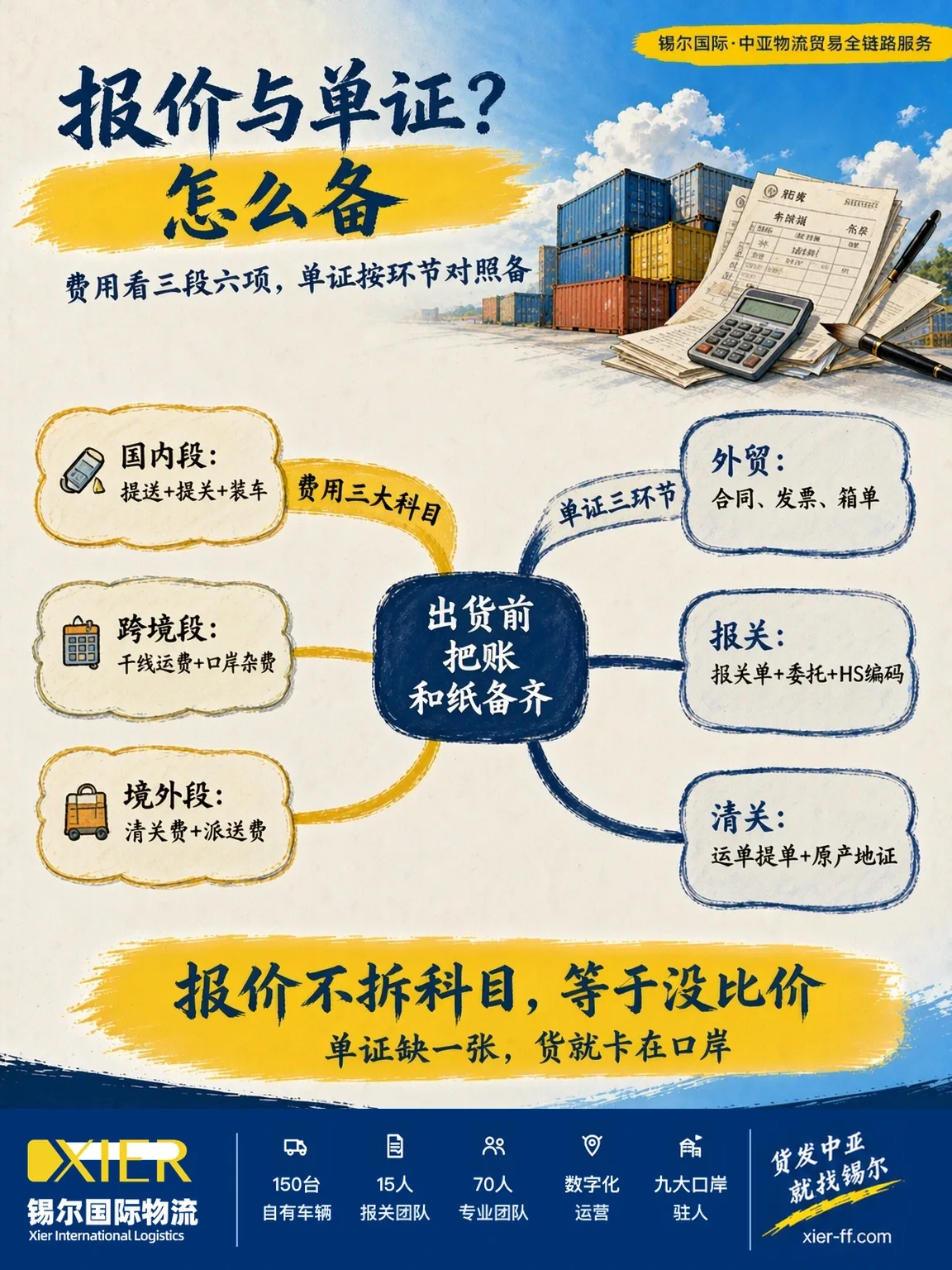 图:报价不拆科目等于没比价——费用看三段六项,单证按外贸、报关、清关对照备
Customs clearance in Kazakhstan is the most easily confused part of this route. Common practices include: customs clearance with duties paid, where the service provider handles export and import customs clearance and charges a fixed price; and self-managed customs clearance, where the cargo owner makes the declaration based on import qualifications. There is no absolute good or bad, the key is to clearly define the responsibility boundaries.
For cargo owners who are not familiar with the customs clearance process and hope for a fixed price for costs, customs clearance with duties paid is convenient, but it must be specified in the contract the declaration criteria, the scope of taxes included, and the responsibility for exceptions——who will bear the inspection, additional taxes, and demurrage must be agreed upon in advance. For cargo owners with import qualifications and the ability to make stable self-declarations, self-managed customs clearance has more transparent costs, but also bears the responsibility for the accuracy of documents and declarations.
Here is a reminder: 'Customs clearance with duties paid' does not mean 'nothing to worry about'. The shipper still needs to ensure that the item names, HS codes, and declared values are true and accurate. Otherwise, if found to be false declaration, the additional taxes and penalties often fall on the actual recipient. Understanding 'duties paid' as a package of fees rather than a package of responsibilities is the correct risk expectation.
Sixth, the shipper's pre-shipment record list: a missing document can block the port
Documentation is a strict requirement on this route. The foundation is the three sets of foreign trade documents: contract, commercial invoice, and packing list; the customs declaration process requires a customs declaration form, customs agency letter, and accurate HS code; customs clearance in the destination country usually requires waybills or bills of lading, origin certificates, etc. For goods involving certification or regulatory conditions, additional preparations should be made according to categories.
The two most common problem areas are: first, inaccurate HS code classification leading to incorrect tax rates or regulatory conditions; second, discrepancies in the names, quantities, and amounts of goods on the invoices, packing lists, and customs declarations, which can be easily exposed during port review. It is recommended that a second person check each item after the document is issued, eliminating discrepancies before submission.
| Process | Required Documents | Common reasons for rejection |
|---|
| Foreign trade | Contract, invoice, packing list | Discrepancies in names/quantities/amounts |
| Customs declaration | Customs declaration form, agency letter, HS code | Inaccurate code classification |
| Customs clearance | Waybill/bill of lading, origin certificate | Missing documents, information does not match |
The value of this list does not lie in its length, but in ticking off each item before shipment. Cases of cargo being held at the port due to a missing document in the Central Asia route are not uncommon, and these can almost all be avoided before departure.
Step 7: The operational chain from inquiry to port clearance
By linking the previous sections, a shipment of goods along the Kazakhstan dedicated line can be compressed into a four-step chain. The first step is to inquire and verify the goods, clearly report the model, origin, destination, and time limit, and determine which port to use; the second step is to prepare goods and documents, align packaging, documents, and customs declaration materials; the third step is customs declaration and loading, single-window declaration and port entry; the fourth step is port exit and destination customs clearance and release, completing transshipment, inspection, and final delivery.
Among these four steps, the first and second steps are most easily compressed. Many shippers are in a hurry to send the goods, giving vague inquiry information and leaving documents until the last moment, resulting in being stuck at customs declaration and the port. Only by doing the first two steps solidly can the process go smoothly. The customs clearance and delivery in the overseas section are then implemented by the carrier according to the established responsibility boundaries at the destination.
| Steps | Key Actions | Responsible Party | Deliverables |
|---|
| First Step | Inquiry and verification of goods, determine the port | Shipper + Carrier | Clear routes and quotations |
| Second Step | Prepare goods and documents | Shipper | Comprehensive and compliant documents |
| Third Step | Customs declaration, loading, entry | Customs brokerage + Carrier | 申报单与放行信息 |
| Step 4 | Outbound loading, customs clearance and delivery | Carrier | Warehouse/door-to-door receipt |
8. Common Questions
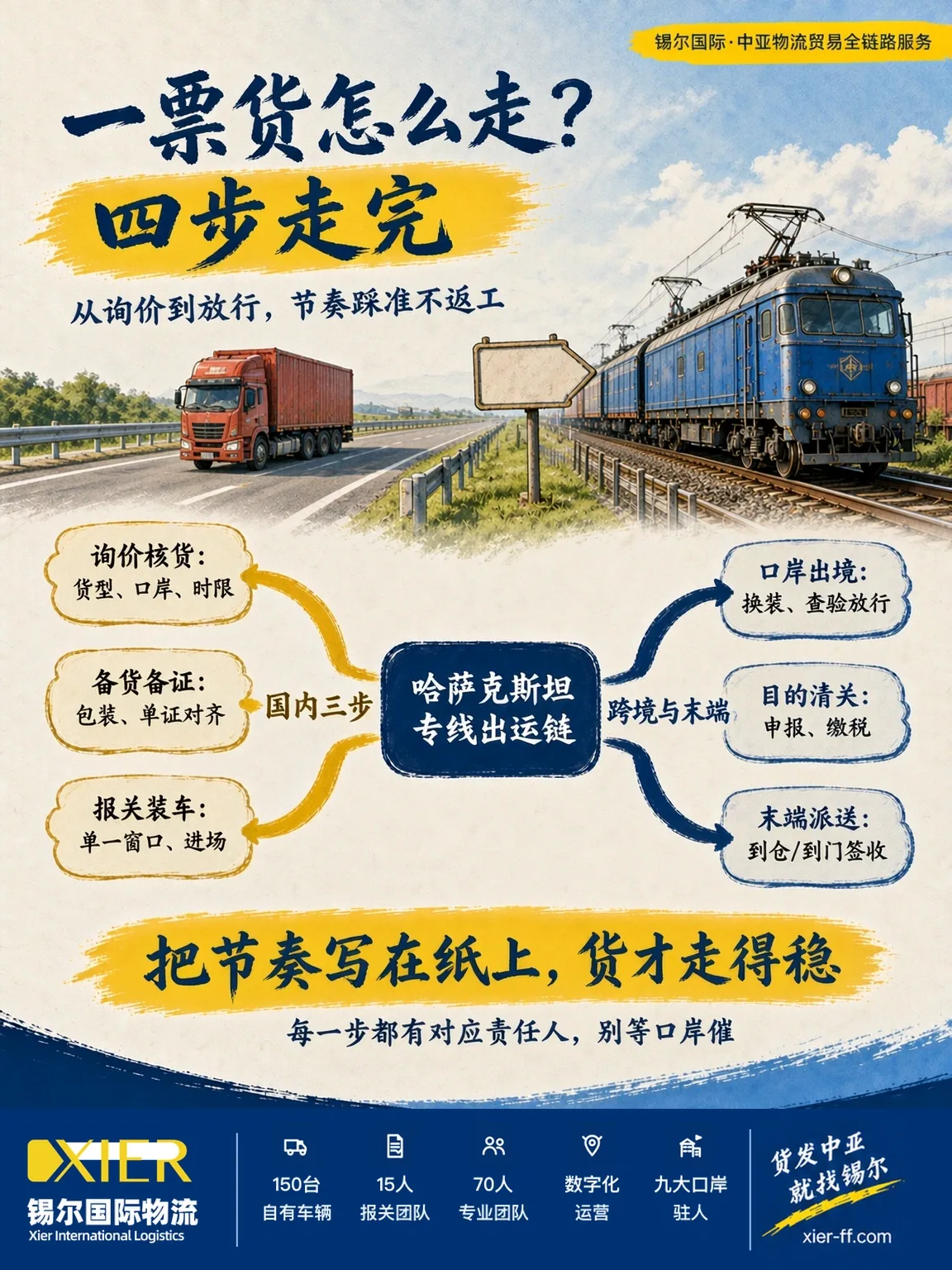 图:四步一条链——前两步做扎实,后面才顺;每一步都有对应责任人
Which port is more suitable for the Kazakhstan logistics dedicated line?
Consider the cargo type and destination. For large volumes in full container loads and cost optimization, prioritize the railway channels of Khorgos or Alashankou; for large equipment with door-to-door requirements, road transport is more flexible; if the cargo is in the southern Xinjiang region or needs to be transported to Kyrgyzstan or Uzbekistan, the Irkeshtam port often saves mileage. There is no absolute best choice, only the most suitable channel for this shipment.
What are the differences between Khorgos and Alashankou?
Both are major ports for Kazakhstan in the northern Xinjiang region. Khorgos has well-developed road and railway conditions, strong channel capacity, and complete supporting facilities; Alashankou is mainly for railway express trains, suitable for bulk and containerized cargo. The specific choice depends on the train schedule, fleet capacity, and port traffic conditions on the day.
How many days does the Kazakhstan dedicated line take?
Road truck transport is usually faster than railway transport, while railway transport for bulk cargo is cost-effective but takes longer. Combined railway and road transport is a middle ground. Actual time is greatly affected by port queuing, loading, customs clearance, and the distance to the final destination. Here we only provide a rough time frame for reference; the exact number of days is subject to the train/fleet schedule on the day of inquiry.
What items should be included in the quotation list?
A complete quotation should be broken down into three major sections: domestic segment (collection, customs declaration, loading), cross-border segment (mainline freight, port station charges), and overseas segment (customs clearance fee in the destination country, final delivery fee). Reporting only a total price without breaking down the items makes it difficult to determine if there are any missing items or duplicate charges.
How to choose between customs clearance with duties paid and self-clearance?
If the shipper is not familiar with customs clearance in Kazakhstan and hopes for a one-price fee, they can choose customs clearance with duties paid, but the declaration standards, tax scope, and abnormal responsibility should be written into the contract; if the shipper has import qualifications and can make the declaration independently, the cost of self-clearance is more transparent. The key is to clearly define the responsibility boundaries, not just who is名义上包.
What documents are required for the Kazakhstan dedicated line?
The basics are the three sets of documents for foreign trade: contract, commercial invoice, packing list; during the customs declaration process, a customs declaration form, customs entrustment, and accurate HS code are required; for customs clearance in the destination country, a waybill or bill of lading, origin certificate, etc. are usually required. For goods involving certification or supervision conditions, additional documents according to categories are required. A missing document may cause the goods to be stuck at the port.
About the author: Xier International Logistics, focusing on Central Asia logistics market analysis and digital solutions. This article is based on 10 years of practical data and industry research from Xier International Logistics and is for reference only; the specific plan needs to be customized according to the characteristics of the goods.