If you are considering exporting goods to Afghanistan, you are not alone.
Afghanistan's post-war reconstruction has driven surging demand for imported materials — building materials, machinery and equipment, auto parts, and daily consumer goods — with volumes climbing steadily. Industry statistics show China's exports to Afghanistan grew more than 30% year-on-year in 2025, with freight volume through southern Xinjiang ports rising especially sharply.
But unlike most Central Asian countries, exporting to Afghanistan has no "one universal route." Which port, through which countries, by what transport mode — these decisions directly affect your transit time and cost.
Xier International Logistics has long operated two mature Afghanistan dedicated lines. This article breaks down the strengths and best-use scenarios of each route from real operating experience.
Route 1: The Irkeshtam Line — The Most Mature Northern Corridor
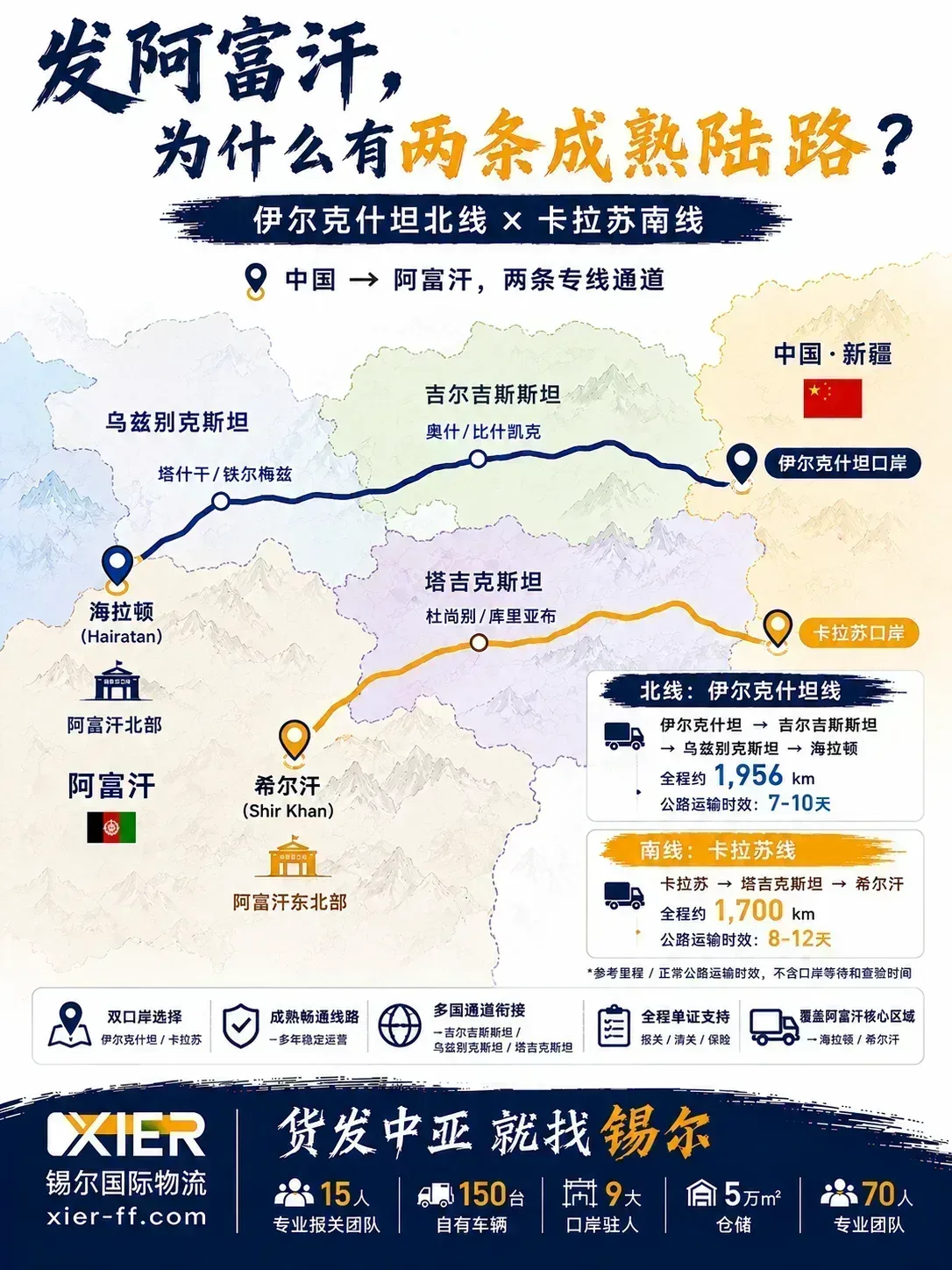
Route Map
China's Irkeshtam port → Kyrgyzstan (Osh / Bishkek) → Uzbekistan (Tashkent / Termez) → Hairatan, Afghanistan.
This is Xier International's highest-volume and most stable Afghanistan line, and the most mature China–Afghanistan overland corridor on the market.
The Irkeshtam port sits in Kizilsu Kirghiz Autonomous Prefecture, Xinjiang, about 240 km from Kashgar, and is one of southern Xinjiang's core ports facing Central Asia. After exiting here, cargo continues west through Kyrgyzstan's Osh region, enters Uzbekistan's Tashkent or Termez, and finally reaches Hairatan, the northern border city of Afghanistan. Total distance is about 1,956 km.
Key Figures
- Total distance: ~1,956 km
- Road transit time: 7-10 days
- Covered port: Hairatan (northern Afghanistan)
- Suitable cargo: heavy equipment, bulk cargo
- Connectable modes: rail + road
Advantages
- Good road conditions: mature highways across Kyrgyzstan and Uzbekistan
- Mature port clearance: stable customs at every transit point
- Stable agent network: long-term local partners
- Accepts heavy cargo: no problem with large, heavy shipments
Best-Use Scenarios
Recommended for: cargo to northern Afghanistan (Mazar-i-Sharif, Kabul), heavy or bulky equipment, and shippers who prioritize stable transit.
Route 2: The Karasu Line — A Flexible Southern Option
Route Map
China's Karasu port → Tajikistan (Dushanbe / Kulob) → Shir Khan, Afghanistan.
The Karasu port is also in Kizilsu Kirghiz Autonomous Prefecture, about 220 km from Kashgar, and is China's only land port with Tajikistan. After exiting Karasu, cargo travels south via Tajikistan's road network and finally reaches Shir Khan, the northeastern border city of Afghanistan.
Key Figures
- Total distance: ~1,900 km
- Road transit time: 8-12 days
- Covered port: Shir Khan (northeastern Afghanistan)
- Suitable cargo: light industrial goods, daily necessities
- Connectable modes: road
Advantages
- Flexible routing: more corridor choices within Tajikistan
- Covers the northeast: reaches Kunduz, Taloqan directly
- Less port competition: lower congestion than busy northern ports
- Can handle dangerous goods: with advance filing
Best-Use Scenarios
Recommended for: cargo to northeastern Afghanistan (Kunduz, Taloqan), light industrial goods, and shipments where port congestion is a concern.
The Two Routes at a Glance: One Table
| Dimension | Irkeshtam Line | Karasu Line |
|---|---|---|
| Exit port | Irkeshtam (China) | Karasu (China) |
| Transit countries | Kyrgyzstan, Uzbekistan | Tajikistan |
| Afghanistan entry | Hairatan (north) | Shir Khan (northeast) |
| Total distance | ~1,956 km | ~1,900 km |
| Road transit | 7-10 days | 8-12 days |
| Road condition | Mature highways | More mountain roads |
| Preferred cargo | Heavy / bulk equipment | Light industrial / daily goods |
| Port congestion | Higher (busy) | Lower |
| Best destination | Mazar-i-Sharif, Kabul | Kunduz, Taloqan |
Practical Advice: How to Choose?
Choosing a route is not a single-choice question but the optimal match to your cargo. Three principles help you decide fast:
❶ Look at the destination.
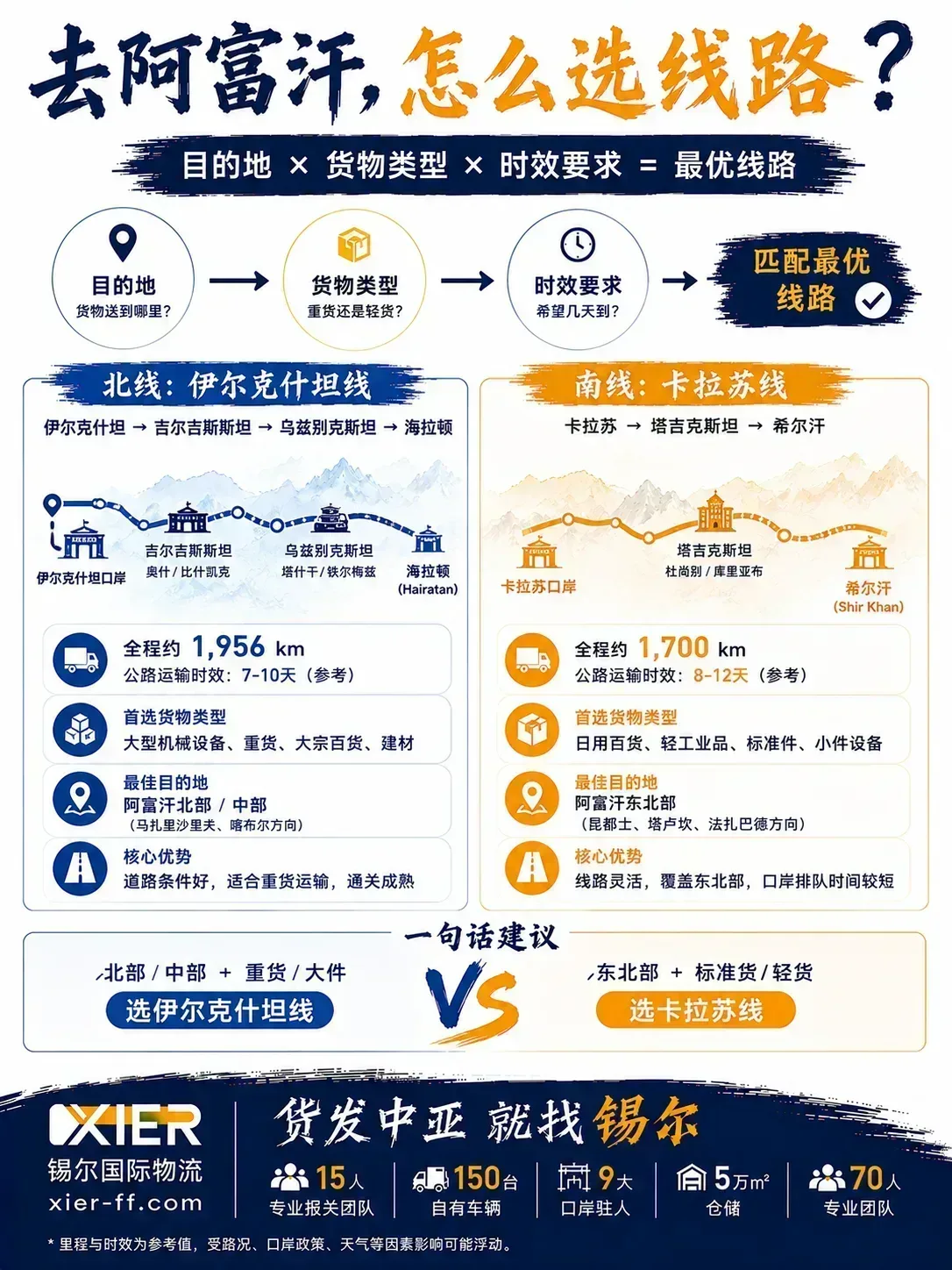
❷ Look at the cargo type.
❸ Look at the time requirement.
💡 Xier's field tip: for northern Afghanistan, prioritize the Irkeshtam line; for the northeast, the Karasu line is often better.
Why Choose Xier International for Your Afghanistan Line?
Many forwarders can handle Central Asia routes, but few run an Afghanistan dedicated line year after year.
Since its founding in 2021, Xier International has kept the Afghanistan line as a core service:
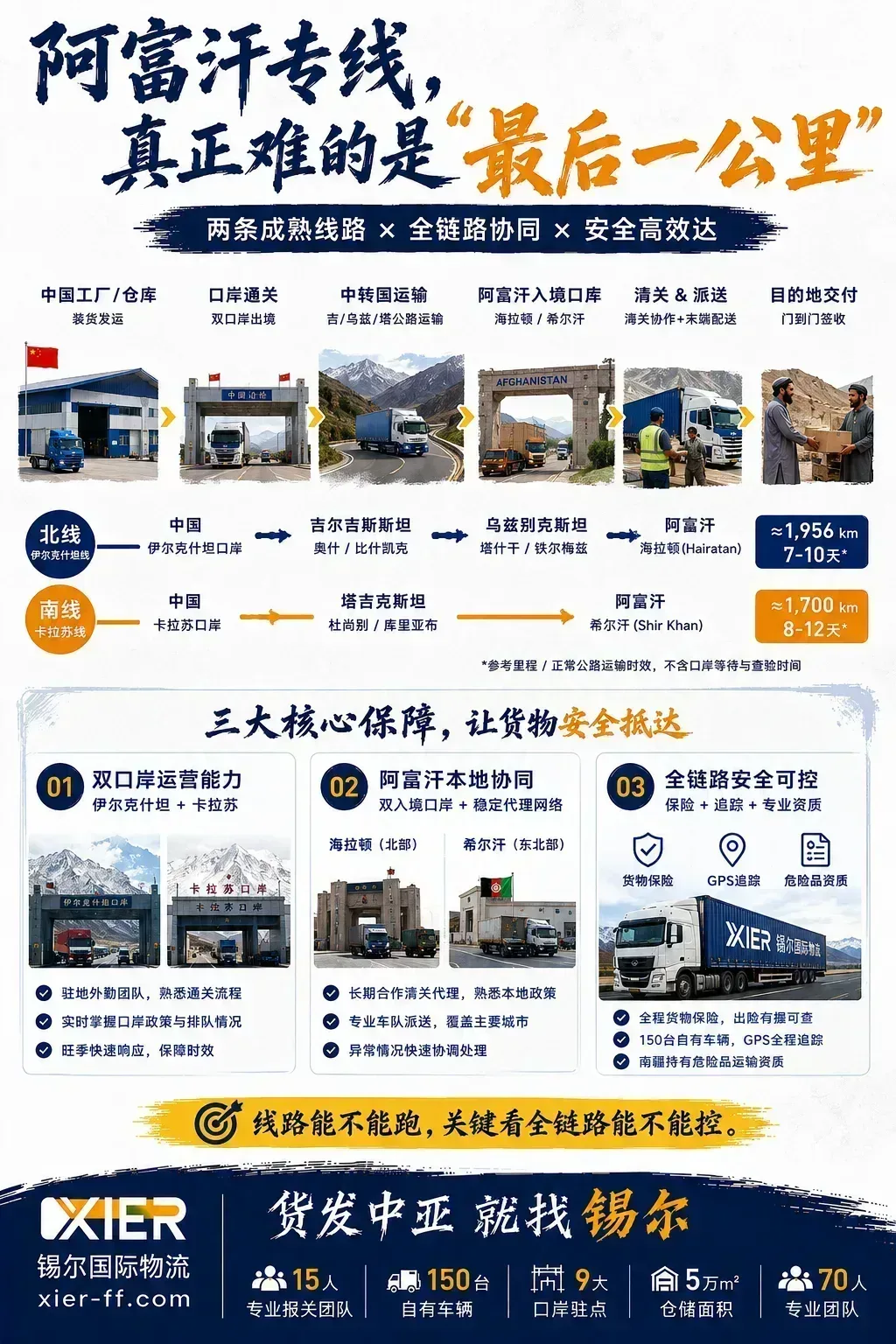
- Durable operation at both ports
- A stable local agent network
- Its own fleet of 150 transport vehicles
- Full cargo insurance
- Dangerous-goods transport qualification
If you are looking for an Afghanistan logistics plan, talk with Xier International first. Share your cargo info and we will recommend the most suitable route.
Frequently Asked Questions
① Which is faster, the Irkeshtam line or the Karasu line?
The Irkeshtam line is about 1,956 km with road transit of 7-10 days; the Karasu line is slightly shorter but with more mountain roads in Tajikistan, at 8-12 days. Actual time depends on port efficiency, weather, and road conditions. Choose by destination: for northern Afghanistan (Mazar-i-Sharif, Kabul) prefer Irkeshtam; for the northeast (Kunduz, Taloqan) Karasu works well.
② What cargo suits each route?
Both handle general goods and large machinery. The Irkeshtam line, with mature roads, suits heavy and bulk equipment; the Karasu line, with more mountain roads, suits light industrial goods and daily necessities. Dangerous goods need 3-5 working days' advance filing and both lines can handle them.
③ Is Afghanistan clearance complicated?
Afghanistan's clearance differs from China's and needs a stable local agent. Xier International has long-term clearance partners at Hairatan (north) and Shir Khan, supporting the full flow from port declaration to destination delivery. Confirm HS code, certificate of origin, and packing list before shipping to markedly lower inspection risk.
④ Roughly how much is freight?
Freight varies widely by cargo type, weight, volume, and destination. Contact Xier International directly for a free quote (tel: +86 +86 18195891000); with detailed cargo info we can issue a plan the same day.
⑤ How safe is the cargo?
All Xier International Afghanistan lines carry full cargo insurance; our 150 own vehicles are all GPS-tracked in real time, and resident field staff at the ports respond on-site immediately when needed. Door-to-door visibility is available anytime via the mini-program or website.
⑥ What documents are needed to ship to Afghanistan?
Basic documents: packing list, commercial invoice, sales contract, and certificate of origin. Sensitive categories (machinery, chemicals, etc.) need extra permits. Xier International's declaration team can help assemble the full document set for one-time clearance.
Need an Afghanistan Shipping Plan?
Share your cargo details with Xier International and we will match you to the optimal route — Irkeshtam or Karasu.
About the Author: Xier International Logistics specializes in Central Asia logistics market analysis and digital solutions. This article is based on Xier International Logistics' 10 years of frontline data and industry research and is for reference only; specific plans should be tailored to cargo characteristics.