1. Why Almaty Is the Undisputed Logistics Capital of Central Asia
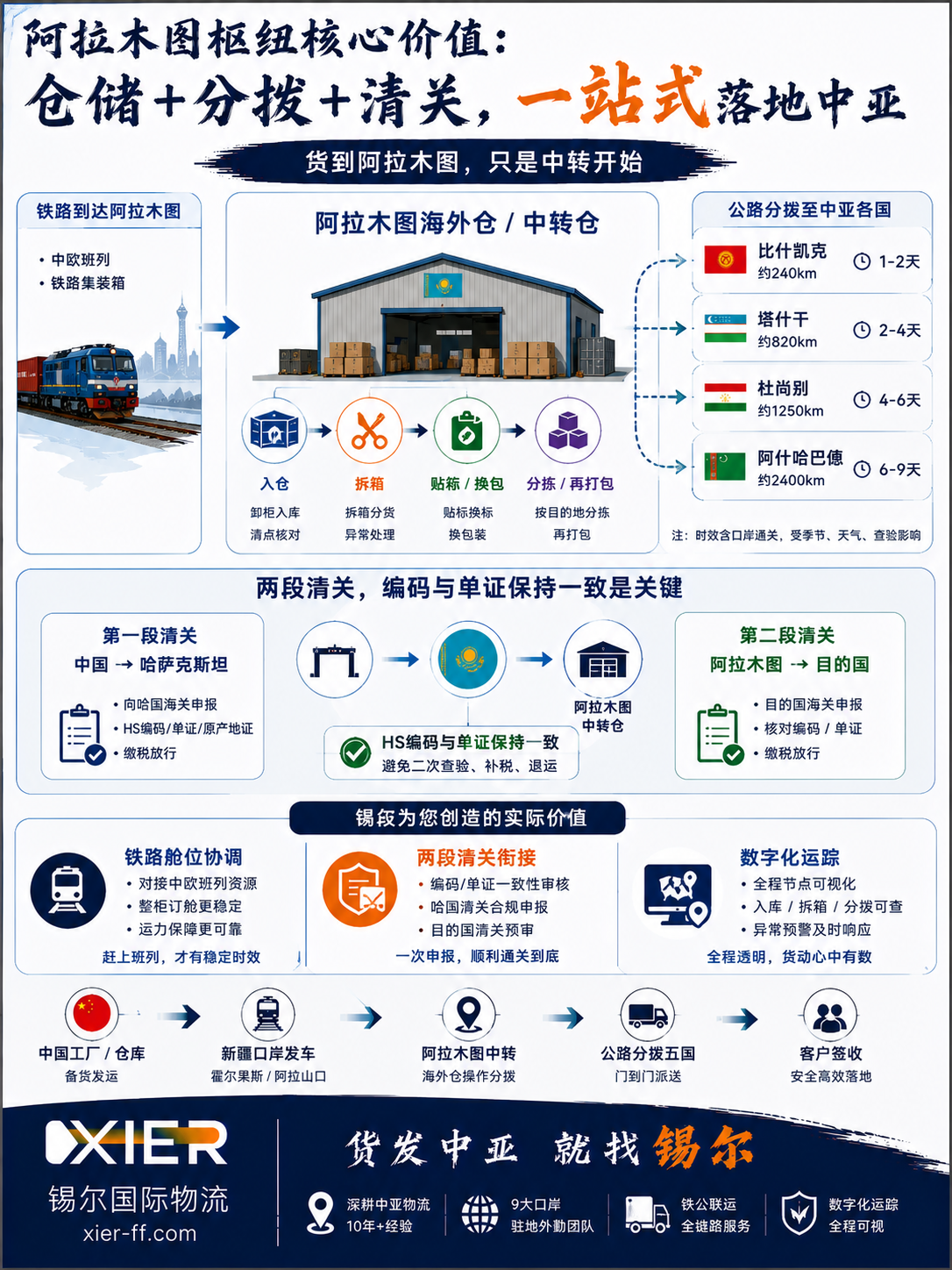
Almaty handles the largest share of transit freight flowing through Kazakhstan. Its position — south of the northern rail corridors but directly connected to Kyrgyzstan, Uzbekistan, and the Pamir routes — makes it the critical transhipment point where rail cargo from China is broken down and distributed by road into five countries.
- Almaty sits on the China-Europe Express rail network via connections from Alashankou and Khorgos
- Over 60% of China's road freight to Kyrgyzstan and Uzbekistan passes through Almaty's logistics zones
- The city's airport serves as a backup air-cargo corridor for urgent or high-value shipments
2. How the Rail-Road Multimodal Flow Works
The typical multimodal flow through Almaty follows a three-stage process:
- Stage 1 — Arrival by rail: Containers or bulk cargo arrive at Almaty rail terminals via China-Europe Express or domestic Kazakh rail. Unloading takes 1–2 days.
- Stage 2 — Customs transit: All cargo entering Kazakhstan for onward transit must complete E-customs transit declaration before unloading. Without this, rail terminals will not release the cargo.
- Stage 3 — Road distribution: After customs transit clearance, cargo moves to Almaty's road logistics zones for deconsolidation, re-loading, and dispatch to destination countries.

3. Kazakhstan E-customs: The Mandatory Gate for All Transit Cargo
Kazakhstan's E-customs system is not optional. It is a legal requirement for all cargo in transit through Kazakhstan, including cargo destined for Kyrgyzstan, Uzbekistan, Tajikistan, and Afghanistan.
- All transit declarations must be submitted electronically before cargo reaches the Kazakh border
- The E-customs record must match the physical cargo: quantity, HS Code, vehicle registration, and route must all be consistent
- Amendments to E-customs declarations after arrival are possible but costly — allow 2–5 days and additional processing fees
- Xier's Kazakhstan team prepares and submits E-customs declarations from the origin, before cargo departs from China
4. Warehouse Distribution and Storage Options in Almaty
Almaty's logistics zones offer several warehouse categories relevant to transit operations:

- Bonded warehouses: Duty-free storage for transit cargo, up to 90 days. Ideal for cargo awaiting onward transport or documentation completion.
- Non-bonded warehouses: For cargo already cleared or destined for domestic Kazakh consumption. Lower cost but duties must be paid before entry.
- Cold storage: Available for food, pharmaceutical, and temperature-sensitive cargo transiting through Almaty.
- Cross-docking facilities: For time-sensitive cargo that needs direct transfer from inbound rail to outbound road without long-term storage.
5. Transit Times to Five Destination Countries
Once cargo is cleared through Almaty, road distribution lead times vary significantly by destination:
| Destination | From Almaty | Route type | Notes |
|---|---|---|---|
| Kazakhstan (domestic) | 1–2 days | Road | Major cities: Almaty, Astana, Shymkent |
| Kyrgyzstan | 2–3 days | Road | Main border crossing: Khorgos–Ruhugem |
| Uzbekistan | 3–5 days | Road / Rail | Via Khorgos or Andijan crossing |
| Tajikistan | 5–7 days | Road | Via Uzbekistan north route or Kyrgyz Pamir |
| Afghanistan | 7–10 days | Road | Hairatan corridor from north; longer in winter |
6. Onward Routes: How Cargo Leaves Almaty Toward Each Country
To Kyrgyzstan
- Primary crossing: Khorgos–Ruhugem (southbound road)
- Cargo consolidates in Almaty's southern logistics zone before dispatch
- Kyrgyz customs clearance at the border; transit time 2–3 days
To Uzbekistan
- Two main corridors: Khorgos corridor (west through Taraz) or northern corridor via Andijan
- Uzbekistan requires separate import customs clearance; documents must be pre-prepared
- Rail option available for bulk cargo heading to Tashkent region
To Tajikistan
- Route: Almaty → Osh (Kyrgyzstan) → Kulma Pass → Dushanbe
- This is a mountainous road corridor; seasonal closures possible in winter months
- Alternative: rail to Uzbek border then road — adds 1–2 days but more reliable in winter
To Afghanistan
- Route: Almaty → Tashkent region → Hairatan border crossing
- Afghanistan customs clearance at Hairatan; requires Dari-language documentation
- Xier's dedicated Afghanistan service includes pre-clearance coordination with Hairatan agents
7. Common Pitfalls at the Almaty Transit Stage
- E-customs mismatch: Wrong HS Code or quantity in the declaration blocks cargo release at the rail terminal
- Missing CMR waybill: Kazakhstan customs requires a CMR waybill for all road transport segments; without it, outbound road dispatch is delayed
- Warehouse overflow: Peak seasons (October–December) fill Almaty bonded warehouses; pre-booking is essential
- ADR transport violations: Dangerous goods require ADR-certified vehicles and drivers in Kazakhstan — non-compliant vehicles are turned back at border crossings
8. Xier's Almaty Transit Services
Xier provides comprehensive door-to-door transit services through Almaty:
- E-customs declaration preparation and submission before cargo departs China
- Rail terminal coordination and container deconsolidation management
- Bonded and non-bonded warehouse booking in Almaty's logistics zones
- Road transport arrangement to all five destination countries
- Transit cargo tracking with real-time GPS and customs status updates
- Emergency document amendment support when E-customs corrections are needed
9. When to Choose Almaty vs Direct Road Routing
- Use Almaty transit when cargo arrives by rail, when consolidating multiple small shipments, when destination is Uzbekistan or Tajikistan, or when Afghanistan-bound cargo needs pre-clearance coordination
- Use direct road routing (e.g., Irkeshtam or Torugart) when cargo originates as road freight, when time is the top priority, or when the final destination is Kyrgyzstan with no rail arrival point needed
Xier's team assesses each shipment individually and recommends the optimal routing based on cargo type, volume, timeline, and destination.
Frequently Asked Questions
Q1: What is the E-customs system in Kazakhstan?
Kazakhstan's E-customs system (electronic customs declaration) is a mandatory digital platform for all transit declarations. All cargo entering Kazakhstan must be pre-declared through this system before arrival at the border. Without a valid E-customs record, cargo will not be cleared at Khorgos or Alashankou.
Q2: What are the transit times from Almaty to neighbouring countries?
From Almaty warehouse distribution centre: Kazakhstan 1–2 days; Kyrgyzstan 2–3 days; Uzbekistan 3–5 days; Tajikistan 5–7 days; Afghanistan 7–10 days. Actual transit time depends on cargo type, customs clearance status, and road conditions.
Q3: Can China-Europe Express cargo be transhipped through Almaty?
Yes. China-Europe Express trains from Alashankou or Khorgos can terminate or tranship at Almaty logistics centres. From there, cargo is distributed by road to Kazakhstan's domestic cities or transhipped to onward rail routes toward Kyrgyzstan and Uzbekistan.
Q4: Does Xier operate its own warehouse in Almaty?
Xier partners with bonded and non-bonded warehouses in the Almaty transport zone, offering consolidation, deconsolidation, short-term storage, and re-labeling services. For long-term storage or cross-docking needs, additional arrangements can be made.
Q5: What documents are needed for transit through Kazakhstan?
Required documents: CMR waybill, commercial invoice, packing list, transit declaration (E-customs), cargo description, and HS Code. For food, chemicals, or dangerous goods, additional certificates (phytosanitary, MSDS, ADR documents) are required. Xier's Almaty team prepares all documentation before cargo arrives.
About the Author: Xier International Logistics specialises in Central Asia logistics market analysis and digital solutions. This article is based on Xier International Logistics' 10 years of frontline data and industry research and is for reference only; specific plans should be tailored to cargo characteristics.