I. Why the money in Central Asia trade is more 'tumultuous' than the goods
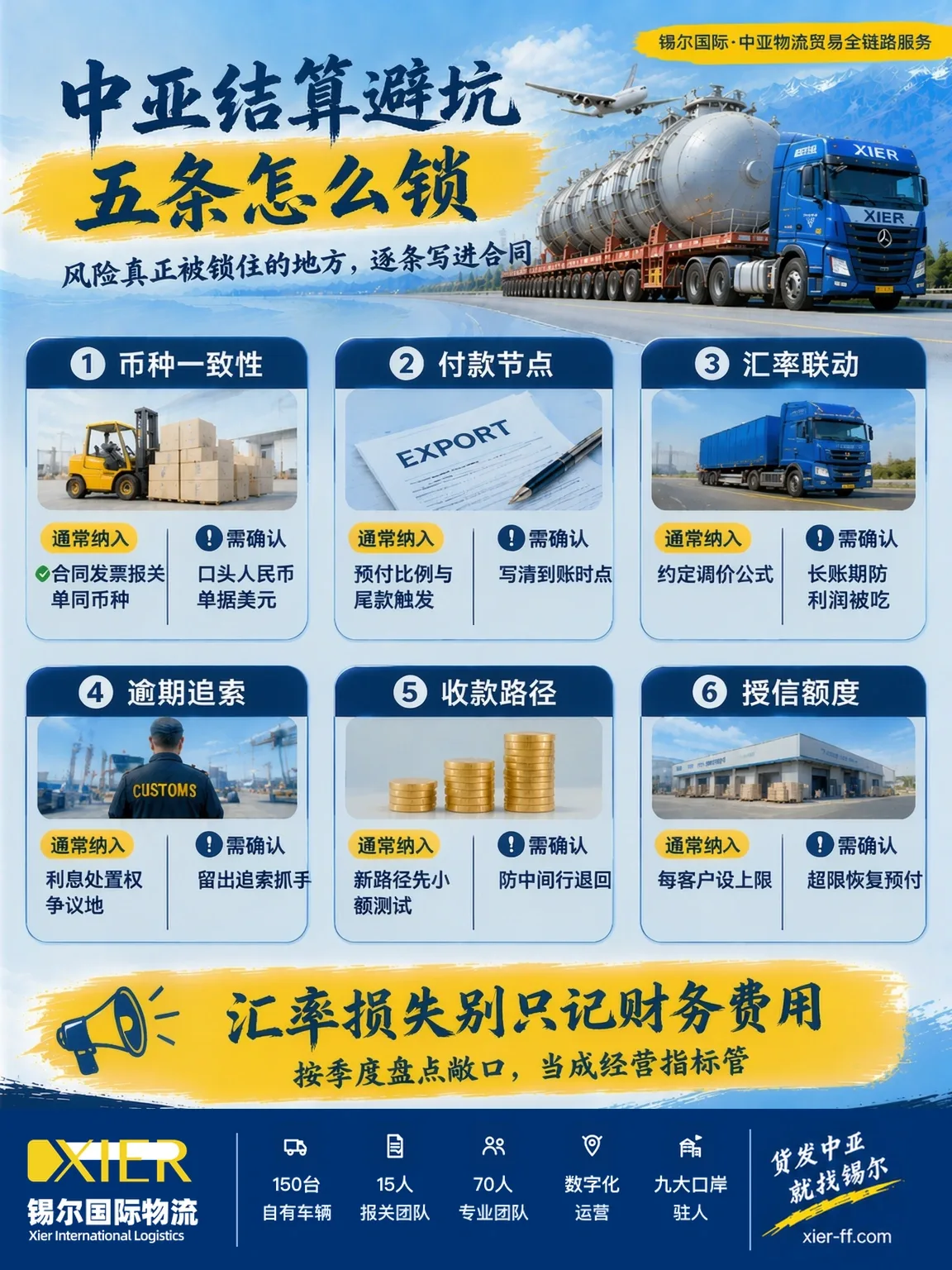 图:汇率损失别只记财务费用——按季度盘点敞口,当成经营指标管
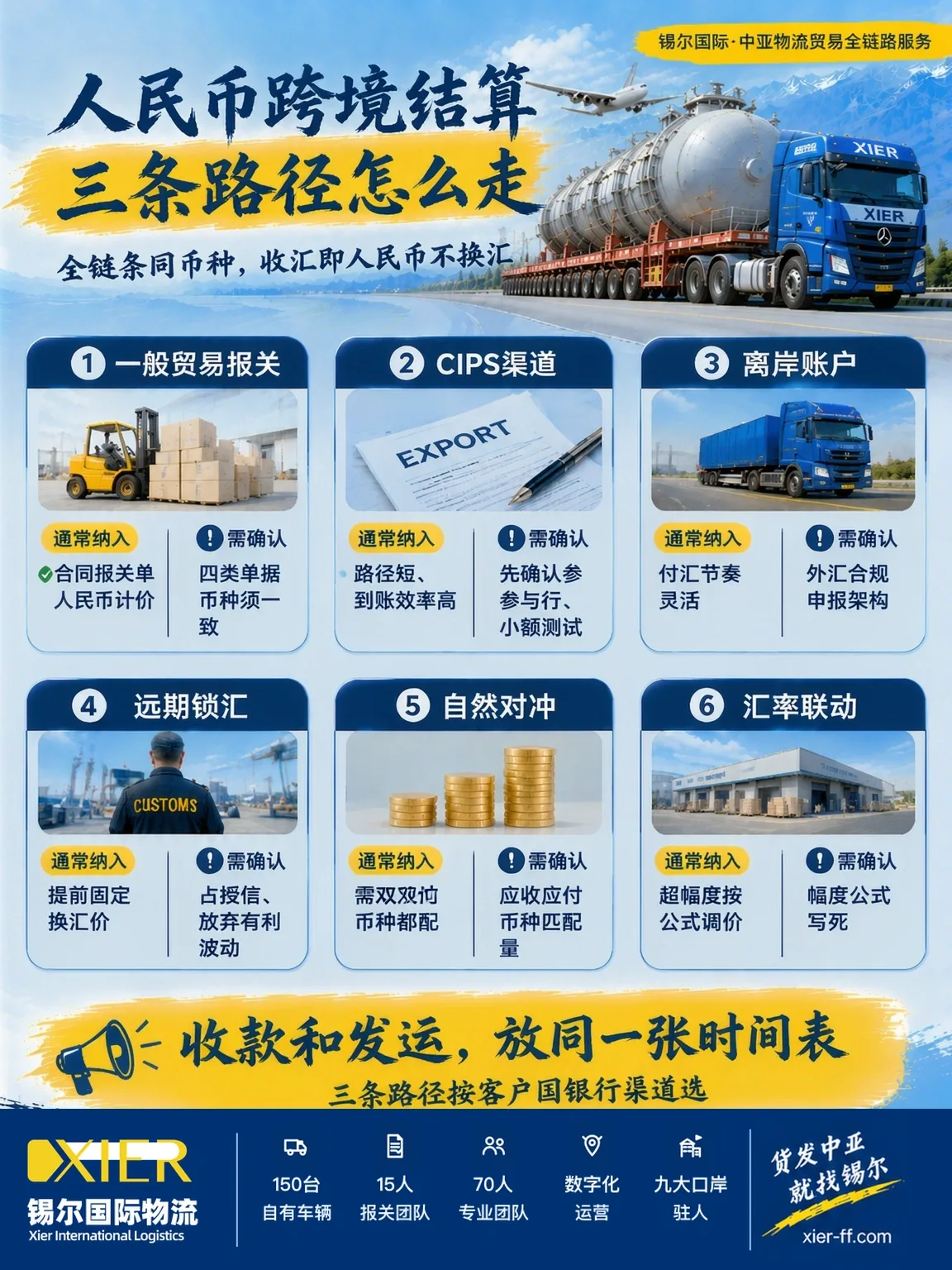 图:收款和发运,放同一张时间表——三条路径按客户国银行渠道选
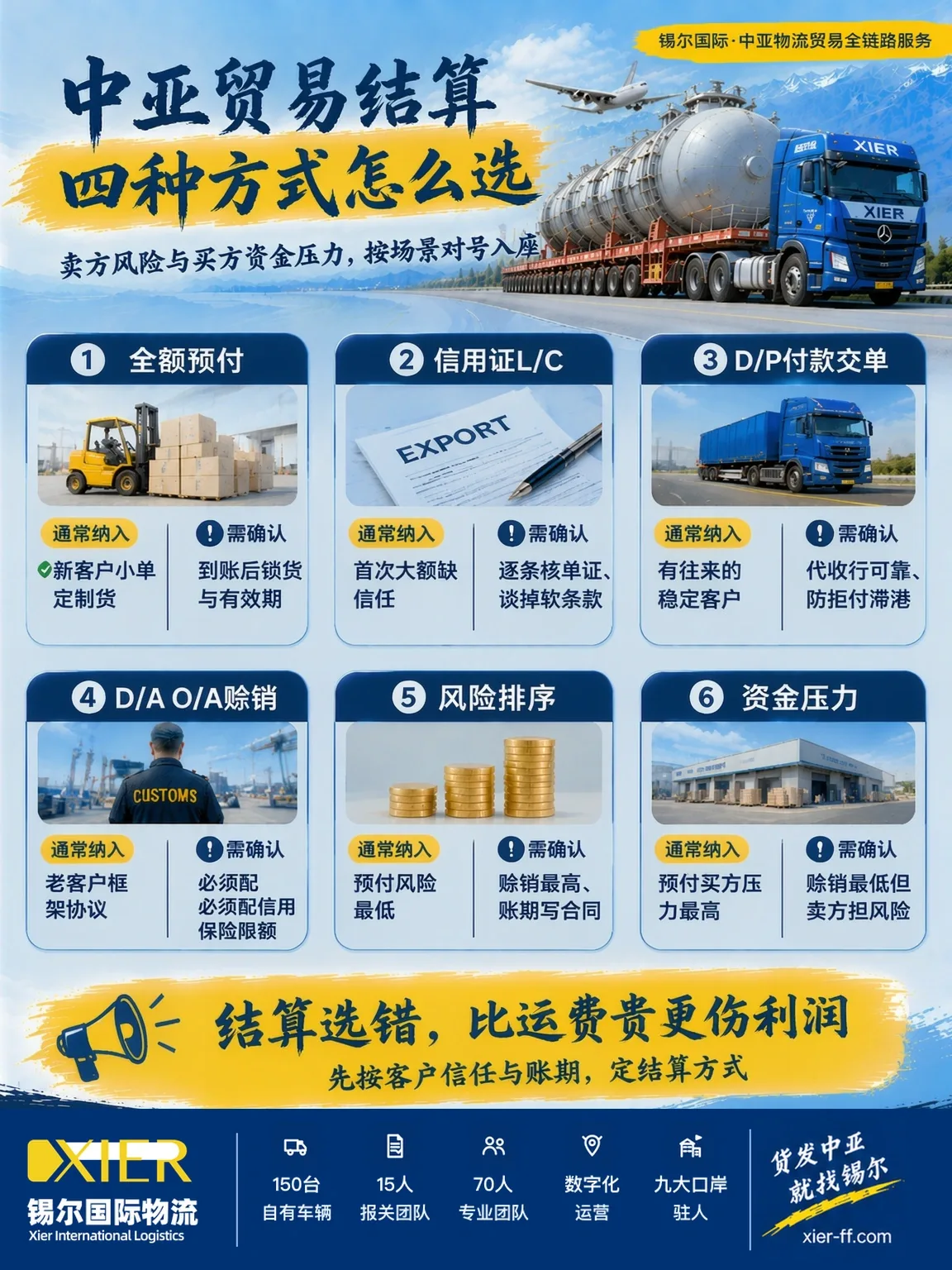 图:结算选错,比运费贵更伤利润——先按客户信任与账期,定结算方式
Enterprises engaged in Central Asia exports often pay more attention to logistics than to collection. But in actual business operations,The goods have arrived but the money has not been collected in full, or the money has been collected and then shrunk, is more damaging to profits than delay.The reason lies in the naturally long currency chain of trade in Central Asia: contracts are often priced in foreign currencies, which may require one or more currency exchanges before the funds are deposited into a RMB account. Each currency exchange involves exchange rate fluctuations, transaction fees, and uncertainty in the time of arrival. As the value of goods increases, these losses are no longer negligible.
In recent years, the use of the RMB in cross-border settlements has increased significantly, and this is no exception for the Central Asia direction. For exporting companies, the direct benefit of RMB settlement is that the exchange rate risk is transferred to the counterparty or banking channels, with a shorter and more predictable payment path; for Central Asian buyers, paying in RMB is often more convenient than raising USD.How to implement it, choose which method, and how to draft the contract are the real factors that determine the size of the risk.
| Link | Common losses in foreign currency settlements | Impact on profits |
|---|
| Exchange chain | Domestic currency → USD → Counterparty's domestic currency, multiple currency exchanges | Each link consumes a little bit of the difference and transaction fees, and the longer the chain, the greater the loss |
| Exchange rate window | The exchange rate between the signing date and the actual receipt date is fluctuating | The longer the payment period, the larger the exposure, and the final settlement may significantly deviate from the assumptions at the time of quotation |
| Time of arrival | Intermediary bank processing, message supplement and return, compliance review | Funds occupied for a longer period of time, affecting the payment rhythm of the next shipment |
| Document quality | Declaration information does not match the contract and invoice, resulting in the order being returned | The process of reissuing orders can take several days, and in severe cases, it can affect the qualification for receiving payments |
Secondly, there are four main settlement methods in Central Asia trade, and you can see the differences in one table
The main settlement methods commonly seen in Central Asia trade mainly include: full prepayment (T/T in advance), letter of credit (L/C), documents against payment (D/P), acceptance against payment (D/A), and open account (O/A). They are not simply good or bad, but rathera risk-sharing and cash allocation plan of 'who bears the risk and whose cash is occupied'. The core basis for choosing is the depth of cooperation between the two parties, the transaction amount, and the operability of the banking system in the destination country.
| Settlement Method | Seller's Risk | Buyer's Financial Pressure | Applicable Scenario | Practical Points |
|---|
| Full Prepayment (T/T in advance) | Lowest | Highest | New customers with small orders and long preparation cycles for customized goods | The contract should clearly state the locking of goods and validity period after the payment is received to avoid disputes after the exchange rate fluctuates |
| Letter of Credit (L/C) | Lower, depending on the quality of the documents | Medium, requires opening of letter of credit and credit | First large transaction, both parties lack a trust foundation | Check each item of the document requirements to ensure 'document consistency', and negotiate soft clauses in advance |
| D/P Payment against Documents | Medium | Lower | Stable customers with a history of transactions | Confirm that the collecting bank in the destination country is reliable, and be vigilant against the buyer's refusal to pay after the goods arrive, which may cause the goods to be delayed at the port |
| D/A / O/A Open Account | Highest | Lowest | Old customers, long-term framework agreements | It is mandatory to pair credit insurance or limit management, and the payment period should be written into the contract with a right of pursuit clause |
A common misconception is that 'large customers' are synonymous with 'low risk'. In actual cases, it is often long-term, cautious old customers who have problems with payment—orders get bigger and payment periods get longer until a certain shipment blows up and they look back at the accounts.The settlement method should be dynamically adjusted according to 'the amount and payment period of this shipment', rather than following emotions
Three landing paths for cross-border settlement in RMB
For Central Asian buyers with China as the procurement location, RMB settlement is not complex in operation, and there are three main landing paths, each suitable for different types of enterprises.
| Path | Basic process | Advantages | Points to note |
|---|
| RMB customs declaration and settlement for general trade | The contract is priced in RMB, the currency of the customs declaration is RMB, and the payment is received through the cross-border RMB channel of the bank | The entire chain is in the same currency, the receipt is in RMB, and there is no need to exchange currency again | The currency of the contract, invoice, customs declaration, and bill of lading must be consistent; otherwise, the bank will block the review |
| Cross-border RMB payment system (CIPS) channel | The buyer's bank in the buyer's country makes a remittance directly connected to or through an agent bank to the cross-border RMB payment system | Short and efficient payment path, with many participating banks in some countries | Confirm in advance that there are participating banks in the buyer's country, and do a small amount of test transaction before the first receipt |
| Offshore RMB account payment and receipt | Open an offshore RMB account overseas, and the payment is initially deposited into the offshore account before being transferred back to the domestic territory | Flexible payment rhythm, convenient for connecting with overseas transit trade | Involves foreign exchange compliance reporting; the structure should be set up under professional guidance, do not take shortcuts |
In practice, the top priority is the first point: the full chain of contracts and customs declaration in RMB. Its core value is not 'more money', butCompress the exchange rate uncertainty from 'signing to receipt' to almost zero——The quoted price is exactly what you get. For foreign trade orders that already have thin profit margins, this is very practical.
IV. Short-term receivables: risk avoidance toolset for exchange rate
As long as the payment term exists, there is an exchange rate exposure. RMB settlement solves the problem of 'multiple exchange transactions', but for credit sales, D/P and other payment terms with payment terms, active management tools are still needed. Common tools can be categorized into four types:
| Tools | Principle | Advantages | Cost / Threshold |
|---|
| Forward exchange settlement (locked exchange rate) | Agree with the bank on the exchange rate on a future date | Fix the exchange rate in advance, have a clear quote in mind | Occupies credit line or margin; even if locked, you give up the benefits of favorable price fluctuations |
| Natural hedging | Match the receivables and payables in currency, use import payment to offset the export receipt exposure | Zero cost, does not occupy quota | 要求企业进出口双向都有量,匹配节奏要管理 |
| Pricing Terms (Linked to Exchange Rate) | Adjustment or cost-sharing based on formula when the contract exceeds the agreed-upon range | Shared risk, negotiations are relatively easy to pass | The range and formula must be written in stone, leaving no room for post-event disputes |
| Shorten payment period + batch collection | Increase prepayment ratio, settle in batches at key points | Directly compress the open position time, and also improve cash flow | Negotiation capability required for the buyer, can be paired with discount for payment period |
The four types of tools are not single-choice questions. Common combinations are:Use locked exchange rate as a foundation for large long-term accounts, and add exchange rate linkage clauses at the end of the contract; rely on prepayment ratio and batch collection for daily small and medium orders to control the open position. It is recommended to confirm product details and fees with the opening bank before the tools are implemented, as the conditions of different banks vary greatly.
V. Contract Terms: Where the risk is truly locked in
All the arrangements mentioned above ultimately need to be reflected in the contract text. The following five clauses are recommended to be reviewed item by item in each export contract towards Central Asia:
| Clause Item | Key points for writing suggestions | What if it is missing |
|---|
| Pricing and settlement currency | Explicitly write 'Priced in RMB, settled in RMB', and be consistent with the customs currency | Default interpretation is USD, an additional exchange rate exposure is added during receipt of payment |
| Payment milestones | Prepayment ratio, trigger conditions for final payment (such as bill of lading date) are listed item by item, and the time point of the payment receipt is written clearly | Vague milestones, final payment may be long-term outstanding without anyone claiming it |
| 汇率联动 | Adjustment formula for exchange rate fluctuations exceeding a certain range within the agreed payment period | Profit from long-term orders is eaten up by fluctuations |
| Overdue and recovery | Overdue interest, right of disposal of goods, and place of dispute resolution should be itemized | No hold when there is a real problem |
| Consistency of currency in documents | The currencies and amounts of the contract, commercial invoice, customs declaration, and logistics documents should be interlocked | Bank review and return of documents, passively extending the collection cycle |
Sixth, match the scene: how different enterprises choose
By combining the previous elements, three typical scenarios of reference configuration can be given:
| Scenario | Suggested settlement method | Suggested exchange rate tool | Logistics coordination points |
|---|
| New customer / trial order | Full prepayment or letter of credit | Under the prepayment system, the exposure is extremely small, and no additional lock exchange rate is required | Book the cargo after the receipt of payment, binding the capital risk and shipment node |
| Old customer / rolling replenishment | Prepay 30% + balance upon copy of bill of lading, or D/P | With a short payment period, natural hedging or small amount lock exchange rate is sufficient | Ship in batches according to the payment node to avoid waiting for payment |
| Engineering projects / large-scale long-cycle | Stage-by-stage collection, payment milestones to a certain percentage before shipping the next batch | Lock exchange rate covers the signed but not yet collected part + exchange rate linkage clause | Logistics scheduling corresponds to payment milestones step by step, and shipping is suspended if payment is not made on time |
In any scenario, it is recommended to「Payment Nodes」and「Logistics Nodes」are managed on the same schedulePayment progress determines shipment progress, and shipment documents trigger payment in return——only when both sides are tightly connected can we avoid both stockpiling and capital investment.
Seven, Pitfall List: The five most common pitfalls in Central Asia settlement
| Pitfall | Typical Performance | Avoidance Measures |
|---|
| Currency types「Mouth Renminbi, Documents in US Dollars」 | Negotiated in Renminbi, customs declaration and invoices are done in US Dollars | Align the currency types of the four types of documents before placing an order, and check each ticket one by one |
| Soft clauses in letters of credit | Payment terms depend on the buyer issuing certain documents or proofs within their control | Identify each clause during the examination of the letter of credit, and negotiate to remove soft clauses before issuing the letter of credit |
| Account periods are extended layer by layer | Old customers always say「Next time together」,the open position rolls over and over | Set a credit limit for each customer, and revert to prepayment if exceeded |
| The payment path has not been verified | The first large amount of remittance is returned by the intermediary bank, and the funds are suspended in the middle | Test small amounts through the new path first, and confirm that the entire chain is smooth |
| The exchange rate loss is accounted for as「Financial Expenses」 | The loss per ticket is not large, but the cumulative loss for the whole year eats up a large piece of net profit | Inventory the open position quarterly, and treat exchange rate gains and losses as an operational indicator |
Eight, FAQ: Frequently asked questions about RMB settlement in Central Asia
Central Asia买家愿意接受人民币付款吗?
The acceptance has significantly increased in the past two years. For buyers with a high proportion of procurement from China, payment in RMB saves the procedures of exchanging USD; some national banking systems have already connected to the RMB cross-border payment channels, and the operational threshold is decreasing. Specifically for individual buyers, it is recommended to present two options directly during negotiations: RMB price and USD price, allowing the other party to vote with their cost.
Is there still exchange rate risk after RMB settlement?
The exchange rate risk in the collection process has basically been eliminated, but there is still some residual exposure: one is the fluctuation of the account period between quotation and receipt (the fluctuation has been greatly reduced when priced in RMB); the other is the passive exchange caused by the buyer's actual payment currency not matching the contract. Therefore, the terms of the contract currency and the consistency of documents are still the first line of defense.
Is it cost-effective to lock in exchange rates for small orders?
In most cases, it is not cost-effective - locking in exchange rates has a minimum transaction size and fixed costs, and the handling fee for small orders may exceed the potential loss from exchange rate fluctuations. A more practical approach for small exposure is to shorten the account period, increase the advance payment ratio, or do natural hedging with应付 of the same currency.
What should be done if the banking channels in the counterparty country are unstable?
First conduct a small-scale test transaction to verify the payment path, and then discuss large transactions; at the same time, require the buyer to provide feedback from the payment bank, and promptly replenish the order if the message is returned. Long-term cooperative customers can agree on 'advance written notice of payment path changes' in the contract to avoid funds being suspended in the air.
Can the settlement method and logistics terms be mutually compromising?
Yes, and this is the most commonly used negotiation flexibility: when the buyer requests to relax the payment terms, it can be exchanged for a shorter delivery period commitment or simpler transportation terms; conversely, when we offer a better freight rate, we can require an increased advance payment ratio. Binding both sides in the negotiation is easier to close a deal than each party stubbornly holding their ground.
How can we determine whether or not to offer credit sales to a certain customer?
Consider three dimensions: historical payment record (not looking at promises but actual payment time), the proportion of the single ticket amount to your working capital, and the current payment environment of the counterparty's industry and country. If any of the three do not meet the standard, use advance payment or letter of credit as a transition, and then relax the terms after accumulating a record.
Settlement and logistics are never two separate lines: payment rhythm determines shipment rhythm, and transportation documents trigger the collection nodes. If the current orders are stuck at the combination decision of 'how to collect payment and when to ship', welcome to do a check on the shipment and collection plan in combination with specific trade terms, and sort out the currency, nodes, and paths at one go.
About the Author: Xier International Logistics, focusing on Central Asia logistics market analysis and digital solutions. This article is based on 10 years of practical data and industry research from Xier International Logistics and is for reference only; specific plans need to be customized according to the characteristics of the goods.