I. Where is the Khorgos Highway Port located?
The Khorgos land port is located in the Horgos County of Yili Kazakh Autonomous Prefecture, Xinjiang, adjacent to the Almaty Province of Kazakhstan, and is one of the most important land ports in western China. It, along with the Alashankou Port, is situated on the exit channel of the northern Xinjiang, but they have different functions: Alashankou is mainly for rail transshipment, while Khorgos is a dual-channel of both rail and road, corresponding to the Khorgos (Atenkorli) side of the Kazakhstan. For goods destined for Yili and surrounding areas, as well as those heading west to Khorgos (Almaty direction), Khorgos is one of the closest to the source of goods and the most convenient for export via road.
Why are the road port and the railway port two different things
Railway transshipment has to face the gauge difference: the Chinese standard gauge (1435 millimeters) is different from the broad gauge (1520 millimeters) of the Kazakhstan and the CIS, which requires transshipment or wheel change at the port, thus making the railway operation chain longer and the port stay more predictable but not compressible. Highway motor transport does not require gauge change - the whole vehicle (or trailer) goes through customs declaration, inspection, and border inspection before directly driving out of the country, entering the Kazakhstan road network and continuing to deliver to places like Almaty, with a shorter chain and more seamless door-to-door service.
In simple terms: rail is good at transporting standard containers to bulk destinations at a lower unit cost; road transport is good at delivering whole vehicles, equipment, project cargo, and small batches of urgent goods with greater flexibility to the door. It's not an either/or choice, but rather different suitable solutions for the same shipment under different types of cargo.
III. What cargo is suitable for the Khorgos road port
The following types of cargo are often more convenient for road ports than for rail:
- Whole vehicles and project cargo: When the volume of a single shipment does not constitute a full container, or the shape is irregular, or exceeds the limits, and rail transportation is restricted, road whole vehicles are more flexible;
- Equipment and machinery: For oversized or overweight single pieces of engineering equipment, agricultural machinery, and production lines, road transport can directly use flatbed trucks or low-bed trailers;
- Small batches and urgent cargo: Not waiting for a full container, not waiting for people, and high door-to-door requirements, the flexibility of road transport is evident as it can depart as soon as it arrives;
- Destination is not along the rail line: If the cargo needs to be delivered to smaller and medium-sized cities with better road network access, road end delivery is more cost-effective.
Conversely, for standardized specifications, stable batches, and cargo that is sensitive to unit costs, container bulk cargo is usually more economical to transport via the Alashankou railway. If in doubt, first lay out the cargo parameters and the destination country, and conduct a channel rehearsal before deciding.
IV. Full process and reference time for road motor transport for export
For export through the Khorgos road port, in practice, it is divided into six steps:
- Pre-inspection upon entering the areaThe outbound vehicles enter the customs supervision area from the supporting area of the cooperation center, pre-enter and verify the documents and actual goods for consistency;
- Export declarationSubmit invoices, packing lists, contracts, licenses (if applicable), etc., and declare the name of the goods, HS code, quantity and weight, origin and destination;
- Customs inspectionRandomly inspected based on the risk level, the inspection rate for general goods is relatively low, while for hazardous goods and sensitive commodities it is higher;
- Border inspectionVerify the driver's documents and vehicle documents (such as TIR documents), and after clearance, the vehicle can leave the country;
- Kazakh customs clearanceEnter the Kazakh side to handle import customs clearance, which can be handled by the cooperative agent;
- Overseas deliveryAfter customs clearance, the final delivery to the consignee is completed by the Kazakh or destination country's fleet.
In terms of timeliness, the port stay at the land border is usually shorter than the railway transshipment, but it is significantly affected by the completeness of documents, inspection intensity, closure, and holidays. Here is a reference range under smooth conditions, not a guaranteed delivery time - the actual cycle will fluctuate with the actual conditions of the week, and it is recommended to push the planned delivery date forward rather than delay it.
V. Detachable trailers, hoisting, and TIR: Three organizational methods at the road port
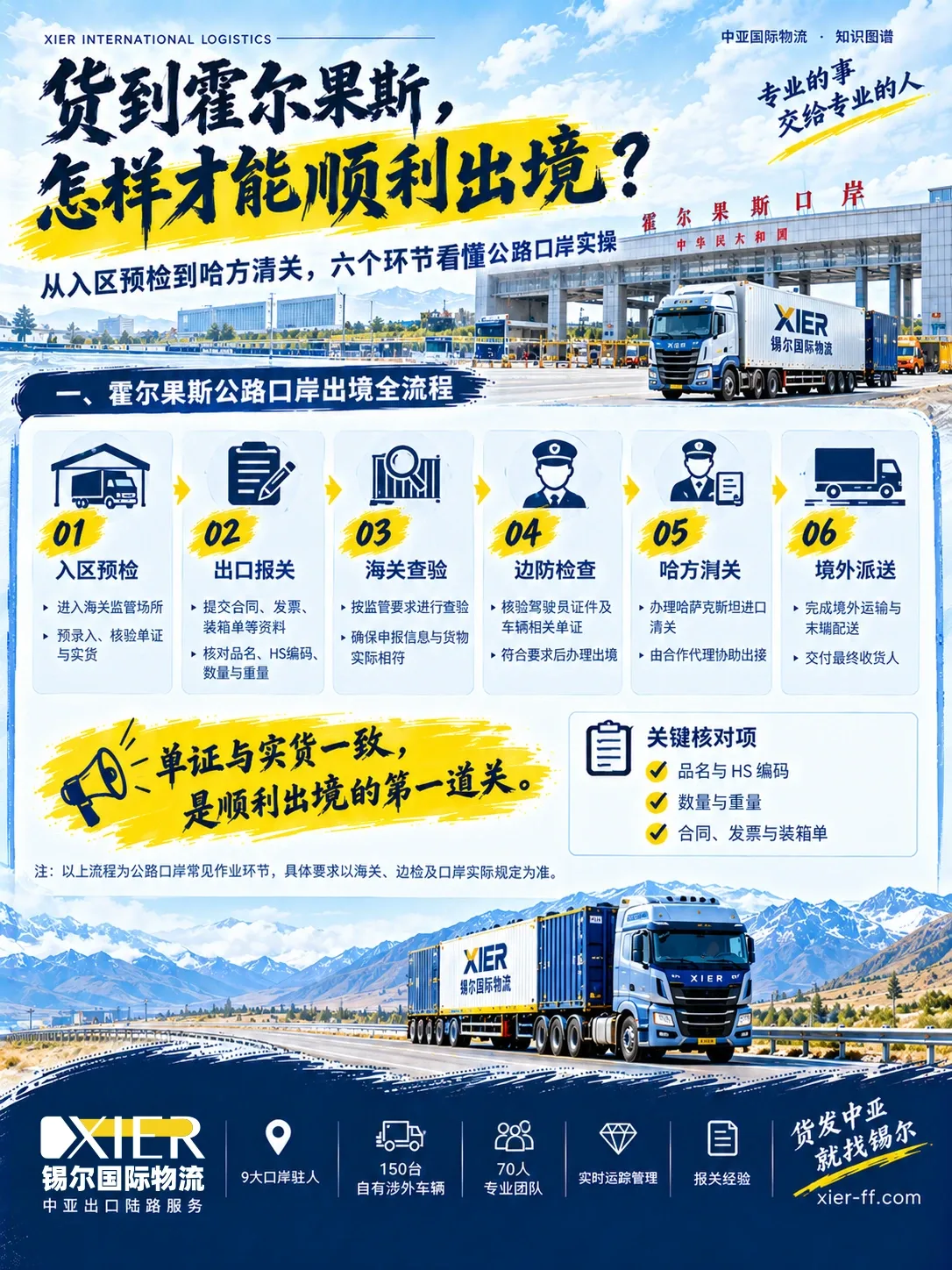 图1:霍尔果斯公路口岸出境全流程——从入区预检到哈方清关六步看懂
Although the same for road outbound, there are common three organizational methods:
- Whole vehicle direct transit:Combined truck and trailer departure, the simplest method, suitable for general full truckload cargo;
- Detachable or hoisting for reinstallation:Transfer of truck heads or trailers at the border between domestic and foreign, reducing deadhead mileage and improving vehicle turnover, suitable for stable round-trip routes;
- TIR Transport:Based on the International Convention on Road Traffic, the TIR Carnet allows for one-time customs declaration and inspection exemption along the route in contracting countries, significantly improving cross-border road transport efficiency, suitable for long-haul routes with multiple country transits.
Choose based on the stability of the route, the volume of cargo per trip, and whether there are multiple country transits. Use detachable trailers to reduce costs on stable routes, use TIR for long-haul routes with multiple country transits to save on on-route inspections, and use full truckload direct transit for scattered and urgent cargo for the most flexibility.
Sixth, Khorgos Highway Port vs. Southern Xinjiang Highway Port: How to choose different types of cargo
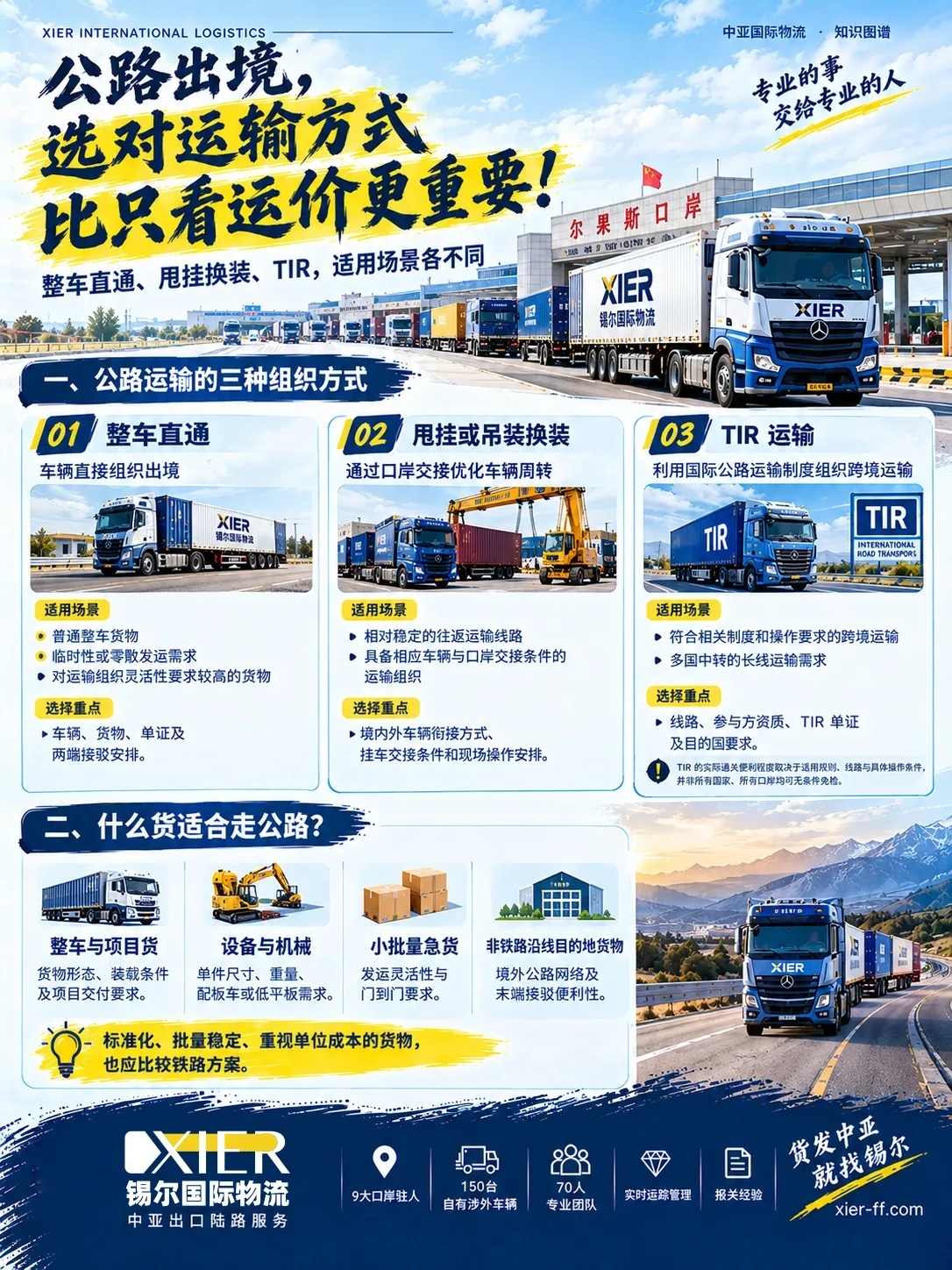 图2:公路出境三种组织方式——整车直通、甩挂换装与 TIR 各适用什么货
Many customers will ask: Should my cargo go through the northern Xinjiang Khorgos or the southern Xinjiang Irkeshtam and Turghart? They are not substitutes but complementary:
- Khorgos (Northern Xinjiang):Iron and road dual access, the most convenient route to Almaty and beyond, and the nearest source of Yili and surrounding areas for cargo departure;
- Irkeshtam、吐尔尕特(南疆)Corresponding to the direction of Kyrgyzstan (Bishkek) and the western line of Uzbekistan, the Khorgos base camp is strong, providing greater stability for整车, equipment, and project cargo heading to the southern lines of Kyrgyzstan and Uzbekistan.
Judgment sequence: first look at the type of goods, then the destination country, and finally consider the balance between timeliness and cost. Standard specifications, stable batches, and pursuit of unit cost - both the Beijiang Railway or the Khorgos Highway can be selected; irregular, time-sensitive, and cargo requiring on-site coordination at the port - the southern line is often more stable. Xier International Logistics has permanent resources at both the southern and northern Xinjiang ports, and can plan primary and backup channels within the same plan.
Seven, Common Pitfalls and Avoidance List in Practice
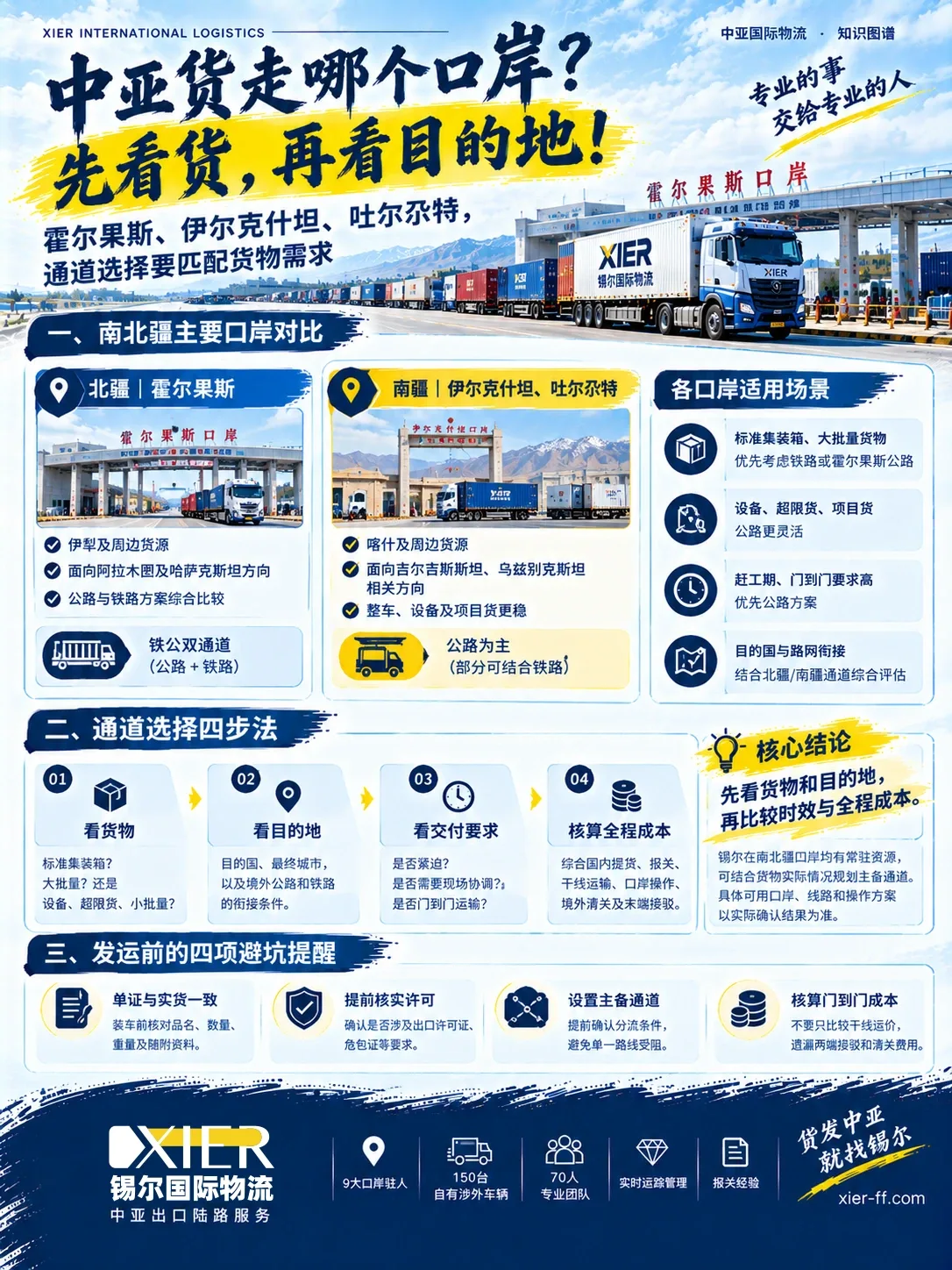 图3:中亚货走哪个口岸——北疆霍尔果斯与南疆口岸通道怎么选
- Pitfall 1: Mismatch between documents and actual goods——Invoice quantity and weight do not match the actual goods, and the marks do not match the packing list. Avoidance: Take photos and archive before loading, and check each item on the packing list and invoice.
- Pitfall 2: Incorrect HS coding——Product name and coding do not match, and it may take half a day or several days to redo the order. Avoidance: Have a professional customs broker review HS classification before shipment.
- Pitfall 3: Missing export license or dangerous goods package certificate——Chemicals, some electromechanical products, and hazardous goods involve permits, and failure to obtain them directly at the event may result in cargo seizure. Avoidance: Verify permit requirements at the quotation stage.
- 坑4:Focus on only one channel——Lack of strategy during temporary port control. Avoid pitfall: Clearly state the primary and backup channels and分流 rules in the plan.
- 坑5:Neglecting the cost of both ends——Only calculate the mainline price, forgetting about collection, customs declaration, and overseas connection. Avoid pitfall: Quote the full door-to-door segment.
Eight, Common Questions
1. How to choose between road and rail?
Standard specifications, stable batches, pursuing unit cost—preferably choose rail or Khorgos highway for整车; irregular, time-sensitive, and need on-site port coordination for整车, equipment, and project cargo—road is more flexible. If unsure, first lay out the parameters for a channel preview.
2. Can small batch urgent goods be transported by road?
Yes. When there is no need to wait for a full container, no waiting time, and high door-to-door requirements, the flexibility of road transportation is most obvious, more controllable than waiting for train schedules.
3. Which channel for equipment cargo?
For oversized or overweight engineering equipment, agricultural machinery, and production lines, road transportation with flatbed trucks or low-bed trailers is the most direct; if the volume can be made up and the destination is to the west of Xinjiang, rail transportation can also be considered. The key is the shape of the individual item and the destination road network.
4. Who handles the customs clearance in theKazakhstan?
It is usually completed by the logistics company through cooperative agents in theKazakhstan or the destination country. In door-to-door plans, this segment should be included in the same contract and responsibility division to avoid handing over as soon as the goods leave the country.
5. What is TIR and how is it useful to me?
TIR is a customs clearance system under the International Convention on Road Traffic, and with a TIR Carnet, you can clear customs once and be exempt from inspections along the way in contracting countries, significantly improving the efficiency of road transit in multiple countries, suitable for long-distance cross-border transport.
6. How to estimate time efficiently without being deceived?
Always calculate the full door-to-door segment: trunk line plus domestic pick-up and customs clearance, plus overseas connection and customs clearance, plus possible warehousing. Reporting only the trunk line price may easily lead to additional costs at the ends for connection. Plan delivery dates in advance, leaving buffer time for port stay and overseas connection.
Khorgos Highway Port
Cross-border road transport
Central Asia Logistics
TIR International Road Transport
Port Operation
About the AuthorXier International Logistics, focusing on market analysis and digital solutions for Central Asia logistics. This article is based on 10 years of practical data and industry research of Xier International Logistics and is for reference only. Specific plans need to be customized according to the characteristics of the goods.