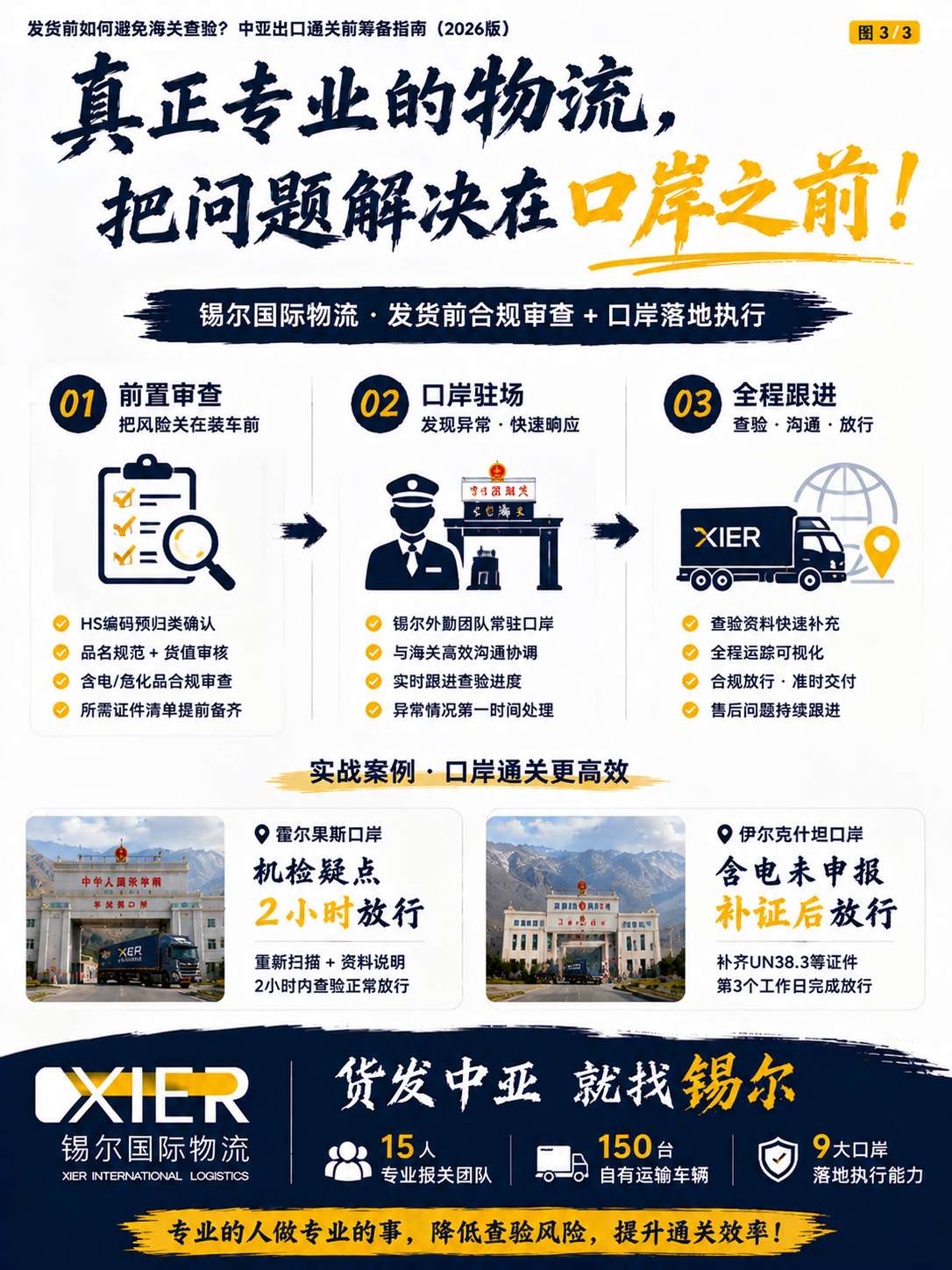
I. Customs Inspection ≠ Cargo Problem — Don't Panic
Let's clarify this first: being inspected by customs does not mean your cargo has a compliance problem.
Inspection is a normal regulatory procedure conducted by customs under the Customs Law. Based on risk control rules, customs performs random or targeted checks on import/export goods to verify that the declared content matches the actual goods and to maintain normal trade order.
From the data, the inspection rate for Central Asia export cargo at Xinjiang ports is generally at a normal level, and most inspections conclude with 'inspection normal, released.' But once inspected, insufficient pre-shipment preparation easily incurs extra dwell and communication costs. Therefore, doing compliance before loading is the fundamental way to reduce risk.
Inspection is mainly divided into two types:
- Machine Inspection(H986): large scanning equipment scans containers/vehicles without opening; inspectors judge by image; typically 2–4 hours, and some ports can release within half a day;
- Manual Inspection: requires opening the container for physical verification, sampling, document checking, etc.; typically 1–3 business days, possibly longer for complex cases.
II. Pre-Shipment Check: The 6 Most Common High-Risk Points for Central Asia Exports
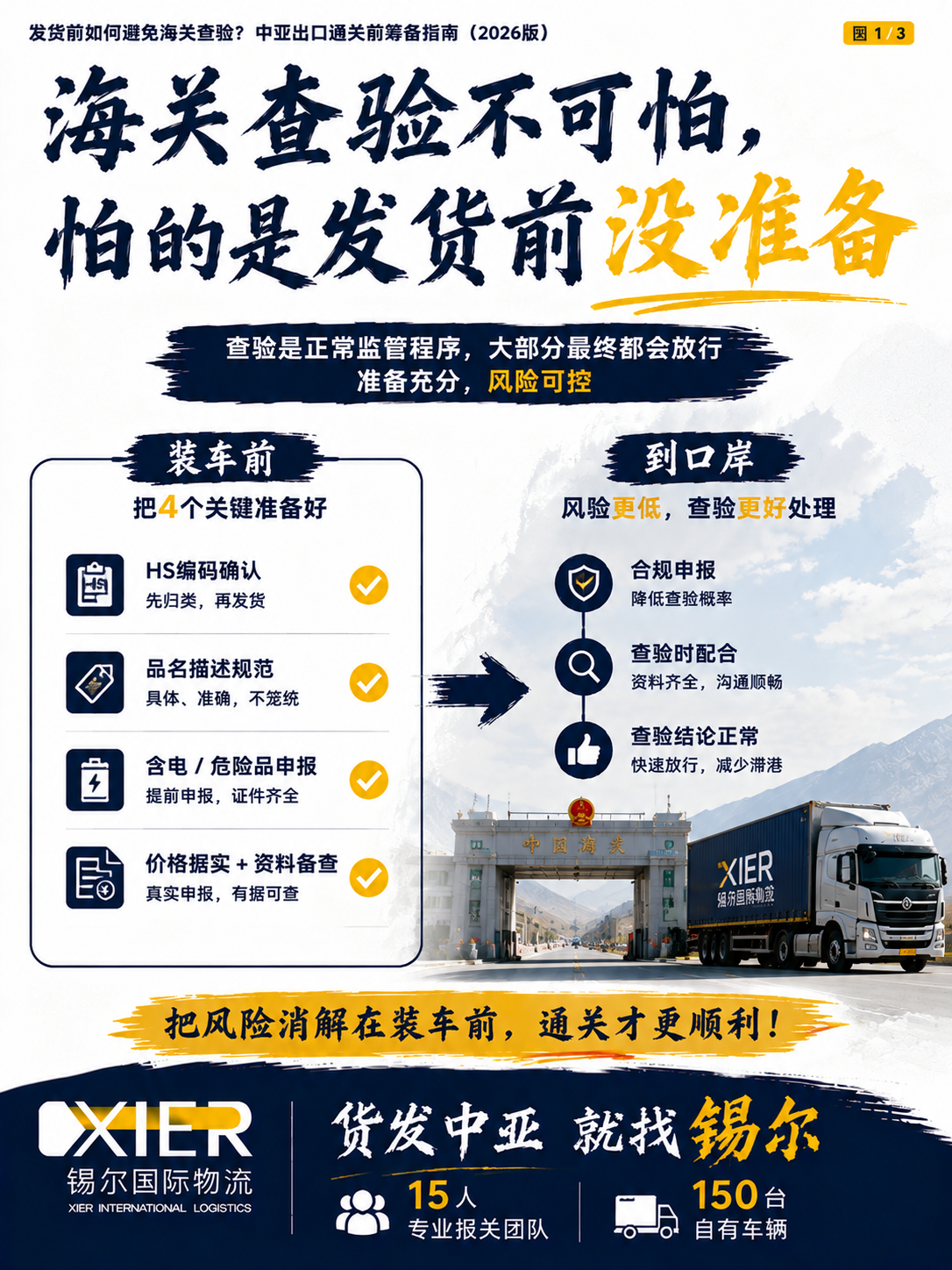
To prevent inspection, the key is to clear each high-risk point before shipping. Below are the most common inspection triggers for Central Asia export cargo at Xinjiang ports, also the pre-shipment checklist to prepare in advance, ranked by frequency:
1. Dispute over HS Code Classification (the number-one inspection cause)
For the same product, different declarers may give different HS code judgments. When customs believes the classification is wrong, it will detain the cargo for further verification.
Typical scenarios: machinery parts classified into different chapters, mixed-material products with unclear classification, and new product categories without clear classification reference.
Prevention: before export, confirm the HS code classification basis with your customs team, and prepare product manuals, technical parameters, and other supporting materials for inspection.
2. Overly Vague Product Name Description
"Mechanical parts", "general cargo", "samples" — such vague descriptions are a "hotspot" for customs inspection. Customs cannot determine the nature of goods from the declared product name and will inevitably open the box to verify.
Standard practice: the product name must be precise to the specific commodity name, e.g., "hydraulic cylinder for crawler hydraulic excavator (bore 120mm)" is better than "excavator parts".
3. Declared Value Deviates from Market Price
Customs has a global commodity price database; a declared price clearly deviating from the market average for the same category triggers price review. Both under-declaration to evade tax and over-declaration to defraud are inspected.
Proper practice: declare export cargo prices truthfully and provide real commercial invoices; for special pricing (related-party transactions, gift samples, etc.), prepare an explanation in advance.
4. Battery-Containing, Dangerous, or Chemical Goods Not Declared in Advance or Lacking Qualifications
Batteries, lithium batteries, electric equipment, chemical raw materials, etc. are key supervised commodities by customs. Exports of electric goods must truthfully declare the corresponding numbers such as UN3480/3481 or UN3171, and dangerous goods must be accompanied by a dangerous goods packaging certificate, a transport condition identification report, etc.
Xier International holds dangerous goods qualifications at ports such as Irkeshtam, Torugart, and Khorgos, with rich experience in handling battery-containing and dangerous goods exports, and can provide you with pre-compliance review services.
5. Missing Documents or Documents Inconsistent with Cargo
Export of electromechanical products without an export license, goods involving the export control list, or failure to submit FORM E or FORM P certificates of origin — incomplete documents or inconsistency with actual cargo information are common delay causes.
Proper practice: learn the required document list for the destination country in advance, and keep the accompanying documents strictly consistent with the physical goods.
6. New Enterprises or Low Credit-Rating Enterprises
Customs implements credit-rating management for different enterprises. Advanced certified enterprises (AEO) have a significantly lower inspection rate than general-certified and general enterprises. Newly registered enterprises or those with violation records have a relatively higher inspection probability.
III. Xier Port Case Studies: How Pre-Preparation Avoids These Pitfalls
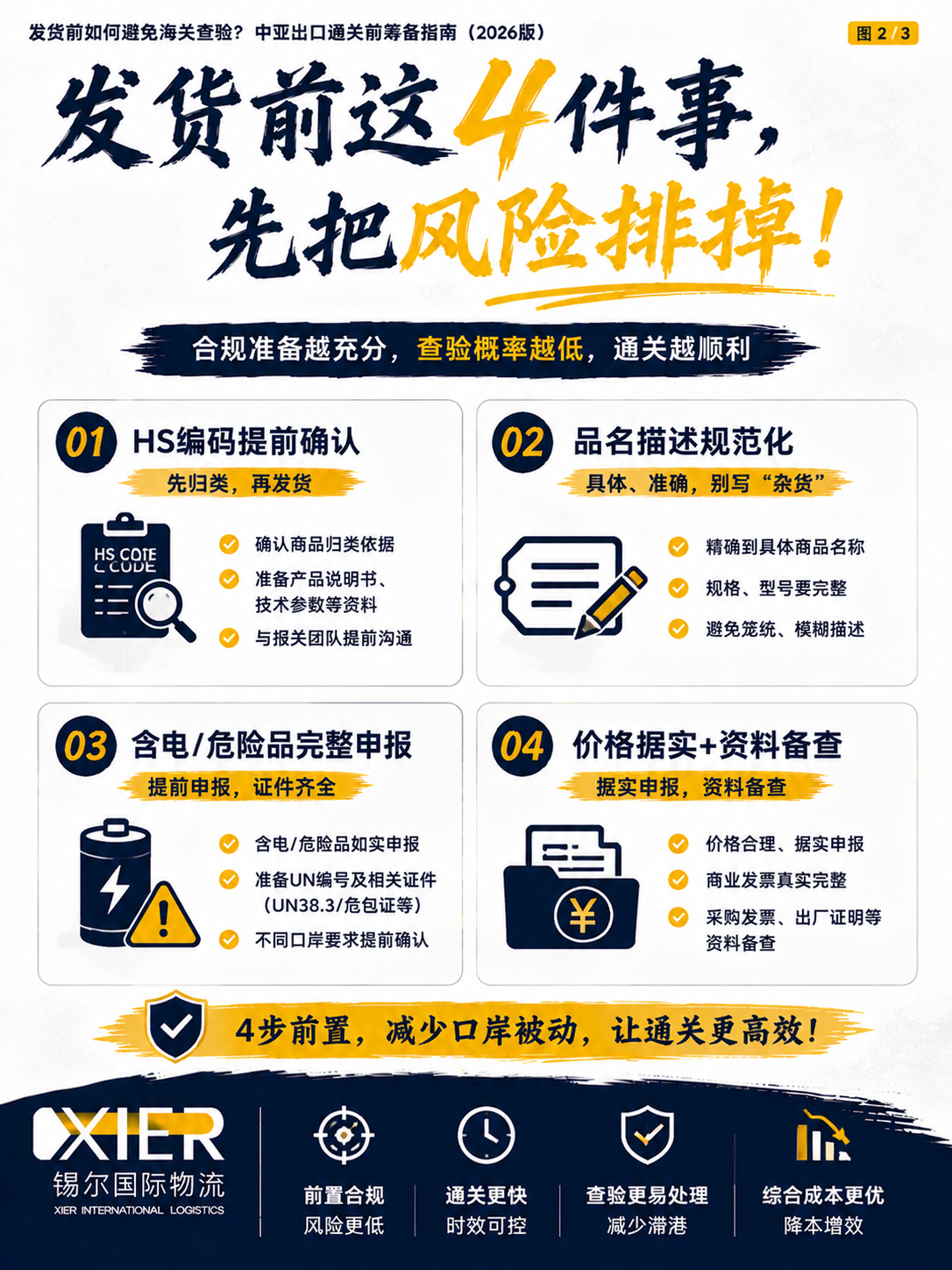
Case 1: Machine Inspection Doubt, Released in 2 Hours (Khorgos)
An export enterprise declared a batch of engineering tires, exiting via Khorgos road port; the machine-scan image showed a discrepancy between stacking density and declared quantity, raising customs inspection concern.
Xier's on-site team arrived within 30 minutes, coordinated a re-scan with customs, and provided packing details and loading photos as supplementary explanation; 2 hours later the inspection was normal and the cargo was released. The client was not present throughout; Xier's on-site staff handled everything.
Case 2: Lithium Batteries Not Declared, Manual Inspection + Document Supplement (Irkeshtam)
A client exported a batch of LED lamps with built-in button batteries not separately declared in the customs declaration. During inspection, customs found the cargo was battery-containing and required the battery UN38.3 test report and dangerous goods packaging certificate.
Xier's on-site staff immediately contacted the client to supplement the documents, while explaining to customs that the product contains a tiny built-in battery at low level and communicating the sampling-testing process. After documents were completed, release was achieved on the 3rd business day.
Lesson: battery-containing cargo must be fully declared at the customs stage; don't wait for customs inspection to discover it.
IV. Prevention Over Remediation: Do These Four Things Before Shipping
The best response is to prevent inspection from happening. The following four points, done before shipping, can greatly reduce inspection probability and handling difficulty:
- Confirm HS Code in Advance: don't guess from experience; confirm the code and classification basis with your customs team before shipping;
- Standardize Product Name Description: precise product name and complete specifications; avoid vague descriptions;
- Full Declaration of Battery-Containing/Dangerous Goods: for special cargo such as built-in batteries, liquids, powders, declare fully in the customs declaration with supporting documents accompanying the goods;
- Truthful Price + Documents on File: export cargo prices are true and reasonable; purchase invoices and factory certificates are prepared.
Frequently Asked Questions
Will inspection lead to cargo seizure or fines?
Under normal circumstances, if the cargo is truthful and compliant after inspection, customs will release it normally without extra fines or seizure. Seizure usually occurs in illegal situations such as smuggling violations or concealed goods. Xier International advises truthful declaration and compliant operation; inspection does not equal a problem.
Who bears the storage fees when cargo dwells at port during inspection?
Reasonable storage fees incurred during inspection are normally borne by the cargo owner. But detention caused by declarant-attributable reasons such as declaration errors or incomplete documents is the shipper's responsibility; if it is normal customs risk-controlled inspection with a normal conclusion, the cost can be negotiated with the logistics provider. It is recommended to specify this in the contract in advance.
How long is the port waiting time after inspection?
Machine inspection typically takes 2–4 hours, with some ports releasing within half a day; manual inspection typically takes 1–3 business days; if sampling-testing or cross-department joint inspection is involved, it may extend to 5–10 business days. Xier International's on-site teams at each port follow up throughout the inspection to compress waiting time at every step.
What documents must be noted for battery-containing cargo exported to Central Asia?
Lithium-battery-equipped devices (UN3481), independently packaged lithium batteries (UN3480), etc., must provide a UN38.3 test report, dangerous goods packaging certificate, or transport condition appraisal report. Some battery-containing products also require an export license. Different destination countries have different requirements for battery-containing cargo; confirm with Xier International before shipping.
How to lower an enterprise's export inspection rate?
First, maintain a good credit record; AEO-certified enterprises enjoy lower inspection rates. Second, standardize declaration — HS code, product name, price, and documents must all be true and accurate. Third, build a stable import/export compliance system and regularly self-check export cargo for compliance. Xier International can assist clients with pre-export compliance review to reduce inspection risk.
About the Author: Xier International Logistics — focused on Central Asia logistics market analysis and digital solutions, based on a decade of Xier's operational data and industry research, for reference only; specific solutions must be tailored to your cargo.