Among all cargo exported to Central Asia from Xinjiang ports, over 60% has a destination or transit point related to Kazakhstan. This country, ranking ninth in the world by area, with its vast territory and superior geographic location, has become the most important logistics hub in Central Asia and even Eurasia. Whether cargo is shipped to Uzbekistan, Kyrgyzstan, or enters Russia and European markets via Kazakhstan, familiarity with Kazakhstan's logistics trunk network and clearance rules is a basic skill every Central Asia exporter must master.
I. Why Kazakhstan Is the Absolute Core of Central Asia Logistics
Kazakhstan spans Europe and Asia, with a territory of over 2.72 million square kilometers, bordering China's Xinjiang to the east, the Caspian Sea to the west, Russia to the north, and Uzbekistan and Kyrgyzstan to the south. The vast majority of China–Europe rail lines from China must cross Kazakhstan to reach Europe; and much road freight from Xinjiang ports also passes through Kazakhstan to other Central Asian countries.
In terms of economic scale, Kazakhstan is the largest economy among the five Central Asian countries, with a total GDP exceeding 270 billion USD in 2025, and total import and export trade accounting for over 60% of its GDP. In logistics infrastructure, Kazakhstan has the most complete railway network in Central Asia — with a total mileage of over 15,000 km and a road network exceeding 100,000 km, and Almaty and Atyrau are the core hubs for aviation and Caspian shipping respectively. Its superior geographical location combined with well-developed infrastructure naturally makes Kazakhstan the distribution center and transit corridor of Central Asia logistics.
II. Kazakhstan Railway Trunk: Almaty and the China–Europe Rail West Line
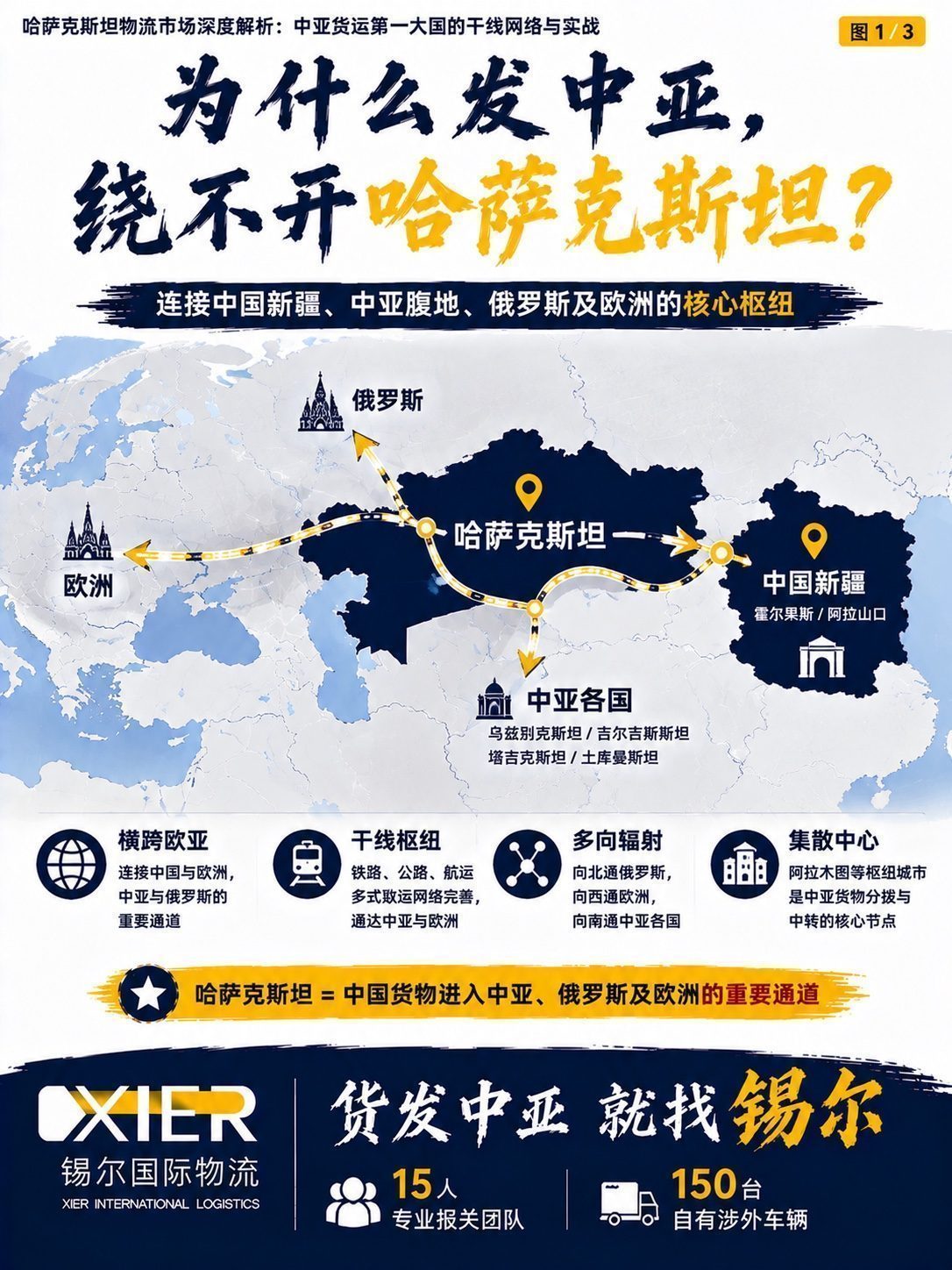
Kazakhstan's railway network has a "cross-shaped skeleton" structure: the east-west line traverses the whole territory, extending from China's Alashankou/Khorgos direction to Russia and Europe; the north-south line connects Almaty with northern and central Kazakhstan. The two core nodes — Almaty and Nur-Sultan (formerly Astana) — constitute the two main axes of Kazakhstan's logistics network.
Almatyis Kazakhstan's largest city and economic center, and the most important railway hub in Central Asia. Cargo exiting from China's Khorgos rail port is reloaded at Kazakhstan's Alakol, then goes south to Almaty, where it can transit to all of Kazakhstan and toward Uzbekistan and Turkmenistan. At the same time, Almaty is also a key node of the Trans-Caspian International Transport Route (TITR), from where cargo can go by rail to the eastern Caspian coast, then by sea to Baku, Azerbaijan, and onward to Georgia, Turkey, and Europe.
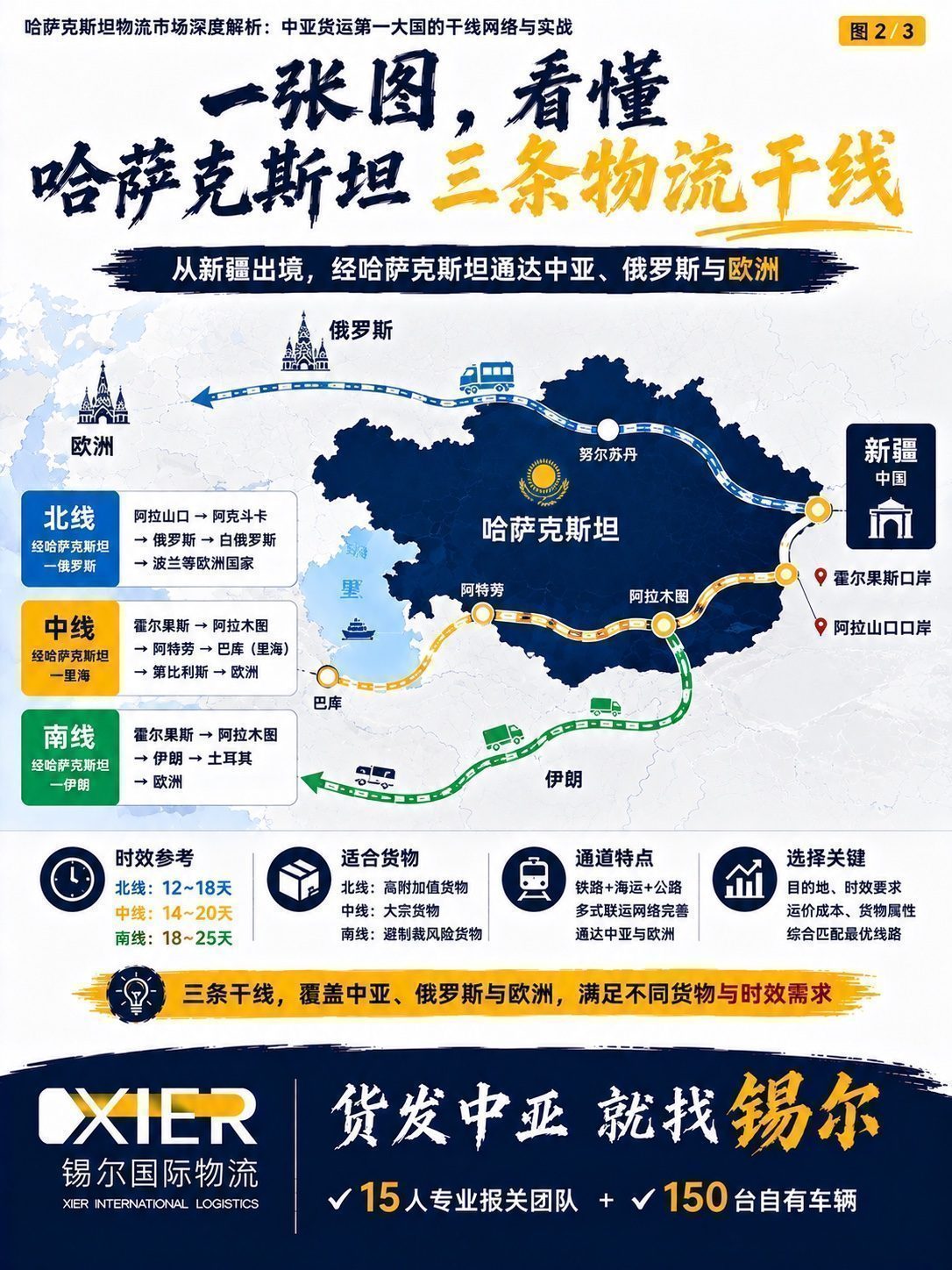
China–Europe Rail West CorridorIn terms of routes, China–Europe block trains exiting from Xinjiang mainly cross Kazakhstan via the following routes:
| Route | Main Via | Transit Time | Suitable Cargo |
|---|---|---|---|
| North Line (via Kazakhstan–Russia) | Alashankou → Aktogay → Russia → Belarus → Poland | 12–18 days | High-value-added cargo, industrial goods with high time sensitivity |
| Middle Line (via Kazakhstan–Caspian) | Khorgos → Almaty → Atyrau → Baku → Tbilisi → Europe | 14–20 days | Bulk cargo, medium-time-sensitive cargo sensitive to freight rates |
| South Line (via Kazakhstan–Iran) | Khorgos → Almaty → Iran → Turkey | 18–25 days | Cargo of certain categories avoiding sanction risks |
For exporters, using Kazakhstan's rail corridor means cargo can be shipped directly from Xinjiang to European or Middle Eastern markets without repeated customs clearance at Central Asian borders. Xier International Logistics has on-site teams at the two major rail ports of Alashankou and Khorgos, assisting clients with exit declaration and reloading coordination.
III. Almaty Land Transport Hub: Road Distribution and Warehousing Practice
Besides rail, Almaty is also the core distribution center for road freight. Cargo exiting from Xinjiang road ports such as Irkeshtam and Torugart is usually deconsolidated, sorted, and re-distributed upon arrival in Almaty, then sent via Kazakhstan's road network to Tashkent and Samarkand in Uzbekistan, Bishkek in Kyrgyzstan, and Ashgabat in Turkmenistan.
Transit permit system.Kazakhstan implements relatively strict access management for foreign freight vehicles. Chinese freight vehicles usually can only reload at the Kazakh border area and then be carried by Kazakh or local fleets for the in-Kazakhstan segment. This means road cargo from Xinjiang typically requires two to three different carriers in relay to complete the journey.
ATA Carnet and TIR Carnet.Xier International Logistics holds an ATA Carnet and TIR Carnet (international road goods transit manual). Transit cargo via Kazakhstan can enjoy simplified customs procedures with the TIR Carnet, without repeated unpacking inspection at the Kazakh border. This is especially important for high-value and time-sensitive cargo.
Almaty warehousing support.Almaty has multiple customs-supervised warehouses and free economic zones; cargo can be stored in Almaty pending orders, cleared in batches, and distributed to neighboring countries. For exporters with multi-country distribution needs in Central Asia, establishing a forward warehouse in Almaty is an effective strategy to control overall costs.
IV. Kazakhstan Clearance Practice: Rules and Notes
For cargo transiting through or imported into Kazakhstan, the following clearance points must be understood:
Transit cargo vs import cargo: different declaration types.If goods only transit through Kazakhstan to a third country, they should be declared under "transit transport" and are subject to Kazakhstan's transit regime, requiring a waybill (CIM/CMR) and transit guarantee. Transit goods are generally not subject to customs duties, but a refundable transit deposit is required. If importing to Kazakhstan locally, a complete import clearance process must be completed, including tariff payment and import license processing.
HS Code mapping.Kazakhstan adopts the Harmonized System (HS), but its customs codes differ somewhat from China's 10-digit system, and tax rates and regulatory conditions for some categories also differ. It is recommended to confirm code accuracy with a professional customs broker familiar with Kazakh customs regulations before shipping.
Rail waybill (SMGS/CIM).Kazakhstan rail transport uses the SMGS (Agreement on International Railway Freight) waybill, which differs from China's CIM waybill in format and operation. Xier International Logistics' customs team is familiar with the interface between the two waybill formats and can assist exporters with document preparation and reloading coordination.
Dangerous goods special provisions.Kazakhstan strictly manages dangerous goods transport; importing and transiting dangerous goods requires advance permits and notation of UN numbers and hazard classes on waybills and documents.
V. Xier's Practical Capability in the Kazakhstan Direction
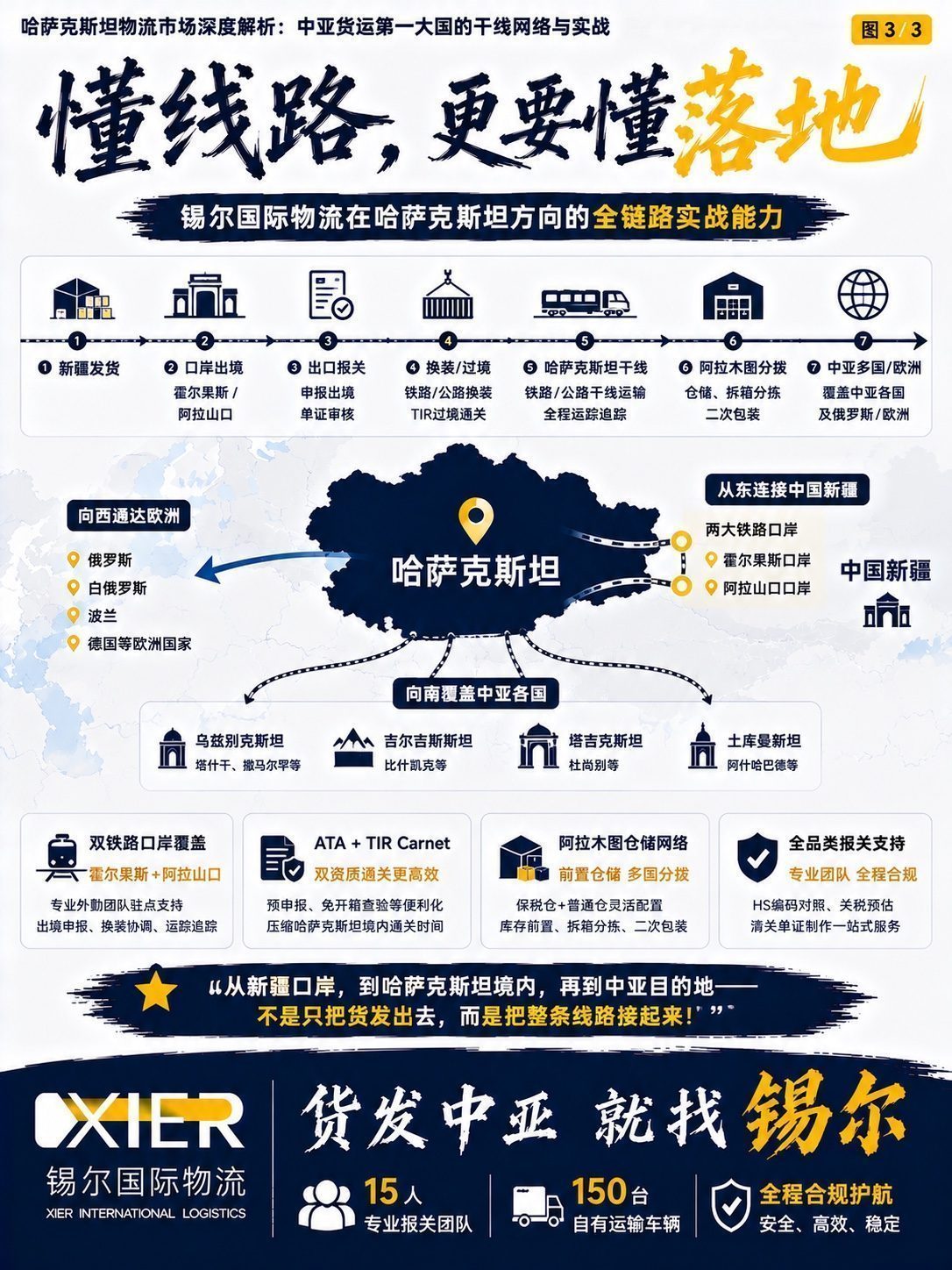
As the core hub of Central Asia logistics, Kazakhstan's clearance rules and operational complexity place high demands on a logistics provider's professionalism. Xier International Logistics has accumulated years of practical experience in the Kazakhstan direction, mainly reflected in the following aspects:
Dual-port rail shipment.Xier on-site teams are stationed at both major rail ports, Khorgos and Alashankou, assisting clients with exit declaration, reloading coordination, and tracking. Rail cargo from these two ports can cover hub nodes such as Almaty, Nur-Sultan, and Atyrau via major Kazakh cities.
Dual qualifications: ATA Carnet + TIR Carnet.Xier International Logistics holds an ATA Carnet and TIR Carnet; transit cargo via Kazakhstan can enjoy facilitation measures such as pre-declaration and unpacking-free inspection, effectively compressing in-Kazakhstan clearance time.
Almaty cooperative warehousing network.Xier has built a cooperative warehousing network in major Central Asian cities, including bonded and non-bonded general warehouses in Almaty, providing inventory pre-positioning, deconsolidation, and re-packaging for clients with multi-country distribution needs.
Full-category customs support.For machinery, electronics, chemicals, textiles, and various export goods, Xier's customs team can provide HS code mapping, duty estimation, and clearance document preparation, helping clients complete sufficient compliance preparation before cargo enters Kazakhstan.
Kazakhstan is the absolute core of Central Asia logistics and an important gateway to the European market. Familiarity with this market's operating rules and finding a provider experienced in local operations is a key step to delivering cargo safely and efficiently.
Frequently Asked Questions
For cargo to Kazakhstan, is export customs declaration handled at Xinjiang ports or import customs declaration in Kazakhstan?
Both are needed. Export customs declaration is handled at Xinjiang ports (declaring exit to Chinese customs); when cargo enters Kazakhstan, transit declaration or import clearance must be handled separately based on cargo nature (transit or import). If cargo only transits Kazakhstan to a third country, it should be declared under transit transport, subject to Kazakhstan's transit system — no duty but a transit guarantee is required.
How many days does a China–Europe block train via Kazakhstan to Europe usually take?
Exiting from Xinjiang's Khorgos or Alashankou and traveling via Kazakhstan's rail line to a European destination station, the overall transit time is about 12–20 days, depending on the chosen route (north/middle/south), number of reloads, and border clearance efficiency. Xier International Logistics has on-site teams at both major rail ports to assist with reloading and clearance, compressing waiting time at each node.
Can Almaty, Kazakhstan serve as a warehousing center for multi-country distribution in Central Asia?
Yes. Almaty has multiple customs-supervised warehouses and free economic zones; cargo can be stored in Almaty pending orders, cleared in batches, and distributed to Uzbekistan, Kyrgyzstan, Turkmenistan, etc. This approach suits exporters with multi-country distribution needs in Central Asia, enabling inventory pre-positioning and lower per-clearance costs.
What clearance conveniences can a TIR Carnet enjoy in Kazakhstan?
Transport vehicles holding a TIR Carnet (international road goods transit manual) can enjoy facilitation measures in Kazakhstan such as pre-declaration and reduced unpacking inspection. After pre-declaration at the Kazakh border, cargo is in principle released for transit without unpacking inspection, with clearance formalities completed at the destination — especially important for high-value and time-sensitive road transport.
What special procedures are required for dangerous goods transported via Kazakhstan?
Dangerous goods transiting or imported via Kazakhstan require advance dangerous goods transport permits, with UN numbers and hazard classes noted on waybills and documents. Xier International Logistics holds dangerous goods transport qualifications, is familiar with Kazakhstan's dangerous goods import and transit regulations, and can assist clients in completing permits and documents in advance to avoid cargo delays at ports.
About the Author: Xier International Logistics — focused on Central Asia logistics market analysis and digital solutions. Based on a decade of Xier's operational data and industry research, this article is for reference only; specific solutions must be tailored to your cargo.