I. How the Three Major FTZ Areas Divide Labor
The Urumqi area focuses on inland opening hub and airport-port-railport linkage; the Kashgar area faces Central Asia and South Asia, developing bonded logistics and cross-border e-commerce; the Khorgos area highlights port economy, cross-border trade, and processing. The significance for logistics enterprises is: based on cargo direction, you can place warehousing, distribution, and customs nodes in the smoothest area, reducing detours. Refer to Khorgos Port Clearance Complete Guide, to understand the practical clearance process of the Khorgos area.
II. What Can Be Enjoyed in Terms of Taxation
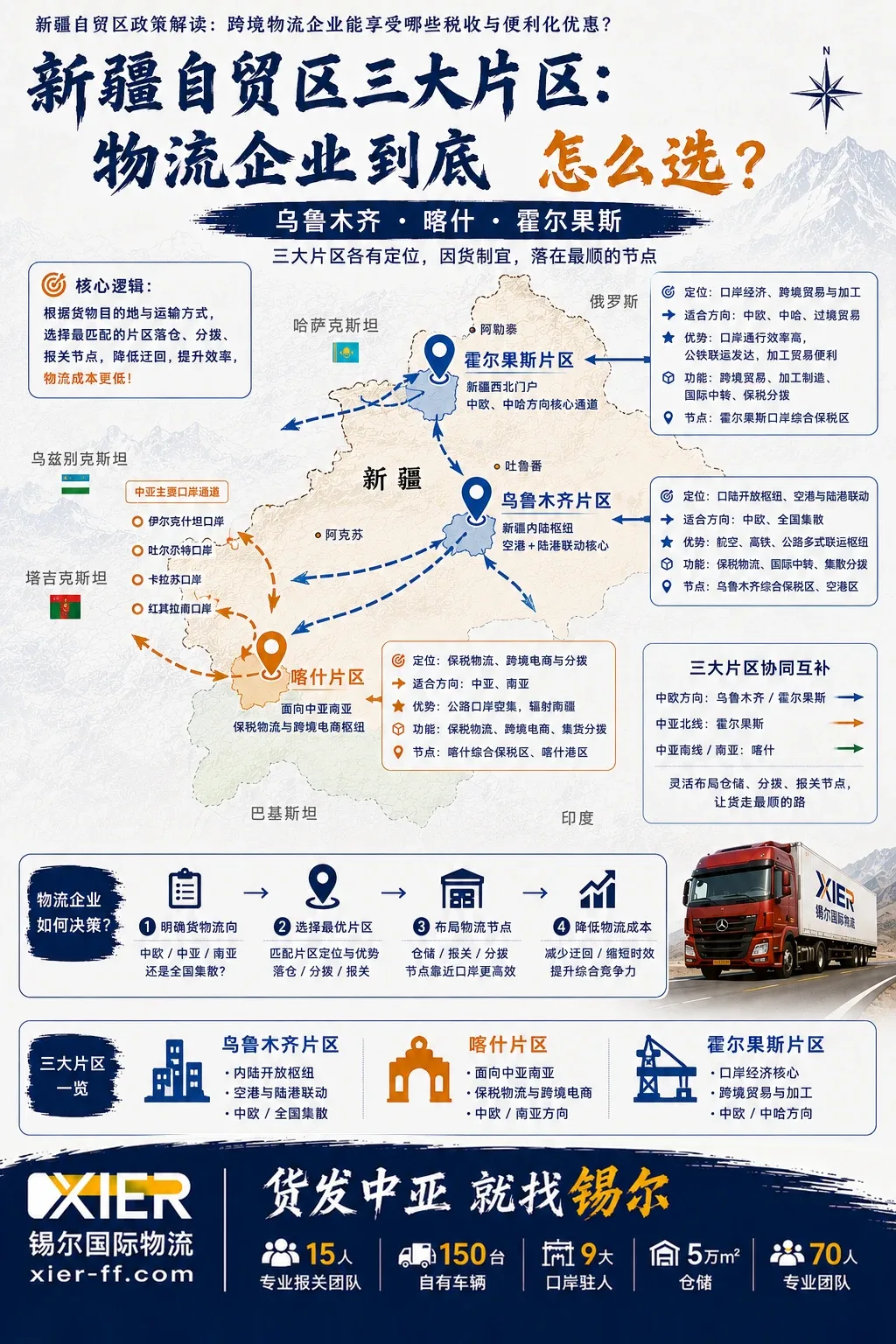 图1:新疆自贸区三大片区定位与选区决策(乌鲁木齐·喀什·霍尔果斯)
Encouraged-industry enterprises meeting the conditions can apply the western development tax preferential policy, with corporate income tax levied at a 15% rate, significantly lower than the general 25% level. Bonded logistics and bonded warehousing businesses within the FTZ area follow "frontier open, second line controlled" for goods — entering the bonded warehouse does not first levy import tax, and tax is calculated by actual flow only upon exit, which is more cash-flow friendly for transit and distribution businesses. For which specific one applies and how to file, it is recommended to confirm with the competent tax authority based on the enterprise's actual business, avoiding one-size-fits-all application.
III. Customs Facilitation Dividends
The FTZ promotes reforms such as customs integration, advance declaration, and two-step declaration, strengthening port-territory customs coordination. The most direct benefit for cross-border logistics enterprises: territorial declaration and port release, reducing cargo queuing at the border; AEO advanced certified enterprises enjoy lower inspection rates and priority clearance; cross-border e-commerce B2B export has dedicated declaration channels, making small-batch multi-shipment orders smoother. The multimodal "single document system" is also advancing, making rail-road and road-rail transshipment easier. For more route comparisons, see Xier Central Asia Route Network。
IV. How to Use Bonded and Warehousing Distribution
Urumqi, Kashgar, and other places have comprehensive bonded zones and bonded logistics centers, where enterprises can conduct bonded warehousing, international distribution, simple processing, and entrepot trade. Xier has deployed 50,000-square-meter-level bonded warehouse resources in Xinjiang, providing clients with integrated services of warehousing plus customs declaration plus last-mile delivery, especially suitable for Central Asia consolidation businesses needing "enter zone first, then distribute". See details in Xier Bonded Warehousing and Customs Declaration Services。
V. Cross-Border Settlement and RMB Facilitation
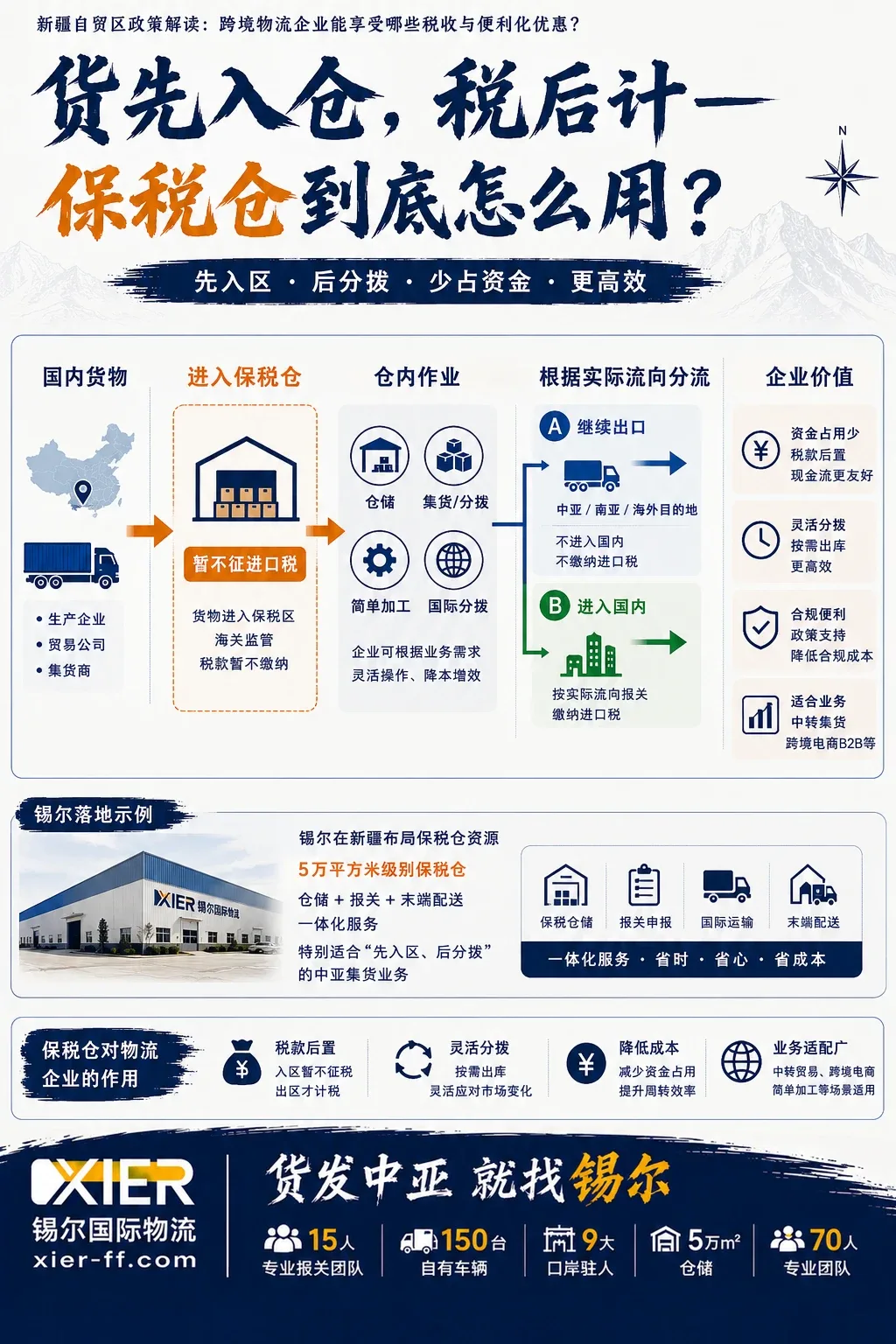 图2:保税仓"先入区、后分拨"一体化服务流程(锡尔落地示例)
The FTZ supports cross-border RMB settlement facilitation; qualified enterprises have simpler procedures for cross-border RMB settlement of goods trade, and better control over exchange rates and payment rhythm. For logistics enterprises with many Central Asian clients and mixed currencies, this is a real operational convenience.
VI. How Logistics Enterprises Can Capture These Policies
Step 1, sort out business: which goods go bonded transit, which go general trade, which suit cross-border e-commerce B2B. Step 2, select area for warehousing: for Central Asia direction prioritize Kashgar area bonded resources, for China-Europe direction look at Urumqi and Khorgos. Step 3, qualification preparation: AEO certification, cross-border e-commerce declaration qualification, bonded warehousing cooperation. Step 4, find a customs team familiar with Xinjiang ports to implement; policy dividends must be captured through documents and processes. Also refer to Karasu Port Transit Guide, to understand the clearance coordination of southern Xinjiang ports.
Xier Can Help You Implement
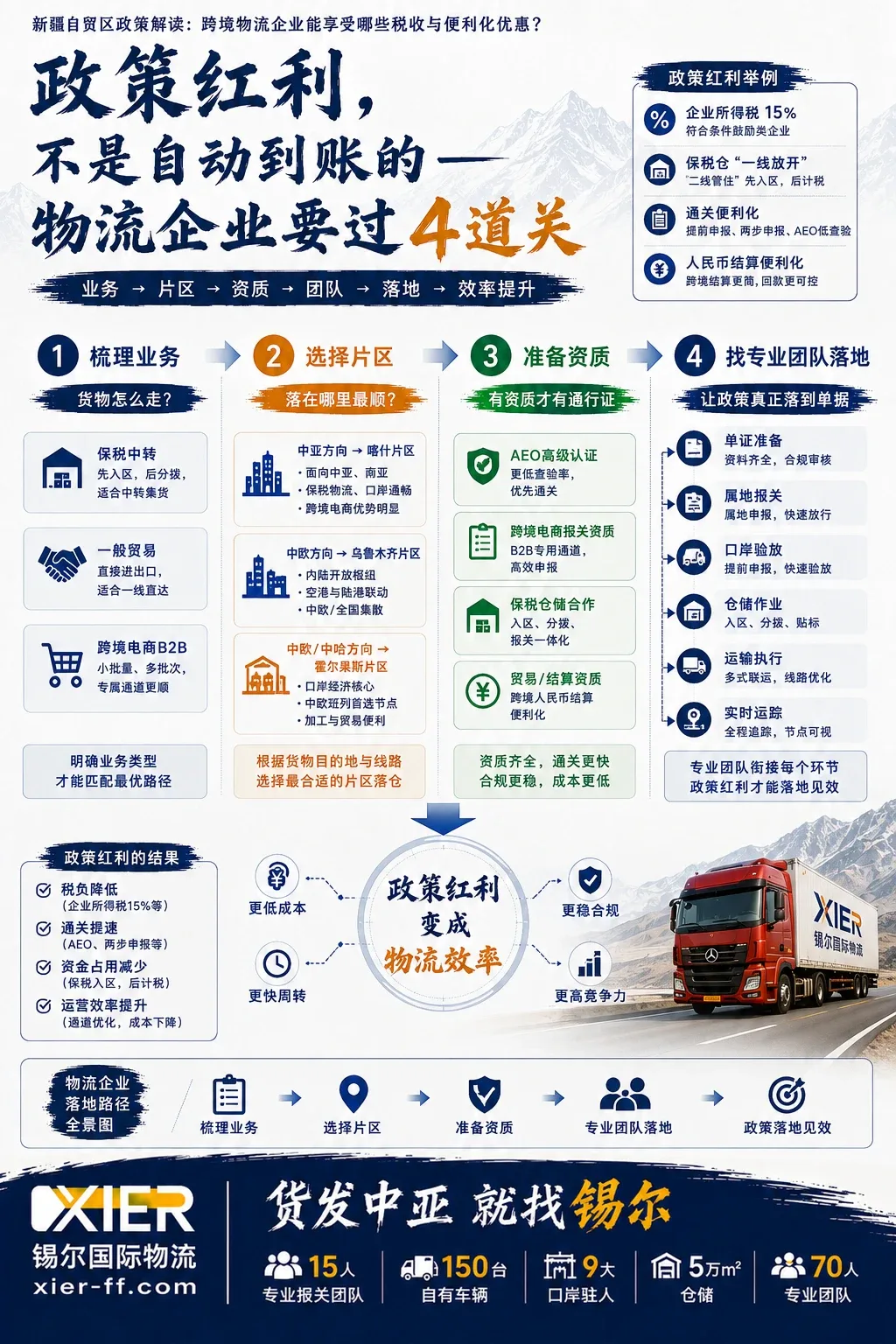 图3:政策红利落地四道关全景(业务→片区→资质→团队)
Xier International Logistics operates on an ongoing basis at core nodes across Xinjiang such as Urumqi and Kashgar, with its own customs clearance team averaging over 5 years of experience, providing one-stop services including bonded warehousing linkage, cross-border e-commerce B2B customs declaration, Central Asia road and multimodal transport, and full-process digital tracking. If you are evaluating how much the free trade zone policy can save your business, we can combine your goods and routes to deliver an actionable plan.
Frequently Asked Questions
When was the Xinjiang Free Trade Zone established?
Inaugurated in November 2023, it comprises three major areas: Urumqi, Kashgar, and Khorgos.
What corporate income tax incentives can cross-border logistics enterprises enjoy?
Encouraged industries that meet the criteria may apply the 15% corporate income tax rate under the Western Development policy; the specifics are subject to determination by the competent tax authority.
What is the role of a bonded warehouse in logistics?
Goods entering the zone are temporarily exempt from import duties, making it suitable for transit distribution and more cash-flow friendly.
What are the benefits of AEO certification?
Lower inspection rates and prioritized customs clearance, suitable for enterprises with high-frequency cross-border shipments.
Does Xier have a bonded warehouse in Xinjiang?
Yes, we provide bonded warehousing linkage and integrated customs declaration and distribution services.
-->
About the Author: Xier International Logistics — focused on Central Asia logistics market analysis and digital solutions. Based on a decade of Xier's operational data and industry research, this article is for reference only; specific solutions must be tailored to your cargo.