I. Why Steel Is Becoming a Popular Export Category to Central Asia
Many Central Asian countries are in an upward cycle of infrastructure and housing construction, with highways, railways, energy pipelines, industrial parks, and residential projects continuously driving steel demand. Steel exported to this region varies greatly in form: there are steel structure components for factories and bridges, and steel pipes for pipelines. For export enterprises, the same "steel," due to different forms and processing degrees, follows different classification standards, requires different accompanying documents, and faces different destination-country certification requirements. To do steel export smoothly, the first step is not to discuss freight but to accurately determine "what tariff item this batch of goods actually is."
Steel goods as a whole fall under Chapter 72 (iron and steel) and Chapter 73 (articles of iron and steel) of the Harmonized System. The starting point is simple: are they primary-form raw materials (slabs, hot-rolled coils, bars and rods), or further-processed articles (sections, pipes, structural components).
II. HS Classification: First Look at Form — Ch. 72 Raw Materials, Ch. 73 Articles
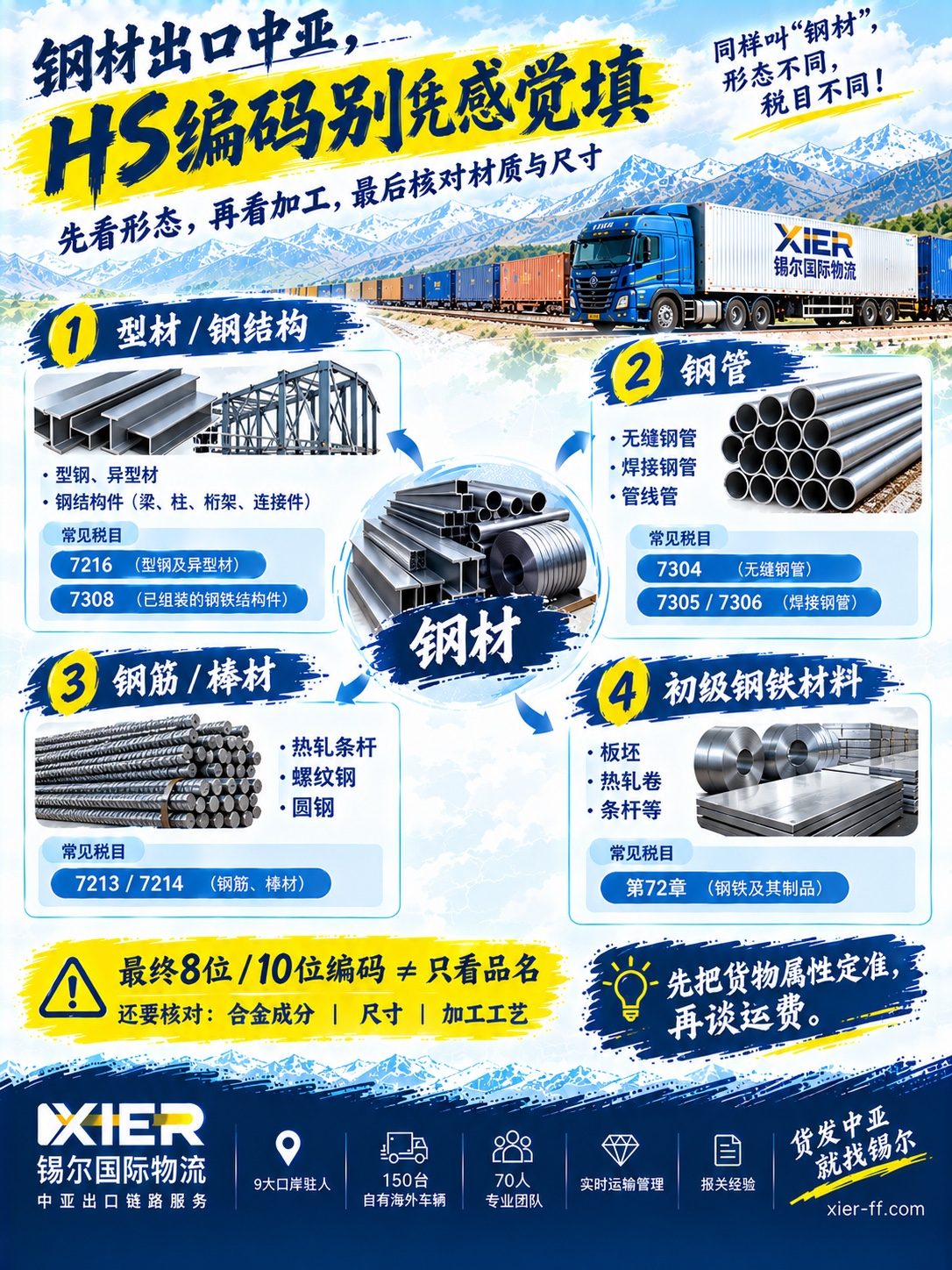
Steel structure components (beams, columns, trusses, connectors).Unassembled section steel is usually classified under heading 7216 (sections and profile shapes of iron or non-alloy steel); assembled or structural-part steel structure components mostly fall under heading 7308. The same "steel beam" — bare section versus truss-made component — may have different headings, determining subsequent regulatory conditions and declaration elements.Central Asia Cross-Border Logistics
Steel pipes (seamless pipes, welded pipes, line pipes).Seamless steel pipes commonly fall under heading 7304, welded steel pipes are classified under 7305 and 7306 by process. Steel pipes for pipeline projects often also involve wall thickness, pipe diameter, and material certificates, which must correspond one-to-one with the certificate of origin and quality certificate when declaring.
Rebars and bars (threaded steel, round steel).Hot-rolled bars and rods commonly fall under headings 7213 and 7214, with rebars mostly in this range. Whether ribbed or further processed directly affects subheading determination. A reminder: the above are common heading ranges; the final 8-digit and 10-digit codes must be confirmed by the customs broker or customs classification department based on alloy composition, dimensions, and processing technology — they cannot be directly applied by experience.
III. Customs Clearance Documents: What Affects Transit Time More Than "Freight" Is Whether Documents Are Complete
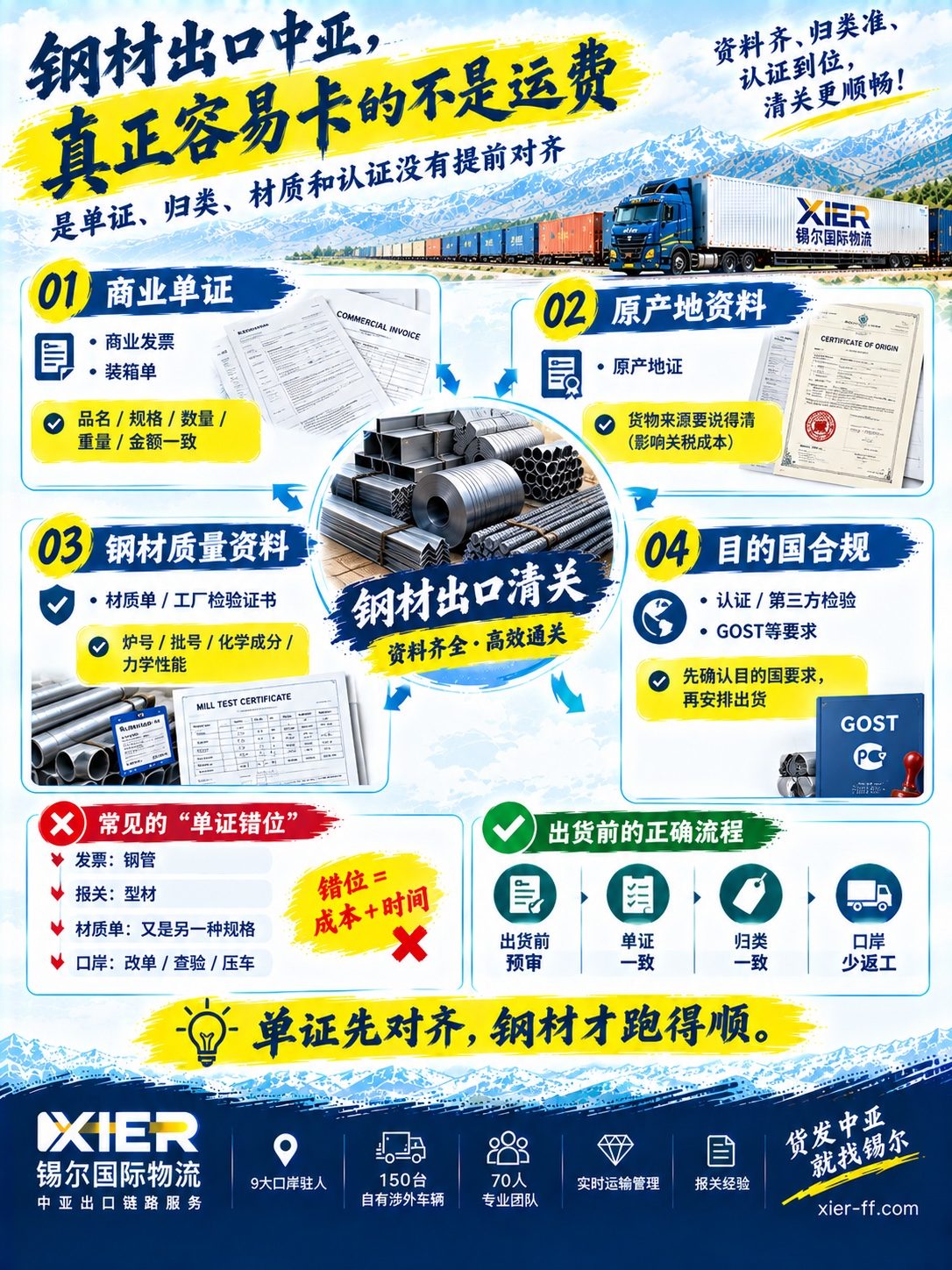
For steel exports to Central Asia, what really holds up time is often not transport but accompanying documents. The following types of materials are recommended to be prepared before shipment:
Commercial invoice and packing list.Product name, specifications, quantity, net/gross weight, unit price and amount must be consistent throughout, especially the product name must match the classification standard, avoiding the mismatch of "invoice says steel pipe, customs declares section steel."Certificate of origin.The Central Asia direction mostly applies the Generalized System of Preferences or bilateral preferential arrangements; the certificate of origin directly affects tariff cost, and it is recommended to issue it with the shipment.Quality and factory inspection certificate (material sheet).The heat number, batch number, mechanical properties, and chemical composition of steel are key documents for destination-country customs clearance and acceptance; missing any of them can directly stall unloading or acceptance.Packaging and marking.Steel is mostly shipped nude or in bundles; long-haul road transport requires anti-slip lashing, rust prevention, and clear shipping marks to ease terminal tallying and destination-country verification.
IV. Destination-Country Certification and Compliance: Don't Let "Shipable" Get Stuck at "Sellable"
Some Central Asian and CIS markets impose mandatory certification or standards (such as the GOST system) on steel; before export you must confirm whether the destination country requires certification or third-party inspection. Another easily overlooked point is trade remedy measures: certain steel categories face special regulation in some markets, and if you don't confirm before shipment, you may only discover the restriction at the port, losing the whole truckload to demurrage. Front-loading compliance is far cheaper than fixing it afterward.
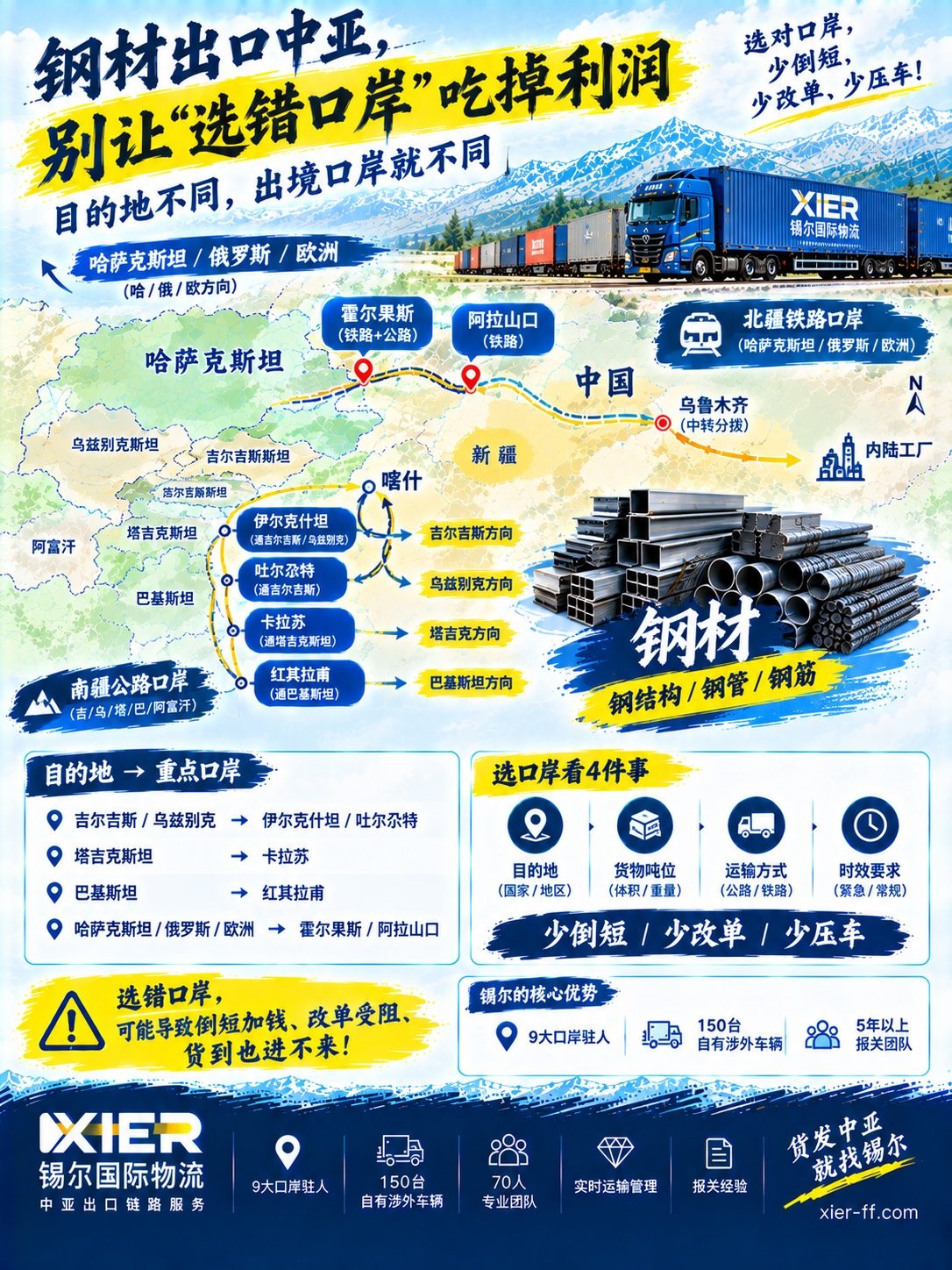
V. Choose the Right Port: Southern Xinjiang Road Ports Are the Shortcut to Kyrgyzstan/Uzbekistan/Tajikistan
Steel is bulky and heavy, so the choice of transport route directly affects the number of short hauls and the total cost. For shipments to Kyrgyzstan, Uzbekistan, Tajikistan, Pakistan, and Afghanistan, the southern Xinjiang road ports are the smoothest exit choice.Wuqia Irkeshtam Portis Xier's core advantage port with a long-term on-site team; field staff track the cargo upon arrival and handle inspection on the spot, with direct links to the Osh–Bishkek–Tashkent corridor, making it the smoothest road exit for the Kyrgyzstan/Uzbekistan direction; combined with southern Xinjiang road ports such as Torugart (to Kyrgyzstan), Karasu (to Tajikistan), and Khunjerab (to Pakistan), plus niche-line capabilities like the Afghanistan dedicated route, steel can be consolidated and exited from the nearest origin. For shipments to Kazakhstan, Russia, and Europe, use the northern Xinjiang Alashankou (China–Europe freight train main rail corridor) and Khorgos (rail + road dual corridor), connecting to the Urumqi multimodal hub. It should be emphasized that,Choosing the right port means less re-handling, fewer document revisions, and less vehicle idling. Xier has long-term staff at nine major ports, 150 self-owned foreign-trade transport vehicles, and a Kashgar customs declaration team with over five years of experience, using on-site presence at the ports to cover the uncertainties.About Xier International
VI. Pre-Shipment Self-Check List: Four Things to Clarify First
Before shipping steel smoothly, the enterprise itself can run a round of self-check first:First, what exactly is the form and material of the cargo.Sections, pipes, bars, and structural parts fall under different tariff items; the alloy composition and processing method determine the final code.Second, what certification does the destination country require.GOST, third-party inspection, certificate of origin—clarify in advance; don't wait until before unloading to find a certificate missing.Third, align documents and classification first.The commercial invoice, packing list, material certificate, and certificate of origin must be consistent front to back—easier than revising documents at the port.Fourth, is there on-site follow-up?At the same price, having someone on-site versus waiting for remote instructions can differ by several days in outcome. For a dedicated calculation, contact 18195891000 Get the plan.
Frequently Asked Questions
How exactly is the HS code determined for steel exports to Central Asia?
First look at the form and degree of processing: primary raw materials fall under Chapter 72, further processed products under Chapter 73; sections, pipes, bars, and structural parts each have corresponding tariff items (e.g., 7216 sections, 7304/7305/7306 pipes, 7213/7214 bars). However, the 8-digit and 10-digit subheadings must be confirmed against alloy composition, dimensions, and processing method; it is recommended to leave the determination to a customs declaration team with port experience rather than applying rules of thumb directly.
What accompanying documents are required for steel export?
Four core documents: commercial invoice, packing list, certificate of origin, and quality/factory inspection certificate (material certificate). The heat number, batch number, and mechanical properties of steel are key to destination-country acceptance; their absence will directly stall acceptance; the packaging marks must also be clear for easy port tallying.
Is destination-country certification (such as GOST) mandatory?
It depends on the specific country and product. Some Central Asian and CIS markets impose mandatory certification or third-party inspection requirements on steel; this must be confirmed before shipment, otherwise the goods may arrive but cannot be cleared or sold. It is recommended to front-load certification before shipment rather than re-apply at the port.
Which port is smoothest for steel pipes and rebar?
For shipments to Kyrgyzstan, Uzbekistan, and Tajikistan, prioritize southern Xinjiang road ports, among which Wuqia Irkeshtam is Xier's core on-site port, directly connecting Osh–Bishkek–Tashkent; for the Kazakhstan/Russia/Europe direction, use the northern Xinjiang Alashankou and Khorgos rail corridors. Choosing the right port reduces short hauls and vehicle detention; the specific plan is calculated based on cargo volume, tonnage, and timeliness.
Why do different logistics quotes for the same shipment of steel vary so much?
The difference usually lies in route and resources: which port, road or rail, whether there is on-site tracking, and whether documents are aligned at once—all roll into the total cost. A low quote with a mismatched port or no follow-up may end up recovering the price gap through days of vehicle detention. When comparing quotes, ask the other party to clarify "which port, what mode, who follows up at the port."
About the Author: Xier International Logistics — focused on Central Asia logistics market analysis and digital solutions. Based on a decade of Xier's operational data and industry research, this article is for reference only; specific solutions must be tailored to your cargo.