I. Where Exactly Is the "Deep Water": Four Types of Information Gaps
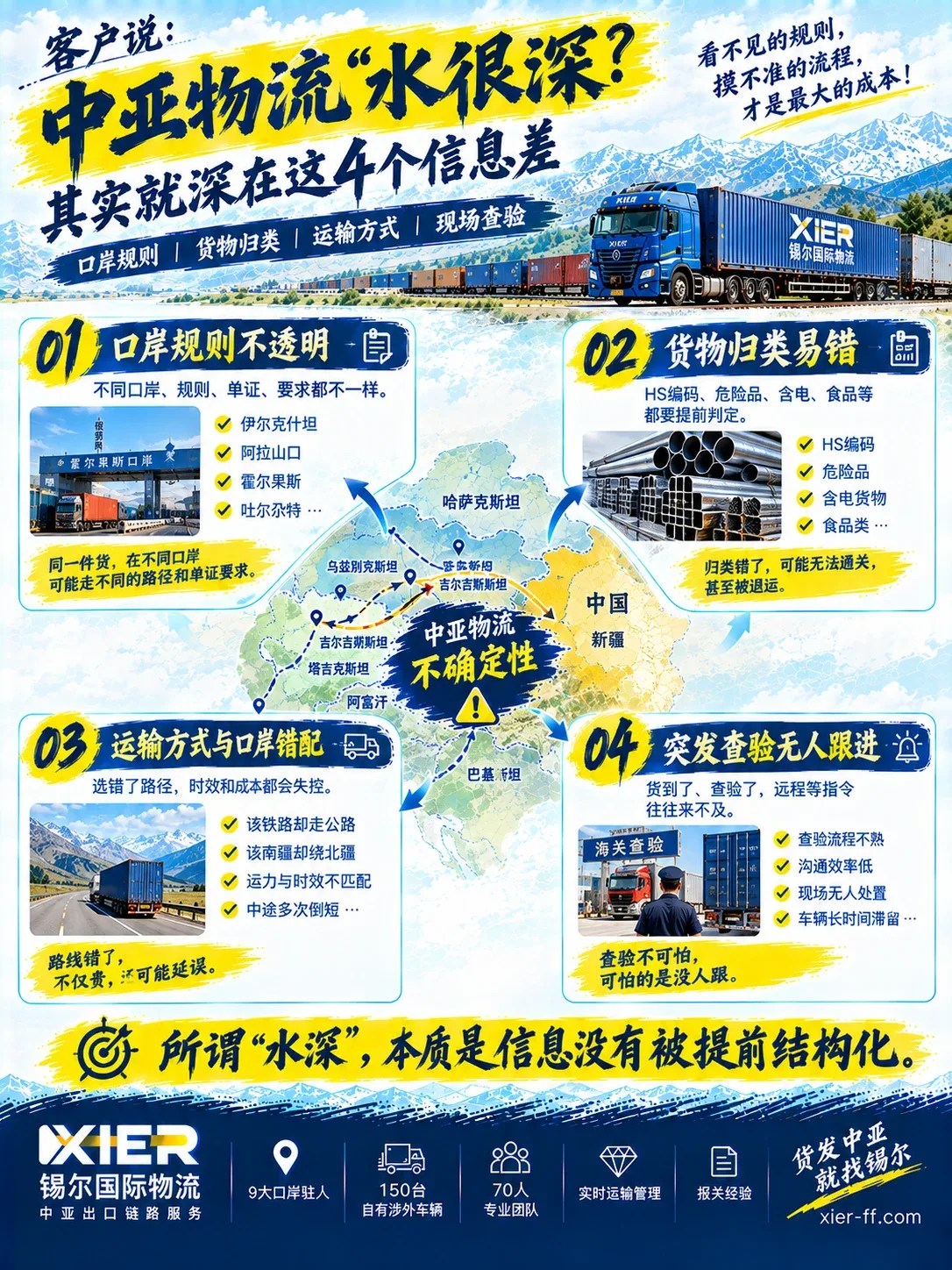
Many enterprises exporting to Central Asia for the first time keep saying "logistics is a deep water." This feeling does not come from nowhere but is the result of four types of information gaps stacked together. The first type isopaque port rules: For the same commodity, the paths and document requirements that can be taken at Irkeshtam, Alashankou, and Khorgos are different, and enterprises often only figure it out after problems arise. The second type iserror-prone cargo classification: HS code filled wrong, or dangerous / electrical goods qualifications not judged in advance — only at the port do they find "this shipment cannot go this way." The third type ismode-port mismatch: Those that should go by rail are consolidated onto road, those that should use southern Xinjiang road ports detour to northern Xinjiang — both transit time and cost spiral out of control. The fourth type isunattended sudden inspection: Goods arrive, inspection happens, but waiting remotely for instructions is often half a beat slower than on-site handling, and a vehicle gets held for days. Laying these four information gaps out, the so-called "deep water" can actually be managed structurally.
II. Break Uncertainty Into Five Controllable Links
The approach of a professional team is not to wait for the enterprise to step on a pit and then fight the fire, but to break transport into five links before shipment and align each one.
Link 1, cargo classification.First determine the HS code, then confirm the port qualifications for special goods such as dangerous, electrical, and food — first clarify "whether it can go," so there is no rework later.Central Asia Cross-Border Logistics
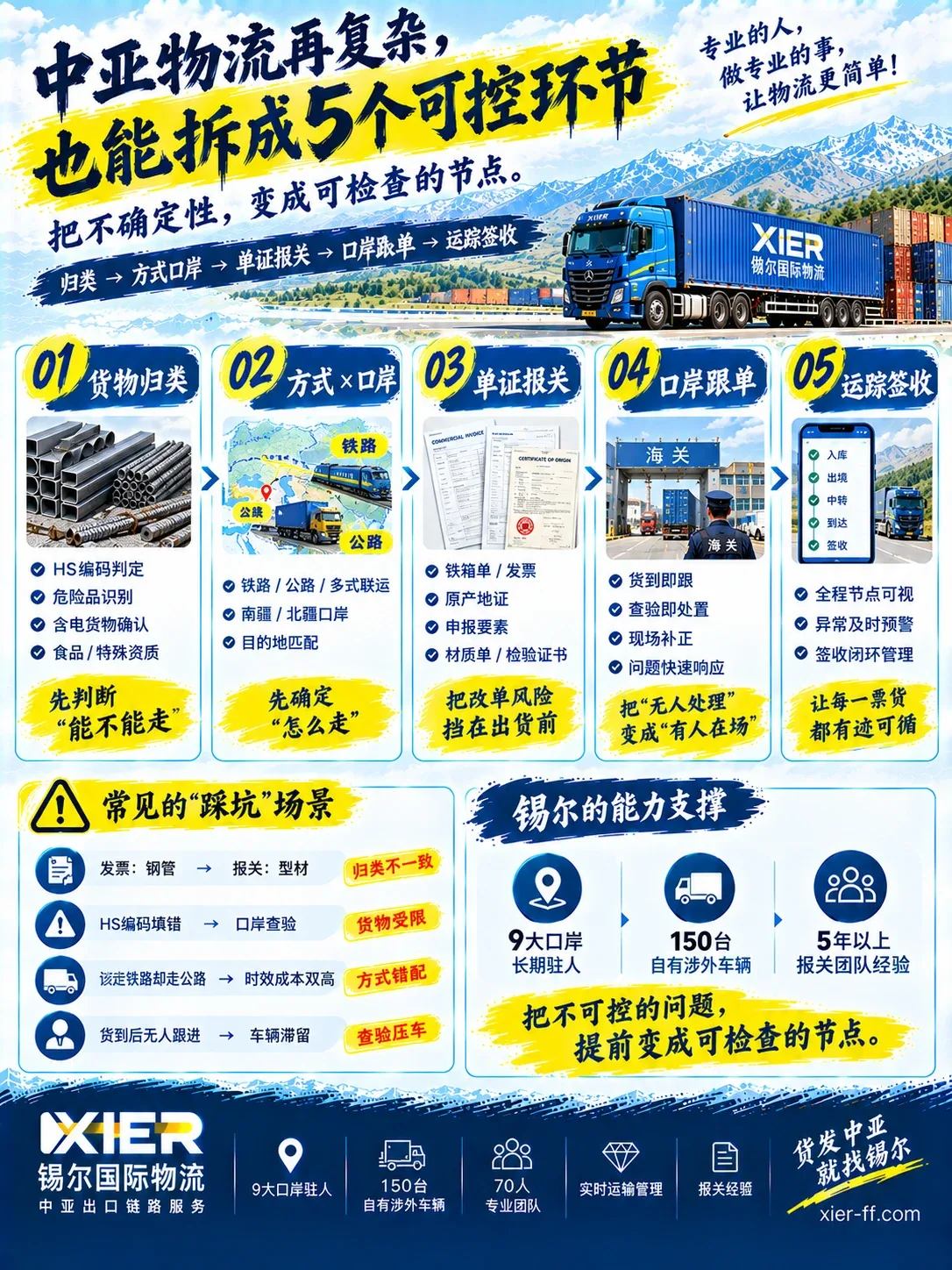
Link 2, transport mode and port matching.For shipments to Kazakhstan, Russia, and Europe, the main route is the northern Xinjiang railway corridor; for Kyrgyzstan, Uzbekistan, Tajikistan, Pakistan, and Afghanistan, road is more direct. If this step is wrong, it is almost impossible to correct at low cost later.
Link 3, documents and customs declaration.Packing list, invoice, certificate of origin, and declaration elements aligned at once — minimize document revisions. Xier's customs team has an average of over 5 years of experience and knows the declaration standards of each southern Xinjiang port.
Link 4, port tracking and inspection.This is the link that most depends on "being on-site." Track the order on goods arrival and handle inspection immediately — it relies on long-term on-site port staff, not remote phone calls waiting for instructions.
Link 5, transport tracking and sign-off.From warehousing to sign-off node feedback, the whole process is visible, and sign-off closes the loop. Stringing the five links together, uncertainty becomes one checkable node after another.
III. Port Resources Are the Hard Backing of Professionalism: What On-Site Staff at 9 Major Ports Means
What makes the above five links implementable is not rhetoric but hardware-like resource layout. Xier has long-term staff at 9 major ports, 150 owned foreign-related transport vehicles, and a customs team averaging over 5 years of experience — this means for the same shipment, having someone on-site reduces short-haul, document revisions, and vehicle holds.
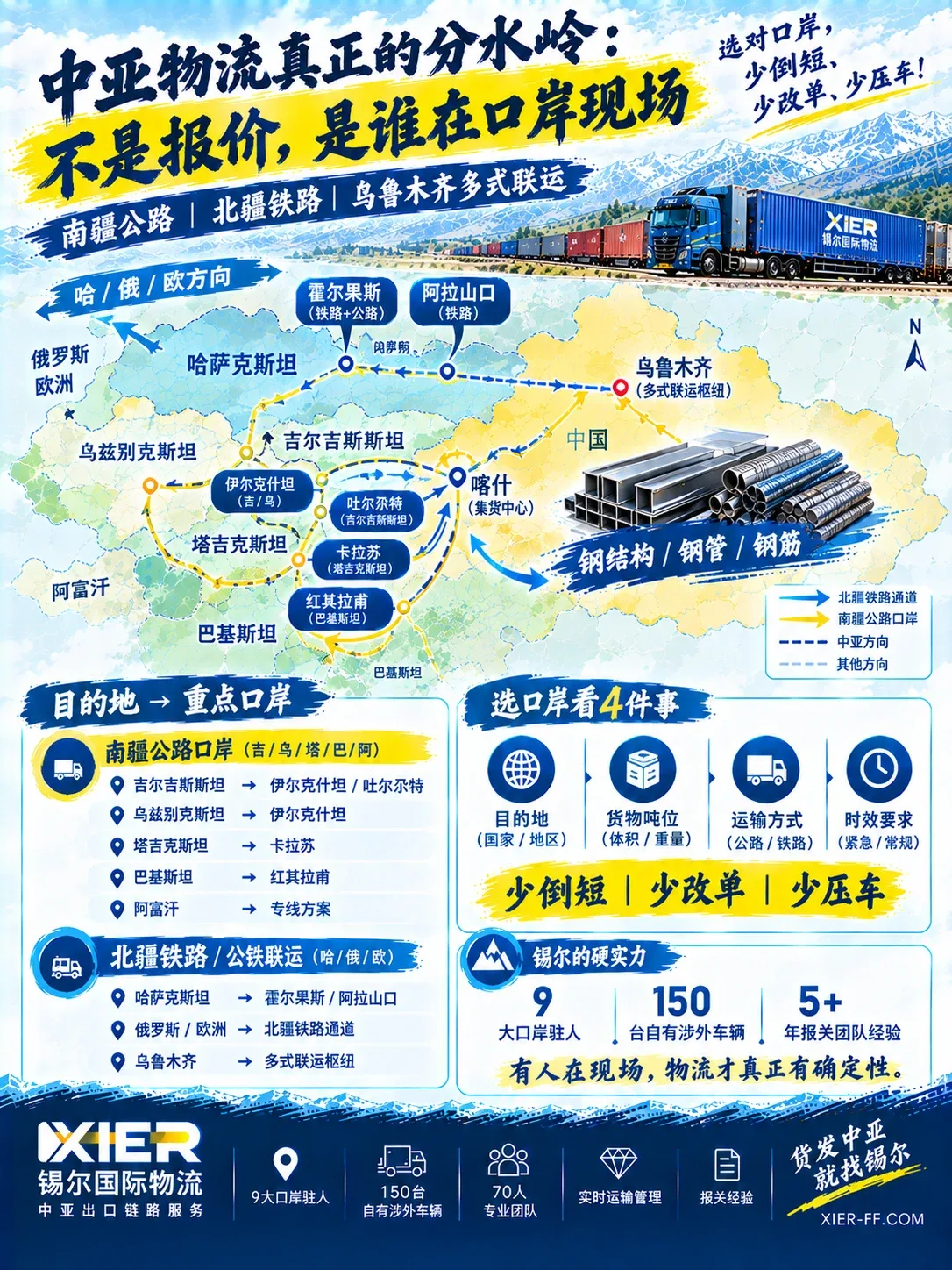
For the Kyrgyz / Uzbek / Tajik / Pakistan / Afghanistan directions, the core isWuqia Irkeshtam Port— this is Xier's core advantage port with long-term on-site presence; the field team tracks the order on goods arrival and handles inspection immediately, directly connecting the Osh — Bishkek — Tashkent line, the smoothest road exit for the Kyrgyz / Uzbek direction; combined with southern Xinjiang road ports such as Torugart (to Kyrgyzstan), Karasu (to Tajikistan), Khunjerab (to Pakistan), and niche-line capability like the Afghanistan dedicated line that large platforms are unwilling to touch, it forms a road network covering South Asia and the Central Asian heartland. For the Kazakhstan / Russia / Europe directions, it uses the northern Xinjiang Alashankou (China-Europe train main railway corridor) and Khorgos (rail + road dual corridor), connecting with the Urumqi multimodal hub for consolidation and distribution. For dangerous goods and hazardous chemical transport, the corresponding qualifications and declaration capability can also be undertaken. For export enterprises,Choosing the right port means less re-handling, fewer document revisions, and less vehicle idling— and this is precisely why professionalism must be grounded at the 'port' level.About Xier International
IV. Pre-Shipment Self-Check List: Clarify Four Things First
To turn "deep water" into "controllable," enterprises themselves can first do a round of self-check, then find a team with port experience for calculation:
First, clarify the destination and cargo nature.Which country, whether it is dangerous / electrical / food, directly determines which ports can be used and what qualifications are needed.Second, fix the transport mode and port first.For large planned shipments, prioritize rail; for small batches, door-to-door, and urgent replenishment, prioritize road; once the direction is set, the port is basically determined.Third, align documents and classification first.Confirming the HS code, certificate of origin, and declaration elements before shipment is much easier than revising documents at the port.Fourth, is there on-site follow-up?At the same price, having someone on-site versus waiting remotely for instructions can differ by several days in results. Clarifying these four things makes the quote more accurate and the plan more stable. For a dedicated calculation, contact 18195891000 Get the plan.
Frequently Asked Questions
Why do different logistics providers quote very differently for the same shipment?
The difference is often not in the "freight" itself but in the underlying path and resources: which port, road or rail, whether there is on-site tracking, whether documents are aligned at once — all roll into the total cost. A low quote but with port mismatch or no follow-up may ultimately recover the price difference through days of vehicle holds. When comparing prices, it is recommended to have the other party clarify "which port, what mode, who follows up at the port."
Which ports can dangerous or electrical goods go through?
Such goods have hard requirements on port qualifications and declaration, and not all ports can accept them. For enterprises involving chemicals, lithium batteries, and hazardous chemicals, the choice of transport mode must first pass the "qualification gate." Xier has the corresponding qualifications and declaration capability, able to undertake the niche lines that large platforms are unwilling to touch, but whether and which port it can go through must be judged in advance based on the goods' MSDS and packaging information.
What if goods are inspected at the port?
Inspection itself is not scary; what is scary is no one handling it on-site. Xier has long-term staff at 9 major ports; the field team tracks the order on goods arrival and handles inspection immediately, able to cooperate with customs on-site and supplement materials, avoiding long vehicle detention. Aligning documents and classification before shipment can reduce the probability of detention after inspection at the source.
How to judge whether a Central Asia logistics company is reliable?
Just look at three things: first, whether there is on-site port staff (rather than pure agent re-dispatch); second, whether there is own transport capacity (Xier's 150 owned foreign-related vehicles); third, whether there is a stable customs team (Xier averages over 5 years of experience). These three points determine whether a shipment problem is "someone solving it on the spot" or "both ends waiting on the phone."
What information should I prepare before shipment for an accurate quote?
Four pieces of information are most critical: destination country, cargo name and nature (whether dangerous / electrical / food), approximate cargo volume and size, and expected transit time. Giving these four to a team with port experience yields an actionable transport mode and port plan, rather than a vague "approximate price."
About the Author: Xier International Logistics — focused on Central Asia logistics market analysis and digital solutions. Based on a decade of Xier's operational data and industry research, this article is for reference only; specific solutions must be tailored to your cargo.