I. Why Central Asia Cross-Border Freight Especially Needs Insurance
Shipping goods from Xinjiang to the five Central Asian countries, Afghanistan, or via Russia to Europe, the chain is much longer than domestic trade: roads must cross mountains and ports, railways must change gauge and transload, and sea-rail multimodal requires multiple transshipments. Each segment has the possibility of cargo damage, loss, wet damage, and shortage; when encountering port inspection detention or extreme-weather road closures, delays cascade and amplify. Customs only bears "reasonable care" responsibility for import-export goods; commercial risks during transport are mainly covered by insurance.
Many foreign trade enterprises suffer their first setback when goods arrive in Almaty or Shymkent only to find cartons crushed, damp, or short-packed, with the carrier refusing compensation citing "improper packaging" or "inherent loss," and having themselves bought the wrong insurance type. In fact, transport risk can be planned before shipment — Xier International Logistics has long-term staff at 9 major ports, 150 owned foreign-related transport vehicles, and a Kashgar customs team with over 5 years of experience, and can factor in vulnerable points and port stay time at the planning stage; Tel 18195891000.
II. Which Freight Insurance to Buy: How to Choose Basic, Comprehensive, All-Risk
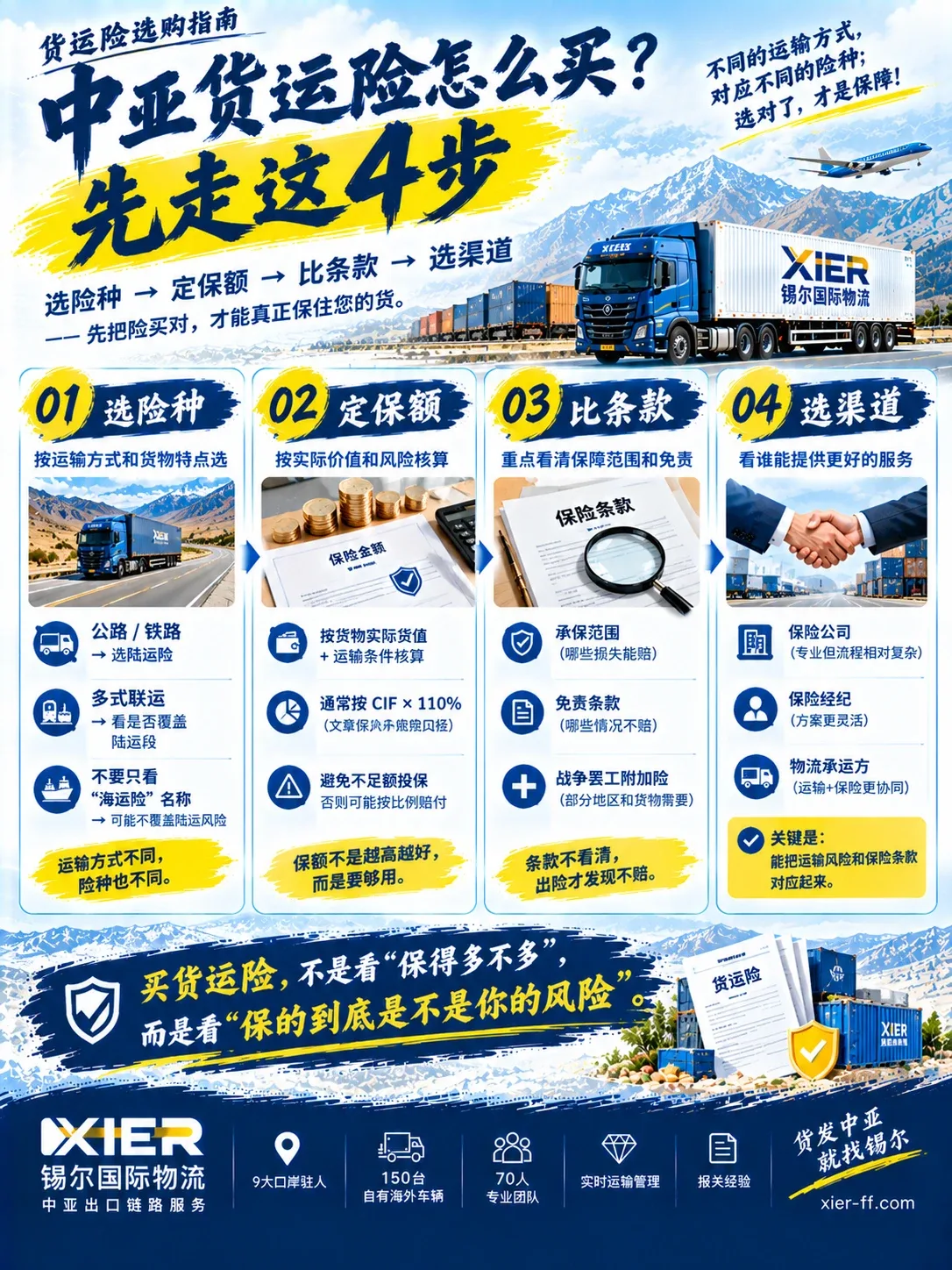 图1:中亚货运险怎么买?先走 4 步——选险种、定保额、比条款、选渠道,把险买对才是真保障。
International freight insurance commonly has three tiers:Basic riskThe narrowest coverage, usually only core accidents (such as conveyance collision, fire, explosion);Comprehensive riskExtends basic risk to cover common risks such as theft, rain damage, and breakage;All-riskThe broadest coverage, pays almost everything except expressly excluded, with the highest premium. For goods to Central Asia, comprehensive risk is the cost-performance baseline; for fragile items such as electromechanical products, ceramics, and glass, all-risk is recommended directly.
The core of choosing the tier is "cargo value × fragility × chain complexity." A full-truckload of steel on a dedicated rail line with standard packaging is sufficiently covered by comprehensive risk; a consolidated shipment of daily ceramics to Tashkent via two transloadings deserves all-risk. If unsure how to configure, you can first go throughContact Xier International Logisticsto get a customized transport + insurance suggestion based on cargo characteristics.
III. How to Set the Insured Amount: Don't Stumble on the Invoice Amount
The insured amount is not filled in randomly. The standard practice isinvoice amount + freight + a certain proportion of expected profit (usually insured at 110% of CIF value). The most common pitfall is "underinsurance" — to save premium, only insuring at 70% of cargo value; when an incident occurs, the insurer pays proportionally, and you bear the remaining 30% yourself. On a 100,000 USD shipment insured for only 70,000, the claim maxes out at 70,000, with a 30,000 gap lost for nothing.
Another pitfall is estimating "by weight" rather than "by cargo value." High-value-added electronic parts are small in volume but high in value; estimating insured amount by tonnage will inevitably be severely insufficient. Before insuring, have the freight forwarder or insurance broker verify the value range corresponding to the HS code — more worry-free than arguing afterward.
IV. What Is Covered and What Is Not: Read the Exclusion Clauses Carefully
All-risk is not "everything paid" either. Typical exclusions include: inherent defects or natural loss of goods (such as natural weight loss of grain, evaporation of liquids), damage from improper packaging, losses during the shipper's responsibility period, and war / strike risk not separately attached. If going through complex-situation directions to Central Asia, you need to separately confirm whether to addwar risk, strike risk。
The most easily overlooked in the exclusion clauses is "improper packaging." Wooden boxes not IPPC-fumigated, cartons not pressure-resistant, naked items not fixed — after an incident, insurers often reject claims citing packaging responsibility. This also explains why choosing the right packaging is as important as choosing the right insurance type — relevant standards can be referred toXier International packaging and customs service。
V. Claims in Practice: Standard Actions from Incident to Payment
When a real incident occurs, being one step slow may forfeit the claim right. The standard process is:Photograph / video record evidence on-site immediately → Report to both the carrier and the insurer within 24 hours → Obtain port or third-partyinspection report → Prepare waybill, invoice, packing list, claim form, and other documents → submit the claim. Missing any link may lead to reduced payment or even rejection.
Real case:A Urumqi building materials enterprise shipped a batch of tiles to Bishkek via Irkeshtam Port land transport. Before loading, Xier's on-site staff found the wooden pallets were not moisture-proofed and suggested adding stretch film; after the enterprise adopted it, no wet damage occurred despite rain en route. Another customer in the same batch, for convenience, skipped protection, and upon arrival found cartons damp and outer boxes damaged, with the insurer deducting about 30% of the payment due to "improper packaging." Same port, same weather — the protection action determined whether and how much was paid.
This also points out a client-perspective fact: choosing a 7×24-hour clearance port (such as Irkeshtam) and reducing the goods' open-air stay at the port is itself a means to reduce cargo damage and preserve the evidence chain. Xier International has long-term on-site presence at Irkeshtam, able to follow up on inspection, release, and protection on-site, minimizing the impact of port detention on goods.
VI. Proactively Manage Risk: Three Things Beyond Insurance
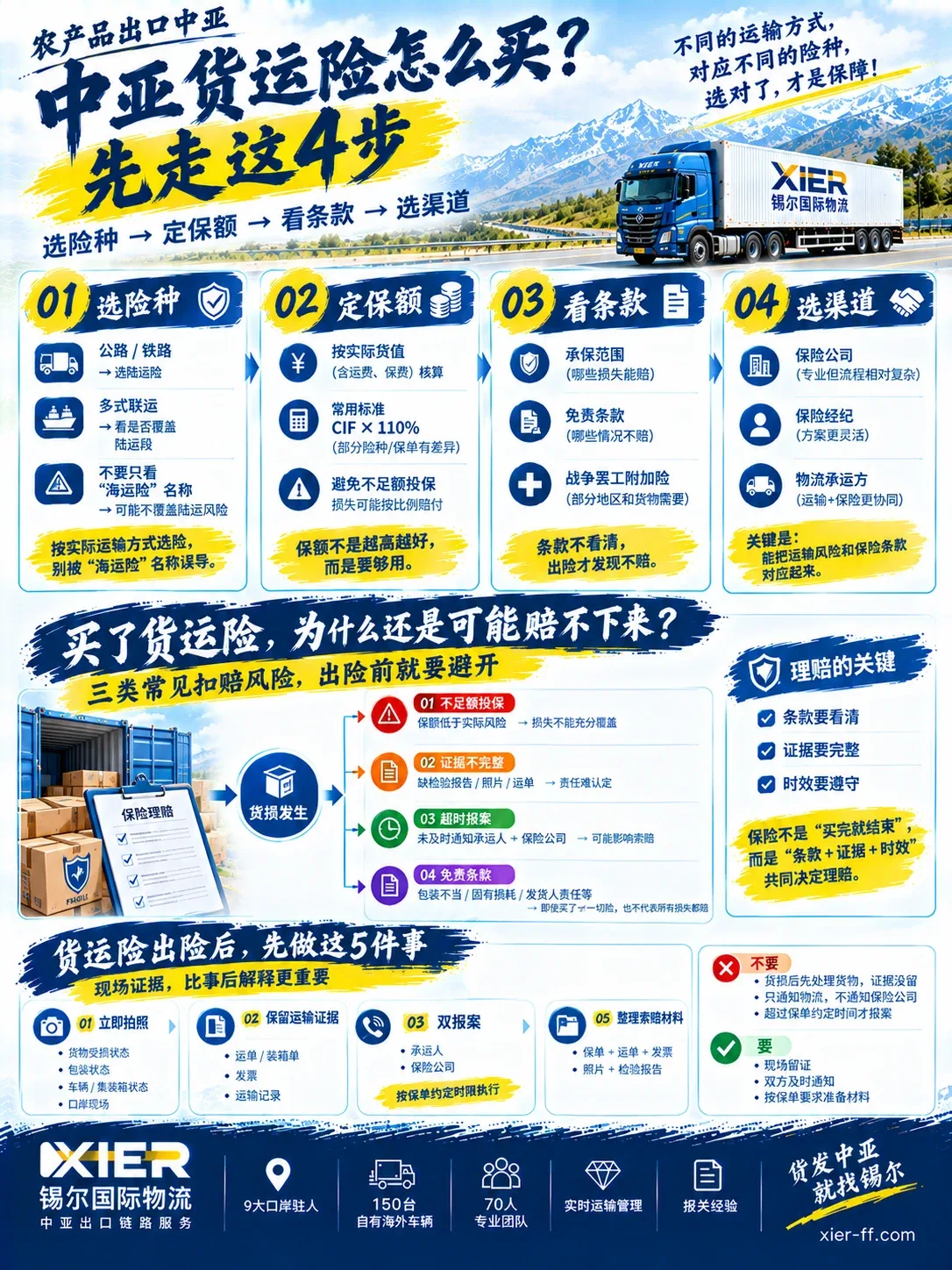 图2:三类常见拒赔风险与出险后先做的 5 件事——现场证据比事后解释更重要。
Insurance is after-the-fact compensation; what really reduces cost is raising certainty beforehand. For goods to Central Asia and Afghanistan, it is recommended to simultaneously watch three things: first,choose the right port and route— southern Xinjiang Irkeshtam is smoothest to Uzbekistan and southern Kyrgyzstan, Torugart corresponds to northern Kyrgyzstan, Karasu leads to Tajikistan, Khunjerab leads to Pakistan; second,get packaging and documents right, reducing detention and rejection; third,choose a carrier with on-site and customs teams, someone on-site to handle problems when issues arise.
For the northern Xinjiang direction, Khorgos (rail + road dual corridor) and Alashankou (main railway corridor) are more suitable for bulk containers; Urumqi can connect multimodal transport, combining road consolidation with rail trunk lines. For the Kyrgyz / Uzbek / Tajik / Pakistan / Afghanistan directions, prioritizing Irkeshtam and confirming the carrier's on-site presence and transit time data at that port is the standard play for this line. For more vehicle types and capacity, seeXier owned fleet vehicle models; actual route cases seeXier Customer Cases。
Frequently Asked Questions
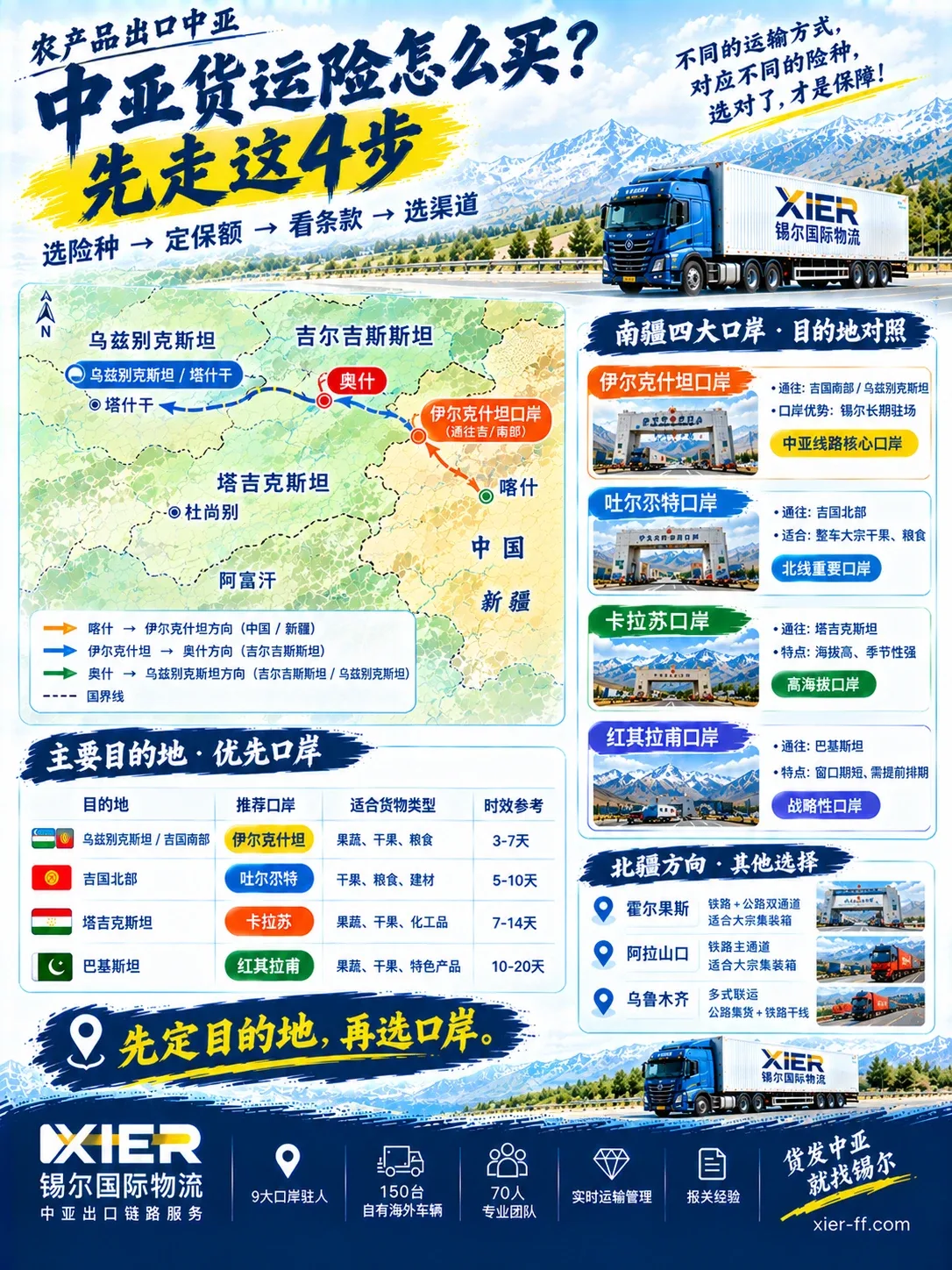 图3:农产品出口中亚,先定目的地再选口岸——南疆四大口岸(伊尔克什坦/吐尔尕特/卡拉苏/红其拉甫)目的地对照与主要目的地时效参考。
Q1: For Central Asia by land, buy marine or land transport insurance?
Insure according to the actual transport mode. Road / rail land transport should buy land transport insurance (or multimodal insurance covering the land segment); you cannot apply marine insurance clauses that only cover water voyages, otherwise land-segment cargo damage may not be covered.
Q2: Is all-risk really "everything paid"?
No. All-risk pays everything except expressly excluded, but inherent loss, improper packaging, losses during the shipper's responsibility period, and unattached war / strike risk remain excluded. Before insuring, read the exclusions item by item; don't be misled by the name.
Q3: Can the insured amount be filled in by invoice amount?
Too low. The standard is to insure at 110% of CIF value (cargo value + freight + premium) to cover expected profit. Insuring only by invoice amount means you bear the profit portion and excess loss yourself when an incident occurs; underinsurance also leads to proportional payment.
Q4: If goods are damaged during port inspection, will the insurer pay?
The key is the cause of damage and the policy terms. If it is a transport-risk within coverage, it can be paid with the inspection report; if deemed improper packaging or inherent defect, it is usually excluded. Therefore, choosing a 7×24 clearance port, reducing detention, and keeping on-site evidence directly affect whether the claim goes smoothly.
Q5: How soon after an incident must you report?
Each policy differs, but generally requires dual reporting to both the carrier and the insurer within 24 hours after the incident, and obtaining a third-party inspection report. Late reporting may forfeit the claim right; on-site photos and waybill are the most basic evidence.
About the Author: Xier International Logistics — focused on Central Asia logistics market analysis and digital solutions. Based on a decade of Xier's operational data and industry research, this article is for reference only; specific solutions must be tailored to your cargo.