The 16th China-Eurasia Expo (CAEXPO) opened on August 14 in Kashgar. Shandong set up three exhibition zones with 88 enterprises; Xinjiang local agricultural specialties and agricultural machinery enterprises made concentrated appearances, with multiple signed projects for agricultural products and machinery exports to Central Asia landing. But many enterprises are stuck on a practical problem:Signing is easy, but how to stably transport the goods?
Agricultural machinery is bulky, and agricultural products fear damage and spoilage; their requirements for transport routes, port clearance, and cold-chain packaging are completely different from ordinary goods. Starting from CAEXPO signed projects, this article breaks down the 5-step export-to-Central-Asia logistics landing, helping enterprises truly turn "signing" into "arrival".
I. The Logistics Proposition Behind CAEXPO Signings
Under this CAEXPO theme "Building the Eurasian Golden Corridor, Sharing Silk Road Cooperation Opportunities", 44 countries and regions and nearly 1,400 enterprises participated. Xinjiang agricultural specialties (walnuts, dried fruits, nuts) have a natural advantage via southern Xinjiang ports; Shandong agricultural machinery enterprises (Weichai Lovol, etc.) use the expo to expand Central Asia channels. Demand from the five Central Asian countries for agricultural machinery and products continues to grow.
But exporting enterprises generally encounter three types of landing difficulties:Agricultural machinery is large and heavy(ordinary LTL can't load it, needs full truckload or framework),Strict inspection and quarantine for agricultural products(incomplete phytosanitary documents or sealed packaging will be returned),Unfamiliar with ports(wrong port selection costs days or even gets stuck). Logistics landing tests execution more than signing.
II. Five-Step Logistics Landing for Export to Central Asia
Xier International Logistics breaks agricultural machinery/products export to Central Asia into 5 standard steps, each followed by port field staff, avoiding the unclear "where are the goods" problem:
- Step 1 Goods Preparation and Consolidation: origin warehouse or factory collection; agricultural machinery grouped by unit, agricultural products by batch; labeling and counting to generate waybill.
- Step 2 Inspection Declaration and Customs Clearance: HS code pre-review, agricultural products process inspection and quarantine documents, agricultural machinery checks tax-related codes and regulatory conditions.
- Step 3 Southern Xinjiang Port Exit: Kashgar bonded warehouse assembly, Irkeshtam/Torugart customs declaration and inspection, average release 2-4 hours.
- Step 4 Overseas Trunk Transport: road trunk distribution across the five Central Asian countries, full GPS tracking, first-time alerts on anomalies.
- Step 5 Door-to-Door Signed Receipt: direct signed receipt in destination cities such as Almaty/Tashkent/Bishkek.
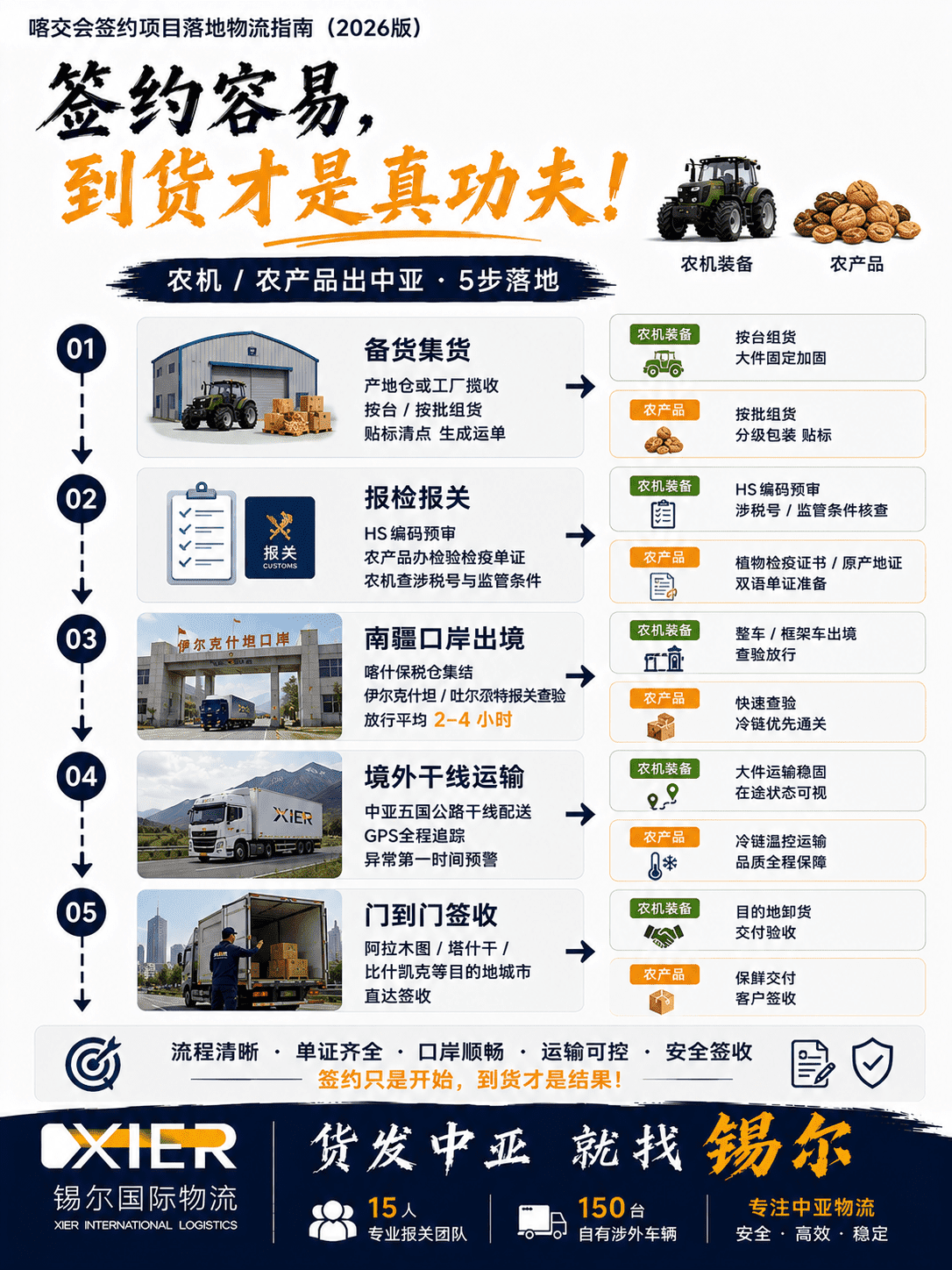 图1:出口中亚物流5步落地标准作业
III. Southern Xinjiang Port Route Selection: Which Port for Machinery and Products
The four major southern Xinjiang road ports each have adapted directions; wrong selection not only costs more but may also stall timeliness:
- Irkeshtam: leads to Uzbekistan and Tajikistan, core southern Xinjiang port, first choice for dried fruits/nuts and fresh fruit cold chain, with Xier's own vehicles stationed.
- Torugart: leads to Kyrgyzstan, commonly used for agricultural machinery and tractors, convenient for full-truckload framework transport.
- Karasu: the route to Tajikistan, seasonally open (May–October); in winter, detour via Irkeshtam.
- Khunjerab: leads to Pakistan, highest altitude, suitable for Pakistan-bound agricultural products.
 图2:农机/农产品货型与出口路线匹配参考
Route selection depends on cargo type, destination, and timeliness. Xier has resident field staff at nine major ports; helping customers choose the right route saves more cost than blind shipping. Related reading:Which Route for Shipping to Afghanistan、How to Ship Logistics to Uzbekistan。
IV. Agricultural Product Export: Inspection, Quarantine, and Cold Chain Key Points
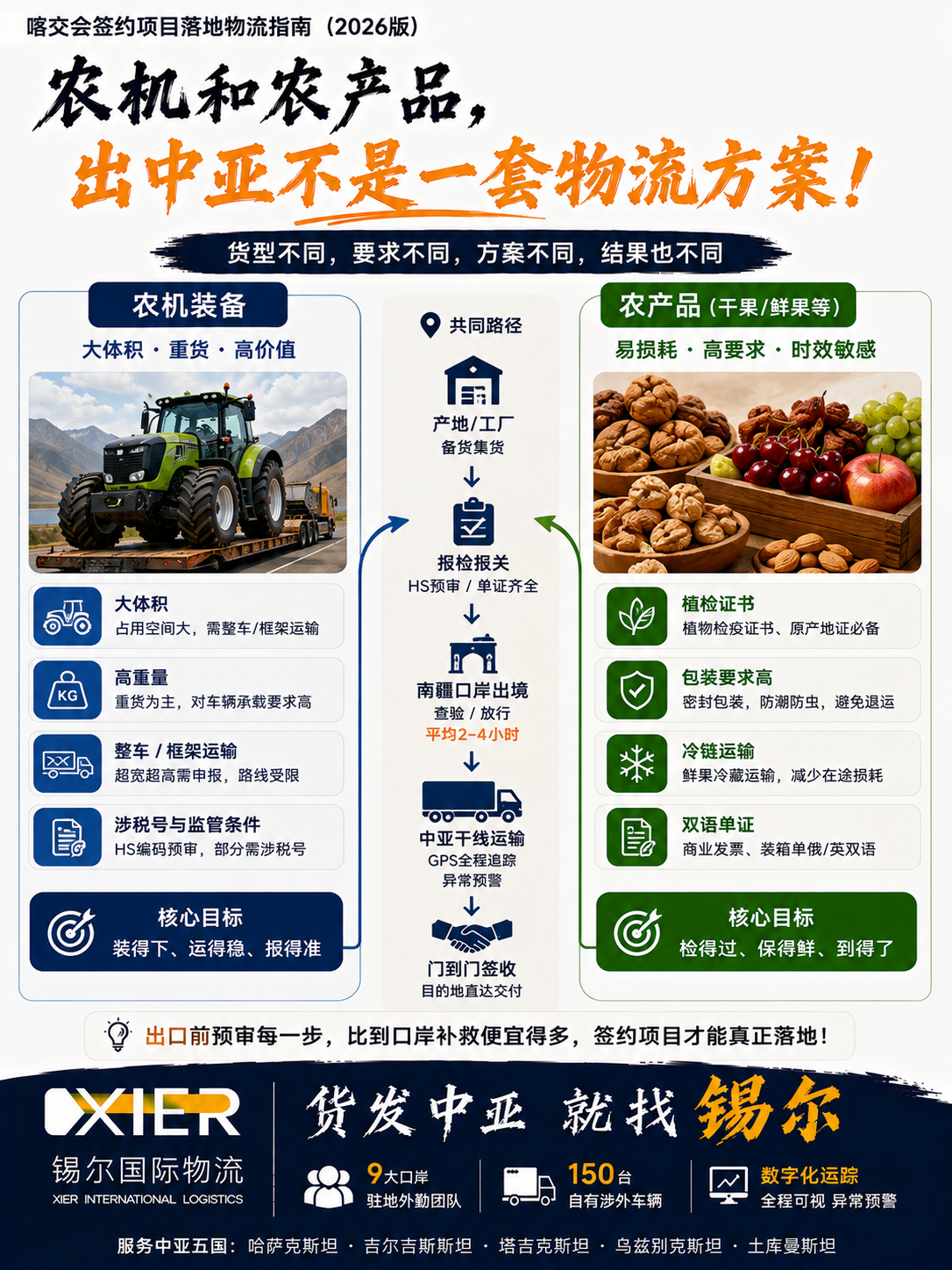 图3:农机装备与农产品出口中亚方案差异
For agricultural products exporting to Central Asia, documents and packaging are the two major thresholds:
- Inspection and Quarantine Documents: dried fruits and nuts require phytosanitary certificates and certificates of origin; sealed packaging, moisture-proof and pest-proof measures in place to avoid return upon arrival.
- Cold Chain Packaging: fresh fruits like cherries and apples go by refrigerated truck, with fast clearance at Irkeshtam to reduce in-transit loss.
- Bilingual Documents: commercial invoices and packing lists in Russian/English bilingual format to reduce port communication costs.
Xier's customs team has an average of over 5 years of experience and can assist in pre-reviewing HS codes and phytosanitary documents, blocking rejection risk before exit.
V. Xier International Logistics' Landing Solution
For CAEXPO signed projects, Xier provides three core guarantees:
- Nine-Major-Port Resident Field Staff: throughout cargo entry, inspection, and release, staff follow up in person — not via remote phone directing of drivers.
- 150 Owned Foreign-Trade Vehicles: equipped at major Southern Xinjiang ports — no container dumping in peak season, guaranteed emergency support.
- Digital Tracking Platform: every step from warehousing to signing is visible, with anomalies alerted in real time.
Real Cases: walnuts from a Xinjiang dried-fruit enterprise shipped to Tashkent exited via the Irkeshtam port; phytosanitary documents passed pre-review on first try, taking 9 days from origin consolidation to customer signing. For hard metrics to judge a logistics company, refer to5 Hard Indicators for Choosing a Cross-Border Logistics Company。
Frequently Asked Questions (FAQ)
Q1: What qualifications are needed for agricultural machinery export to Central Asia?
Agricultural machinery itself is general trade export, requiring HS code declaration, commercial invoice and packing list; if it contains an engine/battery, corresponding compliance documents are needed. Some machinery can enjoy origin policies; Xier can assist with pre-review.
Q2: Do agricultural products need phytosanitary documents for export?
Dried fruits/nuts and fresh fruits require phytosanitary certificates and certificates of origin, with sealed moisture-proof packaging. Incomplete documents may lead to return upon arrival; pre-review before exit is recommended.
Q3: Which southern Xinjiang port is fastest?
Irkeshtam is the core southern Xinjiang port with average release 2-4 hours; Torugart suits Kyrgyzstan-bound machinery. Route selection depends on destination, not just proximity.
Q4: How to keep cold-chain agricultural products fresh?
Refrigerated truck + fast clearance combination, with priority arrangement for Irkeshtam exit to reduce transit time. Use moisture-proof and thermal-insulated packaging materials for better quality assurance upon arrival.
Q5: How Is Freight Calculated?
Agricultural machinery quoted per unit/volume; agricultural products by weight or volume (whichever is greater). Includes trunk + port customs declaration + overseas delivery; for specifics call 18195891000 for cargo-type-based calculation.
About the Author: Xier International Logistics — focused on Central Asia logistics market analysis and digital solutions. Based on a decade of Xier's operational data and industry research, this article is for reference only; specific solutions must be tailored to your cargo.