I. Why is the customs clearance process the most likely to cause delays
Many cargo owners focus their efforts on finding trucks and pressuring freight rates, only to find that their goods are delayed at the customs clearance stage. Although the five Central Asian countries are geographically connected, each country has very different customs rules, document requirements, and certification systems. The materials needed for the same batch of building materials can vary by a factor of two when transported through Kazakhstan and Turkmenistan.
Customs clearance issues can lead to delays of a few days and increased storage costs, or even the return or seizure of the entire shipment. Therefore, it is more cost-effective to understand the customs thresholds of the destination country before shipping to Central Asia than to try to put out fires after the fact. Below, we break down the requirements by country, and finally provide a quick reference table.
II. Kazakhstan: Focus on HS codes and certifications
Kazakhstan is the largest economy in Central Asia with a relatively mature customs system and transparent documentation requirements. Basic materials include commercial invoices, packing lists, contracts, transport documents, and origin certificates. As a member of the Eurasian Economic Union, it can also use the unified customs clearance process within the union, which is more efficient.
There are two common pitfalls in practice: one is incorrect HS code classification, which can lead to incorrect customs duties or the need for additional explanations; the other is incomplete certification documents, such as technical compliance proof required for some electromechanical products. For how to submit these documents at land border crossings, you can refer to ourOperational Analysis of the Khorgos Land Border Crossing; If the consignee is in the eastern part of Kazakhstan,Baktu / Jimunai, these two routes to Kazakhstan are also worth comparing in terms of routes.are also worth considering.
III. Uzbekistan: Rapid reforms, high requirements for certification and localization
Uzbekistan has made significant customs reform efforts in recent years, moving towards electronicization and acceleration overall, but the pace of implementation varies by region. The document system is similar to that of Kazakhstan, and it is particularly important to note that some categories require local certification and labeling language, and importers often need to prepare customs clearance authorization in advance.
The most secure approach is to prepare the certification list and customs clearance authorization item by item before shipment, rather than waiting until reaching the port. Preparing in advance can minimize the repeated communication at the port, making the overall delivery period more controllable.
Four, Kyrgyzstan: Alliance Channel, Process relatively simplified
Kyrgyzstan is also a member of the Eurasian Economic Union, and customs clearance can make use of the unified framework within the alliance, with a low repetition rate of documents, and the overall process is simpler than that of non-members. It is also very suitable as a transshipment or distribution node - many goods destined for surrounding countries will first arrive in Bishkek for a second transfer.
It should be noted that the throughput capacity of Kyrgyzstan's border ports is limited, and queuing is obvious during peak seasons. When choosing routes, don't just look at the simplicity of the documents, but also consider the queuing time at the ports. For how to compare the timeliness and cost of rail and road routes, ourRail vs. Road Route Selection Guidecontains specific cost inflection point analysis.
Five, Tajikistan: Many mountainous roads, border and inland transportation are key
Tajikistan's terrain is mainly mountainous, with long and complex transportation distances from ports to the interior, and customs clearance itself is not the most demanding, but the logistics connection is most prone to accidents. Goods heading to Dushanbe are usually imported through the Turgar Pass or Irkeshtam Port and then transported by land to the interior.
Therefore, for shipping to Tajikistan, customs documents should be prepared according to standard procedures, but the real challenge lies in 'the road after the port.' It is recommended to confirm the responsibility for cross-border transportation with the carrier before shipment to avoid the risk of goods being stuck in the gap between the port and the interior.
Six, Turkmenistan: The Most Isolated, Quotas and Permits Are Major Barriers
Among the five countries, Turkmenistan has the highest customs clearance threshold. It is not a member of the Eurasian Economic Union and operates its own permit and quota system. Many categories of imports require prior approval, and in addition to the documents, additional import permits are required. The process cycle is long and uncertainty is high.
If the business involves Turkmenistan, the most secure approach is to have the importer obtain the permit before shipment and include the approval cycle in the overall delivery time. Otherwise, if the goods arrive at the door and the permit has not been obtained, the storage costs will quickly eat into the profit.
Seven, Customs Clearance Quick Reference Table for the Five Countries
| Country | Union Membership | Document Characteristics | Main Bottlenecks | Practical Suggestions |
|---|
| Kazakhstan | Eurasian Economic Union | Mature system, high level of electronicization | HS Coding, Product Certification | Pre-check Coding and Compliance Documents |
| Uzbekistan | Non-Union | Under Reform, High Certification Requirements | Local Certification, Customs Clearance Authorization | Importer to Prepare Authorization and Labels in Advance |
| Kyrgyzstan | Eurasian Economic Union | Process Simplification, Transshipment Possible | Port Throughput, Queueing During Peak Season | Include Queueing Time in Delivery Schedule |
| Tajikistan | Non-Union | Standard Documents, Difficult to Connect | Inland Transport Road Conditions | Clear Responsibility for Cross-border Transshipment |
| Turkmenistan | Non-Union | License Quota System | Long Pre-Approval Cycle | Obtain License Before Shipment, Allow Sufficient Time |
Eight, Common Reasons for Detention and How to Avoid Them
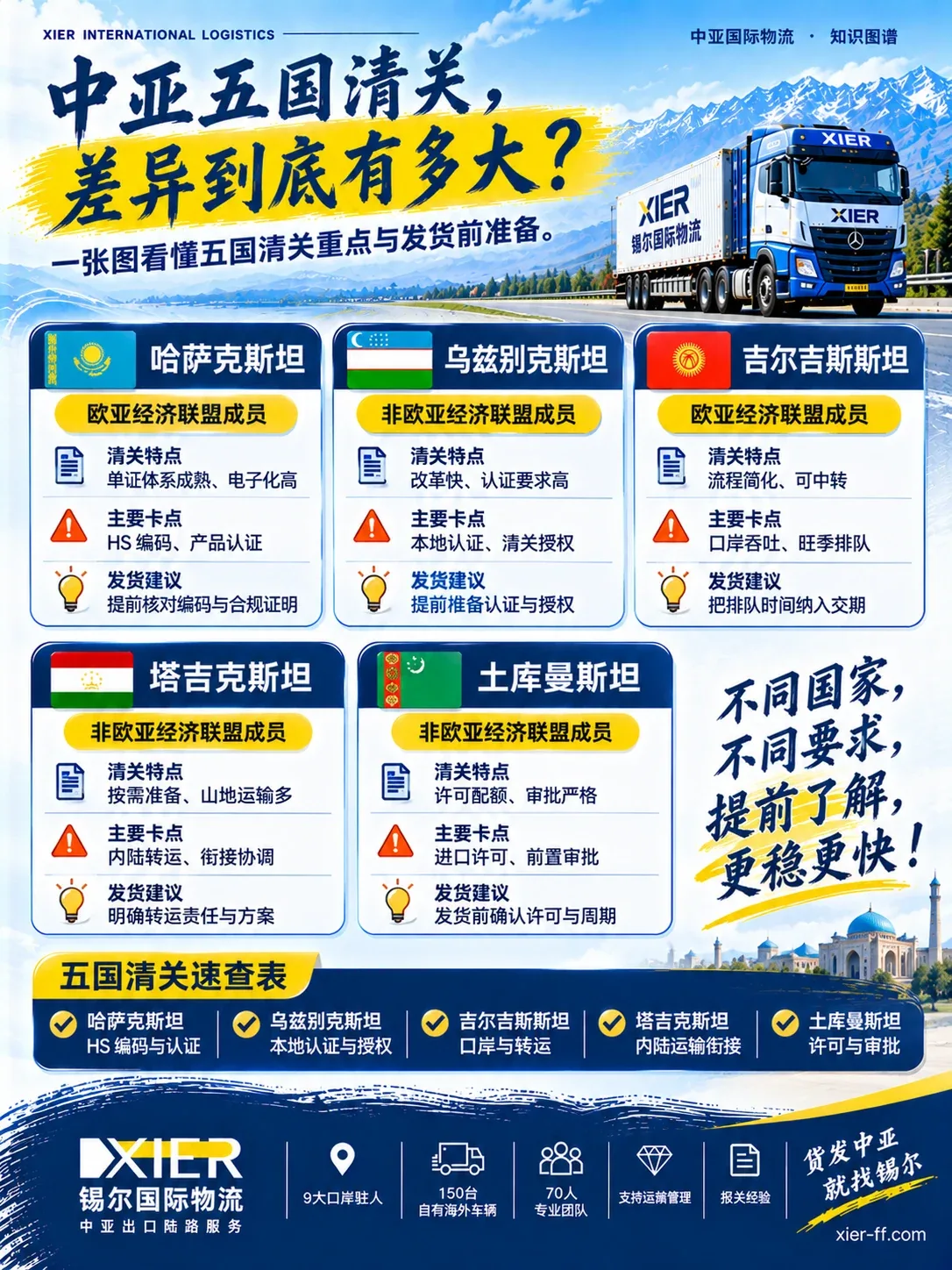 图:中亚五国清关差异对比与速查——HS 编码、认证、许可与口岸衔接各有侧重
The reasons for customs detention in the five countries are highly concentrated: incomplete documents or inconsistent information (invoices, packing lists, contracts not matching), HS coding errors leading to abnormal taxes and duties, lack of mandatory certification, low declared value causing suspicion, and restricted goods not going through special approval.
There are only four ways to avoid them: have the three-party documents mutually verified before shipment; confirm the HS coding with a professional customs brokerage; prepare certification documents according to the destination country list item by item; and declare the value of goods truthfully. It may seem繁琐, but it is much more cost-effective than being detained at the port for a few days.
9. Suggestions for selecting customs clearance paths according to cargo types
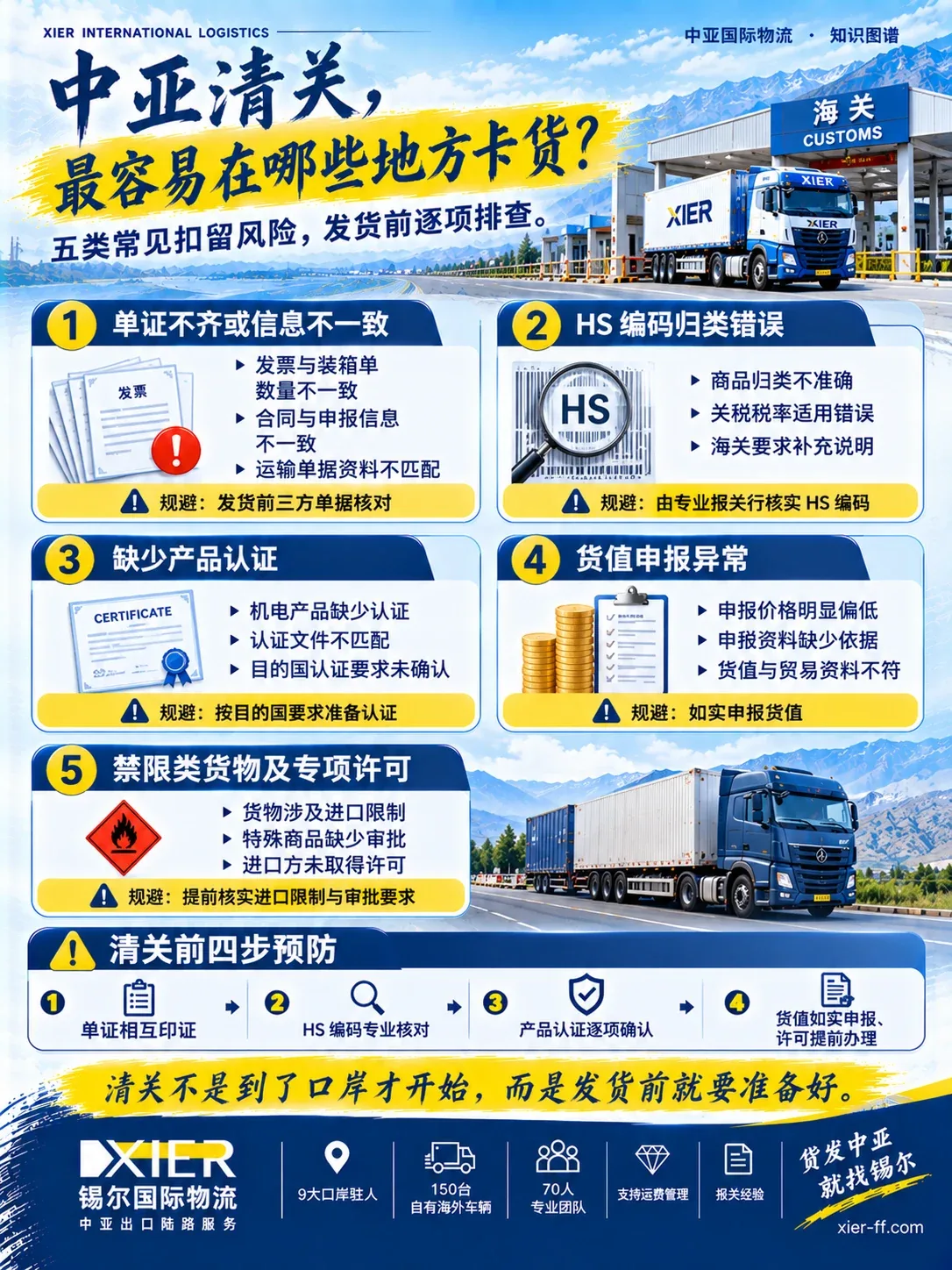 图:清关最常卡的五类风险——单证一致、HS 编码、强制认证、货值申报、禁限审批
Perishable goods and time-sensitive items: Prioritize ports close to the border and fast customs clearance, converting mileage advantages directly into time advantages, and pre-electronicization of customs documents.
Machinery and equipment, and bulk industrial products: Focus on certification and HS code, choose the route where documents can pass in one go, and don't just compare freight costs.
Return cargo (minerals, cotton spinning, grain): The customs clearance logic is similar to the outgoing route, but more attention should be paid to quarantine and import qualifications, especially for food raw materials.
10. Common Questions
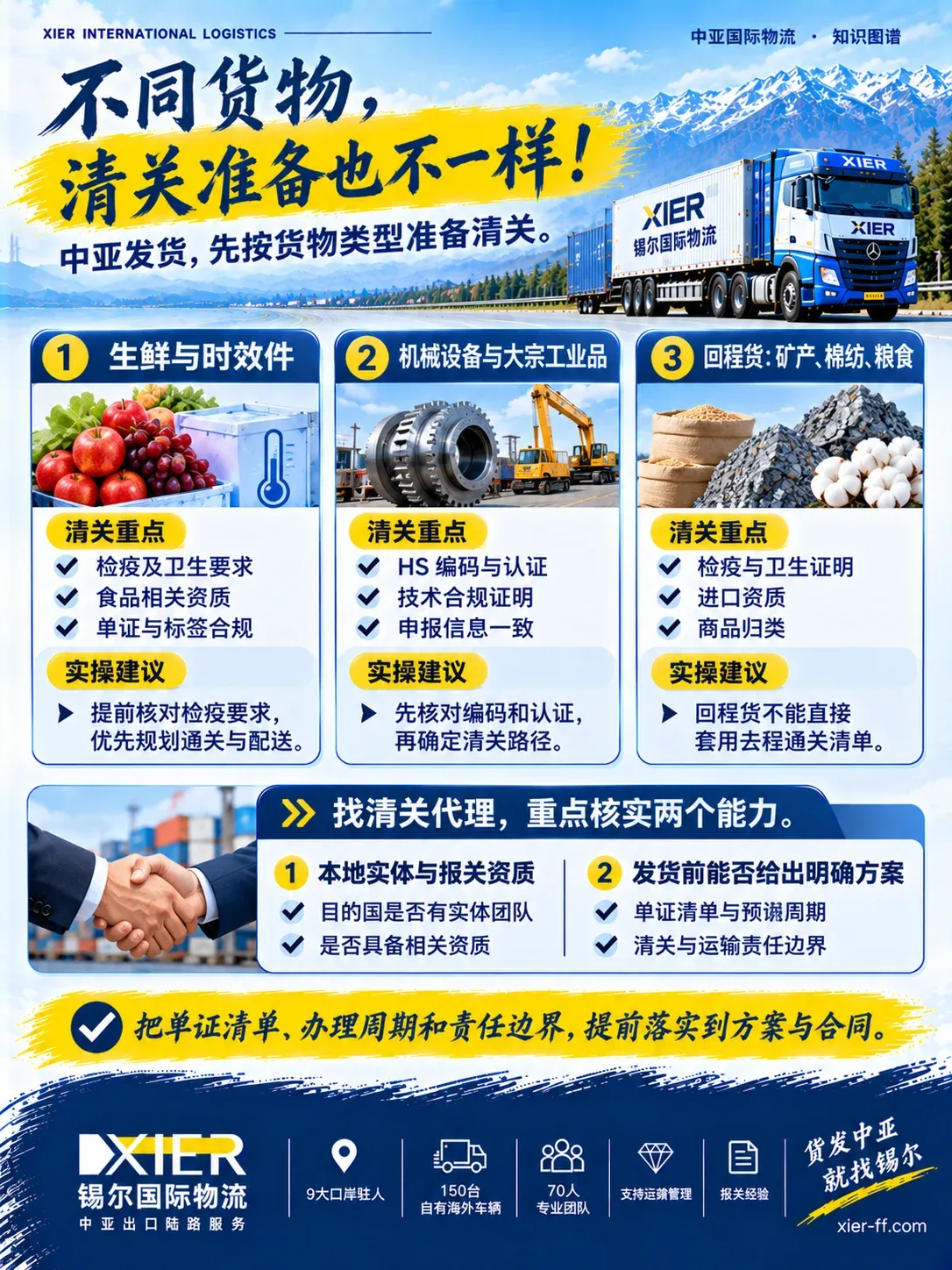 图:不同货类清关准备不同——生鲜时效件、机械设备工业品、回程货各有重点
Question: How much can the customs clearance time differ for the same shipment in five countries?
The difference mainly lies in the permit and certification stages. Kazakhstan and Kyrgyzstan follow the alliance framework, and it usually takes three to five days to clear; Uzbekistan, depending on the preparation of certification, is usually one week; Turkmenistan, if the permit is in place in advance, it may take one to two weeks, and if not, it may take longer. So, when scheduling, don't use a uniform number of days, estimate separately for each destination country.
Question: Which goods are most likely to be detained at customs?
Top three highest risks: mismatched documents, missing mandatory certifications, and significantly low declared value of goods. Additionally, prohibited or restricted items (such as specific chemicals, radio equipment) that haven't gone through special approval are almost certain to be seized. Go through these three categories before shipment to mitigate most risks.
Question: What should be considered when looking for a customs broker?
Look at two points: first, whether the broker has a physical presence and local customs declaration qualifications in the destination country, as having a contact person in China alone is not enough; second, whether the broker can provide a 'document list plus estimated cycle' before shipment. Brokers who are vague often encounter unexpected issues. Writing the responsibility boundaries into the contract is more reliable than verbal commitments.
Question: Is the customs clearance for return goods the same as for outgoing goods?
The general framework is the same, both require invoices, packing lists, contracts, and transportation documents, but return goods involving minerals, cotton spinning, and grain often involve quarantine and import qualifications. Food raw materials also require additional health or quality inspection certificates. Before making a return trip, list and confirm these quarantine requirements separately, and do not directly use the outgoing list.
Differences in import documents and tariff logic required in the five Central Asian countries
Common reasons for detention and how to avoid them in each country
Quick Reference Table: Key customs clearance points for the five countries at a glance
About the AuthorXier International Logistics, focusing on Central Asia logistics market analysis and digital solutions. This article is based on 10 years of practical data and industry research from Xier International Logistics and is for reference only; specific solutions need to be customized according to the characteristics of the goods.