1. When shipping hazardous materials to Central Asia, it's often not the freight rate that holds up the goods
In the consultations on exporting to Central Asia, there is a type of shipper who is most anxious: the goods are chemical products, electrical equipment, or lithium batteries, and the first question they often ask is 'How much is the freight, and how many days will it take to arrive.' However, for such goods, what truly determines whether they can be shipped on time is not the numbers on the quotation sheet, but the two thresholds of qualifications and packaging. Without qualifications, the goods cannot enter the regulatory warehouse; if the packaging is not compliant, they will be returned at the port.
The biggest difference between dangerous goods exports and general cargo is the additional compliance chain of 'certificates accompanying goods and documents matching goods'. Each link in the chain - classification, packaging, documents, declaration, and carrier qualifications - has corresponding responsible parties and their own risk points for returning orders. Missing any link will result in the transportation cost and time saved previously being recalculated.
This article does not repeat the details of 'which goods can be transported, which route to take, and how to declare customs' - those contents have been covered in a special article by Xier previously. Here, we only address three more preliminary matters: what qualifications the carrier needs to have, what documents the shipper needs to prepare, and how to select UN packaging. Getting these three things right is the true starting point for the Central Asia cross-border logistics of dangerous goods.
Secondly, clarify three matters first: whether it is a dangerous good, which category it belongs to, and who will declare it
Whether a shipment is actually a dangerous good cannot be determined by 'I have sent it like this before', but rather by a clear conclusion. The first step is to conduct a classification and identification of the dangerous characteristics: a qualified institution issues a 'Transportation Conditions Identification Certificate' based on the MSDS (Material Safety Data Sheet) and actual goods situation, providing UN number, dangerous category, packaging category, and special regulation code. The 14th item of transportation information in the MSDS is of great importance and will be checked by the port customs clearance.
The second step is to determine the dangerous category. Common categories include Category 3 (flammable liquids), Category 8 (corrosive substances), and Category 9 (miscellaneous dangerous goods, where lithium batteries are often classified). If the category is incorrectly determined, it will lead to a chain of errors in packaging, marking, and declaration. Therefore, it is better to spend more time on the identification stage than to change the documents at the port.
The third step is to determine the packaging category. Packaging categories are divided into three classes (I, II, III) based on the degree of danger, with Class I corresponding to high danger and the strictest requirements, and Class III being relatively lenient. It determines the testing standards for packaging to pass, such as drop, stacking, and airtightness, which must be consistent with the conclusions of the identification document. Many returns are not due to the lack of packaging but because the packaging category is marked too low.
| Judgment stage | Based on documents | The conclusion given | Consequences of errors |
|---|
| Whether it is a dangerous goods | MSDS + classification identification report | Whether it belongs to dangerous goods | Omissions are treated as concealed reporting |
| Dangerous category | Transportation conditions identification document | Categories 3/8/9 and UN numbers | Packaging and declaration chain errors |
| Packaging category | Transportation conditions identification document | I/II/III packaging grade | Packaging not up to standard leads to return |
| Declaration criteria | Summary of the above three items | Single window selection elements | A single letter error leads to a return |
三、承运方要有哪些资质
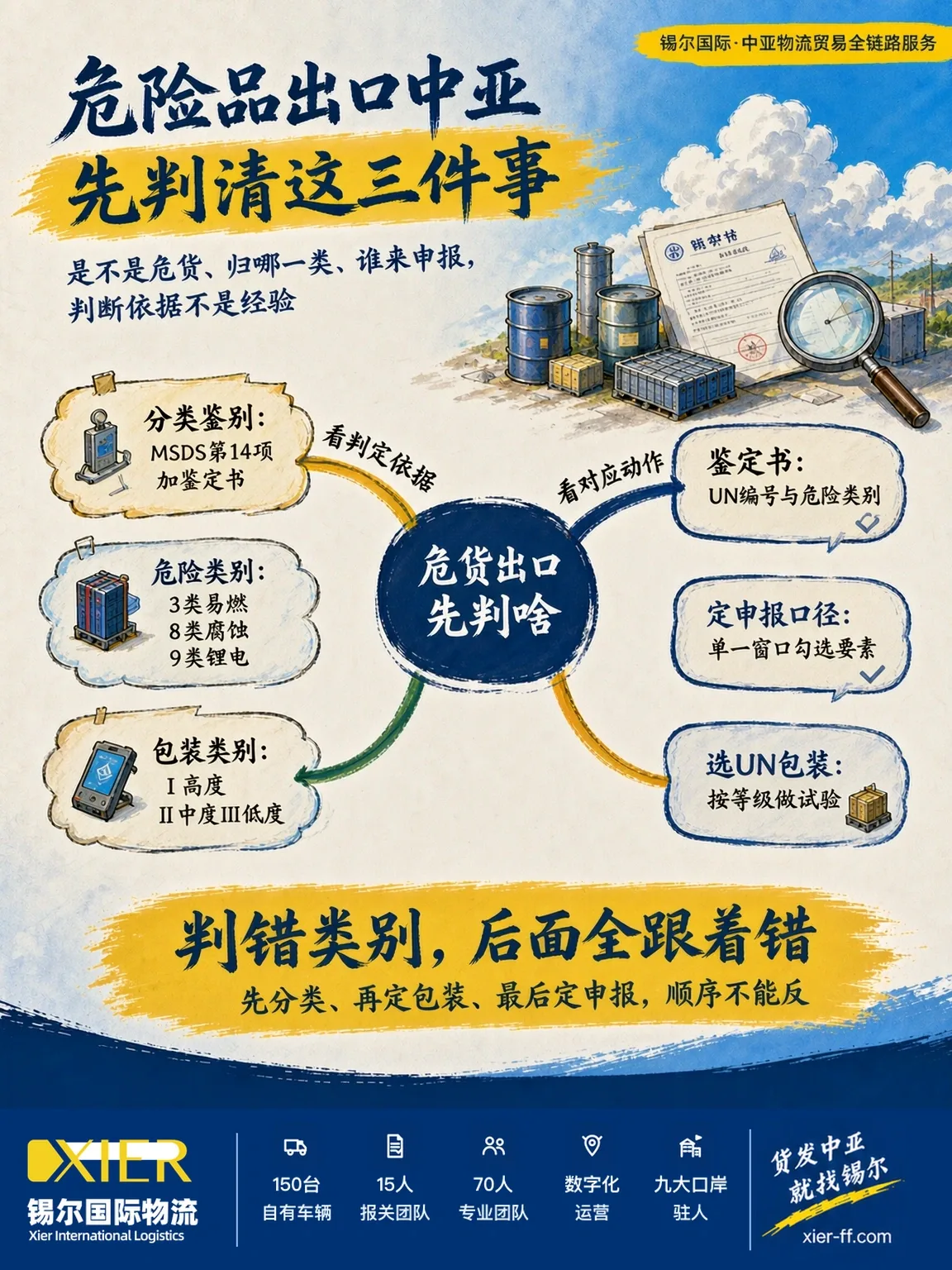 图:出口前先判三件事——分类、类别、包装等级,判错了后面全跟着错
Hazardous goods transportation requires strict qualifications for carriers, and shippers should verify them before entrusting the cargo, rather than after it arrives at the warehouse. For road transport, carriers must have the 'Road Transport License for Hazardous Goods,' with drivers and escorts holding corresponding professional qualifications for road transport personnel, and the vehicle itself must have a 'Road Transport Certificate for Hazardous Goods.' There are significant differences in these certificates between local transport in Xinjiang and international transport teams, and cannot be solely based on quotations.
For cross-border sections, there are additional requirements: first, international road transport permits, and second, the hazardous goods transport qualifications and customs registration of the countries along the route. For common road channels in the Central Asia direction, such as exiting through the Irkeshtam port to connect with Kyrgyzstan and Uzbekistan, the carrier must be able to connect the domestic and overseas qualifications to avoid discovering that there is no one to take over the overseas section upon arrival at the port.
| Qualification Items | Applicable Subjects | Verification Points |
|---|
| Road Transport License for Hazardous Goods | Carrier Company | Whether the scope of the permit covers the categories transported |
| Driver/escort professional qualifications certificate | Accompanying personnel | Certificates are valid, categories match |
| Vehicle Road Transport Certificate (Hazardous Goods) | Transport Vehicles | Vehicle matches the核定载重 and tank inspection |
| International Road Transport Permit and Customs Registration | Cross-border Carrier | Overseas section can be connected, port can be cleared |
Four, documents required by the shipper: The 'dangerous package certificate' is not a single document
The most easily misunderstood is the 'dangerous package certificate'. It is actually a combination of two documents: one is the 'Outbound Cargo Packaging Performance Inspection Result Certificate' (commonly known as the performance certificate), which proves that the packaging itself is qualified; the other is the 'Outbound Dangerous Goods Transportation Packaging Use Identification Result Certificate' (commonly known as the use identification certificate), which proves that this packaging matches the goods. The port clearance looks at the use identification certificate, but its premise is the performance certificate.
Both documents have laboratory and on-site cycles, and sufficient time should be allowed for the first application. Performance inspection requires sampling and testing, and use identification requires the customs to inspect on-site whether the packaging matches the goods and whether the markings are standardized. If it is only remembered to apply for it when it is close to the ship's departure or the vehicle's departure, it is basically too late.
In addition to the dangerous package certificate, it is necessary to prepare the Safety Data Sheet (MSDS) and the Chinese dangerous goods identification labels prepared according to the GHS system. Common reasons for rejection include incorrect label placement, outdated SDS version, mismatch between Chinese product name and UN number. For lithium battery types, a UN38.3 test summary must be provided; for packages that meet the conditions of Rule 188, packaging use identification may not be required, but each package must still be marked with a lithium battery label.
| Documentation | Issuer | Function | Common reasons for return of documents |
|---|
| Packaging performance inspection result form | Packaging production enterprise/Customs | Proof of packaging qualification | Lack of performance form, packaging model does not match |
| Packaging usage identification result form | Goods production enterprise/Customs | Proof that packaging matches the goods | Not processed, goods and documents do not match |
| MSDS (SDS) | Production enterprise or professional institution | 16 safety information items | Old version, missing transportation information in the 14th item |
| Transportation conditions identification certificate | Qualified testing institution | UN number/Category/Packaging category | Conclusion does not match the physical item |
| GHS hazard communication label | Production enterprise | Chinese hazard communication | Label incorrectly attached, name and number do not match |
| UN38.3 test summary | Testing institution (battery type) | Battery transportation safety certificate | Missing or model does not match |
V. How to choose UN packaging: Look at the category, look at the marking, look at the match
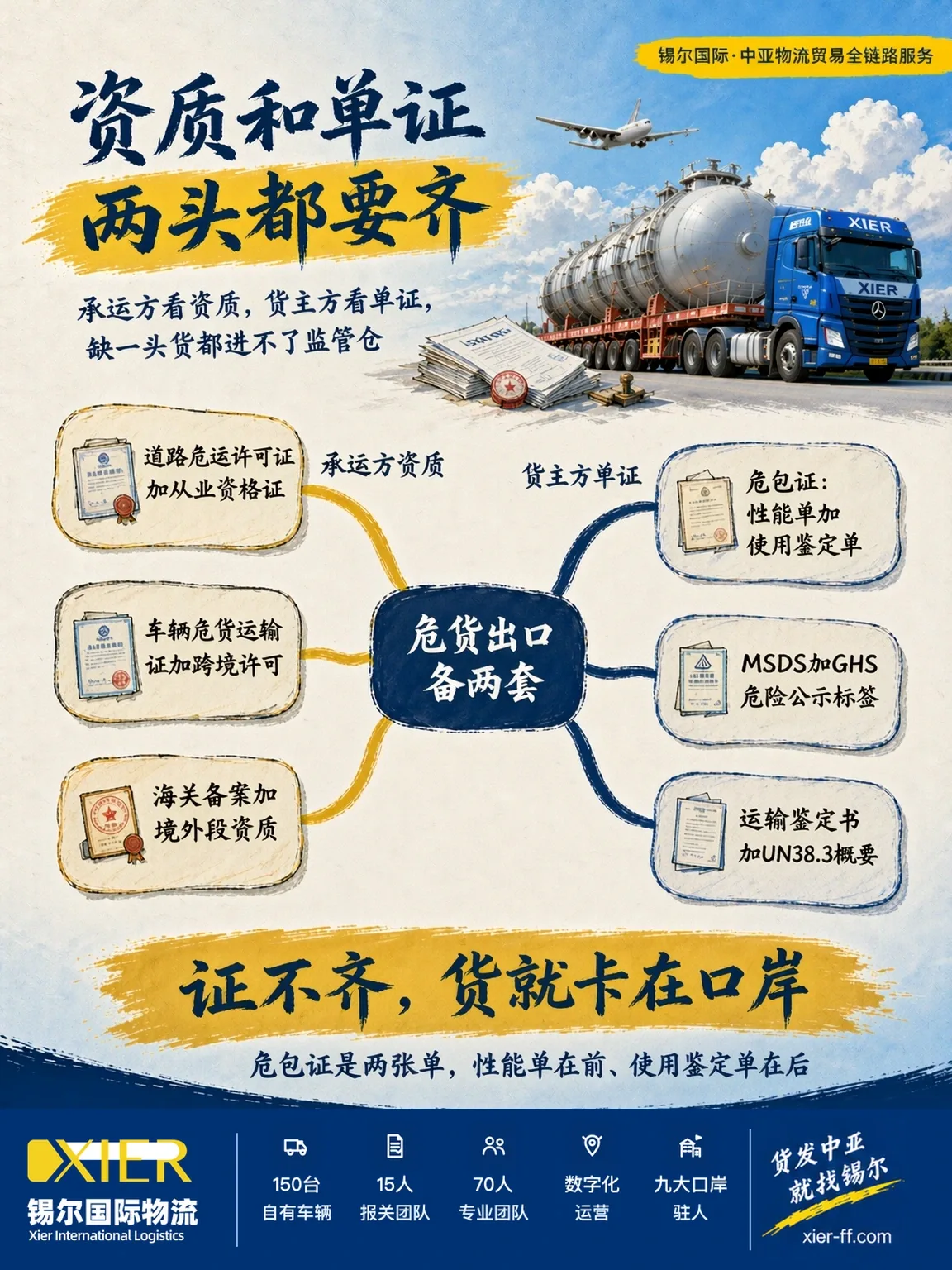 图:资质看承运方,单证看货主方——两头都齐,货才进得了监管仓
The core logic of UN packaging is 'packaging grade matches the degree of danger of the goods'. Packaging categories I, II, III correspond to different rigorousness of tests; choosing a lower grade is non-compliant, and choosing a higher grade increases cost but does not take risks. In actual operation, the most secure approach is to strictly select the packaging according to the packaging category given in the transportation conditions identification certificate, and not to make arbitrary adjustments.
The packaging must have standardized UN markings, with the letters and numbers corresponding to the packaging type, material, category, and test information. These codes must also be entered word for word during single-window declaration, and a single character error may result in the order being rejected. The packaging must also match the characteristics of the goods - liquids must be leak-proof, solids must be spill-proof, and lithium batteries must be短路-proof and insulated. These details will be checked on-site during the usage certification process.
| Packaging Category | Degree of Hazard | Test Requirements | Applicable Direction |
|---|
| Class I | High Hazard | Most Strict (drop/stacking/airtight) | High Hazard Category |
| Class II | Medium Hazard | Moderate | Most Routine Hazardous Goods |
| Class III | Low Hazard | Relatively Lenient | Low Hazard Category |
It should be noted that thicker packaging is not always better; it must correspond to the UN number and packaging category. A common misconception among customers is to continue using old packaging, thinking 'it worked last time,' but when the category or type changes, the packaging is no longer suitable. The packaging plan should be re-checked against the current certification document before each shipment.
Six Steps: From Documentation Preparation to Port Clearance
Linking the first few sections, the process of a dangerous goods shipment from preparation to dispatch can be compressed into a four-step chain. The first step is to entrust a qualified institution to classify and identify, obtain an identification certificate, determine the UN number, category, and packaging category; the second step is to apply for two dangerous goods packages, and prepare MSDS and GHS labels at the same time; the third step is to select UN specification packaging according to the identification conclusion, and do a good job of leakage prevention, short-circuit prevention, and other treatments; the fourth step is to declare in the single window, select the UN number, dangerous category, packaging category, and packaging UN mark, and upload the identification result document.
The fourth step is the most prone to errors. If the customs broker enters a wrong letter or number in the UN marking of the packaging during data entry, the system will immediately reject the order. It is recommended that after the document is issued, a second person should review each item before submission, and lock the consistency of 'certificate, packaging, and declaration' before submission. For the overseas section, the corresponding rules are followed according to the mode of transport, road cross-border refers to ADR, railway refers to RID, and the carrier is responsible for the record and permit along the route.
| Steps | Key Actions | Responsible Party | Deliverables |
|---|
| First Step | Classification and Identification | Testing Institution/Shipper | Transport Conditions Identification Certificate |
| Second Step | Apply for Dangerous Goods Package + Prepare Labels | Packaging Factory/Shipper/C customs | Performance Sheet, Use Identification Sheet, MSDS |
| Third Step | Select UN Packaging and Load | Shipper/Packing Party | Compliant Packaging Unit |
| Fourth Step | Single Window Declaration + Port Release | Customs brokerage/carrying party | Declaration form + CARNET and other vehicle-related documents |
Seven, prioritize compliance before discussing timeliness
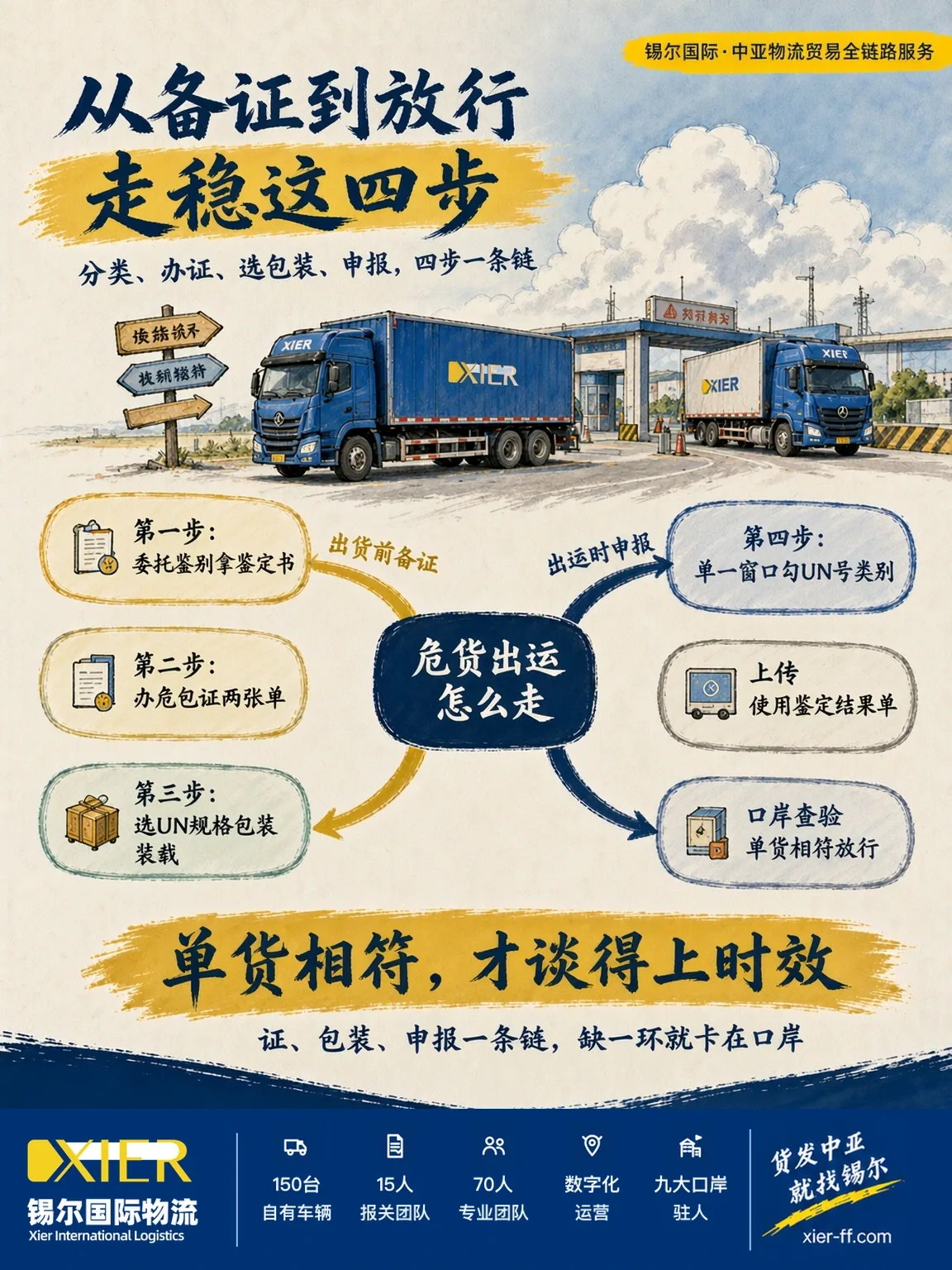 图:四步一条链——证、包装、申报逐项对齐,缺一环就卡在口岸
Exporting hazardous goods to Central Asia, timeliness is not achieved by compressing transportation time, but by completing compliance actions in advance. Classification identification, hazardous package certificate processing, and packaging selection all have fixed cycles. These times are spent before shipment, so they won't be repaid in the form of detention at the port.
Xier International Logistics, when undertaking hazardous goods transportation across the border in Central Asia, is accustomed to presenting the qualification and document list to the customer for item-by-item comparison before discussing routes and quotations. The reason is simple: general cargo can be sent first and supplemented later, but hazardous goods must be complete before they can be sent. Only by crossing this threshold is the logistics route from China to Central Asia open for hazardous goods.
Eight, common questions
When exporting hazardous goods to Central Asia, which hazardous package certificates are involved?
The dangerous goods certificate is a combination of two documents: the 'Outbound cargo transportation packaging performance inspection result form' (performance form) applied for by the packaging production enterprise to the customs, and the 'Outbound dangerous goods transportation packaging use identification result form' (use identification form) applied for by the goods production enterprise. The port checks the use identification form, on the premise that the packaging itself has a performance form.
What is the difference between MSDS and transport condition identification documents, and are both required?
MSDS (SDS) is a chemical safety data sheet, which includes 16 items of information such as composition, hazards, first aid, fire prevention, etc.; the transport condition identification document is issued by a qualified institution, which directly provides the UN number, hazard class, packaging class, and special regulations. The former answers what the goods are, while the latter answers how to manage them in transportation, and both are usually required.
Is UN38.3 required for lithium batteries transported via Central Asia road transport?
Lithium-ion batteries and lithium metal batteries are dangerous goods and generally need to be declared with the UN numbers UN3480/UN3090, etc., and provide a summary of the UN38.3 test. If the conditions of Article 188 of the dangerous goods regulations for each transportation mode are met, packaging use identification may not be required, but each package must still be affixed or hung with a lithium battery label.
What do the packaging classes I, II, III mean?
Packaging categories are divided according to the degree of danger, with Category I corresponding to high danger, Category II moderate danger, and Category III low danger; the smaller the number, the stricter the requirements. It determines the testing standards for packaging to be done, such as drop resistance, stacking, and airtightness, which must be consistent with the conclusions given in the transport conditions certificate and cannot be reduced arbitrarily.
What are the transportation qualifications required for transporting dangerous goods?
The carrier must have a 'Road Transport License for Dangerous Goods,' the driver and escort personnel must hold corresponding professional qualifications, the vehicle must have a 'Road Transport Certificate for Dangerous Goods,' and for cross-border sections, an international road transport permit and customs record are also required. It is much more convenient to verify these items before entrusting the task than to make up for them later.
What are the most common mistakes when making a single window declaration?
The most common mistakes are filling in the UN number, danger category, packaging category, and packaging UN marking incorrectly or inconsistently, as well as forgetting to upload the use assessment result sheet. A single letter or number error during entry may result in a rejection, so it is recommended that a second person review and submit the document after it is issued.
About the AuthorXier International Logistics, focusing on Central Asia logistics market analysis and digital solutions. This article is based on 10 years of practical data and industry research from Xier International Logistics and is for reference only; specific plans need to be customized according to the characteristics of the goods.