1. After winter, what changes first is not the price of transportation, but the operation window of the port
Starting from the middle and late November each year, the first thing that appears at several highland ports in southern Xinjiang is not price increases, but shorter daylight hours, road icing, snow removal, and temporary traffic control. Irkeshtam, Turgar, and Karasu are all located in high-altitude mountainous areas, with large temperature differences between day and night in winter. The time for normal operation during the day is compressed, and the rhythm of vehicle queuing, loading, and inspection is shifted as a whole.
Many companies treat winter as a 'freight rate issue'—thinking that paying a bit more can ensure timely delivery. The reality is that three things really bottleneck the shipment during winter: the port's passage windows, the anti-freezing packaging of goods, and the scheduling being too late. Money cannot solve the problem of icy mountain roads, nor can it retrieve the lost working hours.
From Xier International Logistics' winter shipment records over the past few years, the orders that have encountered problems generally fail at the same four stages: no anti-freezing treatment before loading, goods damage during the waiting period at the port, discrepancies between the documents and the actual condition of the goods after anti-freezing additions, and scheduling being blocked in the last week before the holiday. This article breaks down the judgment basis, actions, and scheduling rhythm of this winter period into a table for easy reference before shipment.
II. Winter Characteristics of the Three Major Ports in Southern Xinjiang
When choosing a port during winter, it's not about 'which line is cheaper,' but 'which line can maintain stable operations under low temperatures and snowfall.' The three ports have different altitudes, road conditions, and main destinations, resulting in significant differences in their winter performance.
| Port | Main Destination | Altitude and Climate Characteristics | Impact on Winter Operations | Suited Goods |
|---|
| Irkeshtam | Southern Kyrgyzstan (Osh direction), Uzbekistan | Altitude nearly 3000 meters, many mountain passes and winding sections | After snowfall, mountainous sections are prone to temporary traffic control, with customs clearance and transshipment mainly during the day | Whole vehicles, equipment cargo, and project cargo take priority |
| Tulghat | Northern Kyrgyzstan (Bishkek direction) | Above 3,700 meters in altitude, with lower temperatures and stronger winds | During extreme cold periods, vehicle startups are slow and transshipment efficiency decreases, requiring additional waiting time | Whole vehicles, bulk goods, and steel and building materials |
| Karasu | Tajikistan (Kulma direction) | Above 4,000 meters in altitude, with the entire route being highland | The shortest passage window, with daytime concentrated operations mainly in winter | Project cargo, equipment cargo, and single category whole vehicles |
It should be noted that the seasonal switching rules for the Red River Valley (China-Pakistan direction) have been discussed in a separate article. This article only discusses the directions to Kyrgyzstan, Uzbekistan, and Tajikistan. An experience to note when selecting ports: do not rely on a single port for timeliness during winter. If a batch of goods is allowed to be shipped from multiple ports, the other line can still handle it if one port is temporarily controlled.
Third, calculate 'a few days slower' as specific days
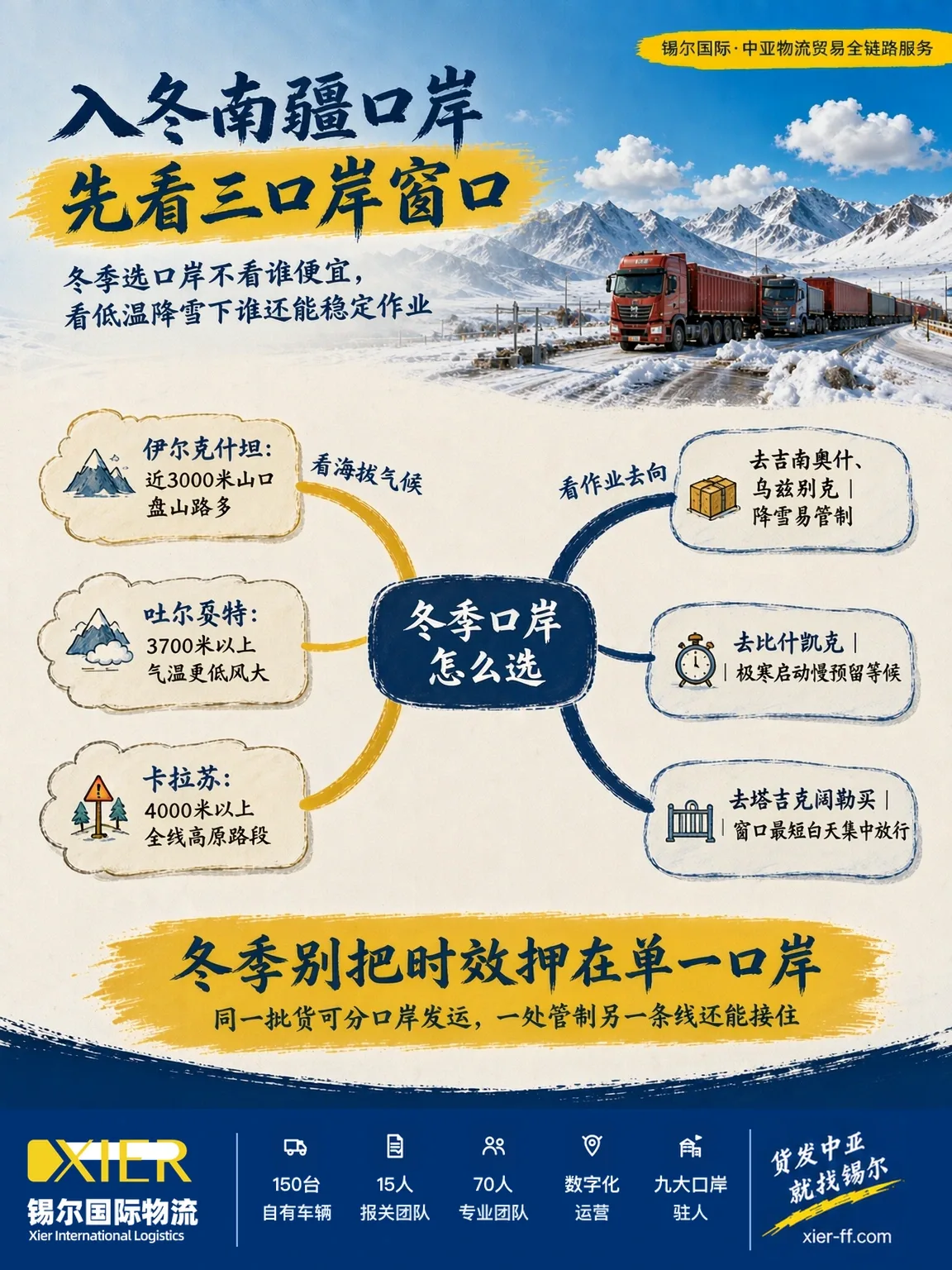 图:冬季选口岸先看作业窗口——三口岸按海拔、去向和适配货类对照,别把时效押在单一口岸
The most common mistake in winter quotations is to say that the additional time is 'about a few days slower'. The following table lists the additional quantities for common links during winter as intervals, and the scheduling should take the upper limit instead of the median.
| Link | Reference for normal temperature season | Common winter additional | Reason for additional |
|---|
| Loading and collection | 0.5–1 day | +0–1 day | Additional anti-freezing treatment, secondary reinforcement, and re-inspection time required |
| Domestic trunk line (Urumqi–Kashgar / Wuqia) | 1–2 days | +0.5–1 day | Speed limit and temporary traffic control after snowfall on mountainous sections |
| Port queuing and inspection | 1–2 days | +1–3 days | Shortened working hours, and vehicles are concentrated for release after clearing snow |
| Overseas section (Kyrgyzstan / Uzbekistan / Tajikistan) | 2–5 days | +1–3 days | Snowfall on overseas mountainous sections and customs clearance in the destination country overlap |
| Total (full chain) | — | +3–8 days | It is recommended to schedule according to the upper limit when promising to customers |
The table is an experience interval, and the actual situation is subject to the current port announcement and road conditions. There is a detail in terms of use: use the upper limit when reporting the time to customers, and use the median when scheduling internally. This way, it will not cause a breach of contract due to optimistic promises, nor will it leave transport capacity idle due to excessive caution.
Four, which goods must be treated in winter
Not all goods require special winter packaging. The real need for additional investment is for categories sensitive to low temperatures, with the judgment criteria being 'whether low temperature will change the physical state or transportation properties of the goods'. The table below lists the necessary actions by category of goods.
| Category of Goods | Risk of Low Temperature | Necessary Treatment | Packaging and Loading Points |
|---|
| Liquid chemicals, paints and coatings | Viscosity increase and freezing can cause container cracking | Insulate or add antifreeze components according to product name and transportation properties | Leave space for expansion in drum packaging, prohibit full loading; stand upright without tilting |
| Precision instruments, electronic equipment | Condensation water, plastic parts脆化 under low temperature | Desiccant + moisture-proof film + thermal insulation lining | Avoid direct contact with metal structural components, add shock absorbers when placed on the ground |
| Machinery and engineering vehicles | Battery discharge, oil road waxing, hydraulic oil viscosity change | Change to low-temperature engine oil, check the freezing point of antifreeze fluid, insulate the battery | Add waterproof cloth to key parts, check each fixed point after loading |
| Food and agricultural products | Freezing injury, deterioration after repeated thawing | Insulate with a thermal box or cotton blanket, control ventilation | Do not transport with heat sources or chemicals, avoid repeated opening of the box |
| Steel, building materials | Surface icing causes slippage, interlayer displacement | Use wood blocks + anti-slip binding | Remove ice from the loading surface before stacking, add anti-slip materials between layers |
| Electrical products (battery type) | Low temperature capacity attenuation, change in transportation properties | Declare according to actual transportation properties, insulate if necessary | Individual packaging is insulated and anti-short-circuit, avoiding compression |
An often overlooked related issue: if the packaging is changed, the documents must be changed accordingly. In winter, to prevent freezing, additional insulation is added, the inner packaging is replaced, and the weight of each item is adjusted. If the customs declaration of the name of the goods, number of pieces, gross and net weight is not updated in sync, it will be rejected at the port due to 'mismatch between goods and documents', and all the days saved in advance will be wasted.
V. Full truckload and project goods: winter reinforcement is another set of actions
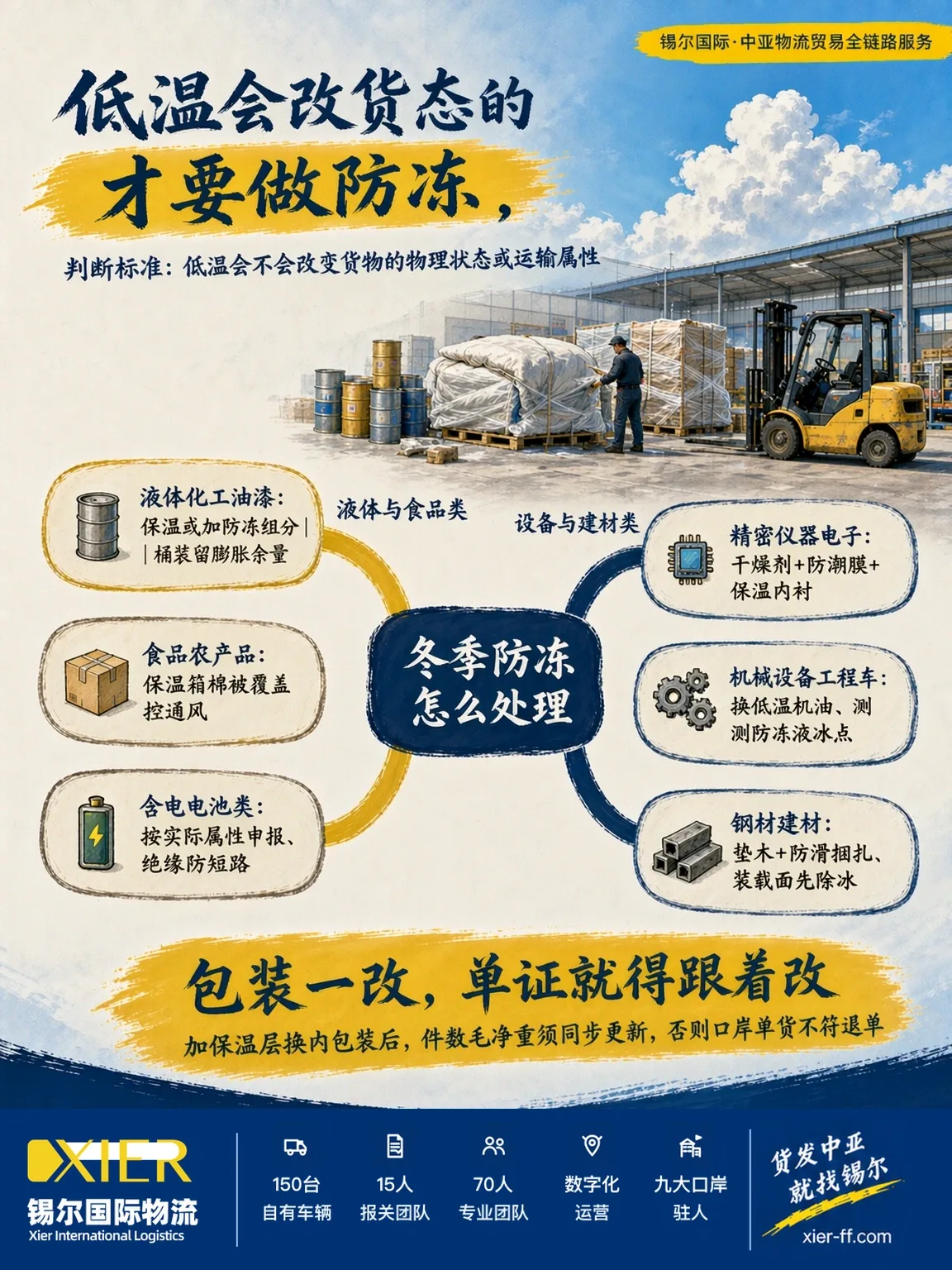 图:低温会改变货态的才需额外投入——六类货必做处理与包装要点逐项对照
Full truckload goods, equipment goods, and project goods are the main focus of Xier on the South Xinjiang line, and they are also the categories that test operational details the most in winter. These goods have high value, cannot be disassembled, and have many oversized pieces. Once there is displacement or freezing damage on the road, the loss is much greater than the freight price difference. Winter reinforcement is not 'tying an extra two ropes', but it needs to be checked at several fixed nodes.
| Part / Link | Routine seasonal practices | Winter enhanced practices | Inspection nodes |
|---|
| Truck floor | Wooden blocks, anti-slip pads | Remove ice first, then lay anti-slip pads, add anti-slip surface to wooden blocks | Before loading |
| Tie-down and fixation | Tensioner + steel wire rope | Increase tie-down points, add protective corners at the contact points between the chain and the goods body | Once before loading and once before departure |
| Covering and snow prevention | Single-layer waterproof cloth | Double-layer tarpaulin, no water accumulation depression on the top, preventing snow from collapsing | Before each journey |
| Tires and brakes | Routine vehicle condition check | Anti-slip chains in the vehicle, brake air line drainage and anti-freezing | Before departure |
| Vehicle documents | Routine documents | Add anti-freezing treatment instructions and emergency contact information | Before departure |
There is still one time account to calculate for the project cargo: permit for oversized items, route survey and escort arrangements. In winter, a longer lead time is required. What can be done in advance is not transportation, but survey and permit. The route survey in the snow season is affected by road conditions, and the process that could have been completed in a week may take two weeks or more. The thing that can be done in advance is not transportation, but survey and permit.
Sixth, scheduling rhythm: move the shipment forward by half a month
The core of winter scheduling is not 'calculate which day it can arrive', but 'avoid the days when work cannot be carried out'. From November to the following February, the port status and supply of transport capacity will change significantly at several nodes, and the corresponding actions are also different.
| Time window | Port and transport capacity status | Recommended actions | Risk alert |
|---|
| Mid-November to early December | First snow, occasional control, pre-festival inventory begins to concentrate | Lock in transport capacity for whole vehicles first, send goods that are already fully prepared with documents and packaging | Transport capacity is tight, and quotations fluctuate significantly |
| Mid-December to early January of the following year | Low temperature peak, shortest working window during the day | Only send goods that are fully prepared with packaging and documents, and add buffer to the ceiling | Significant extension of queuing time at the port |
| 1 月中—2 月初(春节前) | Pre-holiday Rush Delivery and Holiday Switch Arrangement | Confirm the port opening and closing time in advance, and release the goods before the holiday | The last week before the holiday is basically uncontrollable |
| After the middle of February | Gradual recovery, concentrated release of pre-holiday backlog | Resend the backlog goods, communicate with the customs clearance party in the destination country in advance | Concentrated arrivals lead to customs congestion in the destination country |
In terms of operations, winter scheduling is about half a month earlier than the normal temperature season, which is a relatively safe approach. The reason is not that it is really slow by half a month on the road, but that once a temporary control is encountered, all subsequent links will be pushed forward. The half month in advance is essentially a buffer for the uncontrollable, not for the transportation margin.
Seven, Three Unique Documents and Insurance Traps in Winter
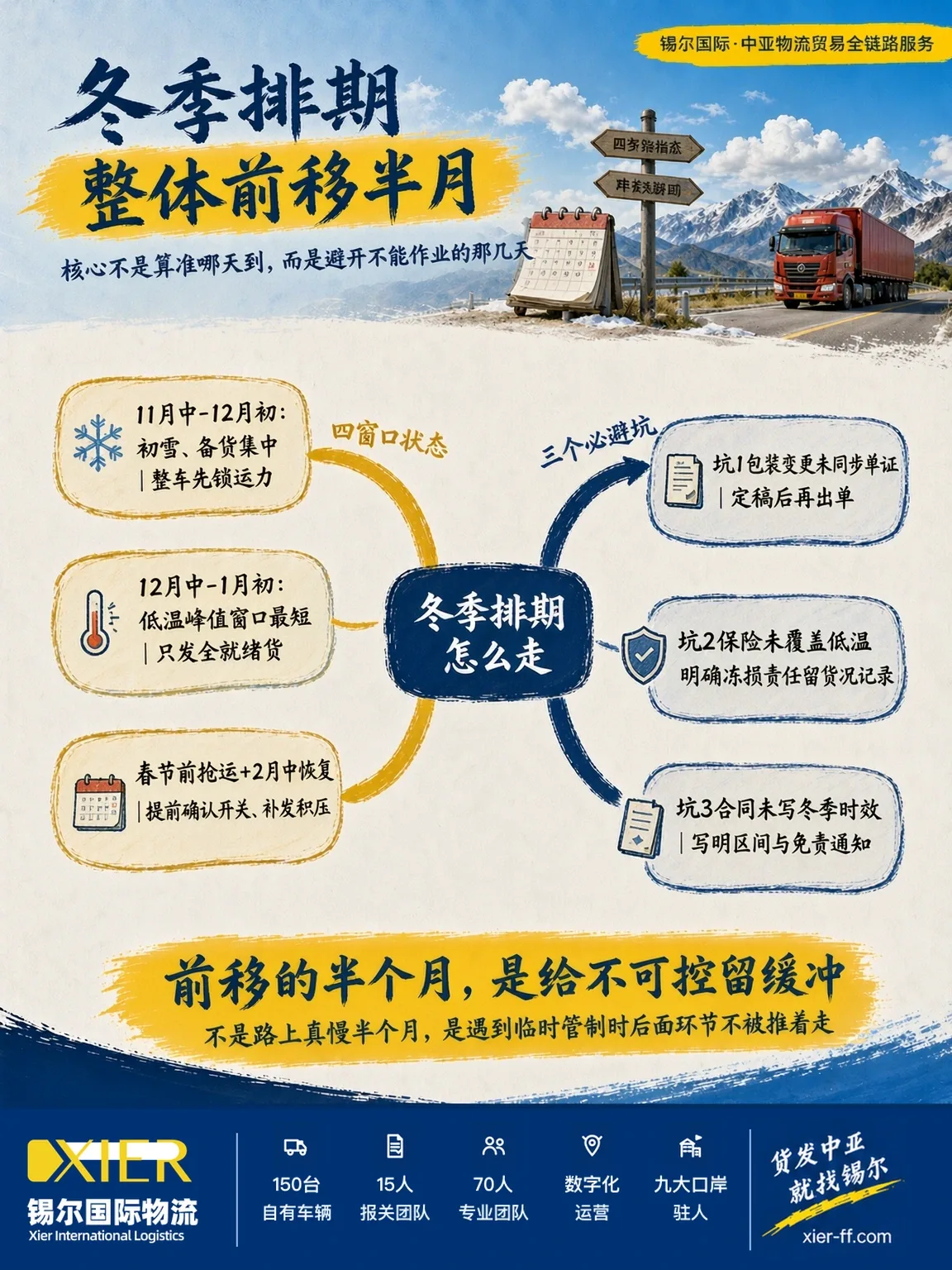 图:排期整体前移半个月——四窗口状态对应动作,节前最后一周基本不可控
| Trap | Specific Performance | Consequences | Countermeasures |
|---|
| Packaging change not synchronized with documents | After adding insulation and changing the inner packaging in winter, the number of pieces and gross/net weight are still the old data | Inspection found that the goods do not match the documents, return the order and change the order | Finalize the packaging before issuing documents, and no longer change the packaging after the documents are issued |
| Insurance liability does not cover low temperature | Continue to use the conventional freight insurance terms | Frozen damage and thawing deterioration are considered to be out of the scope of liability | Clearly specify the responsibility for low temperature and frozen damage when insuring, and keep a record of the condition of the goods at the time of loading |
| The contract does not stipulate the winter time limit | The contract only specifies the regular delivery time, without mentioning the winter season intervals and exemption boundaries | Disputes arise over responsibility division after delays occur | The contract clearly states the winter delivery time intervals, exemptions under controlled conditions, and notification obligations |
The third pitfall is often overlooked because it is not at the operational level but at the contract level. Many delays in winter are not the carrier's fault, but if it is not clear in the contract what constitutes an uncontrollable situation and how long it takes to notify after the event, post-event can only rely on negotiation.
Chapter 8: Common Questions
Should we go through Irkeshtam or Turgart in winter?
It depends on the destination and type of goods. For destinations in the southern part of Kyrgyzstan or via Osh to Uzbekistan, Irkeshtam is more convenient; for directions to Bishkek, Turgart is shorter in distance but higher in altitude and lower in temperature, with stricter requirements for vehicles and packaging in winter. For project goods and oversized items, the mountain pass conditions of Irkeshtam are given priority.
Will low temperatures prevent hazardous goods from being shipped?
It's not 'cannot be shipped', but it is necessary to confirm the transportation attributes first. Some hazardous goods may crystallize, separate, or change in pressure at low temperatures, requiring actual status verification of packaging and declaration. It is recommended to discuss these goods case by case, and provide the name, status, and packaging method to the operator for confirmation in advance.
拼箱在冬季还合适吗?
It can be done, but with a lower priority than full truckload. Consolidated cargo means multiple loading and unloading, and opening the container. In winter, every time the container is opened, the goods have to go through a temperature difference again, and the risk of condensation water and freezing damage increases. General cargo that is not sensitive to temperature differences is not a problem, but precision equipment and liquid goods are recommended to be transported as full truckload.
Does the freight cost always increase in winter?
Not necessarily. The real variable is the supply and demand of transportation capacity, not the temperature. During the weeks of concentrated shipment before the holiday, tight transportation capacity will push up the price quotes; while in the recovery period after the holiday, transportation capacity is relatively loose, and the price may even fall. The judgment should be based on the shipment timing falling into which window, not 'whether it is winter'.
How to handle temporary border control?
The first step is to confirm the scope of control and the expected duration, the second step is to judge whether the goods can be transferred to another border, and the third step is to notify the customer to adjust the delivery expectation. The sequence of these steps cannot be reversed - transferring the goods before notifying often turns explainable delays into unexplainable breaches of trust.
How early should the preparation for project cargo be started in winter?
It is recommended to start one month before the planned shipment date. Permits for oversized cargo, route surveys, and escort plans all require a longer lead time in the snow season, and the survey itself is affected by road conditions. Allowing this time is more effective than rushing time in the transportation process.
About the authorXier International Logistics, focusing on Central Asia logistics market analysis and digital solutions. This article is based on 10 years of practical data and industry research from Xier International Logistics and is for reference only; specific solutions need to be customized according to the characteristics of the goods.