I. Why It's Hard to Calculate the Total Cost of Full Container and LCL for Central Asia Railway Containers
Almost everyone who does business with the Central Asia railway has encountered the same situation: the same phrase 'send a container to Almaty' can result in a price difference of several hundred dollars. When you dig deeper, one is quoted by the container (FCL) per box, another by the cubic meter or ton for a less than container load (LCL), and some even mix in port transloading, customs clearance in the destination country, and final delivery. Different quotes naturally lead to different prices. Many shippers, after receiving two or three quotes, just look at the total at the bottom and make a decision, only to find out after the goods arrive that this is not included and that is an additional charge, and the budget keeps increasing.
What needs to be clarified are actually two things:First, should this shipment be sent as a full container or a less than container load——This determines the loading method, container type, documents, and timeliness;Second, how is the freight calculated——This determines which items should be broken down in the quotation, which are included by default, and which will be charged separately. These two things may seem like something the freight forwarder should worry about, but they are directly related to the shipper's costs and the certainty of delivery. Not understanding this can easily be misled by 'low prices' during the inquiry process.
It should be noted that freight rates, port handling fees, and taxes fluctuate with the type of cargo, port, peak/off-peak seasons, and current policies, and are negotiated on a case-by-case basis. Below, we do not discuss specific numbers, but provide a set of reference frameworks for verification - it is more important to clarify boundaries before inquiring for prices than to obtain a 'low-looking' total price. Hold the framework in hand and then compare prices to know whether the other party is quoting the same thing or two different matters.
Secondly, consider the volume and nature of the goods: where does the boundary between full container and LCL (less than container load) lie
It is not 'which is cheaper, choose that' for full container and LCL, but rather determined by the volume and nature of the goods. If the volume is sufficient to fill a container and there is a single consignee, it is usually more stable to go with a full container: loading, sealing, and documentation are all centered around one shipper, with fewer links and clear responsibilities, and the delivery time is also more controllable. If the goods are scattered, do not fill a container, and belong to multiple consignees, then consider LCL - combining goods from multiple parties into one container can reduce the main line costs, but it requires collection at the origin and unloading at the destination, adding an additional link and more potential places for fees and time to arise.
In addition to the volume of goods, the nature of the goods is also crucial. Heavy goods are calculated by weight, while light and bulky goods are calculated by volume, with different billing logic. Hazardous materials, oversized, and overweight goods also have additional weight, size, and access constraints on the railway, not all routes can accept them. The container type also needs to be calculated based on both volume and weight - 20-foot, 40-foot, and high-cube containers have different volumes and weight limits; choosing a smaller one may not fit, and choosing a larger one is a waste of money, and attention must also be paid to the railway's axle weight constraints. Below are six cards that clearly list 'what is usually included' and 'what needs to be confirmed separately' for each dimension.
| Dimension | Usually Included | To Be Confirmed Separately |
|---|
| Full Container Load (FCL) | Sufficient volume for a full container, single consignee | Whether to discard the container and consolidate if it is not full |
| Less than Container Load (LCL) | Scattered volume, multiple parties in one container | Destination port deconsolidation fee and delivery time |
| Nature of goods and packaging | General merchandise can be consolidated, heavy goods are better in full containers | Whether hazardous materials or oversized goods can be transported by rail |
| Container selection | 20-foot/40-foot/high-cube containers by volume | Railway weight limits and axle weight constraints |
| Port and route | Alashankou/Khorgos/Erlian | Congestion and queuing time at transshipment stations |
| Documentation and access | Customs declaration documents, railway waybills | Access and customs clearance qualifications in the destination country |
III. How to calculate freight: a quotation sheet should be divided into six subjects
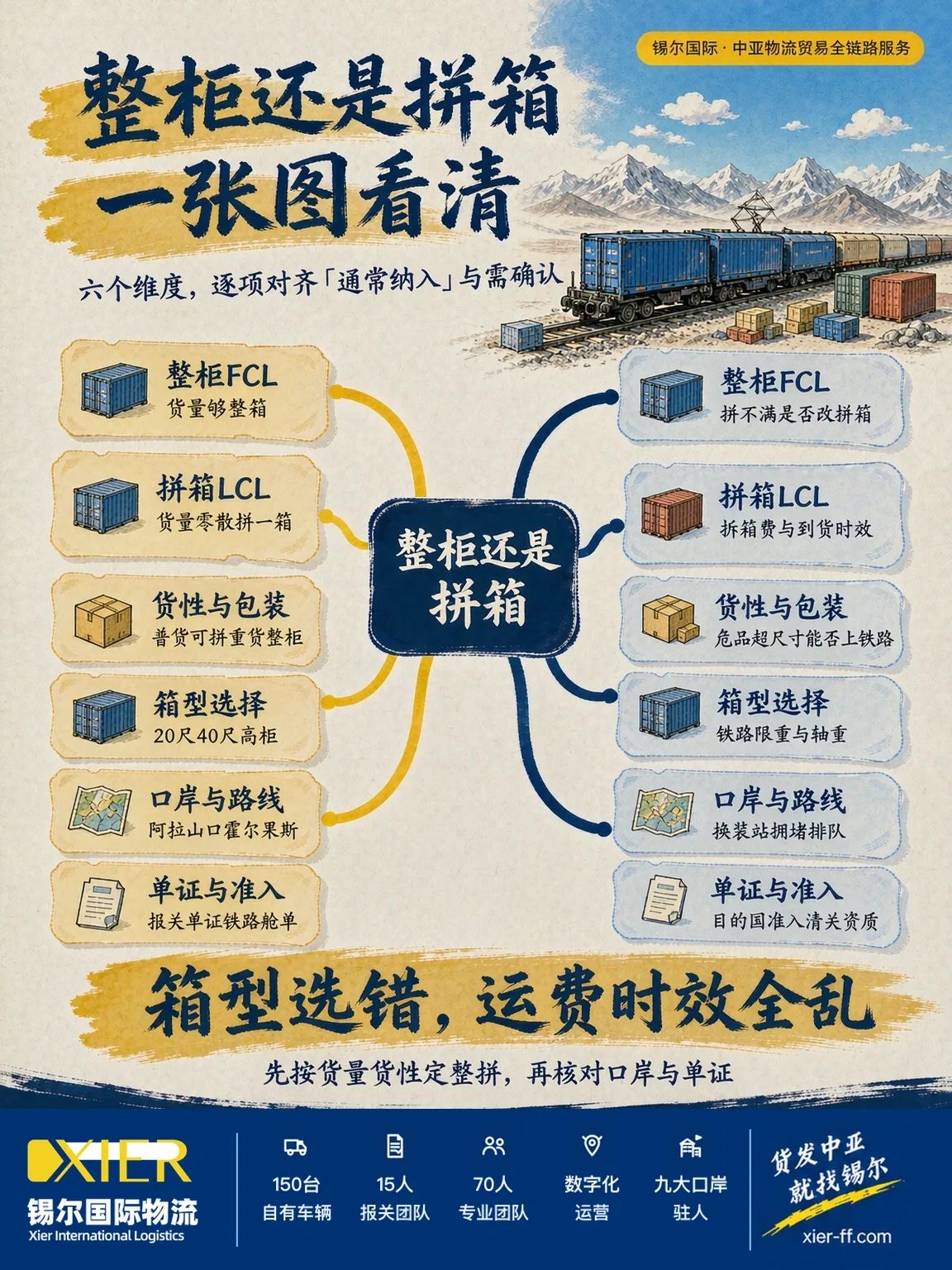 图:箱型选错,运费时效全乱——先按货量货性定整拼,再核对口岸与单证
When obtaining the Central Asia railway quotation, the biggest taboo is to only see the total price. A low total price is often because some items are omitted or different services are bundled into the same number. For example, some quotations only include the port and do not cover transshipment; while others reach the destination station but do not include customs clearance and delivery. The total price is not comparable due to different scopes. To compare the price, the quotation sheet should at least be broken down into six items, and each item should be checked individually.
During the verification process, focus on the 'usually included' and 'to be confirmed' columns: for the domestic section, check how the pick-up distance and vehicle waiting time are calculated; for the trunk line, check if the transshipment fee and reinforcement fee are included; for the port section, check the boundaries of storage and inspection coordination; when calculating the demurrage fee and extra container usage, from which day should it start; whether the customs clearance in the destination country includes entry permit and inspection and certification; and whether the final delivery includes second delivery and unloading waiting. Although these items may seem small individually, they may account for a significant part of the total cost. Any item that is not clearly written may become 'additional charge' after the goods arrive. Below are the six items listed one by one, and ask according to these when inquiring, which will basically not be missed.
| Items | Usually included | To be confirmed / Easily omitted |
|---|
| Domestic pick-up, delivery, and loading | Factory pick-up to dispatch station | Remote pick-up and waiting for loading are additional charges |
| Railway trunk line freight | From dispatch station to port or destination station | Whether transshipment fee and reinforcement fee are included |
| Port terminal miscellaneous fees | Customs declaration, loading, storage | Overdue storage, inspection coordination |
| Container usage fee | Container rental and return | Demurrage, overdue container use |
| Destination country customs clearance | Import declaration, document submission | Entry permit, inspection and certification |
| Final delivery | Destination station to warehouse | Second delivery, unloading waiting |
Four, full container and LCL shipping, how to proceed in six steps
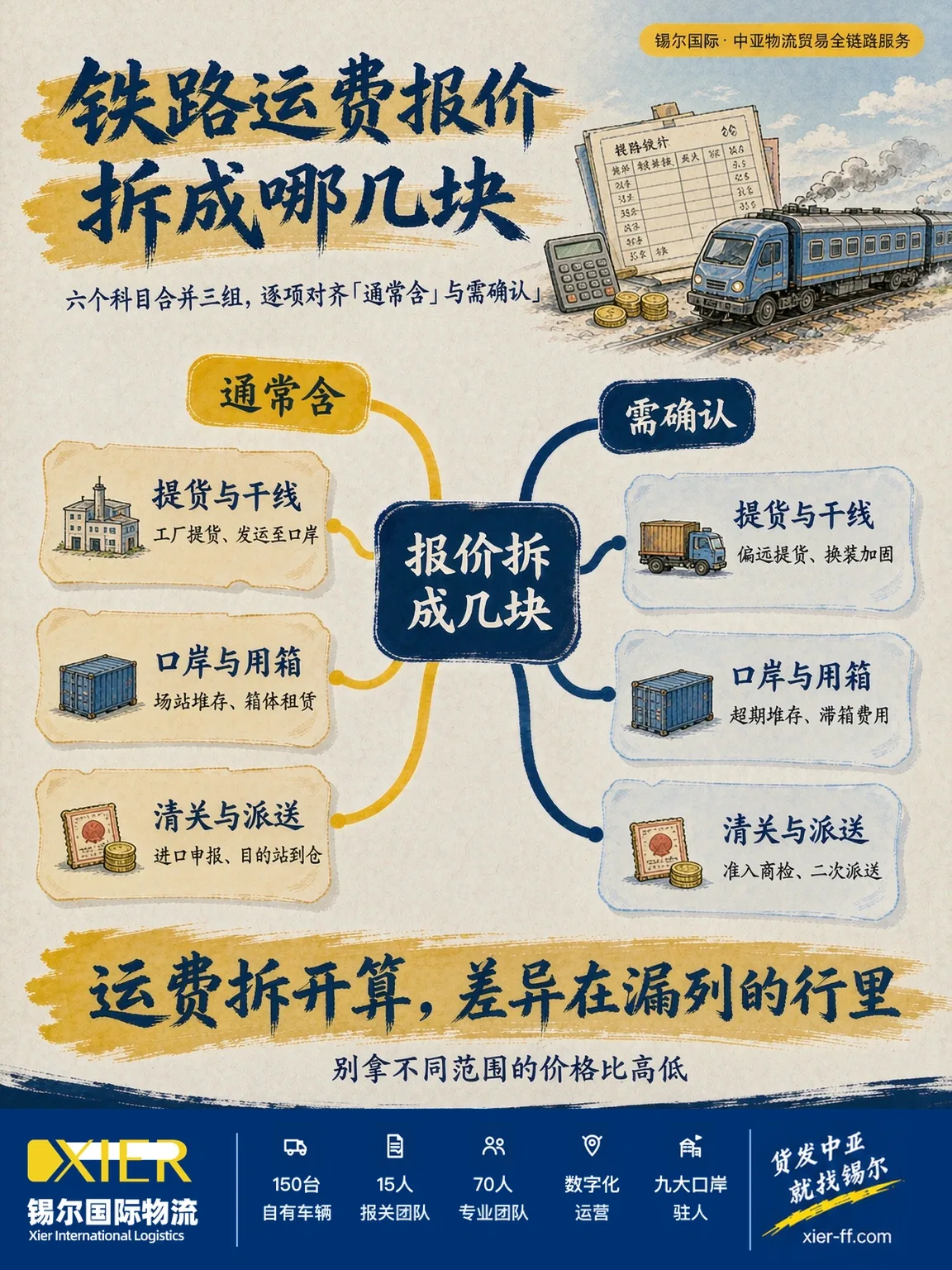 图:运费拆开算,差异在漏列的行里——三组科目逐项对照,别拿不同范围的价格比高低
Choose the right container type, complete the subjects, and finally ensure the process runs smoothly. The Central Asia railway chain is long, with many ports and different entry requirements in each country. If the responsibility of any step is not clearly written, it is easy to argue after the goods arrive. Proceed with the following six steps, align 'who is responsible for what' at each step, and have a fallback for exceptions.
Step 1: Inquiry, don't just report a total amount, break the six subjects apart and ask, clarify to which section it includes; Step 2: Booking Container and舱位, determine full and LCL and container type according to cargo volume, confirm whether a booking can be guaranteed during peak periods; Step 3: Loading and Customs Clearance, prepare the packing list and export documents in advance, leave time for inspection and amendment; Step 4: Port Transshipment, wide-gauge transshipment and customs clearance are key points, inquire about queuing time and reinforcement costs; Step 5: Port Customs Clearance, import declaration and entry, and pre-inspection of inspection and quarantine; Step 6: Delivery to Warehouse, ensure smooth handover and delivery at the destination station, avoid excessive storage and second delivery. It is recommended to write the trigger conditions and responsible parties of each step into the contract, rather than relying on verbal commitments.
| Steps | What to Do | Common Pitfalls |
|---|
| 1 Price Comparison | Break down the subjects, inquire about the container type | Don't just compare the total price |
| 2 Booking Container and舱位 | Determine full and LCL and container type according to cargo volume | Booking guarantee during peak periods |
| 3 Loading and Customs Clearance | Packing list and export documents, export declaration | Inspection cooperation, amendment |
| 4 Port Transshipment | Wide-gauge transshipment, customs clearance | Queuing time, reinforcement costs |
| 5 Port Customs Clearance | Import declaration, document submission | Entry, inspection and quarantine |
| 6 Delivery to Warehouse | Destination station pick-up, delivery | Excessive storage, second delivery |
Five, Avoiding Pitfalls: The Four Most Common Misjudgments
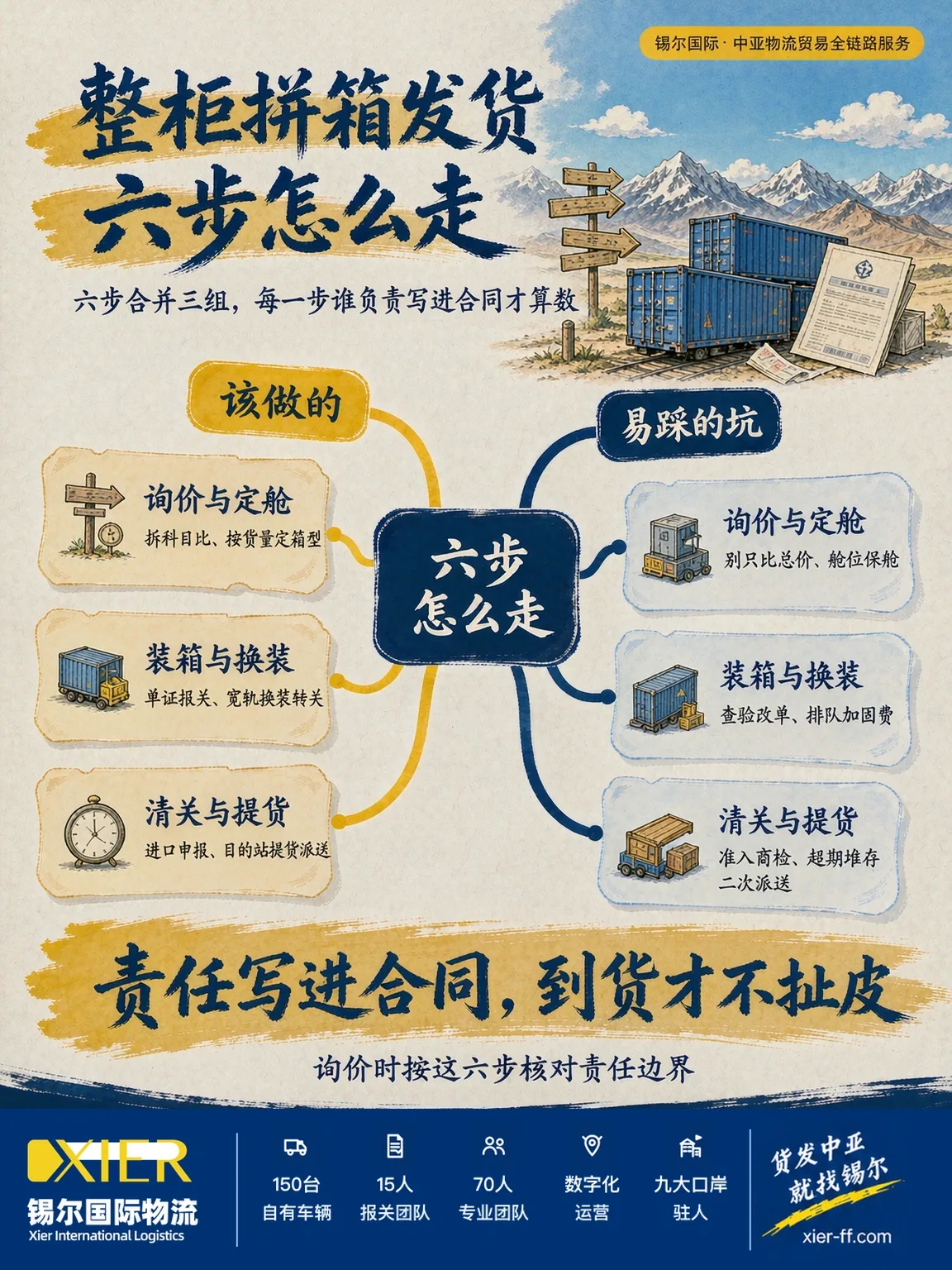 图:责任写进合同,到货才不扯皮——询价时按这六步核对责任,到货才不扯皮
| Misjudgment | The Truth |
|---|
| 「If the cargo is light, it must be consolidated loading」 | Heavy cargo, when calculated by ton, may sometimes be more cost-effective than a full container; first calculate the cargo volume and container type together |
| 「The lower the total price, the more cost-effective it is」 | The lower total price often comes from missing items; comparing without breaking down the items is like comparing different scopes |
| 「The quoted price includes transloading」 | Whether wide-gauge transloading, reinforcement, and queuing are included depends on the contract, not on oral commitments |
| 「Any company can handle Central Asia rail」 | The key is whether the destination country has customs clearance resources and whether there is someone on-site to handle exceptions |
These four misjudgments have a common point: they all made a judgment based on 'what seems to be' when information was incomplete. Less cargo does not necessarily mean consolidated cargo is cost-effective, low price does not necessarily mean lower total cost, and a quote does not necessarily mean a commitment. By comparing the three diagrams - looking at the type of cargo and its nature for container types, looking at the subject breakdown for freight, and looking at the responsibility boundaries for the process - you have a practical framework for inquiring about prices. For Central Asia railway container shipping, the real way to save money is not to lower the total price, but to clarify the boundaries and calculate exceptions in advance. If you have a specific shipment at hand, please send us the destination country, type of cargo, completeness of documents, and delivery requirements. We will align each item on this checklist and provide you with a service scope clearly stating 'what is included, what is not included, and what situations require additional payment' to resolve any discrepancies before shipment.
Common Questions
How is the freight calculated for full container and LCL (Less than Container Load) shipping?
Full container shipping is usually quoted at a fixed price based on container type (20 feet/40 feet/hi-cube), while LCL shipping is more often based on volume or weight, with different rates that cannot be directly compared. When inquiring about prices, you should clarify which method the other party uses and what is included in the price.
What are the general subjects included in the freight quotation for Central Asia railway shipping?
At least the following six items should be broken down: domestic pick-up and delivery, railway trunk line freight, port station handling fees, container usage fees, customs clearance in the destination country, and final delivery. The low price for missing items is often made up in the form of 'additional charges' after arrival.
Who is responsible for the transshipment and demurrage fees?
Whether the wide-gauge transshipment, reinforcement, overdue storage, and demurrage fees are included depends on the contract agreement. When making a quote, it is necessary to specify the triggering conditions and the party responsible to avoid disputes after arrival.
Can dangerous goods and oversized cargo be transported via the Central Asia railway?
Due to railway weight, gauge, and access constraints, not all routes can accept dangerous goods and oversized cargo. It is necessary to check the qualifications of dangerous goods, packaging requirements, and port access in advance, and negotiate on a case-by-case basis.
Which link is most prone to problems in the process of full container and LCL shipping?
Port transshipment and customs clearance in the destination country are segments with a high incidence of exceptions. Choosing service providers with port representatives and stable customs clearance resources in the destination country can significantly reduce the risk of loss of control in the queuing, inspection, and access links.
About the author: Xier International Logistics, focusing on Central Asia logistics market analysis and digital solutions. This article is based on 10 years of practical data and industry research of Xier International Logistics and is for reference only; specific plans need to be customized according to the characteristics of the goods.