I. Why 'Customs Clearance with Duties Paid' is especially difficult to negotiate in the direction of Central Asia
「Customs clearance with duties paid」is one of the most commonly used and easily misunderstood terms in the foreign trade circle. It is not a trade term with a unified definition, and what different freight forwarders say often refers to different service combinations: some refer to export customs declaration and destination country customs clearance, some include tax and fee advance payment, and some take the transportation and warehousing at both ends as a given.
In the Central Asia direction, this issue will be magnified. The chain is long, there are many ports, the tax regulations and document requirements of each country are different, and there are also variables such as transshipment, inspection, and customs clearance. If the quotation only talks about 'full package', it is easy to have a divergence of 'agreed to be included but requires additional payment' after the goods arrive. What needs to be clarified is not the price level, butboundaries: who is responsible for what, which subjects are included, which situations will trigger additional payments, and who is responsible for exceptions.
This article does not discuss specific quotations - freight rates, taxes, and port charges fluctuate with the type of goods, port, peak and off-peak seasons, and current policies, and are negotiated on a case-by-case basis. Below, we will use several tables to clarify 'which parts the 'one ticket double customs clearance with duties paid' should be broken down into', to help you have a reference framework before inquiring.
Secondly, define the boundaries: what is usually included and what is not included.
To unpack a shipment from start to finish, the most controversial issue is often the scope of 'default inclusion'. Below is listed by stage, with the specific terms of the contract as the standard.
| Stage | Generally included | Commonly requires separate confirmation / charged separately |
|---|
| Domestic pick-up | May include door-to-door pick-up as per agreement | Remote pick-up address, waiting for loading, storage over time |
| Export customs declaration | Declaration, document preparation | Classification disputes, inspection cooperation, amendment and return of documents |
| Cross-border transportation | Mainline transportation to port / destination country | Repacking, reinforcement, escort for over-dimensional cargo, temporary rerouting |
| Destination country customs clearance | Import declaration, document submission | Entry permit, certification, inspection, label compliance |
| Taxes and duties | As per the agreed advance payment or lump-sum terms | Changes in tariff classification, anti-dumping, exchange rate and late payment |
| Final delivery | May include warehouse delivery as per agreement | Consignee pick-up, second delivery, waiting for unloading |
One-liner: The 'taxes paid' covers taxes within the agreed terms, not all unexpected situations. Any scenarios involving inspection, amendment, entry, and over-time detention should be clearly stated in the contract with trigger conditions and settlement methods, rather than left to be discussed upon arrival.
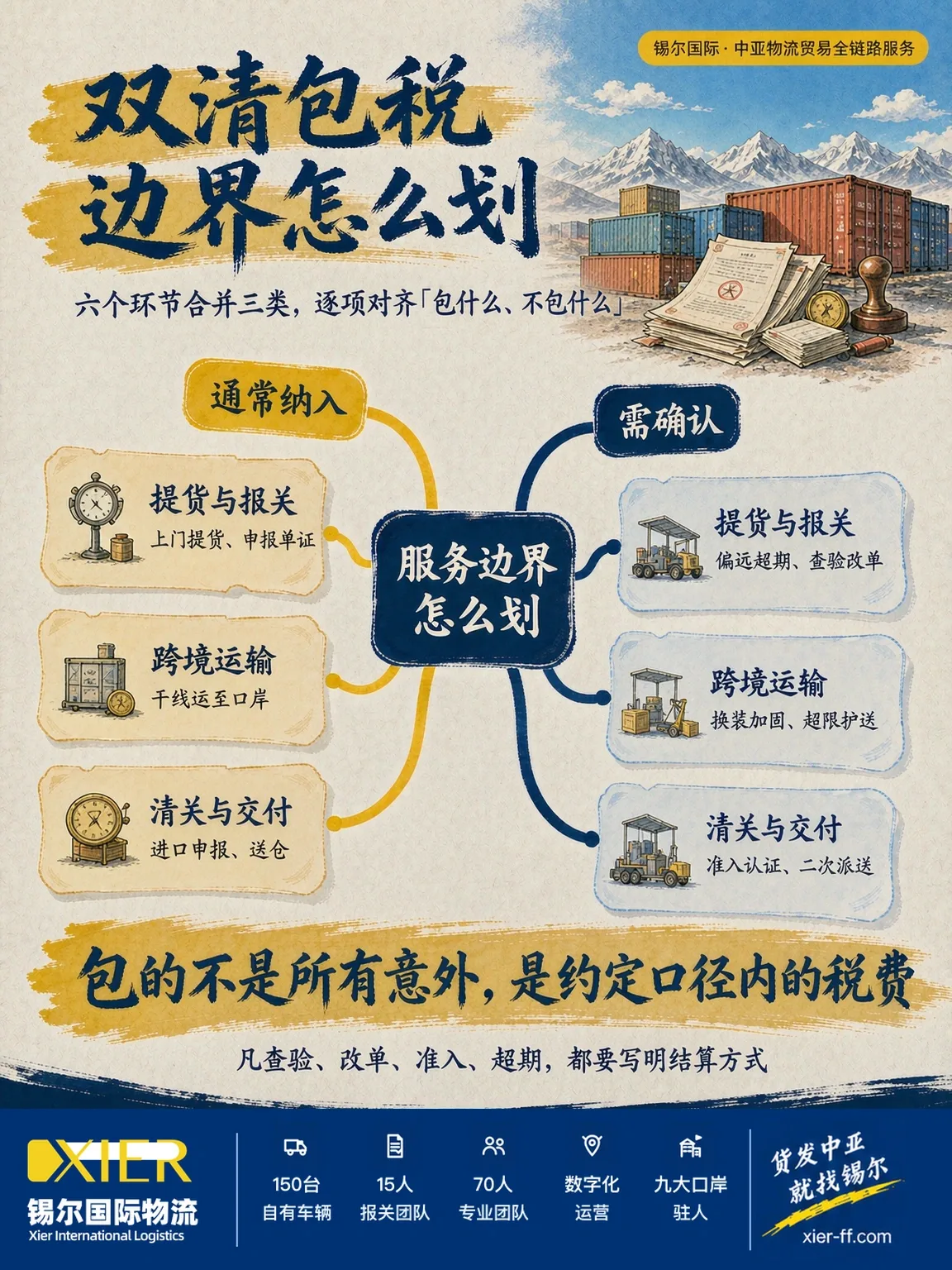 图:按环节拆开——「通常纳入」与「需确认」逐项对齐,包的不是所有意外
三、费用科目:报价单该拆成哪几块
Do not just look at the total amount when comparing prices. Ask the service provider to break down the quotes into items and align them one by one under 'inclusive items', as the differences are often hidden in the few lines not listed.
| Item | What determines it | What to ask when inquiring |
|---|
| Domestic pick-up and delivery, loading | Pick-up distance, cargo type, loading method | Whether including waiting time, forklift, and reinforcement materials |
| Export customs declaration and documents | Complexity of documents, number of items | Who determines classification, how to calculate changes in documents |
| Cross-border trunk freight | Channel, port, vehicle type / box type, peak and off-peak seasons | Whether including change of loading, unloading, and return empty |
| Port and terminal ancillary fees | Current port charges, storage duration | Starting point of storage, who bears the extra charge for overstay |
| Customs clearance agent in the destination country | Declaration complexity, whether third-party permits are required | Whose invoice to use, how to provide release certificates |
| Customs duties and import tax | Tariff classification, cargo value, origin, current tax rate | Advance payment by invoice or lump sum, how to settle the difference |
| Final delivery | Delivery address, unloading conditions | Whether including second delivery and waiting time |
| Exception handling | Inspection, seizure, change of documents, return shipping | Report actual expenses or include in lump sum |
Especially align「关税与进口环节税」这一行Is it for actual expenses reported after ticketing and payment, or a fixed price package? The risks corresponding to these two approaches are completely different—the tax rate fluctuation in the agency model is borne by the shipper, while the uncertainty is included in the service provider's quotation in the package model. There is no right or wrong, but it must be clearly stated.
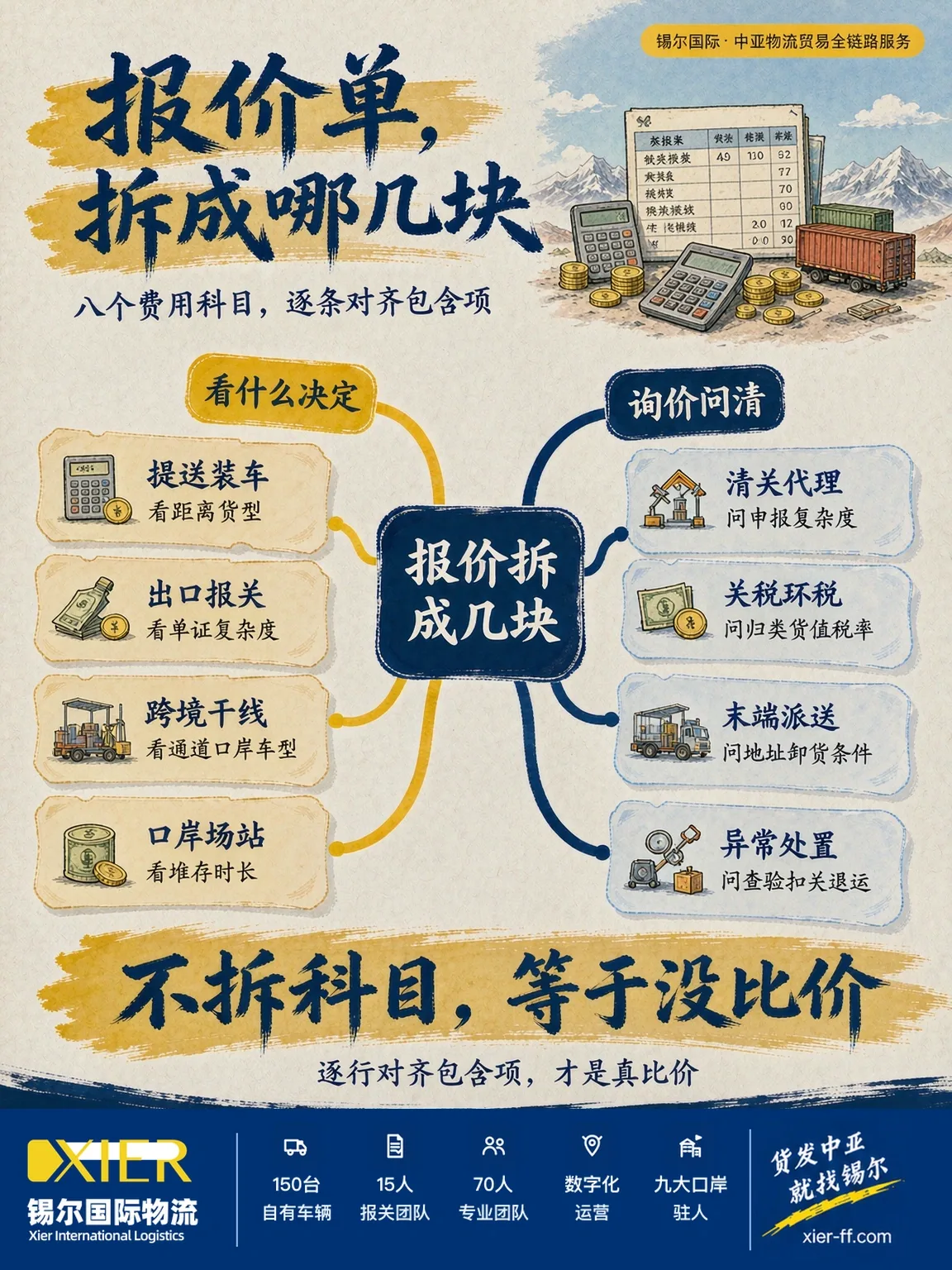 图:报价不拆科目等于没比价——八项费用逐项对齐,差异藏在没列出来的行里
Four, three compliance red lines: These 'convenient' things cannot be touched
Compliance requirements in the direction of Central Asia are tightening year by year. Any practice that evades declaration in the name of 'convenience' saves procedures in the short term, but in the long term, it shifts the risk onto the consignor.
| Red line | Why it cannot be touched | Correct practice |
|---|
| Low declared value / vague product name for 'tax saving' | Inaccurate classification and valuation, immediate seizure upon inspection, tax payment and fines, and impact on subsequent credit | Declare truthfully, do classification and value pre-audit before shipment |
| Use 'customs clearance with duties paid' to circumvent entry and certification | Permits, certifications, and labels are mandatory requirements of the importing country and are not exempted due to the mode of transport | Check the entry list before placing an order, and make up for missing certificates first |
| The heading of the documents does not match the actual trade relationship | The consignor, payee, and contract party do not match, leaving hidden dangers for customs clearance and settlement of funds | Three-party information is consistent, and the agency and agency relationship is written into the contract |
There is a very simple standard to judge whether a service provider is reliable or not:See if it dares to write 'what is not included' and 'what situations will incur additional charges' into the contract。Those that emphasize 'all-inclusive, worry-free, and don't worry about anything' often leave the boundaries as blurred as possible.
Five, Double customs clearance vs DDP vs Customer's own clearance: Three types of responsibility division
‘Double customs clearance’ is a service term, when it is written into the contract, it usually corresponds to different responsibility and risk divisions. First, clarify the three common models, and then it makes sense to discuss the quotation.
| Model | Where the service provider is responsible | What the shipper/receiver retains | Who is suitable for |
|---|
| Double customs clearance (service scope) | Includes export customs declaration, destination country customs clearance, and agreed tax and fee scope | Need to confirm access, authenticity of documents, and boundaries for abnormal handling | Wants one-stop service but still needs to master documents and cargo rights |
| DDP (trade term) | The seller assumes all risks and taxes before delivery to the designated location | The terms of responsibility are defined by the trade contract, and should be distinguished from the scope of freight forwarding services | Buyers and sellers who clearly adopt DDP in the trade contract |
| Customer's own clearance | Only responsible for transportation and the export segment, customs clearance in the destination country is handled by the receiver | Self-coordinate local customs brokers, pay taxes, and obtain permits | The receiver has customs clearance capabilities or fixed agents in the destination country |
A common misconception is to equate 'customs clearance with duties paid' directly with DDP. The former refers towhere the freight forwarding service includes delivery towhile the latter refers tothe division of risks and costs in the trade contract between the buyer and sellerThey are not on the same level, and mixing them up can easily lead to not being able to find the responsible party when an incident occurs.
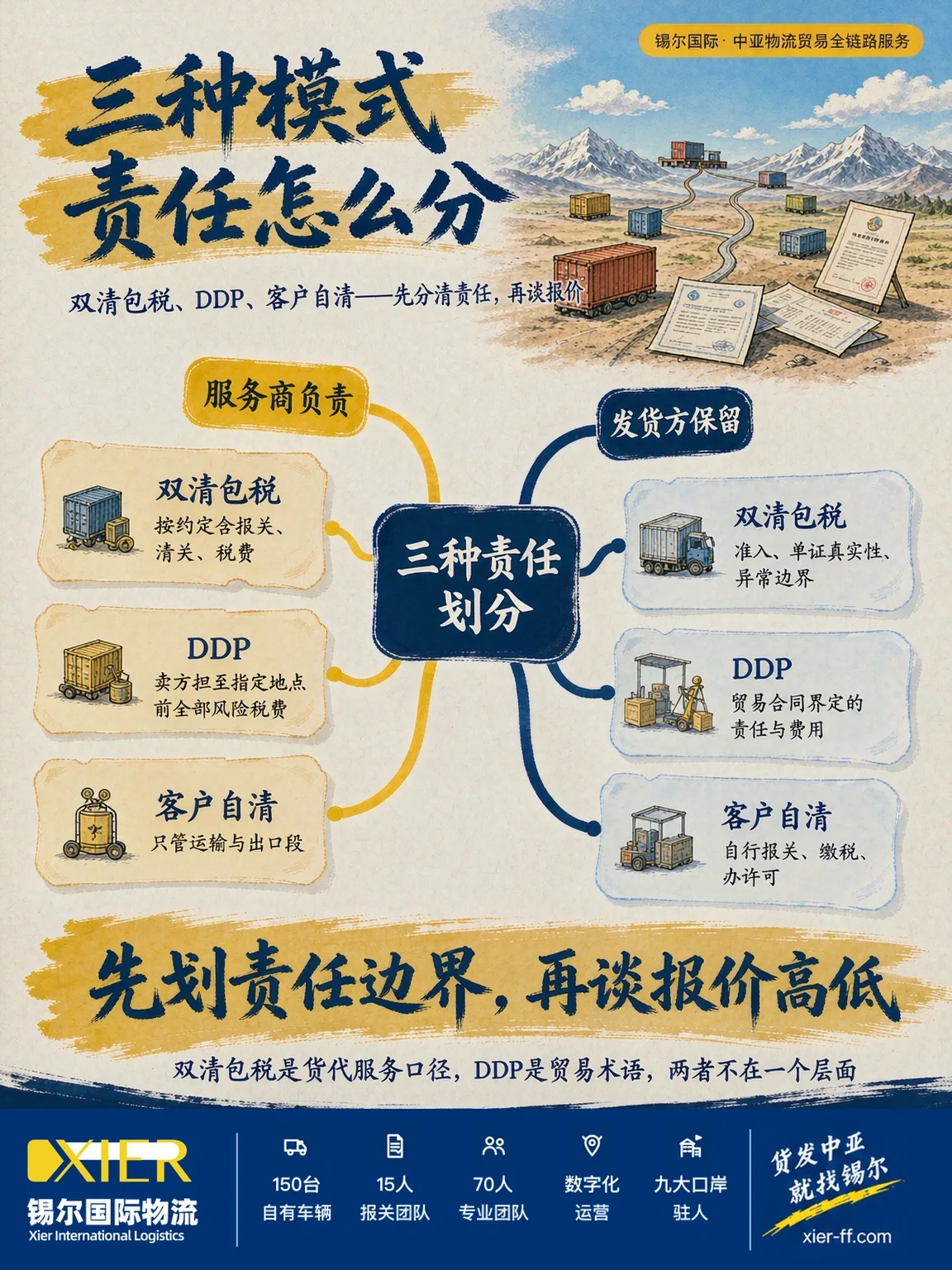 图:三种模式分清再谈价——服务口径与贸易术语不在同一层面,先划责任边界
Sixth, Inquiry Checklist: Write oral commitments into acceptable clauses
The following table can be used directly as an inquiry template. Ask and write each item into the contract, which is more effective in avoiding disputes after delivery than repeated price comparisons.
| Items to verify | The confirmation to obtain |
|---|
| Service boundaries | List each item, indicating whether the end point includes delivery to the warehouse and whether it includes unloading |
| Tax and fee scope | Is it paid on a ticket basis or on a lump sum basis; how to calculate the difference when the tax rate, exchange rate, and classification change |
| Exception handling | Trigger conditions and settlement vouchers for inspection, customs detention, order change, return, and storage beyond the agreed period |
| Document responsibility | Who determines the classification, who issues the documents, who uses the import invoice, and how the release certificate is delivered |
| Pre-access requirements | Who verifies the permit / certification / label requirements of the destination country, and how to handle the lack of documents |
| Time limit scope | When does 'door-to-door' start counting, and are port queuing and weather conditions exempt |
| Cargo rights and insurance | Delivery conditions, cargo damage liability area, whether freight insurance is covered by the carrier |
Seventh, Pitfalls: The four most common misjudgments
| Misjudgment | The truth |
|---|
| 「If I reported a full package price, there will be no additional charges」 | Whether the exceptions such as inspection, amendment, admission, and overdue are included depends on how the contract is written, not on oral commitments |
| 「Only the total price matters」 | A lower total price often comes from missing items; not itemizing for comparison is like comparing apples to oranges |
| 「With customs clearance and duties paid, there's no need to worry about documents」 | The responsibility for the authenticity of documents, classification, and admission still lies with the consignor, while the service provider merely acts as an agent |
| 「Any company can handle customs clearance with duties paid」 | The key is whether the destination country has stable customs clearance resources and whether there is someone on-site to handle exceptions at the port |
8. FAQ: High-frequency questions about customs clearance with duties paid
Will there be additional costs during the all-inclusive price?
It depends on the definition of 'exception' in the contract. The normative practice is to list each situation such as inspection, amendment, return shipment, and overdue storage, specifying whether they are included in the all-inclusive price and how settlement is made based on what evidence. If the contract only has one sentence 'all-inclusive', it is difficult to define in case of disputes, and it is recommended to make up for it during the quotation stage.
Are the requirements of the countries in Central Asia the same?
No, they are not. Tariffs, admission permits, certification, and labeling requirements apply separately to the destination country; for the same shipment to different countries, the documents and pre-shipment verification checklist need to be redone. Do not directly apply the experience of one country to another.
Who determines the value of the goods and HS classification?
The declared statutory liability is on the consignor's side, the service provider can offer classification suggestions and pre-screening, but cannot substitute for the consignor's confirmation. Aligning the product name, material, use, and value before shipment can significantly reduce the probability of inspection and order modification.
Is customs declaration with duties paid the same as DDP?
No. Customs declaration with duties paid is the charge scope of freight forwarding services, while DDP is a term in the trade contract, with different objects of constraint. It is important to clearly write out the trade terms and scope ofentrustment services when signing the contract to avoid mutual avoidance of liability in case of accidents.
How do you determine who to turn to?
Look at three points: whether 'excluded items' and abnormal handling can be written into the contract, whether there are stable customs clearance and release resources in the destination country, and whether there is someone who can handle the inspection and re-loading on-site at the exit port. If only one number is reported and the rest are vague, the risk is usually left for later.
Defining boundaries is more important than lowering prices. If you have a specific shipment in hand, please send us the destination country, type of goods, completeness of documents, and delivery requirements. We will align each item on the checklist above and provide you with a service scope that clearly states 'what is included, what is not included, and what situations require additional payment' to resolve discrepancies before shipment.
About the authorXier International Logistics, focusing on Central Asia logistics market analysis and digital solutions. This article is based on 10 years of practical data and industry research from Xier International Logistics and is for reference only; specific solutions need to be customized according to the characteristics of the goods.