I. Why everyone is comparing 'road or railway' for Urumqi to Almaty
Urumqi to Almaty is the busiest corridor from Xinjiang to Central Asia: one end is China's western gateway, and the other end is the main city of Kazakhstan, the logistics and trade hub of the entire Central Asia. On this route, the most common problem that enterprises are concerned about when shipping is——For the same shipment, should we take the road or the railway?
There is no standard answer to this question, as the cost structure, timing rhythm, and suitable cargo types of the two channels are completely different. Roads are flexible, railways are cheaper, and timeliness fluctuates. Miscounting the account can either result in unnecessary extra expenses or delay the delivery due to cargo being stuck on the road. This article uses several comparison tables to clarify the differences between the two channels at once, helping you have a framework before inquiring for prices.
Secondly, how to travel through the two channels separately
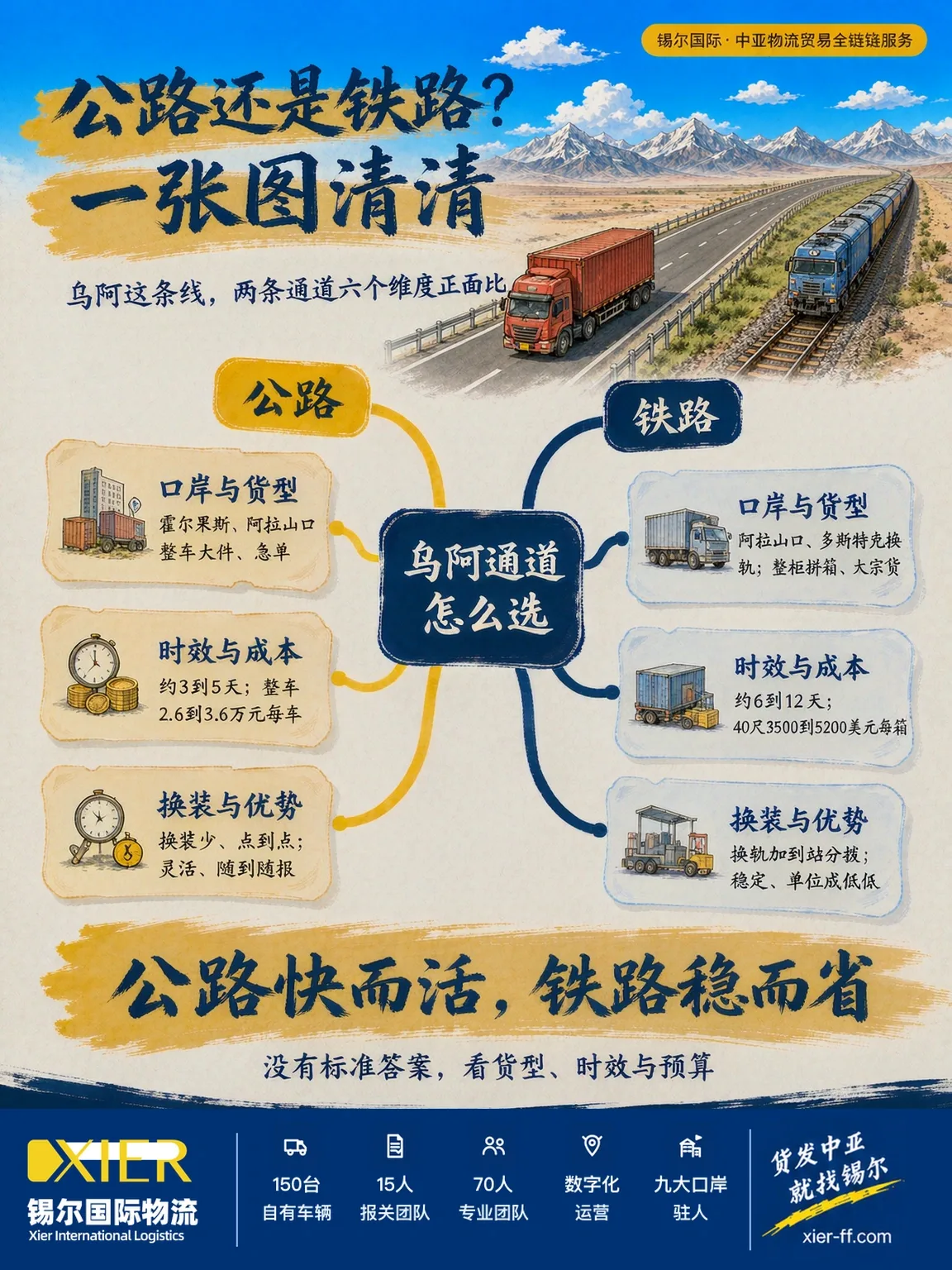 图:公路还是铁路?口岸货型、时效成本、换装优势六个维度一次看清
Firstly, understand the physical path before discussing costs.
| Channel | Main Port / Node | Typical Path | Suitable Form |
|---|
| Road Transport | Khorgos, Alashankou | Urumqi loading → port customs declaration →哈萨克方border crossing换装/直拖 → Almaty warehousing | Whole vehicles, large pieces, time-sensitive goods |
| Railway Combined Transport | Urumqi assembly center → Alashankou / Dostyk | Ürümqi collection → train dispatch → Dostyk transshipment → Almaty Station / Almaty 2 Station | Container full container, LCL, bulk stable cargo |
The advantage of road transport lies in 'point-to-point': from your warehouse to the consignee's door in Almaty, with fewer transshipment links in the middle; the advantage of rail transport lies in 'scale and stability': train schedules are relatively fixed, unit costs are low, and it is suitable for planned large quantities.
Three, cost comparison: one table to see the interval
The following is for the second half of 2026Market reference intervalIt is affected by oil prices, exchange rates, and peak and off-peak seasons, and fluctuates greatly; it is only used to establish a budget framework,The actual price is subject to the inquiry of the current ticket.
| Transportation form | Road reference interval | Railway reference interval | Who is more cost-effective |
|---|
| Truck (13.5 meters/17.5 meters) | About 26,000-36,000 yuan per vehicle | —(Railway by box) | Large-scale truck transportation is more flexible door-to-door |
| Railway full container (40 feet) | — | About 3,500-5,200 US dollars per box | At the same volume, rail transport is usually lower |
| LCL / LCL (per cubic meter) | About 380-620 yuan per cubic meter | About 220-360 yuan per cubic meter | LCL rail transport is significantly more cost-effective |
| Customs clearance + port charges | Single ticket, flexible and negotiable | The train includes some station fees | Determined by the complexity of the goods value and documents |
A point that is easy to overlook: Cost cannot be considered only in terms of freightHighway 'door-to-door' saves the two ends of short-haul and multiple loading and unloading, with overall low hidden costs; although rail is cheaper, if the collection, storage, and transshipment at both ends are not planned well, the saved freight may be eaten back.
Four, time comparison: how many days for door-to-door
| Channel | Door-to-door reference time | Source of fluctuation |
|---|
| Highway full truckload | About 3-5 days | Port queuing, weather, and the speed of customs clearance by the Kazakhstan side |
| Railway full container load / less than container load | About 6-12 days | Frequency of train operation, track change, and station distribution |
In terms of timeliness, highways are generally faster and more controllable, suitable for orders with tight delivery windows; rail is more stable but not as immediate as highways, suitable for scheduled replenishment and inventory allocation.
Five, what goods are more cost-effective to transport by highway
For goods with the following characteristics, consider highways first:
| Scenario | Reason |
|---|
| Full truckload large goods / oversized equipment | Railway has strict size and weight restrictions, while highways can be equipped with flatbed trucks and low-bed trucks |
| Time-sensitive orders | Delivery window ≤ 5 days, difficult to guarantee by rail |
| Flexible customs clearance at the port | Highways can report on arrival, and exceptions can be coordinated on-site |
| Small batch trial orders | When the volume is less than a full container, full truckload or LCL is more cost-effective than trains |
Six, what goods are more cost-effective to transport by rail
| Scenario | Reason |
|---|
| Bulk stable goods | The unit cost of the same volume of goods by rail is significantly lower |
| Less than container load in small batches | Charging by cubic meter, with a significant price advantage for rail |
| Sustainable / Green Logistics Assessment | Railway unit carbon emissions are much lower than road |
| Planable restocking | Train schedules are fixed, convenient for inventory scheduling |
Seven, Avoid pitfalls: The three most common misjudgments in choosing the wrong channel
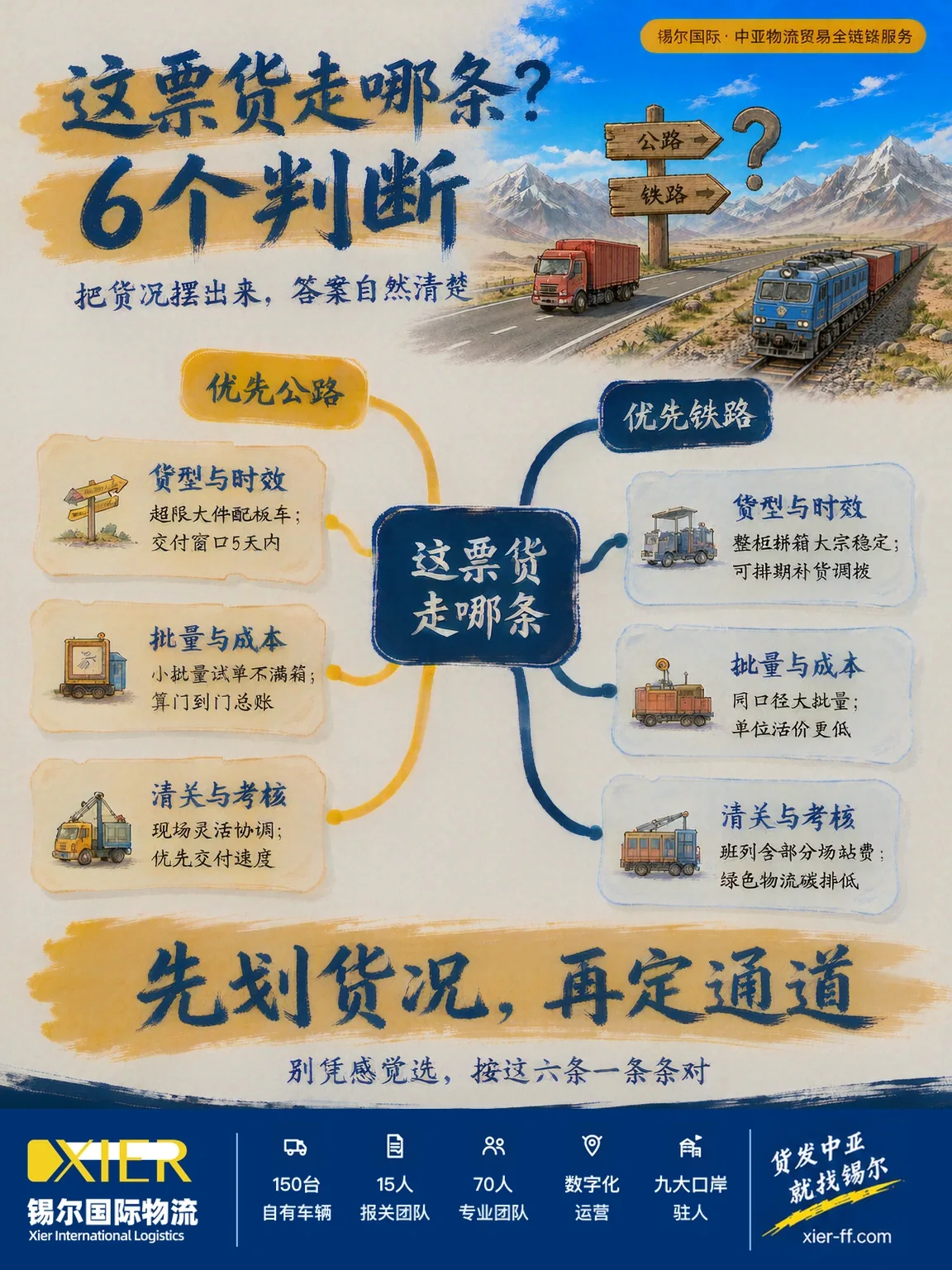 图:把货况摆出来——按货型时效、批量成本、清关考核六个判断定通道
| Misjudgment | The truth |
|---|
| 「Railway is definitely cheaper than road」 | For small batches, urgent orders, and large items, road transportation is more cost-effective overall |
| 「Only compare the cost per kilometer」 | Omissions include short-haul transportation, loading and unloading, warehousing, and capital occupation |
| 「Only look at the number of transportation days for timeliness」 | Customs clearance, transshipment, and distribution are often the bottlenecks |
Eight, FAQ: High-frequency questions about transportation from Ürümqi to Almaty
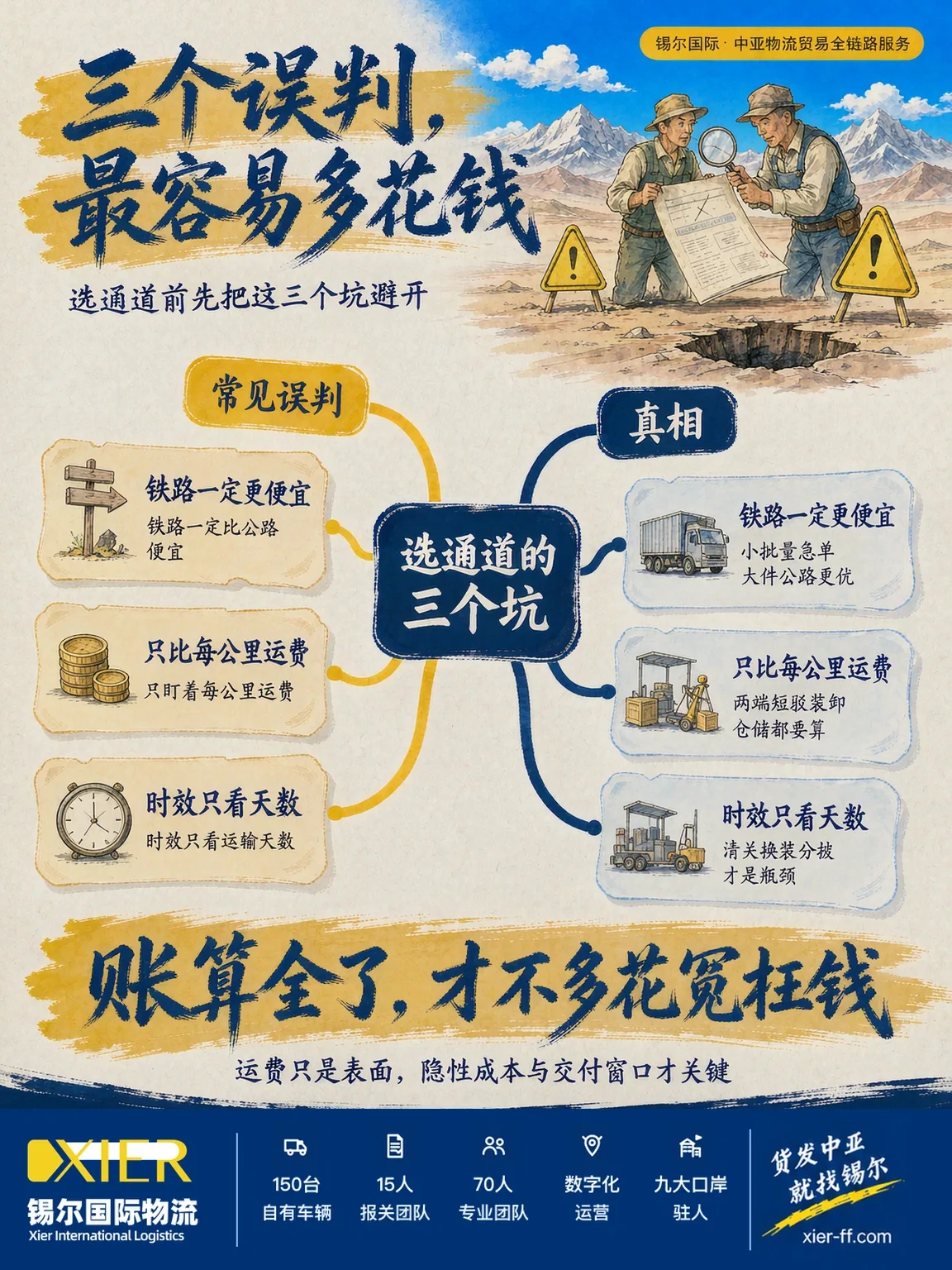 图:三个误判最伤利润,别踩——铁路未必更便宜、时效不只看天数、价不只看每公里
Can road and rail be mixed?
Yes, it is very common. For example, use rail transportation for the outbound journey to distribute large quantities of goods to the Almaty warehouse, and then use local road transportation for the last kilometer distribution; or use road transportation for emergency restocking and rail transportation for regular restocking, forming a 'fast-slow combination'.
How to send out loose cargo that is not a full container in the most cost-effective way?
Prioritize rail consolidation, which has a low cost per cubic meter; if the time is tight and the container is not full, road LCL (Less than Container Load) is the second-best solution. The key is to ask about the 'volume/weight billing criteria' once during the inquiry to avoid settlement based on the higher value.
Where is customs clearance more convenient?
Mostly, import customs clearance is done at theKazakhstan border or Almaty, with documents and tariffs aligned before shipment; road transport is more flexible with on-the-spot reporting, while rail transport depends on the rhythm of the train stations. For high-value goods with complex documents, it is recommended to do document pre-examination in advance.
Why do quotes vary so much between companies?
Differences often come from: whether the two-way short-haul, port charges, exchange rate and oil price surcharges, and the stability of vehicle/box sources. When comparing prices, do not just compare numbers, but align each item 'included' one by one.
How do I decide who to send it to?
Look at three points: whether there are self-operated or stable cooperative resources in Urumqi and Almaty, whether there is a permanent customs clearance capability at the Khorgos/Alashankou port, and whether you can compare and select both road and rail options. Those who only recommend one channel often cannot provide a suitable solution.
Whether to choose road or rail is essentially a choice of 'using budget for time' or 'using time for cost'. If you have a specific shipment, please send us the quantity, size, delivery date, and budget range, and we will provide you with a road+rail comparison plan based on the current market conditions, and calculate the account before shipment.
About the authorXier International Logistics, focusing on Central Asia logistics market analysis and digital solutions. This article is based on 10 years of practical data and industry research from Xier International Logistics and is for reference only; specific solutions need to be customized according to the characteristics of the goods.