I. First clarify: Is your cargo actually "Dangerous Goods / Special Goods"?
Many customers come for the first time and say, 'I only have a little chemical raw material, should it not be considered hazardous goods?' However, after checking the 'List of Hazardous Chemicals' or classifying according to the United Nations regulations for the transport of dangerous goods, it turns out that it has already been listed in the nine major categories. Hazardous goods are divided into nine categories according to the 'Recommendations on the Transport of Dangerous Goods - Model Regulations' of the United Nations, which is the total premise for all subsequent documents and port selection.
Nine categories shorthand
Category 1: Explosives; Category 2: Gases (compressed, liquefied, dissolved, pressurized); Category 3: Flammable liquids; Category 4: Flammable solids, substances liable to spontaneous combustion, substances which, in contact with water, emit flammable gases; Category 5: Oxidizing substances and organic peroxides; Category 6: Toxic and infectious substances; Category 7: Radioactive substances; Category 8: Corrosive substances; Category 9: Miscellaneous dangerous substances (such as lithium batteries, dry ice, etc.). The most common categories in Central Asia land transport are 2, 3, 4, 5, 6, 8, and 9.
The biggest pitfall here is:It's not that you think it's not dangerous and it won't be considered as such. For example, lithium batteries are classified as Category 9, alcohol-based perfumes as Category 3, and certain disinfectant wet wipes containing flammable solutions may also be classified as Category 4. Once the classification is incorrect, all subsequent documents, packaging, and port selection will follow suit.
II. The "Four Certificates and One Document" that must be in order before departure
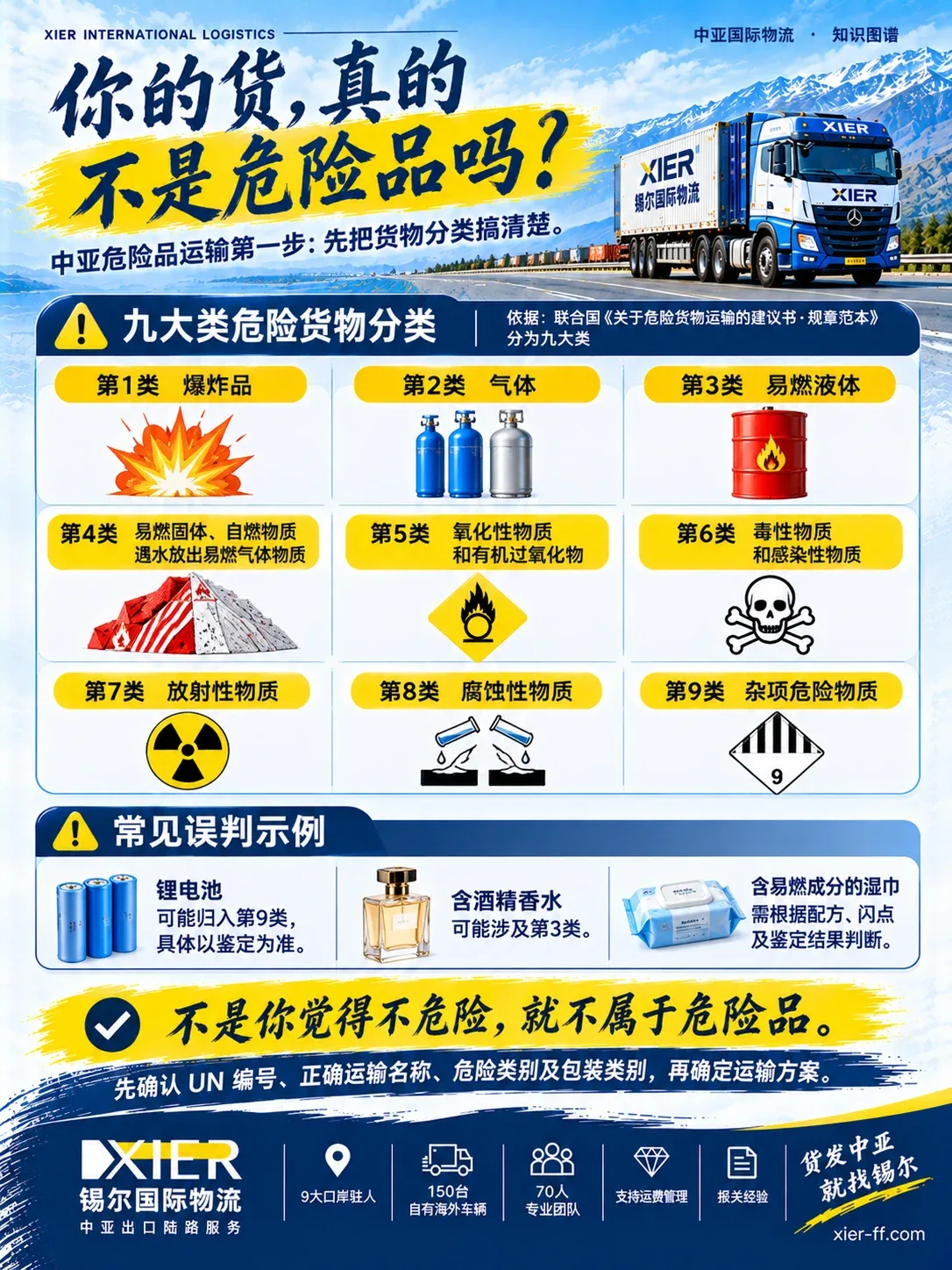 图:危险货物九大类速记——分类一旦定错,后续单证、包装与口岸选择全跟着错
Transporting hazardous goods via Central Asia land routes requires more documents than general cargo. Missing even one will result in the goods being returned at the port. The core list is as follows.
1. Safety Data Sheet (SDS, also known as MSDS in the industry)
This is the "identity card" of hazardous goods transportation, covering sixteen items such as physical and chemical properties, health hazards, first aid measures, fire fighting measures, spillage disposal, transportation information (UN number, correct transport name, packaging category). Note: Central Asian customers often require Russian or local language versions, and the pure Chinese version may be repeatedly刁难 at the border.
2. Exit Certificate for the Transport of Hazardous Goods Packaging (commonly known as "hazardous packaging certificate")
Issued by customs or designated institutions, proving that your packaging meets the requirements for the transport of hazardous goods. Without it, the goods cannot even enter the port. The hazardous packaging certificate must correspond to the physical packaging one by one, cannot be used multiple times, and cannot be used inappropriately.
3. Hazardous Goods Transportation Certificate / Hazardous Assessment Report
Issued by a qualified testing institution, confirming the hazardous category and packaging category of the goods, which is the direct basis for customs declaration and booking. Many cases of return transport are rooted in this assessment not matching the physical goods.
4. Customs declaration + packing list + invoice + contract
They should be complete like general cargo, but the product name must be declared according to the 'Catalogue of Hazardous Chemicals' specifications, and it cannot be a vague name like 'chemical products' for the sake of convenience——this will be subject to customs control and inspection, which will actually slow down the process.
5. Other possible documents
Such as transport permits for highly toxic or easily manufactured toxic chemicals, special permits required by the importing country, UN specification packaging marking photos, etc. Specific to the type of goods and destination country, it is recommended to list them before shipment.
Three, the port is not chosen arbitrarily: the biggest pit is the difference in access
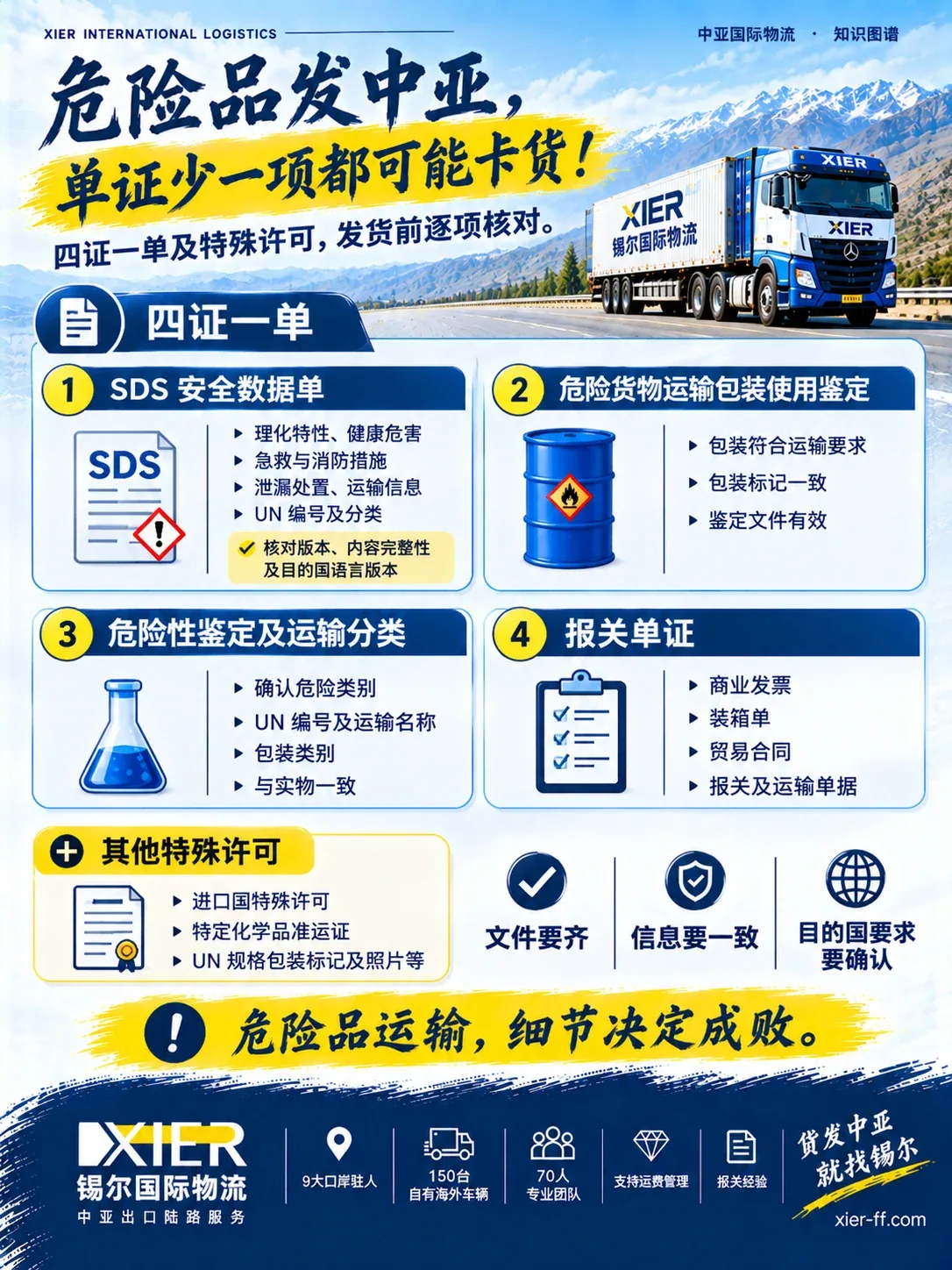 图:出门前必齐的「四证一单」——文件要齐、信息要一致、目的国要求要确认
This is the easiest place to go wrong. Many customers take it for granted that 'as long as the port is close to Xinjiang, that's fine'Not every port accepts hazardous goods, and there are many differences in the qualifications for receiving special goods, supervision warehouses, and dedicated vehicle requirements among different ports.
North Line: Khorgos /阿拉山口 (for Kazakhstan, transiting Central Asia)
These two major ports have large throughput and mature infrastructure and are the main channels for land transportation of hazardous goods, but they also require that the carrier have qualifications for hazardous chemical road transportation and dedicated vehicles. Details of the whole vehicle and bulk cargo clearance at the North Line highway ports, we have《Baktu / Jimunai Port: Two Short Routes for Kazakhstan Freight》It has been disassembled and can be read in combination.
Southern Route: Turghart / Irkeshtam (for Kyrgyzstan and Uzbekistan)
The port of the southern route has relatively limited capacity for handling special goods, and some high-risk categories need to be confirmed in advance with the port regulatory warehouse whether they can be accepted. The requirements for customs clearance vary from country to country, it is recommended to read《Customs Clearance Practice: Quick Reference to Import Customs Differences in the Five Central Asian Countries》, understand the import restrictions of the destination country before booking a container.
High-altitude ports: Kala Su / Hongqila (for Tajikistan and Pakistan)
These ports have seasonal traffic windows, often closed in winter. The impact on special goods is greater: compressed gases, low-temperature liquefied gases have increased risks under low temperature and high altitude, and some categories directly stop accepting during the closed mountain period. If you plan to take this route, be sure to calculate the seasonal window into the time limit.
In one word:Port access should be inquired and confirmed first, don't wait until the vehicle arrives at the port and finds out that it can't be accepted. For specific ports that accept your goods, please contact Xier for document processing and port pre-approval.
Four, Transit and 'Hidden Checkpoints' of the Destination Country
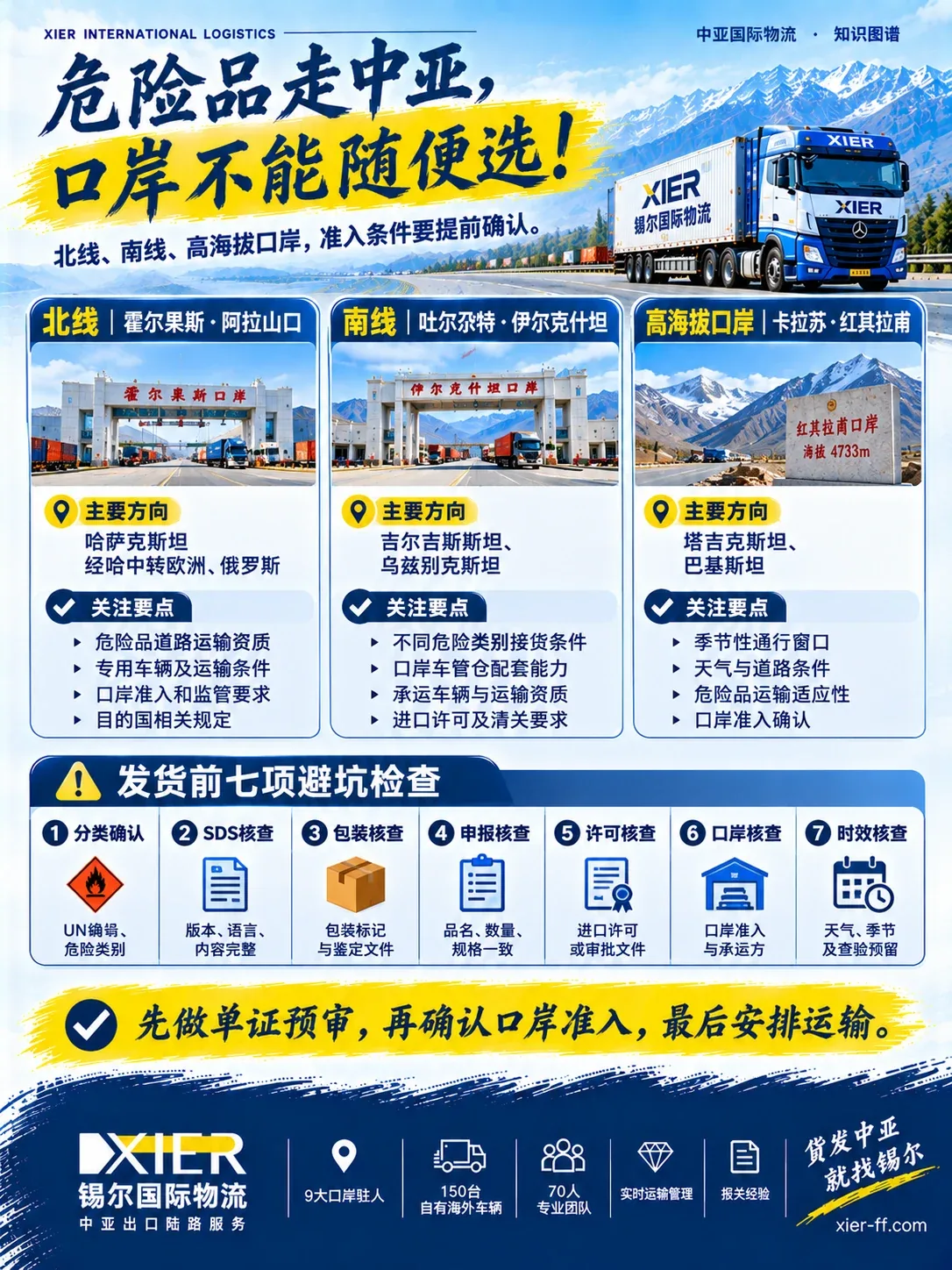 图:口岸不是随便选的——北线/南线/高海拔三线准入差异是最大坑,发货前先做单证与口岸预审
Being able to leave the Chinese port does not guarantee delivery to the customer. The five Central Asian countries each have their own import prohibition lists, safety data sheet language requirements, and certification systems:
- Kazakhstan: Has a relatively完善 regulation for dangerous goods import, requiring advance declaration and preparation of Russian language documents;
- Uzbekistan: Some chemicals require import licenses, and incomplete documents are prone to customs clearance delays;
- Kyrgyzstan and Tajikistan: Limited port handling capacity, it is recommended to confirm high-risk categories in advance;
- Turkmenistan: The strictest entry requirements, most dangerous goods require special approval.
In addition, cross-border land transportation often involves transshipment and transit through third countries, with independent requirements for dangerous goods at each segment. Our Xier 'Freight Forwarding Manual' knowledge base contains more detailed country lists, which can be viewed together with this article; for goods that are not sure, it is safest to conduct a pre-examination before dispatching.
V. Pitfall List (Check this before shipment)
Before shipment, go through these seven points to avoid more than 90% of returns and delays:
- Is the classification correctly determined? Has the UN number, correct shipping name, and packaging category been written correctly?
- Is the safety data sheet the latest version (with all sixteen items complete), and is there a translation in the destination country's language?
- Is the dangerous goods package certificate within the validity period, and do the packaging marks match the physical items?
- Is the declared product name in the customs declaration in accordance with the catalog specifications, and are there any vague names written?
- Does the destination country require import permits or transport permits, and have they been obtained?
- Does the selected port and carrier accept this type of hazardous goods?
- Is the seasonal window, transshipment, and inspection reserve time included in the timeliness?
If there is any uncertainty, it is recommended to do a document and port pre-inspection first, which is much cheaper than making a post-event remedy.
Common Questions
Is "common chemical products" a hazardous material? How do you judge?
Don't rely on intuition. The basis for judgment is the Catalogue of Hazardous Chemicals and the United Nations classification of dangerous goods. Even if you think it's just a little solvent, if any indicator such as flash point, toxicity, or corrosiveness exceeds the limit, it may be classified as Category 3, 6, or 8. The safest approach is to send it to an institution with qualifications for hazard assessment and obtain the transport assessment certificate before booking the cargo, so as not to find out that the classification is wrong when booking the舱.
Is the Chinese version of the safety data sheet sufficient? Do you need to translate it?
The Chinese version is sufficient for domestic transportation and customs declaration; however, for transit and Central Asia destination countries, usually Russian or local language versions are required. Pure Chinese safety data sheets may be required to be translated at the port or destination country customs clearance, which may delay the timeliness. It is recommended to prepare the destination country language version before departure.
What should be done if the port suddenly says it cannot accept hazardous goods?
This is the importance of 'confirm first, book later'. Once it is found that the selected port does not accept this type of goods, the only option is to change to a qualified port or change the carrier, which will result in higher costs and less time efficiency. Therefore, it is essential to have the carrier confirm in writing the port's access before booking, preventing risks before the departure.
Hazardous Materials Classification (Classification) and MSDS Requirements
Differences in Access to Special Goods Among Ports
Linked to the Knowledge Base 'Freight Agency Book' for Traffic Guidance
About the Author: Xier International Logistics, focusing on Central Asia logistics market analysis and digital solutions. This article is based on 10 years of practical data and industry research from Xier International Logistics and is for reference only; specific solutions need to be customized according to the characteristics of the goods.