1. To ship to Uzbekistan, first understand that it is a 'double landlocked country'
In the consultation of cross-border logistics in Central Asia, there is an increasing demand for shipping to Uzbekistan. Tashkent is the main city of Uzbekistan and a common destination for goods on this route. The goods shipped from China to the local area are mostly e-commerce goods, machinery and equipment, building materials, auto parts, and light industrial products. However, many shippers ask about 'how much is the freight, how many days will it take' as soon as they start talking. After answering, they often have to do the work again - because what truly determines whether this shipment can be smoothly delivered are three more preliminary matters: which channel to take, whether the documents and certifications are ready, and how the collection and customs clearance will be handled at the Tashkent end.
Uzbekistan is a dual landlocked country: it does not border the sea itself, and most of its neighboring countries are also landlocked. This means that its imports and exports usually have to pass through neighboring country ports and transit channels, with a longer route and more links than shipping to Kazakhstan. Therefore, when shipping to Uzbekistan, one cannot just look at the big word 'China to Uzbekistan', but must break down the channels, intermediate loading, and customs clearance methods one by one to know where the money is spent and where the time is consumed.
It is necessary to clarify the scope: The time intervals, cost structures, and customs clearance methods mentioned below are common reference frameworks for this route, not commitments for a specific shipment. The accurate figures should be based on the train schedule, fleet schedule, and customs quotation on the day of inquiry. The channels, documents, and subjects mentioned in the text are used to help you establish a judgment framework, not to fabricate specific freight rates.
II. How to choose the channel: Three mainstream paths and corresponding cargo types
For shipments to Uzbekistan, there are three common channels: the northern Xinjiang route through Khorgos by railway express, the southern Xinjiang route through the Irkeshtam port by road for exit connection, and the road channels through ports such as Turghart. The choice is not based on the fame of the port name, but on whether the cargo type, origin, and time requirements match.
The Khorgos railway express is suitable for large-volume container shipments that are sensitive to cost; the southern Xinjiang Irkeshtam road channel is suitable for shipments originating in southern Xinjiang or those requiring door-to-door direct delivery. Organizing shipments from the Kashi area and taking this route often saves mileage; road channels such as Turghart can be used as seasonal supplements. Generally, shipping in volume by rail is more convenient for cost allocation, while urgent shipments and large items are more flexible by road. The specific choice depends on the current port traffic and train schedule on the day.
| Channel | Main method | Suitable cargo | Judgment points |
|---|
| Khorgos | Railway express as the main mode | Large volume full container loads, cost-sensitive | Check train schedule and transshipment |
| Irkeshtam (Southern Xinjiang) | Road transport primarily | Southern Xinjiang origin, door-to-door | Save mileage, check port access |
| Tulghat and other ports | Road transport primarily | Time-sensitive general cargo | Check season and traffic conditions |
Many shippers may overlook the variable of the origin. The same shipment to Tashkent, whether organized from Southern Xinjiang or Northern Xinjiang, the suitable channels may be completely different. Considering 'where the goods come from' in the judgment is more cost-effective and time-saving than simply comparing port names.
III. How to estimate timeliness: railway express trains, road motor transport, and combined rail-road transport
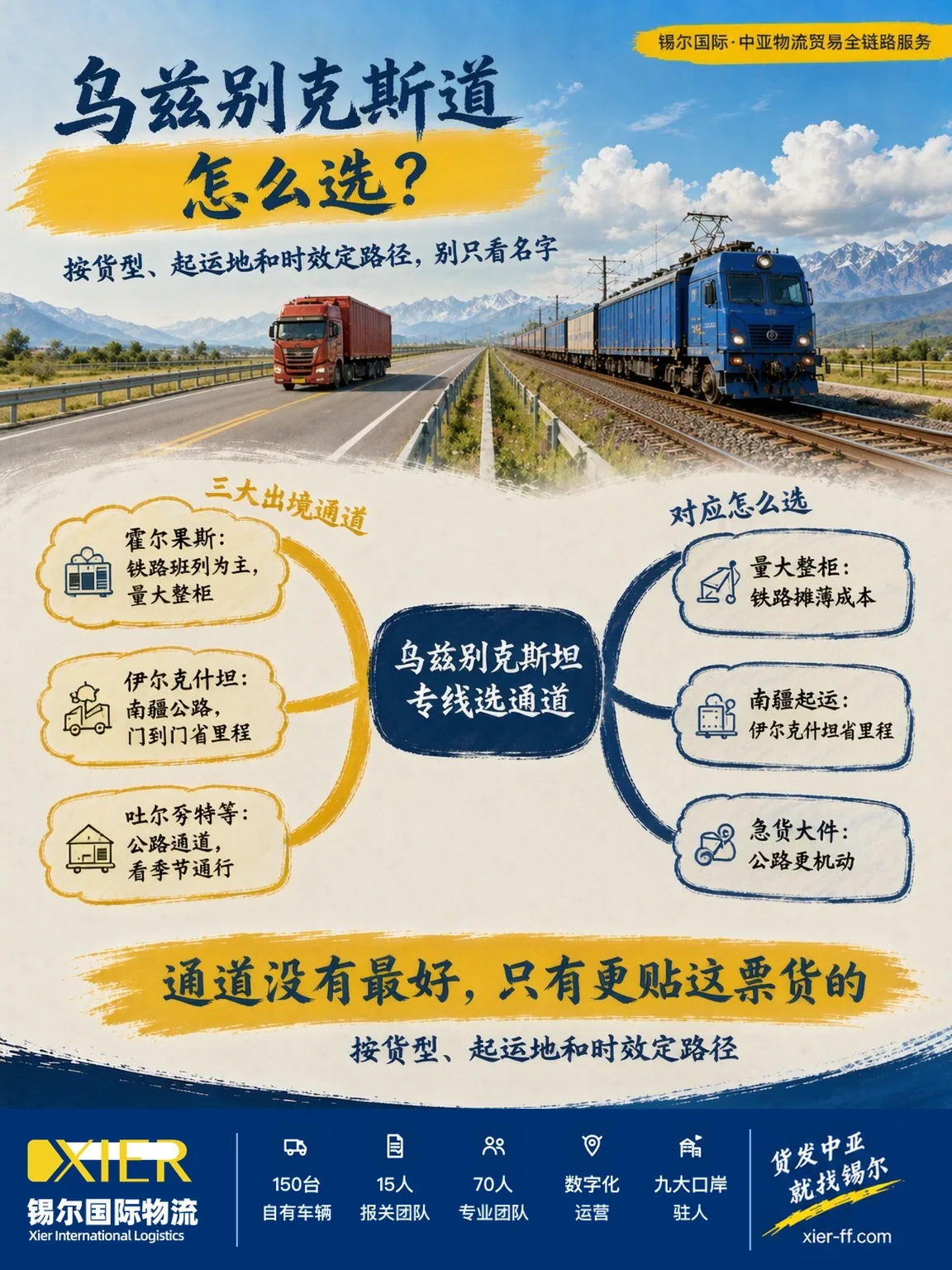 图:通道没有最好,只有更贴这票货的——按货型、起运地和时效定路径
Timeliness is the most easily mislead by a single number, especially for shipments to Uzbekistan. There are three common methods with different rhythms: the low-cost railway express train in Central Asia is suitable for bulk goods, but the cycle is long and affected by train schedules; road motor transport has strong mobility, suitable for urgent goods and door-to-door; combined rail-road transport uses the railway for mainline operations and the road for both ends, between the two.
Because Uzbekistan is a landlocked country, goods often need to be transshipped or transited at neighboring country ports, which adds one to two more links than sending to Kazakhstan. To estimate the time, it is necessary to break it down into several time segments: domestic collection and delivery, export customs declaration, port queuing and transshipment, cross-border trunk transportation, neighboring country transshipment, destination country customs clearance, and final delivery. Any delay in any segment will accumulate backward, among which port transshipment and customs clearance are the two segments with greater fluctuations. Asking about how these two segments are arranged during quotation is more useful than just asking 'how many days in total'.
| Method | Time characteristics | Cost characteristics | Suitable for cargo type |
|---|
| Railway train | Long cycle, depending on scheduling | Bulk cargo costs are low | Full container, high volume, cost-sensitive |
| Road transportation | Flexible, relatively fast | Unit price is high | Urgent goods, large items, door-to-door |
| Iron and road combined transport | Between the two | Compromise | Long trunk, both ends need to be connected |
Therefore, when quoting time, it is recommended to ask three questions: whether it is a train or a team, how the transshipment during the journey is arranged, and who is responsible for customs clearance. Only when these three questions are clear does a day have meaning; otherwise, the value obtained is only an ideal value, which is easy to fall when landing. The following is a framework of intervals, and the specific days are subject to the scheduling of trains and teams on the day of inquiry.
四、费用怎么拆:一张塔什干报价单的几个科目
When quoting for Uzbekistan, it is most忌讳 to only provide a total price. The total price does not reveal what is included or omitted, nor can it be compared with others. Only by breaking down the quotation into three major sections—domestic, cross-border, and overseas—can we talk about 'comparison of prices'.
The domestic section includes pick-up and delivery, export customs declaration, and loading; the cross-border section includes mainline freight, port station charges, and in-transit reloading fees; the overseas section includes customs clearance fees in Uzbekistan, import duties and taxes, as well as Tashkent final delivery fees. Since the route involves transshipment through neighboring countries, reloading and transit fees are unique to this line, and should be clarified separately during inquiries regarding who bears the cost and how it is calculated.
| Segmentation | Item | Main meaning | Inquiries should clarify |
|---|
| Domestic section | Pick-up + customs declaration + loading | Costs before departure from the origin to the port | Whether it includes pick-up and customs declaration document fees |
| Cross-border section | Mainline freight + station charges + reloading fees | Costs from port to port and during transit transshipment | Who bears the reloading and transit fees |
| Overseas section | Customs clearance fees + import duties and taxes + delivery fees | Local customs clearance and final delivery to warehouse/door-to-door | Tax range, delivery to which level |
When comparing prices, align the items column by column; only then can differences be seen. Some quotations have a low total price because customs clearance or delivery is excluded; some quotations may seem expensive but actually include door-to-door service. By breaking them down, we can truly compare prices.
Five, How to proceed with Tashkent customs clearance: The boundary between customs clearance with duties paid and self-clearance
Tashkent customs clearance is the most easily confused link in this route. There are two common practices: customs clearance with duties paid, where the service provider handles export and import clearance with a fixed price; and self-clearance, where the cargo owner makes the declaration based on their import qualifications. There is no absolute distinction between the two, the key is to clearly define the responsibility boundary.
For cargo owners who are unfamiliar with the local customs clearance process and hope for a fixed price, customs clearance with duties paid is convenient, but it must be clearly stated in the contract the declaration criteria, the scope of taxes included, and the responsibility for exceptions - who will bear the cost of inspection, additional taxes, and demurrage must be agreed upon in advance. For cargo owners with import qualifications and the ability to consistently declare on their own, self-clearance has more transparent costs, but they also bear the responsibility for the accuracy of documents and declarations.
Here is a reminder: customs clearance with duties paid does not mean 'nothing to worry about'. The cargo owner must still ensure that the product name, HS code, and value declaration are true and accurate; otherwise, if found to be false, additional taxes and penalties will often fall on the actual recipient. Understanding 'customs clearance with duties paid' as a package of costs rather than a package of responsibilities is the correct risk expectation.
Six, Documents and Certification: What materials should be prepared before receiving the goods in Tashkent?
Documentation and certification are the strict requirements for this route. The foundation is the set of three essentials for foreign trade: contract, commercial invoice, and packing list; the customs clearance process requires customs declaration forms, customs agency letters, and accurate HS codes; in Uzbekistan, customs clearance usually requires bills of lading or air waybills, origin certificates, etc. For goods involving certification or regulatory conditions, additional preparations are required by category.
Uzbekistan is a member of the Eurasian Economic Union, and some goods require EAC certification (Customs Union Conformity Certification) for entry; there are also separate compliance requirements for some categories. For cargo owners dealing in machinery, electrical appliances, food, and building materials, it is necessary to confirm before shipment whether their category requires certification and how long the certification cycle is - without certification, even if the goods arrive at the port, they may not be cleared, and instead, they may be stored and incur costs.
The two most common issues are: first, inaccurate HS code classification, which can lead to incorrect tax rates or regulatory conditions; second, discrepancies in the names, quantities, and amounts of goods on the invoice, packing list, and customs declaration forms, which can be easily exposed during port review. It is recommended to have a second person check each item after the document is issued, eliminating discrepancies before submission.
| Process | Required Materials | Common Reasons for Rejection |
|---|
| Foreign Trade | Contract, Invoice, Packing List | Discrepancies in Name/Quantity/Amount |
| Customs Declaration | Customs Declaration Form, Agency Letter, HS Code | Inaccurate Coding Classification |
| Customs Clearance and Entry | Bill of Lading/Manifest, Certificate of Origin, Category Certification | Missing documents, certification not yet received |
Step 7: The operational chain from inquiry to receiving goods in Tashkent
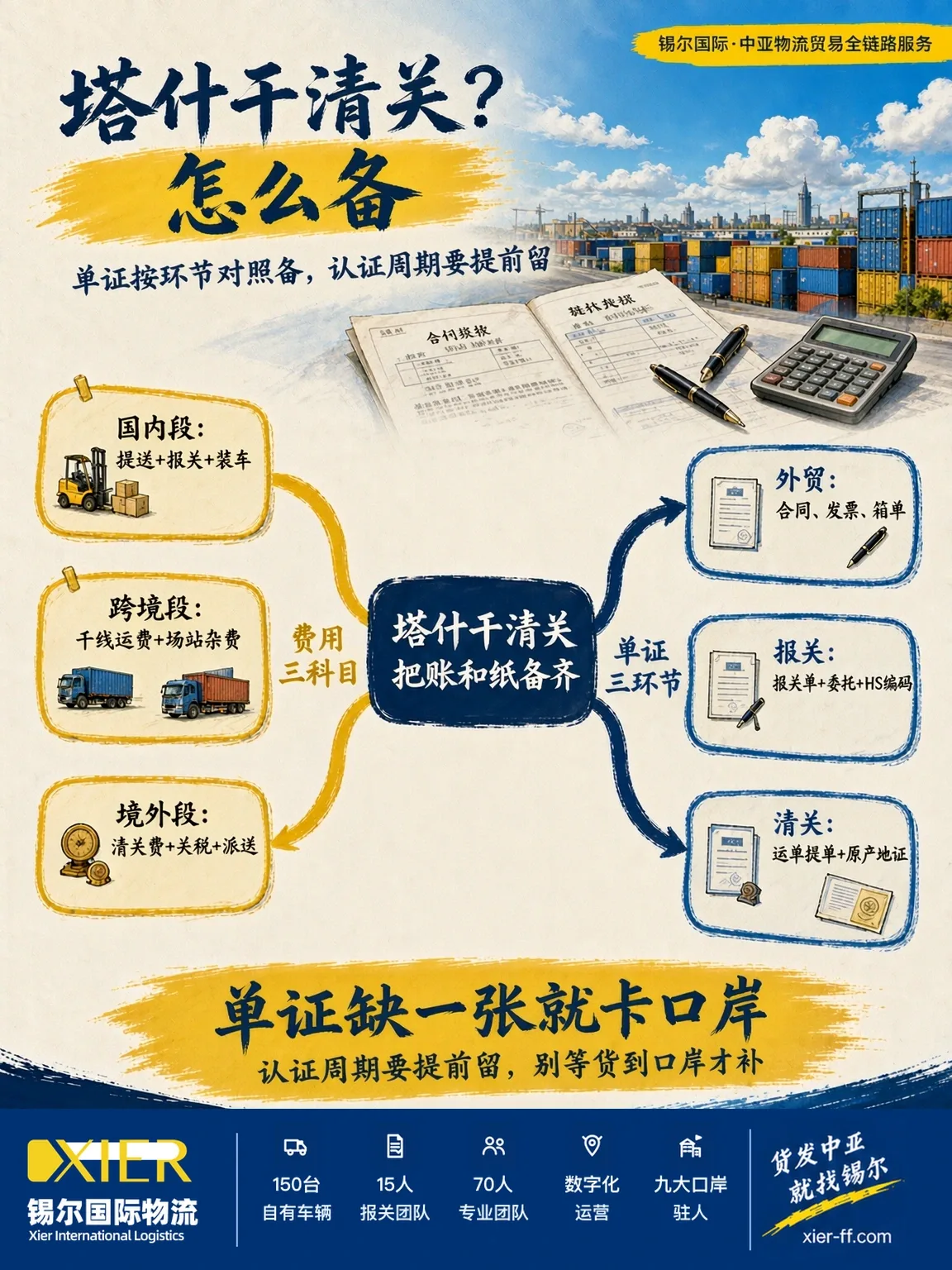 图:单证缺一张就卡口岸——外贸、报关、清关对照备,认证周期要提前留
Linking the previous sections, a shipment to Tashkent can be compressed into a four-step chain. The first step is to inquire and verify the goods, clearly report the model, origin, destination, and time limit, and at the same time determine which channel to take; the second step is to prepare goods and documents, synchronize packaging, documents, certification, and customs declaration materials; the third step is customs declaration and loading, single-window declaration, and entry into the port; the fourth step is exit re-loading, customs clearance, and final delivery to Tashkent.
In these four steps, the first and second steps are easily compressed. Many shippers are in a hurry to send the goods, giving vague inquiry information and leaving documents and certification until the last moment, resulting in being held up at customs declaration and the port. Only by doing the first two steps solidly can the process go smoothly. The customs clearance and delivery in the overseas segment are then implemented by the carrier according to the established responsibility boundaries at the destination.
At the Tashkent end, it is also necessary to confirm one thing: whether the goods are delivered to the warehouse or to the door, whether the consignee can cooperate with customs clearance, and the time and conditions for the final delivery and loading. These may seem trivial, but they often determine whether the goods can be delivered smoothly. It is much easier to write these details into the entrustment in advance than to make up for them later.
| Steps | Key Action | Responsible Party | Deliverables |
|---|
| First Step | Inquire and verify goods, determine the channel | Shipper + Carrier | Clear route and quotation |
| Second Step | Prepare goods, documents, and certifications | Shipper | Complete and compliant documents and certifications |
| Third Step | Customs declaration, loading, and entry | Customs brokerage + Carrier | Declaration form and release information |
| Fourth Step | Outbound loading, customs clearance, and delivery | Carrier | Warehouse/door-to-door receipt |
8. Common Questions
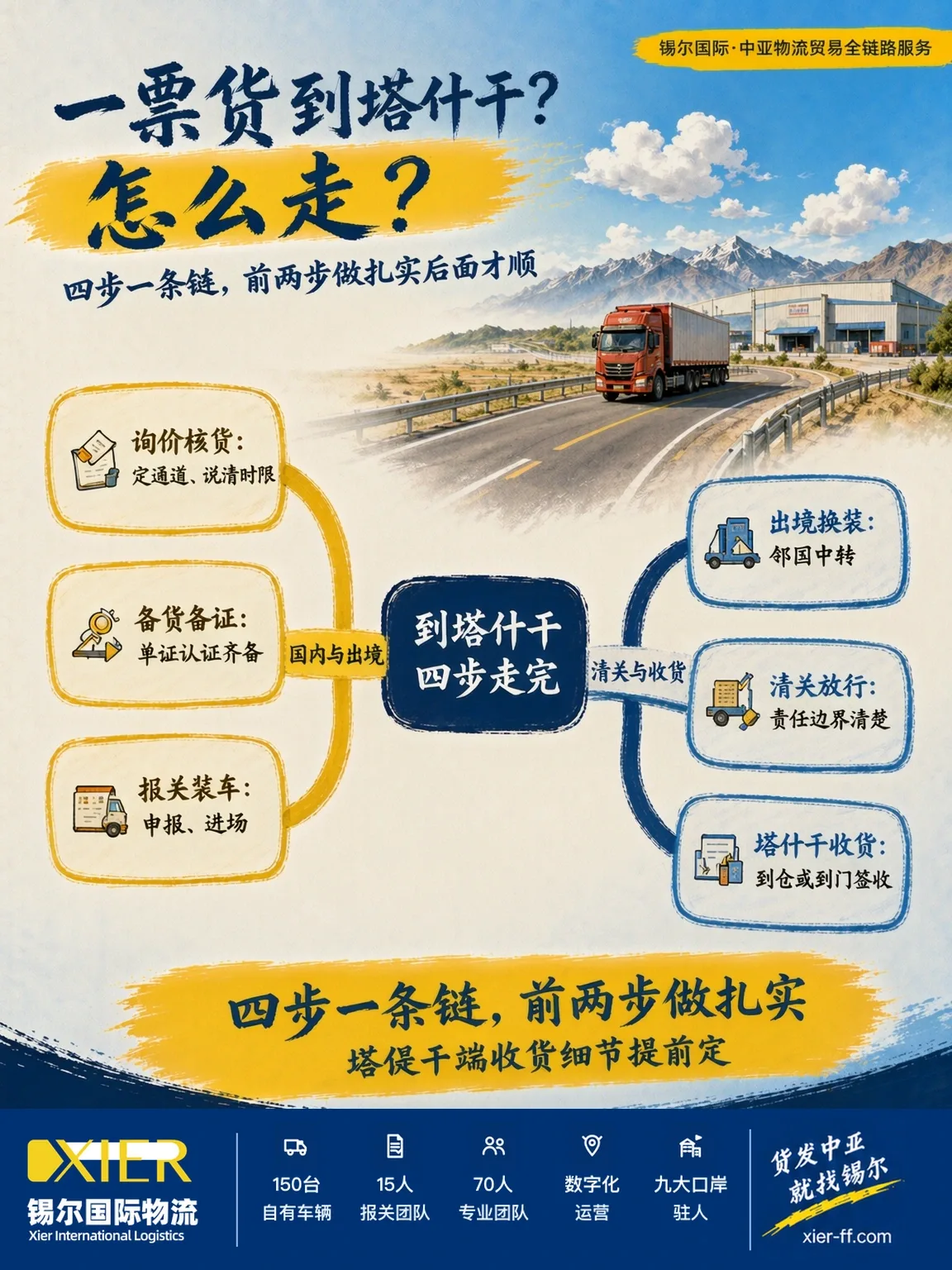 图:四步一条链——前两步做扎实后面才顺,塔什干端收货细节提前定
Which channel is more suitable for shipping to Uzbekistan?
Consider the type of goods, origin, and time requirements. For large volumes in full containers and cost sensitivity, consider the Khorgos railway express; for goods in the southern Xinjiang or door-to-door direct delivery, the Irkeshtam highway channel often saves mileage; for urgent goods and large items, road transport is more flexible. There is no best, only a channel that is more suitable for this shipment, and the specific schedule of the trains and teams on the day of inquiry is to be determined.
Uzbekistan is a landlocked country, what impact does it have on transportation?
It itself is not adjacent to the sea, and most of its neighboring countries are also landlocked countries. Imports and exports usually have to pass through neighboring country ports and transit channels, which are longer in route and have more links. Therefore, the channels, intermediate loading, and customs clearance methods should be considered segment by segment, and not just judged by a total price and a number of days.
塔什干dedicated line大概要多少天?
The railway express is cost-effective but has a longer cycle and is affected by scheduling; road transportation is flexible and suitable for urgent goods; combined transportation is between the two. There are often transhipments or transfers on the way to Uzbekistan, and the timeliness is greatly affected by port queuing, transhipment, and customs clearance. Here, only the interval framework is provided; the exact number of days is subject to the schedule on the day of inquiry.
What documents and certifications are required for Tashkent customs clearance?
The basics are the contract, commercial invoice, and packing list; the customs declaration process requires a customs declaration form, customs authorization letter, and accurate HS code; customs clearance in the destination country usually requires a waybill or bill of lading, and a certificate of origin. Uzbekistan is a member of the Eurasian Economic Union, and some goods also require EAC certification. Those who handle machinery, electrical appliances, food, and building materials should first confirm whether certification is required and the cycle.
How to choose between customs clearance with duties paid and self-clearance?
For shippers who are not familiar with local customs clearance and hope for a fixed price for all costs, customs clearance with duties paid can be chosen, but the declaration scope, tax range, and exceptional responsibilities should be written into the contract; for those with import qualifications and the ability to declare independently, self-clearance costs are more transparent. The key is to clearly define the boundaries of responsibility. Customs clearance with duties paid does not mean that nothing needs to be managed; the declaration of the goods name, HS code, and value must still be true and accurate.
What cost items should be included in the quotation?
It is recommended to break down the cost into domestic segments (collection, customs declaration, loading), cross-border segments (mainline freight, port station handling fees, in-transit transloading fees), and overseas segments (customs clearance fees, import duties, Tashkent terminal delivery fees). Since the route requires transshipment through neighboring countries, transloading and transit fees are unique to this line and should be inquired separately. Reporting only a total price is difficult to compare.
About the Author: Xier International Logistics, focusing on Central Asia logistics market analysis and digital solutions. This article is based on 10 years of practical data and industry research from Xier International Logistics and is for reference only. Specific solutions need to be customized according to the characteristics of the goods.