1. Ship to Kyrgyzstan, first understand that it is a "market surrounded by land on all sides".
In the consultation of cross-border logistics in Central Asia, there has been a significant increase in requests for shipping to Kyrgyzstan and delivery to Bishkek over the past two years. Bishkek is the capital and main receiving area of Kyrgyzstan, and the goods sent from China to the local area are mostly e-commerce goods, machinery and equipment, building materials, auto parts, and daily necessities. However, many shippers ask about "how much is the freight, how many days will it take" as soon as they start talking. After answering, they often have to do the work again——because what truly determines whether this shipment can be smoothly completed are three more preliminary matters: which port to exit from, how to transfer within the country of Kyrgyzstan, and how to prepare the documents and customs clearance.
Kyrgyzstan itself is an inland country, and most of its neighboring countries are also inland countries, so its imports and exports are highly dependent on neighboring country ports and transit channels. China borders Kyrgyzstan, and there are two main land border exit ports in the Xinjiang Kizilsu area——Irkeshtam Port and Turghart Port, both located in southern Xinjiang. This is also a clear difference from the line to Kazakhstan: it is mainly based on road transportation, and there is currently no direct railway express to Bishkek. Therefore, when shipping to Kyrgyzstan, one cannot just look at the big word "China to Kyrgyzstan", but must break down the ports, transfers, and customs clearance one by one to know where the money is spent and where the time is consumed.
It is necessary to clarify the scope: The time limits, cost structures, and document requirements mentioned below are common reference frameworks for this route, not commitments for a specific shipment. The accurate figures should be based on the port passage, team scheduling, and customs clearance quotes on the day of inquiry. The ports, subjects, and documents mentioned in the text are for helping you establish a judgment framework, not for fabricating specific freight rates.
II. How to choose between the two main channels: Irkeshtam Port and Turghart Port
For shipments to Kyrgyzstan, the most common two southern Xinjiang highway channels from China are: one via the Irkeshtam Port and the other via the Turghart Port. Both are within the territory of the Kizilsu Kirgiz Autonomous Prefecture of Xinjiang, leading to different regions of Kyrgyzstan. The choice is not based on the fame of the port names, but on whether the cargo type, origin, and seasonal passage conditions match.
The Irkeshtam Port is located in Wuqa County, connects to the Osh direction in Kyrgyzstan after crossing the border, has relatively mature road conditions, and is a commonly used logistics channel from Southern Xinjiang to Central Asia. Goods organized from the Kashi area often take this route to save mileage. The Turgar Pass is higher in altitude, connects to the Naryn direction after crossing the border, and is more affected by seasons and weather; it is necessary to confirm the traffic status before winter and special weather. Generally, for goods heading to Osh and Bishkek with a starting point in Southern Xinjiang, consider Irkeshtam; the specific route depends on the current port traffic and team scheduling.
| Channel | Main Method | Connecting Direction | Judgment Points |
|---|
| Irkeshtam Port | Road-based | Osh direction, via Bishkek | Saves mileage in Southern Xinjiang, relatively mature traffic |
| Turgar Pass | Road-based | Naryn direction | High altitude, depends on seasonal traffic |
| Other transit routes | Road + neighboring country transit | Combinations based on destination | Check transit and customs procedures |
Many shippers may ignore the variable of the starting point. For the same shipment to Bishkek, whether organized from Southern or Northern Xinjiang, the suitable channel may be completely different. Including 'where the goods come from' in the judgment can save more time and money than simply comparing port names.
Three, how to proceed from the goods to Bishkek: Land chain from the port to the capital
 图:口岸不分高低,选对才省时——按货型、起运地和目的地定通道
After the goods leave the Chinese port, it does not mean they have reached Bishkek. There is still a section of land to be traveled within Kyrgyzstan: Goods exiting through Irkeshtam usually first arrive in the Osh area and then are sent north to Bishkek; goods exiting through Turgart are transported in the direction of Naryn. This section is a clear distinction between Kyrgyzstan's dedicated line and the direct railway express to Kazakhstan - currently there is no direct train service, and the entire route relies on road connections.
This means two things. One is that timeliness and cost are sensitive to the road conditions, weather, and customs procedures within Kyrgyzstan, especially on high-altitude sections in winter, where extra margin should be left; the other is that the delivery boundary of the destination should be clarified in advance: whether the goods are delivered to a warehouse in Bishkek or to the door, and whether the consignee can cooperate with customs clearance, will affect the final arrangement. It is much easier to write these into the entrustment than to make corrections afterwards.
| Stage | Transportation method | Key points of connection | To be confirmed in advance |
|---|
| Exit from Chinese port | Road motor transport | Customs declaration, inspection, and release | Port traffic status on the day |
| Transshipment within Kyrgyzstan | Road motor transport | Transfer to Bishkek in the direction of Osh or Naryn | Road conditions, weather, and customs procedures |
| Bishkek terminal | Road delivery | Delivery to warehouse or door | Receiving address and loading/unloading conditions |
四、时效怎么估:通关、天气与季节因素
Timeliness is easily misled by a single number, especially when shipping to Kyrgyzstan. This route primarily uses road transport, with no fixed train schedules, and timeliness is determined by the叠加 of several periods: domestic collection and delivery, export customs declaration, port queuing and inspection, domestic road transportation in Kyrgyzstan, customs clearance in the destination country, and final delivery. Any delay in any segment will accumulate to the next, with port access and road conditions in Kyrgyzstan being the two segments with significant fluctuations.
Seasonal factors carry a high weight on this route. Ports like Turgar at high altitudes will have worse traffic conditions in winter and severe weather, while the Irkeshtam direction is relatively stable but still depends on the queuing situation on the day. Therefore, when estimating timeliness, it is necessary to clarify three questions: which port is used, how is the domestic transportation arranged in Kyrgyzstan, and who is responsible for customs clearance. Only when these three questions are clarified does a number of days have meaning; otherwise, the number received is just an ideal value. The interval framework provided here is based on the port access and team scheduling on the day of inquiry.
| Time Period | Main Content | Source of Fluctuation |
|---|
| Domestic Segment | Collection, delivery, export customs declaration | Distance from origin, completeness of documents |
| Port Segment | Queuing, inspection, clearance | Port access, seasonal weather |
| Foreign Segment | Domestic transportation in Kyrgyzstan, customs clearance, delivery | Road conditions, transit procedures, customs clearance method |
V. How to break down the cost: several subjects in a Bishkek quotation sheet
Quotations for shipping to Kyrgyzstan should avoid giving only a total price. The total price does not reveal what is included or omitted, nor can it be compared with others. Only by breaking down the quotation into three major sections—domestic, cross-border, and overseas—can 'comparison pricing' be discussed.
The domestic section includes pick-up and delivery, export customs declaration, and loading; the cross-border section includes mainline freight from port to port, station expenses, and domestic transportation within Kyrgyzstan; the overseas section includes customs clearance fees in Kyrgyzstan, import duties and taxes, as well as the final delivery fee in Bishkek. Since this section involves long-distance road transportation within Kyrgyzstan, this is a unique item for this route, and it should be clarified separately who is responsible and how it is calculated when inquiring.
| Segmentation | Item | Main meaning | What to clarify when inquiring |
|---|
| Domestic section | Pick-up + customs declaration + loading | Costs before departure from the origin to the port | Whether it includes pick-up and customs declaration document fees |
| Cross-border section | Mainline freight + station expenses + Kyrgyzstan domestic transportation | Transportation from port to port and within Kyrgyzstan | Who is responsible for the transportation section and how it is calculated |
| Overseas section | Local customs clearance and final delivery to warehouse/door-to-door | Tax range, delivery to which level | 税费范围、派送到哪一级 |
Align the subjects when comparing prices, compare column by column, and the differences will become apparent. Some quotes have a lower total price by excluding customs clearance or final delivery; some quotes may seem expensive but actually include door-to-door logistics. Only by breaking them down can we truly compare prices.
Sixth, how to prepare for documents and customs clearance: export declaration and Kyrgyz side access
Documents and customs clearance are the hard thresholds on this line. The foundation is the three sets of foreign trade: contract, commercial invoice, and packing list; the customs declaration process requires customs declaration form, customs agency authorization letter, and accurate HS code; the Kyrgyz customs usually requires waybill or bill of lading, origin certificate, etc. For goods involving certification or supervision conditions, additional preparations should be made according to categories.
Kyrgyzstan is a member of the Eurasian Economic Union, and some goods require EAC certification (Customs Union Conformity Certification) to enter; for cargo owners dealing with machinery, electrical appliances, food, and building materials, it is necessary to confirm before shipment whether their categories require certification and how long the certification cycle is - without certification, the goods may not clear customs at the port, and instead, they may be stored and incur costs.
There are two common customs clearance methods: customs clearance with duties paid, where the service provider handles export and import customs clearance at a fixed price; and self-clearance, where the cargo owner makes the declaration with their import qualifications. For those unfamiliar with the local procedures and those who prefer a fixed cost, customs clearance with duties paid is an option, but the declaration scope, tax and fee range, and exceptional responsibilities should be clearly stated in the contract; for those with import qualifications and the ability to make stable self-declarations, the cost of self-clearance is more transparent. It should be reminded here that customs clearance with duties paid does not mean 'nothing to worry about'; the item names, HS codes, and value declarations must still be true and accurate.
| Process | Required Documents | Common Reasons for Refusal of Shipment |
|---|
| Foreign Trade | Contract, Invoice, Bill of Lading | Product name/quantity/amount discrepancy |
| Customs Declaration | Customs declaration form, power of attorney, HS code | Incorrect coding classification |
| Customs clearance and access | Bill of lading/airway bill, origin certificate, category certification | Missing documents, certification not yet obtained |
Step 7: The operational chain from inquiry to receiving the goods in Bishkek
 图:纸面先备齐,货才不压口岸——外贸、报关、清关对照备,认证周期要提前留
Link the first few sections together, a single shipment to Bishkek can be compressed into a four-step chain. The first step is to inquire and verify the goods, clearly report the model, origin, destination, and time limit, and simultaneously determine which channel to take; the second step is to prepare goods and documents, synchronize packaging, documents, certification, and customs declaration materials; the third step is customs declaration and loading, single window declaration, port entry, and inspection clearance; the fourth step is exit transfer, Kyrgyz customs clearance, and Bishkek terminal delivery.
Among these four steps, the first and second steps are easily compressed. Many shippers are in a hurry to send the goods, giving vague inquiry information, and leaving documents and certifications until the last moment, resulting in delays at customs and the port. Only by doing the first two steps solidly can the process go smoothly. The transfer and customs clearance within the Kyrgyz Republic are then implemented by the carrier according to the established responsibility boundaries to Bishkek.
At the Bishkek end, it is also necessary to confirm one thing: whether the goods are delivered to the warehouse or to the door, whether the recipient can cooperate with customs clearance, and the time and conditions for the final delivery. These may seem trivial, but they often determine whether the goods can be delivered smoothly. It is much easier to write these details into the entrustment in advance than to make up for them later.
| Steps | Key Actions | Responsible Party | Deliverables |
|---|
| First Step | Inquire and verify goods, determine the channel | Shipper + Carrier | Clear route and quotation |
| Second Step | Prepare goods, prepare documents, prepare certification | Shipper | Comprehensive and compliant documents and certifications |
| Third Step | customs declaration, loading, port entry | customs brokerage + carrier | declaration form and release information |
| Step 4 | export transfer, customs clearance, delivery | carrier | warehouse/door receipt |
8. Common Questions
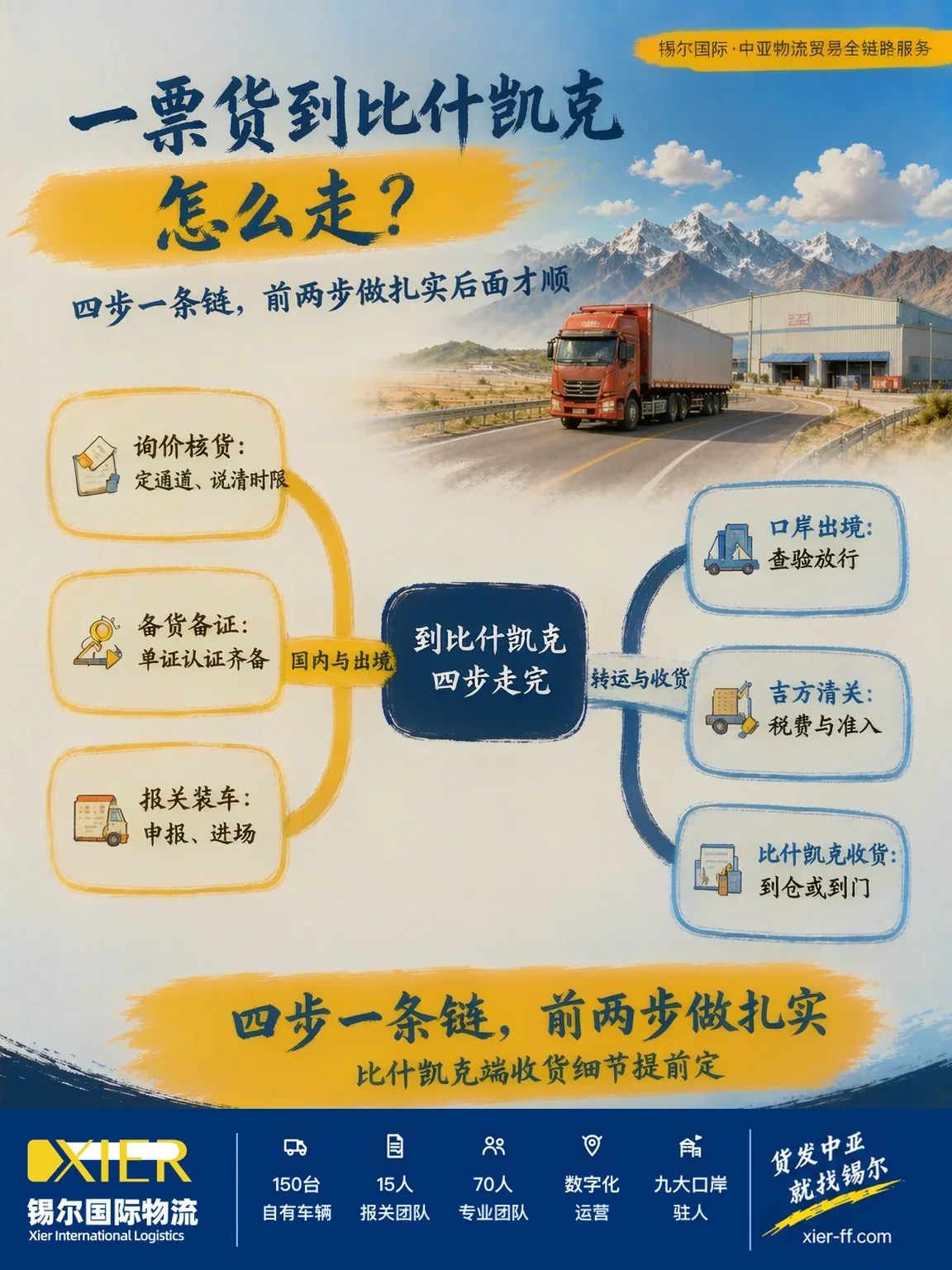 图:四步一条链——前两步做扎实后面才顺,比什凯克端收货细节提前定
Which port channel is more suitable for shipping to Kyrgyzstan?
Consider the type of goods, origin, and destination. For goods heading to Osh or Bishkek from the southern Xinjiang region, consider the Irkeshtam port road channel; for goods heading to the Naryn direction, consider the Turgart port, but be mindful of seasonal access. Urgent goods and large items by road are more flexible. There is no absolute channel that fits all, only the one that is more suitable for this shipment, and the specific details are subject to the port access and team scheduling on the day of inquiry.
Why is the Kyrgyzstan line mainly by road, and is there no direct railway?
Kyrgyzstan is an inland country, and there is currently no direct railway express from China to here. Goods are mostly transported from Xinjiang ports and then by road within Kyrgyzstan to Bishkek. The China-Kyrgyzstan-Uzbekistan railway is still under construction, and the schedule of operation should be based on the official progress. Therefore, the timeliness and cost of this line are sensitive to the road conditions and weather within Kyrgyzstan.
货到比什凯克大概要多少天?
This route is mainly based on road transportation, with timeliness consisting of domestic delivery, export customs declaration, port queuing for inspection, domestic transfer in Kyrgyzstan, customs clearance in the destination country, and final delivery. The port passage and road conditions in Kyrgyzstan are two segments with significant fluctuations, and more buffer is needed during the winter at high-port areas. Only the interval framework is provided here; the exact number of days is subject to the schedule on the day of inquiry.
What documents and certifications are required for Bishkek customs clearance?
The basics include the contract, commercial invoice, and packing list; the customs declaration process requires a customs declaration form, customs authorization letter, and accurate HS code; for Kyrgyz customs clearance, a bill of lading or airway bill and a certificate of origin are typically required. Kyrgyzstan is a member of the Eurasian Economic Union, and some goods require EAC certification. Shippers of machinery, electrical appliances, food, and building materials should first confirm whether the category requires certification and the cycle.
How to choose between customs clearance with duties paid and self-clearance?
Shippers who are not familiar with local customs clearance and hope for a fixed price for all costs can choose customs clearance with duties paid, but the declaration scope, tax range, and exceptional responsibilities should be written into the contract; those with import qualifications and the ability to declare on their own will have a more transparent customs clearance cost. Customs clearance with duties paid does not mean that nothing needs to be managed; the item names, HS codes, and value declarations still need to be true and accurate.
What cost items should a Bishkek quotation include?
It is recommended to break down the domestic section (collection, customs declaration, loading), cross-border section (mainline freight, terminal charges, domestic transit in Kyrgyzstan), and overseas section (customs clearance fee, import duty, Bishkek final delivery). Long-distance road transit within Kyrgyzstan is a unique item for this route, and it needs to be clarified separately who is responsible for it. Reporting only a total price is difficult to compare.
About the Author: Xier International Logistics, focusing on Central Asia logistics market analysis and digital solutions. This article is based on 10 years of practical data and industry research from Xier International Logistics and is for reference only. Specific plans need to be customized according to the characteristics of the goods.