Why are more and more people choosing "rail-road multimodal transport" for exporting to Central Asia?
In traditional thinking, exporting to Central Asia has only two roads: all-rail or all-road. But in actual operations, more and more shippers and logistics managers have found —Combining rail and road in relay is often more cost-effective and controllable than a single mode。
The reason is realistic: Central Asia is vast, and a high proportion of cities have no direct rail access; rail stations are fixed while road can reach door-to-door; the combination of the two just complements each other. The difficulty lies in: when to choose rail, when to choose road, where to transship between them, how to calculate transshipment costs, and how to control timeliness — these are the core decision points of rail-road multimodal transport.
This article uses Xier International Logistics' real operational data to clearly explain the decision logic, typical combination schemes, cost comparison, and pitfall-avoidance points of rail-road multimodal transport all at once.
I. The Essence of Rail-Road Multimodal Transport: Not "Patching Together", But "Optimal Division of Labor"
Rail-road multimodal transport is not simply unloading goods from a train and loading them onto a truck. It is a systems engineering with the core logic ofletting each mode of transport do only what it does best:
- Rail: suitable for long-distance, large-volume, medium-timeliness corridor transport. Stable freight rates, large capacity, less climate impact, suitable for machinery and equipment, auto parts, building materials, etc.
- Road: suitable for short-distance, door-to-door, highly flexible last-mile delivery. Road can reach cities and warehouses that rail cannot, especially suitable for small-batch goods and urgent replenishment.
A typical scenario of rail-road multimodal transport is: from a Chinese factory to a Central Asian city with no direct rail access, goods first go by rail to the nearest major station, then road completes the last leg of delivery. The two legs relay, each performing its role, and the overall timeliness and cost are often better than a single mode.
1. Pure Road vs. Rail-Road Multimodal: When Is Multimodal More Cost-Effective?
There is a simple reference for deciding whether to use multimodal transport:If the total distance from origin to destination exceeds 800 km, and the destination is more than 200 km from the nearest rail station, the cost advantage of multimodal transport is usually between 15% and 30%. For example: shipping a batch of building materials from Yiwu to Dushanbe, Tajikistan, about 4,800 km in total, pure road freight is about 1,800 RMB per ton; going by rail to Alashankou then transferring to road to Dushanbe, the comprehensive freight is about 1,350 RMB per ton, saving about 25%.
2. Pure Rail vs. Rail-Road Multimodal: When Should You Add a Road Leg?
Pure rail is suitable for freight between cities along rail lines, but many Central Asian cities are not on the rail trunk line. Take Kazakhstan as an example: large cities like Almaty and Nur-Sultan have rail, but goods from regions like Mangystau and Aktobe cannot be reached directly by rail and need road connection. Uzbekistan's Bukhara and Samarkand are the same — rail cannot reach the last mile.
The value of adding road to multimodal transport is revealed:Rail transports goods to the nearest major station, and road completes last-mile delivery, saving 30% to 45% of freight compared to all-road, and far more flexible than pure rail.
II. Four Typical Rail-Road Multimodal Combination Schemes
Based on Xier International Logistics' operational experience, the following four combination schemes cover most Central Asia rail-road multimodal demands:
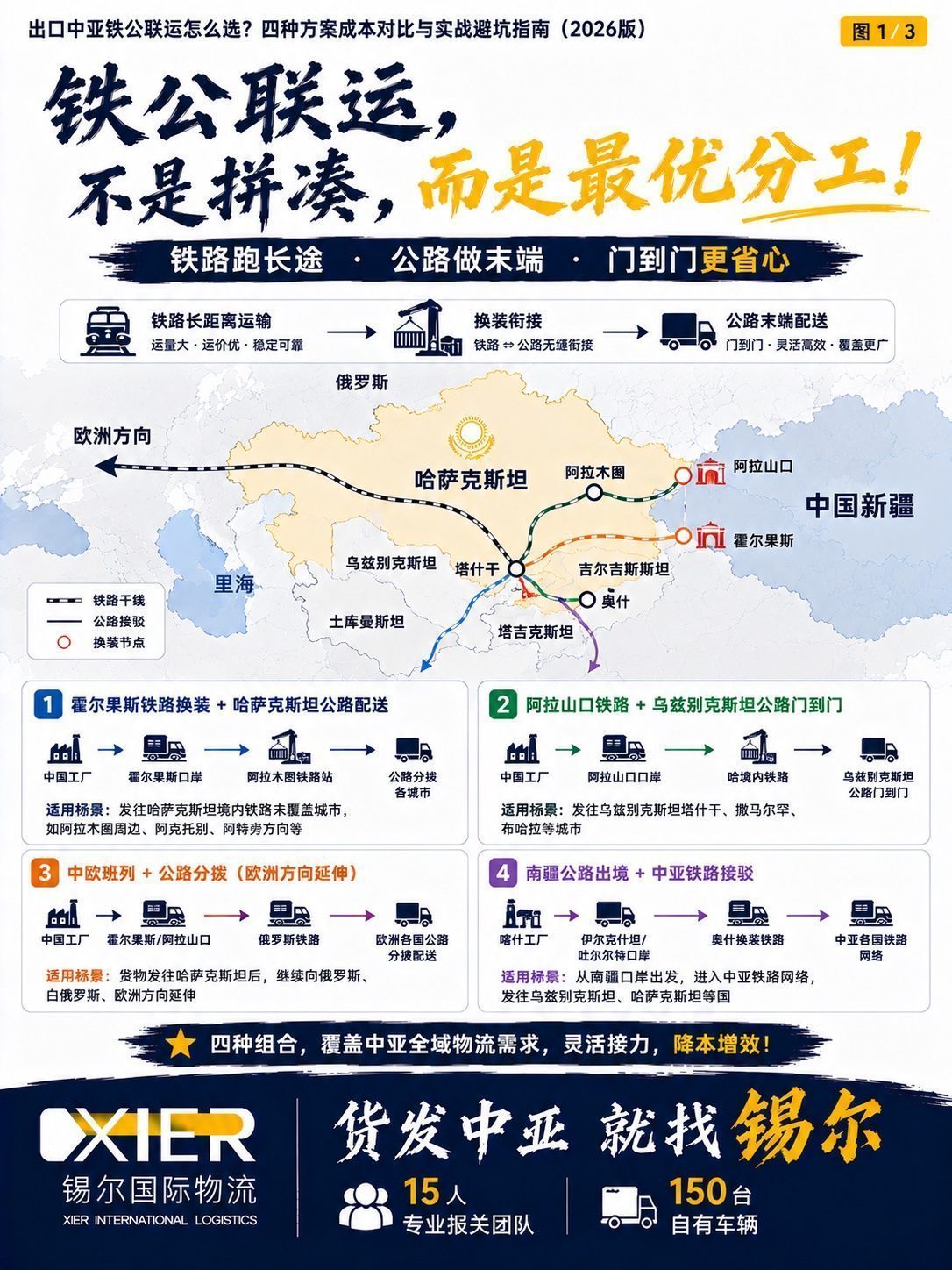
Scheme 1: Khorgos Rail Transshipment + Kazakhstan Road Distribution
Applicable Scenarios:Goods shipped to cities in Kazakhstan not covered by rail, such as around Almaty, Aktobe, and Atyrau directions.
Route:Chinese factory → rail to Khorgos Port → transshipment for exit (Kazakhstan 1520mm broad gauge) → Almaty rail station → road distribution to cities.
Transit Time:Rail segment about 7 to 10 days (domestic segment), Khorgos to Almaty about 2 to 3 days, road distribution 1 to 3 days.
Xier's Approach:Transshipment operation teams are stationed at both Khorgos and Almaty; upon arrival, road transfer is arranged directly, without the customer needing to coordinate themselves.
Scheme 2: Alashankou Rail + Uzbekistan Road Door-to-Door
Applicable Scenarios:Goods shipped to cities in Uzbekistan such as Tashkent, Samarkand, and Bukhara.
Route:Chinese factory → rail to Alashankou → transshipment for exit → rail transport within Kazakhstan → border transshipment at Uzbekistan → road distribution to consignee warehouse.
Transit Time:Rail segment about 8 to 12 days, road distribution 2 to 4 days.
Xier's Approach:The Uzbekistan direction is one of Xier's core dedicated lines, with customs clearance specialists and road partner fleets in both Tashkent and Samarkand, providing door-to-door service.
Scheme 3: China-Europe Block Train + Road Distribution (Europe Direction Extension)
Applicable Scenarios:Goods shipped to Kazakhstan then need to continue west into Russia, Belarus, and Europe.
Route:China → Khorgos/Alashankou → Kazakhstan rail trunk → Russia rail → Belarus/Poland border → road distribution to European countries.
Xier's Approach:Long-term cooperation agreements with European rail and road carriers support door-to-door full-process logistics solutions from China to Europe.
Scheme 4: Southern Xinjiang Road Exit + Central Asia Rail Connection
Applicable Scenarios:Departing from southern Xinjiang ports (Irkeshtam, Torugart), goods need to enter the Central Asia rail network but the exit segment has no rail option.
Route:Kashgar → road to Irkeshtam/Torugart → Osh, Kyrgyzstan → rail transshipment → Uzbekistan/Kazakhstan.
Xier's Approach:The southern Xinjiang road exit segment is operated by Xier's own fleet, with seamless connection between transshipment nodes and the rail segment.
III. How to Calculate Rail-Road Multimodal Cost?
The cost of rail-road multimodal transport consists of the following parts:
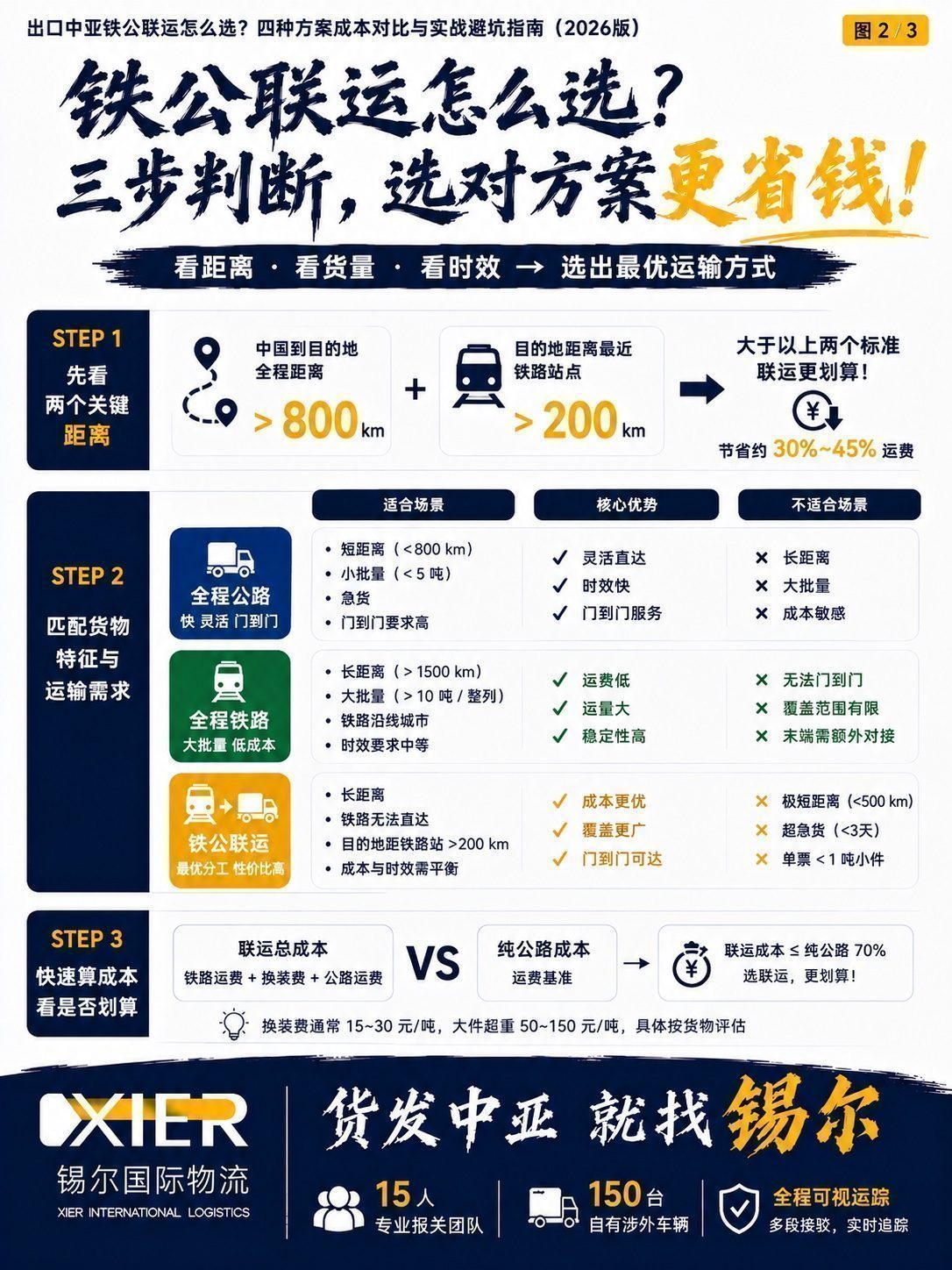
- Rail Segment Freight: charged by weight or volume, affected by peak/off-season, cargo volume, and rail schedule.
- Transshipment/Storage Fee: the fee for unloading goods from the train at the rail station, temporary storage, and reloading onto the truck, usually charged by ton, about 15 to 30 RMB/ton.
- Road Segment Freight: short-distance transport from the transshipment point to the consignee's warehouse, charged by full truckload or by ton.
- Customs Clearance Fee: exit port clearance and destination clearance, charged per shipment or by proportion of cargo value.
Overall, rail-road multimodal saves 30% to 45% of freight compared to pure road; it is 10% to 20% more expensive than pure rail but covers a wider range and offers higher flexibility. To judge whether multimodal is cost-effective, there is a quick formula:
Total multimodal cost ≈ rail freight + transshipment fee + road freight
As long as this total cost is below 70% of pure road freight, multimodal transport has a clear cost advantage.
IV. Three High-Frequency Pitfalls in Rail-Road Multimodal Transport
Pitfall 1: Wrong Transshipment Node Selection Causing Double Secondary Transport
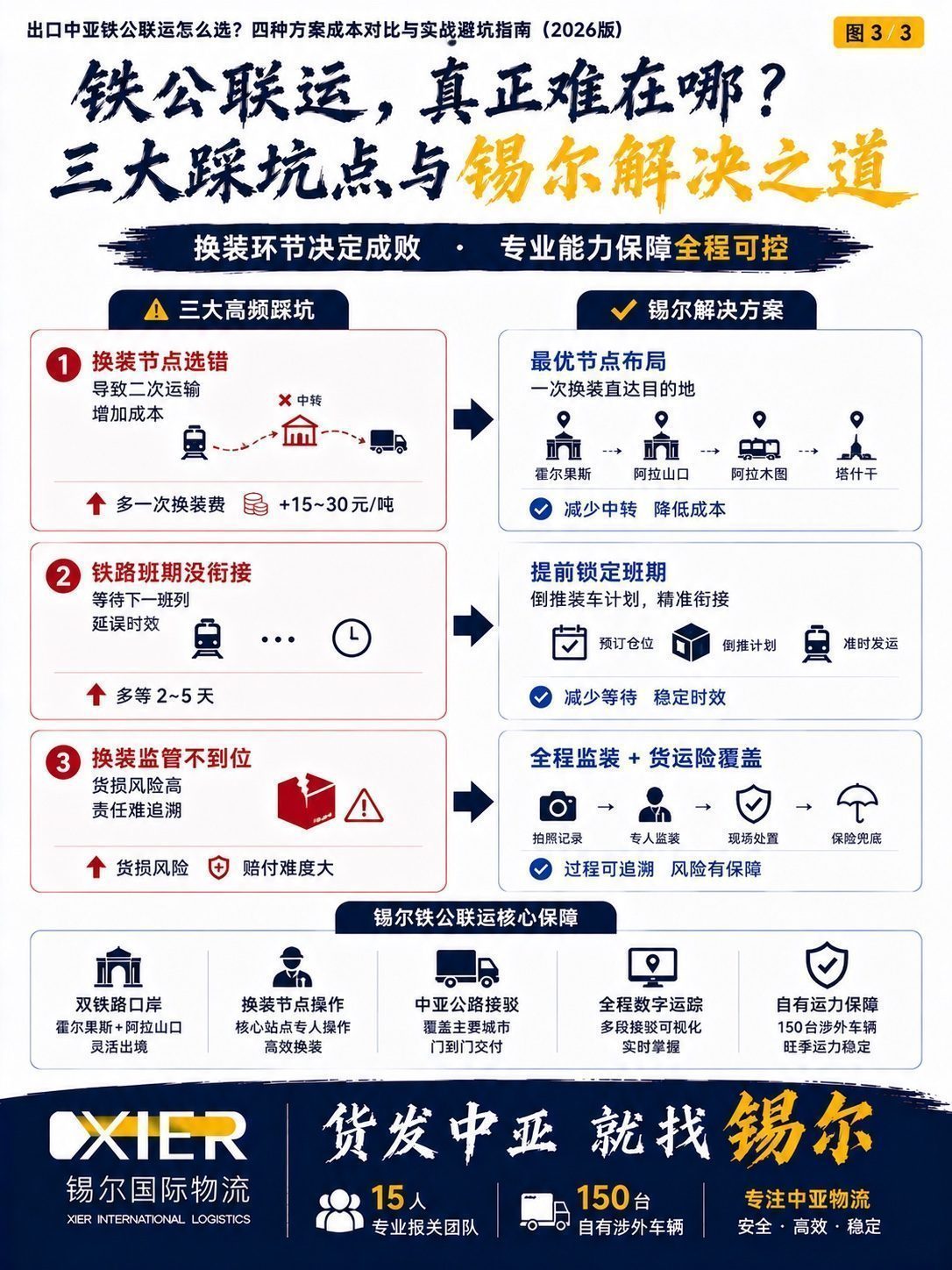
The choice of transshipment node directly affects multimodal efficiency. If the wrong node is chosen, goods may need to be re-handled once more to reach the destination, invisibly adding a transshipment fee and short-haul fee. The correct approach is:Try to select the transshipment node at the intersection of the rail station and road network, reducing secondary handling. Xier International Logistics has operators at every major transshipment node and can recommend the optimal transshipment scheme based on the cargo destination.
Pitfall 2: Uncertain Rail Schedule Causing Transshipment Waiting
Rail block trains have fixed departure times; if the arrival time of goods at the transshipment station does not match the train departure time, you need to wait for the next schedule, adding 2 to 5 days. During peak season, block train space is tight and you may face no available space. Xier's approach is:Book space in advance and back-calculate the loading plan based on the goods' arrival time, trying to have the goods arrive at the transshipment station just as the block train is about to depart, reducing waiting.
Pitfall 3: Cargo Damage or Loss During Transshipment
The transshipment stage is a high-incidence period for cargo damage — non-standard loading/unloading, improper cargo stacking, and undetected packaging damage. Xier International Logistics assigns dedicated loading supervisors at every transshipment node to photograph and record the cargo's appearance and packaging, handling problems on-site when found; full cargo insurance coverage includes the transshipment stage.
V. Xier International Logistics' Rail-Road Multimodal Capabilities
Rail-road multimodal is not just about price, but about the connection capability of multi-leg transport. Xier International Logistics has the following core capabilities supporting stable rail-road multimodal operations:
- Dual-Channel Layout: both the Khorgos and Alashankou major rail ports have operation teams, allowing flexible selection of the exit port based on cargo destination and space availability.
- Transshipment Node Operations: dedicated operators are stationed at major transshipment stations (Khorgos, Alashankou, Almaty, Tashkent) responsible for transshipment coordination and loading supervision.
- Road Connection Network: major cities in Central Asian countries all have long-term partner road transport fleets with sufficient capacity and door-to-door service coverage.
- Digital Tracking: rail-road multimodal involves multiple legs with high tracking difficulty; Xier's digital tracking platform visualizes the entire rail and road segments, allowing customers to know cargo location in real time.
- Self-Owned Capacity Guarantee: Xier owns 150 foreign-related transport vehicles, deployed at major ports in both southern and northern Xinjiang, ensuring capacity and timeliness of the road connection segment during peak season.
Rail-Road Multimodal FAQ
Q1: What goods are most suitable for rail-road multimodal transport?
Machinery and spare parts (single shipment over 5 tons), auto parts, building materials (tiles, steel, cement), textile raw materials, and bulk chemical raw materials are suitable for rail-road multimodal. For shipments under 1 ton or with extremely high timeliness requirements, all-road is recommended.
Q2: How much slower is rail-road multimodal than pure rail?
If the destination is a city along the rail line, pure rail and multimodal have similar timeliness (multimodal adds 1 to 2 days of transshipment waiting). If the destination is more than 200 km from the rail station, multimodal may actually be faster — because road door-to-door saves more time than waiting for the next train.
Q3: What is the transshipment fee?
The transshipment fee varies by cargo type and transshipment station; ordinary goods are about 15 to 30 RMB/ton, and oversized/overweight goods about 50 to 150 RMB/ton. Specific costs need to be evaluated based on the actual cargo situation.
Q4: What if goods are damaged during transshipment?
Xier International Logistics' full cargo insurance coverage underwrites cargo safety during transshipment. Dedicated loading supervisors at each transshipment node photograph and record cargo status, handling anomalies on-site.
Q5: What to do when rail space is tight in peak season?
Xier has established long-term booking partnerships with major rail block train operators, allowing advance space locking to avoid the no-space dilemma in peak season. Meanwhile, the southern Xinjiang road exit channel serves as a backup to ensure on-time shipment.
About the Author: Xier International Logistics — focused on Central Asia logistics market analysis and digital solutions. Based on a decade of Xier's operational data and industry research, this article is for reference only; specific solutions must be tailored to your cargo.