The 16th China-Eurasia Expo (CAEXPO) opened on August 14 at the Kashgar International Convention and Exhibition Center. Guangdong, as the guest-of-honor province, brought over 300 bay-area enterprises to exhibit, with brands like DJI, OPPO, and Honor making concentrated appearances. Consumer electronics, new energy, and home appliances from the Greater Bay Area are accelerating their entry into Central Asia, but many factories are stuck on a practical problem:How to get the goods there?
Rail consolidation is slow, and bulk is unsuitable for small batches; road is flexible but unfamiliar with routes, ports, and customs clearance. This article details the full process of Guangdong → Central Asia road transport, helping bay-area factories choose the right route, control costs, and safely deliver goods to customers.
I. Bay Area Manufacturing Exporting to Central Asia Stuck at the "Last Mile"
Under the CAEXPO theme "Building the Eurasian Golden Corridor, Sharing Silk Road Cooperation Opportunities", 44 countries and regions and nearly 1,400 enterprises participated, with Guangdong guest-of-honor 300+ enterprises, Shandong 88, and Shenzhen a separate 64-enterprise pavilion. Demand from the five Central Asian countries and Afghanistan for consumer electronics, new energy, and home appliances continues to grow, opening a new window for bay-area manufacturing.
But exporters generally encounter three types of pain points:Small batches, multiple shipments(unsuitable for waiting for full rail trains),Time-sensitive(short new-product launch window),Strong door-to-door demand(don't want to run ports themselves). Traditional rail suits bulk stable goods; road transport is more flexible in small-batch scenarios — provided routes and customs clearance are well understood.
II. Full Process of Guangdong → Central Asia Road Transport (6 Steps)
Xier International Logistics breaks bay-area goods export to Central Asia into 6 standard steps, each with someone following up, avoiding the unclear "where are the goods" problem:
- Step 1 Factory Pickup: Greater Bay Area factory warehouse collection, labeling and counting, generating waybill.
- Step 2 Consolidation and LCL: less-than-truckload goods consolidated into full truckloads at Shenzhen/Guangzhou consolidation warehouses, single-shipment cost directly reduced by 30%-45%.
- Step 3 Trunk Transport: Guangzhou-Shenzhen to Kashgar about 5,500 km, road 4-5 days, full GPS tracking.
- Step 4 Port Assembly: Kashgar bonded warehouse temporary storage, customs declaration, loading, Xier field staff on-site follow-up.
- Step 5 Exit Customs Clearance: southern Xinjiang port customs declaration and inspection, average release 2-4 hours.
- Step 6 Central Asia Delivery: destination cities (Almaty/Tashkent/Bishkek, etc.) door-to-door signed receipt.
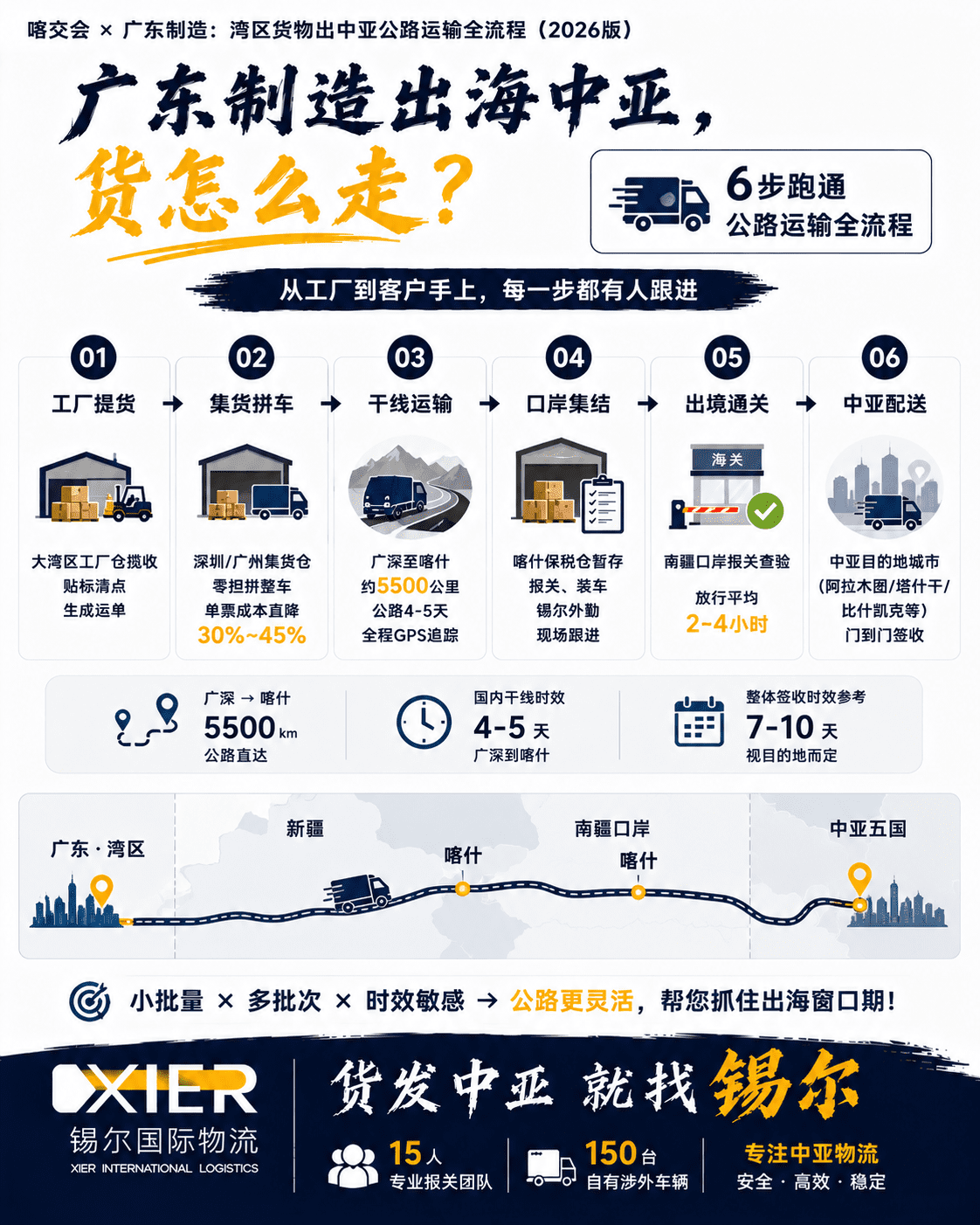 图1:广东制造出海中亚公路运输全流程(6步标准作业)
III. Which Port to Use? How to Choose Among the Four Major Southern Xinjiang Road Ports
Southern Xinjiang is the most convenient land route for bay-area goods into Central Asia. Each of the four road ports has its adapted direction:
- Irkeshtam: leads to Uzbekistan and Tajikistan, the core southern Xinjiang port, with Xier's own vehicles stationed.
- Torugart: leads to Kyrgyzstan, commonly used for agricultural machinery and equipment.
- Karasu: the route to Tajikistan, seasonally open (May–October); in winter, detour via Irkeshtam.
- Khunjerab: leads to Pakistan, highest altitude, suitable for Pakistan-bound goods.
 图2:南疆四大公路口岸选线参考
Route selection is not a single-choice question, but optimal matching — look at cargo type, destination, and timeliness. Xier has resident field staff at nine major ports; helping customers choose the right route matters more than blind shipping. Related reading:Which Route for Shipping to Afghanistan、How to Ship Logistics to Uzbekistan。
IV. Xier International Logistics' Bay Area Export Solution
Addressing bay-area enterprises' small-batch, multi-shipment, time-sensitive characteristics, Xier provides three core guarantees:
- 150 Owned Foreign-Trade Vehicles: equipped at major Southern Xinjiang ports — no container dumping in peak season, guaranteed emergency support.
- Port Resident Field Team: throughout cargo entry, inspection, and release, staff follow up in person — not via remote phone directing of drivers.
- Digital Tracking Platform: every step from warehousing to signing is visible, with anomalies alerted in real time.
Real Cases: a shipment from a Shenzhen consumer electronics enterprise to Almaty exited via the Irkeshtam port, taking 7 days from factory pickup to customer signing, 2 days ahead of the customer's expectation. For hard metrics to judge a logistics company, refer to5 Hard Indicators for Choosing a Cross-Border Logistics Company。
V. Three Tips for Bay Area Factories
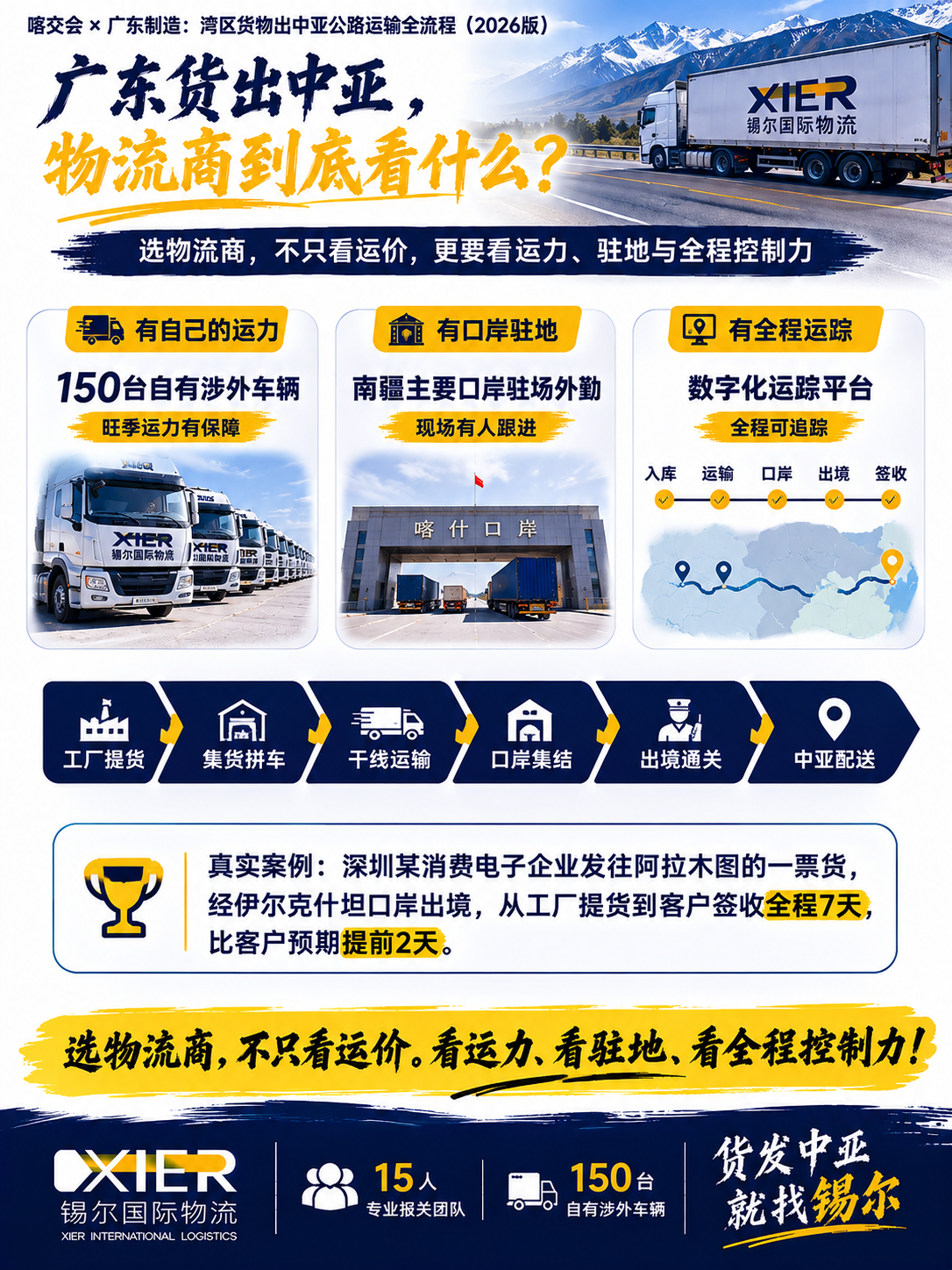 图3:选择中亚物流商应关注的硬指标
- Small batches go by road consolidation, don't force waiting for full rail trains; the window period is more valuable than freight.
- Prepare HS codes and bilingual documents in advance, with commercial invoices and packing lists properly translated; one less rejected document saves several days.
- Choose a freight forwarder with a port resident team, so inspection delays can be handled on-site rather than just waiting for notices.
Frequently Asked Questions (FAQ)
Q1: How long does Guangdong to Central Asia road transport take?
Guangzhou-Shenzhen to Kashgar trunk 4-5 days; port clearance + Central Asia delivery totals about 7-10 days for signed receipt, depending on destination and cargo type.
Q2: How to choose between road and rail?
Small batch, multi-shipment, time-sensitive choose road; bulk stable goods, not time-sensitive choose rail for more savings. Multimodal can combine: rail to Kashgar + road exit last mile.
Q3: What documents are needed for customs clearance?
Commercial invoice, packing list, bill of lading, HS code declaration, certificate of origin (if applicable). Electric goods require battery compliance documents; Xier can assist with pre-review.
Q4: Can electric/new energy goods be shipped?
Yes, but a compliant transport plan is required (UN38.3, battery transport declaration, etc.). Xier has experience with electric goods export operations; just communicate in advance.
Q5: How Is Freight Calculated?
Charged by weight or volume (whichever is greater), including trunk + port customs declaration + overseas delivery. Consolidation shared by volume, full truckload quoted per vehicle. For specifics, call 18195891000 for cargo-type-based calculation.
About the Author: Xier International Logistics — focused on Central Asia logistics market analysis and digital solutions. Based on a decade of Xier's operational data and industry research, this article is for reference only; specific solutions must be tailored to your cargo.