I. Where Is Irkeshtam Port
Irkeshtam Port (Irkeshtam) is located in Wuqia County, Kizilsu Kirghiz Autonomous Prefecture, Xinjiang, at the western end of the Pamir Plateau, adjacent to Osh Region of Kyrgyzstan. It is the land port with the largest clearance volume between China and Kyrgyzstan and the westernmost border port of China, known as the "Western Pole Gateway." It spans a deep canyon transitioning from the southern Tianshan Mountains to the Pamir Plateau, at an altitude of about 2,950 meters.
In terms of mileage, the port is about 230 km from Kashgar (via the Ayi Expressway and National Highway 581), about a 3-hour drive to the southern Xinjiang hub Kashgar; the Kyrgyz side is about 250 km from Osh, and from Sary-Tash turning north connects to the Fergana Basin, while eastward via Osh leads to Uzbekistan. Core exit mileage (authoritative basis): Irkeshtam → Tashkent about 916 km (via Osh / Sary-Tash transit), → Bishkek about 1,200 km, → Dushanbe about 550 km (eastward), with direct connection to Andijan and the Fergana Basin. It is a key node of the China-Kyrgyzstan-Uzbekistan international land corridor and an important hub of the Silk Road Economic Belt connecting Central Asia and radiating to Europe.
II. Why the Volume Has Surged So Fast in Recent Years
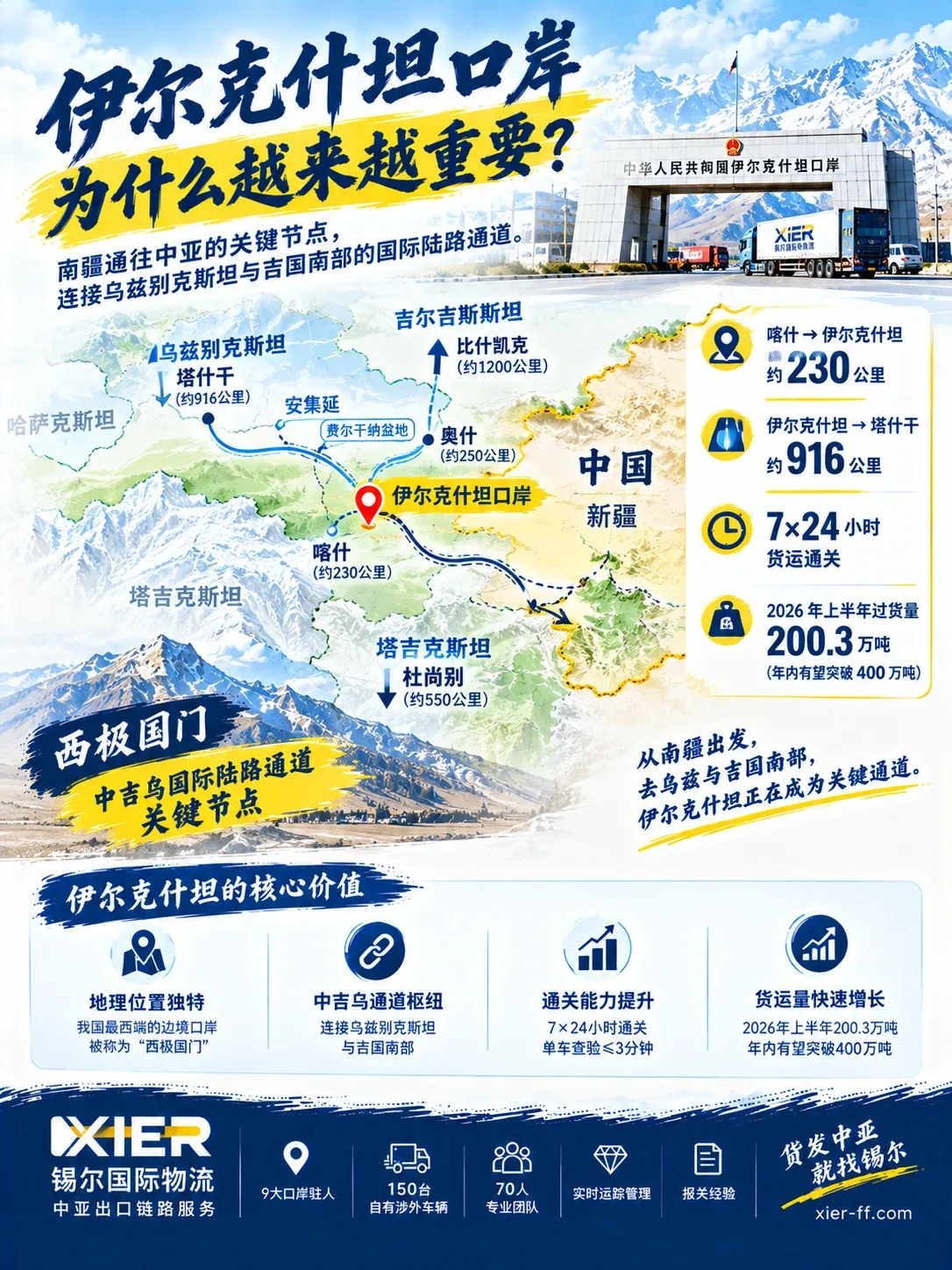
Irkeshtam's explosion comes from the breaking of the "time barrier." Starting June 1, 2025, the port piloted a 7-day 24-hour freight clearance model, becoming the first all-hours freight clearance road port in southern Xinjiang, achieving on-arrival inspection and immediate release of goods, completely breaking fixed-time-slot restrictions.
According to public data from the Xinjiang Daily, the Kizilsu government website, and the Irkeshtam Exit-Entry Frontier Inspection Station: from January to June 2026, a cumulative 2.003 million tons of import-export goods were supervised, a 58% year-on-year increase, breaking the 2-million-ton mark 80 days earlier than the conventional cycle in previous years; based on the current operating trend, annual cargo volume is expected to exceed 4 million tons. As of September 1, this year's cumulative inspected crossings reached 301,000 person-times and 277,000 vehicle-times, up about 47.4% and 46.3% year-on-year respectively. Clearance efficiency has also leaped: single-vehicle inspection compressed from 15 minutes to within 3 minutes, import procedures streamlined from 9 to 4 items and export from 12 to 4, supported by new models such as "road port + inland direct clearance," "green channel," and "multimodal + TIR." Drivers widely report: "Previously we queued for one or two days; now no overnight stay, no queue."
III. What Cargo to Export and How
Exports mainly consist of commercial vehicles (including new-energy vehicles), construction machinery, electromechanical equipment, steel and cement building materials, daily necessities, and fresh fruits and vegetables, among which fruits and vegetables can reach Almaty directly in 6 hours via the green channel; imports mainly consist of Kyrgyz mineral products, grain (the only designated grain import supervision site in southern Xinjiang), meat (in preparation), and Central Asian specialty products. For live animals, the port has released batches of high-quality Holstein dairy cows for export to Uzbekistan.
Taking commercial vehicles / construction machinery / electromechanical equipment as an example, the standard export path is five steps: ① domestic pickup (Kashgar or in-Xinjiang consolidation, with lashing reinforcement and document pre-check) → ② customs declaration and inspection (Kashgar local customs declaration, HS code classification, green channel filing) → ③ port clearance (Irkeshtam 7×24 smart checkpoint, joint inspection with one-time release, single inspection within 3 minutes) → ④ direct delivery abroad (Osh transit to Tashkent / Bishkek / Andijan, Kyrgyz customs clearance) → ⑤ tracking and sign-off (full GPS visibility, node status feedback, anomaly alerts).
IV. How to Select a Port for the China-Kyrgyzstan-Uzbekistan Corridor (Irkeshtam vs Torugart vs Karasu)

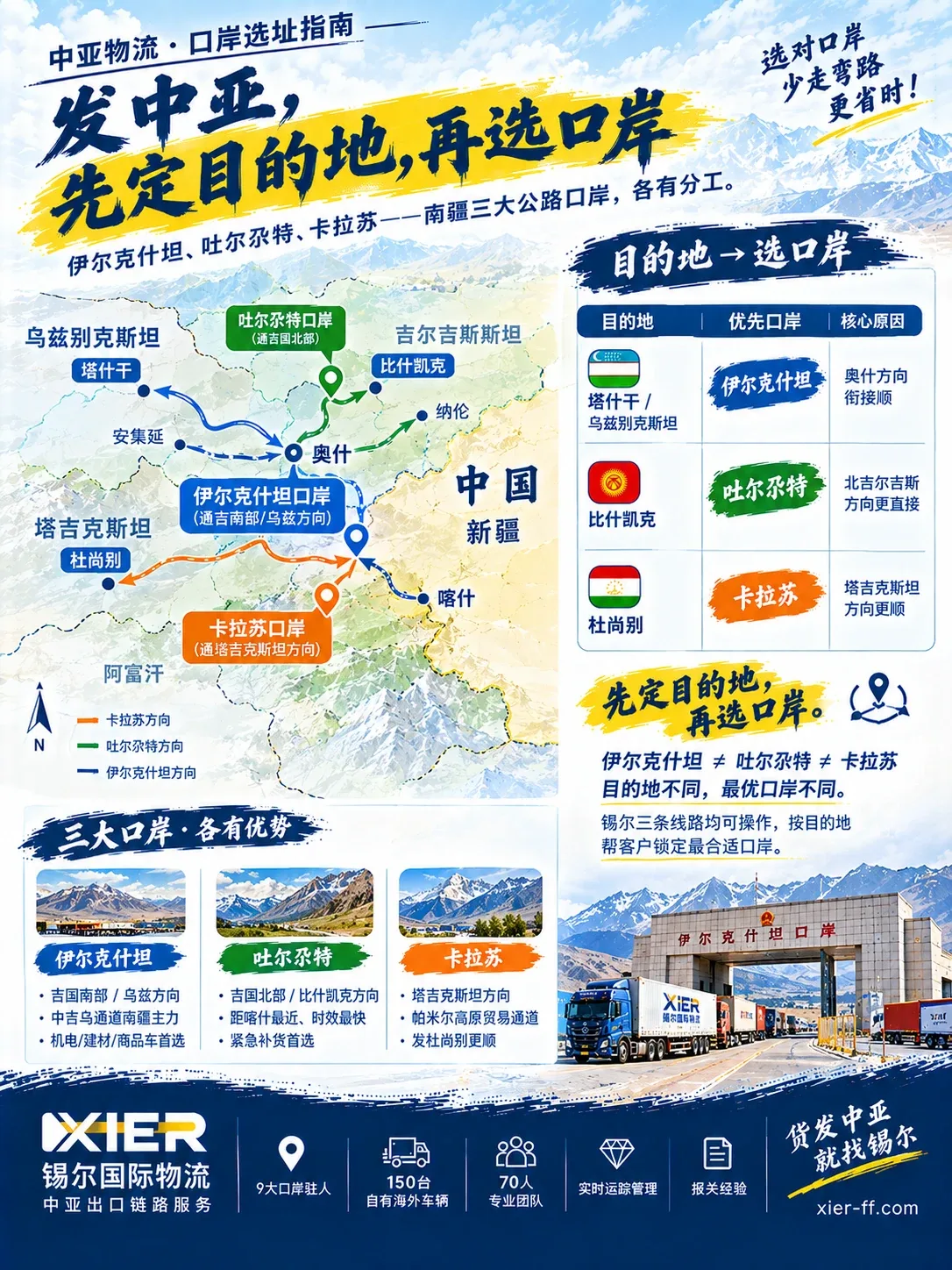
The three major road ports in southern Xinjiang have their own divisions of labor; selecting by destination saves the most time:
① Irkeshtam (about 230 km west of Kashgar): Connects to southern Kyrgyzstan's Osh / Fergana direction, and is the preferred port for shippingUzbekistan (Tashkent, about 916 km), and is also the main southern Xinjiang force of the China-Kyrgyzstan-Uzbekistan corridor. Electromechanical products, building materials, and commercial vehicles go most smoothly to Tashkent via this route.
② Torugart (about 57 km northwest of Kashgar): Connects to northern Kyrgyzstan's Bishkek / Naryn direction; shipping to the Kyrgyz capital Bishkek is closer than via Irkeshtam, and it is closest to Kashgar with the fastest transit, the first choice for urgent replenishment.
③ Karasu (about 220 km south of Kashgar): Connects to southern Kyrgyzstan + Tajikistan transit, an important corridor for Pamir Plateau trade and shipping to Tajikistan. Shipping to Dushanbe goes more smoothly via this route.
Practical advice: For goods to Tashkent / Uzbekistan → choose Irkeshtam; for goods to Bishkek → choose Torugart; for goods to Dushanbe → choose Karasu. Xier operates staffed teams on all three routes and can lock in the right port for customers by destination, avoiding detours and duplicate customs declarations.
V. Transit Time and Precautions
Conventional trucking transit time (assuming smooth clearance): Kashgar → Irkeshtam about 3 hours for loading and waiting for inspection; port clearance on arrival with single-vehicle inspection within 3 minutes under the 7×24 model; after exit, Osh → Tashkent land transport about 2–3 days, full door-to-door about 5–8 days depending on goods and customs clearance. The Bishkek direction via Torugart is faster, about 3–5 days.
Note: Heavy snow in the Pamir Plateau winter (about November to February of the following year) easily closes roads, so transit time needs flexible allowance; oversized / over-limit equipment is recommended to book the "over-limit vehicle channel" in advance; inspection-related goods such as grain, meat, and live animals must use designated supervision sites and green channels, with documents prepared in advance. All transit times and qualifications are subject to the port's latest notice.
Frequently Asked Questions
Q1: Between Irkeshtam and Torugart, which should I use for Uzbekistan?
A: For Uzbekistan (Tashkent), prioritize Irkeshtam; it is the main southern Xinjiang force of the China-Kyrgyzstan-Uzbekistan corridor, about 916 km from Tashkent, with the smoothest Osh transit; Torugart is closer to northern Kyrgyzstan's Bishkek direction, so going to Tashkent would detour. When unsure, have the logistics provider lock the port by destination for the safest result.
Q2: Is the 7×24-hour clearance really on-arrival inspection?
A: Yes. Starting June 1, 2025, Irkeshtam piloted 7-day 24-hour freight clearance, with goods inspected on arrival and released immediately; single-vehicle inspection is compressed to within 3 minutes, and export procedures streamlined from 12 to 4 items. However, extreme weather such as winter heavy snow may still affect actual transit time, so flexible allowance is needed.
Q3: Can commercial vehicles and construction machinery go? How to handle over-limit equipment?
A: Yes. Commercial vehicles, construction machinery, and electromechanical equipment are the port's main export cargo types. Over-limit / large vehicles have dedicated "over-limit vehicle channels" and green channels; it is recommended to book in advance and prepare lashing reinforcement plans; Xier's 150 owned vehicles can serve as large-cargo carriers and port connectors.
Q4: Can inspection-related goods such as grain, meat, and live animals be imported?
A: Yes, but through dedicated channels. Irkeshtam is the only designated grain import supervision site in southern Xinjiang and has normalized imports of Kyrgyz corn, etc.; meat import is in preparation; live animals (such as Holstein cattle) have been exported to Uzbekistan in batches. Inspection-related goods must use designated supervision sites and green channels, with documents (quarantine, origin, etc.) prepared in advance.
Q5: From Kashgar pickup to Tashkent sign-off, about how long, and how to ensure no break in the chain?
A: With smooth clearance, full door-to-door is about 5–8 days (Kashgar loading → Irkeshtam clearance → Osh transit → Tashkent customs clearance sign-off). Assurance relies on three points: Kashgar local customs declaration upfront, port 7×24 one-time release, and full GPS visual tracking + node status feedback + anomaly alerts. Xier has staff at 9 major ports, 150 owned vehicles, and a 5+-year customs team, able to handle the full chain in one go.
About the Author: Xier International Logistics — focused on Central Asia logistics market analysis and digital solutions. Based on a decade of Xier's operational data and industry research, this article is for reference only; specific solutions must be tailored to your cargo.