I. Why "Road or Rail" Is the First Choice Question for Export to Central Asia
Many enterprises exporting to Central Asia for the first time subconsciously treat "rail or road" as a secondary issue — they prepare the goods and sign the contract first, then remember to ask "how should this shipment be transported." But once the transport mode is chosen wrong, it is almost impossible to correct at low cost later: rail follows train schedules, and switching to road temporarily requires re-customs declaration and re-finding vehicles; if road is halfway and found more suitable for rail, the short-haul and document-revision costs are equally high. For Central Asia exports, road and rail are not "two options of the same service" but two structurally completely different corridors — the ports they connect to, the cargo volumes they suit, the destinations they can reach, and even the nature of goods they can carry are all different. Getting this choice right before shipment is the first step in controlling full-process transit time and cost. Xier International Logistics has long-term staff at 9 major ports, 150 owned foreign-related transport vehicles, and a customs team averaging over 5 years of experience, able to align the three things — "mode — port — documents" — for customers before ordering.
II. Underlying Differences Between the Two Modes: Capacity, Transit Time, Cost, Compliance
Conclusion first: There is no absolute "which is better," only "which is more suitable." From four underlying dimensions, the division of labor between road and rail is actually quite clear.
Capacity and cargo volume: Rail suits large-volume, highly planned goods, such as full-train bulk building materials, machinery and equipment, and agricultural products, with unit cost diluted as volume increases; road suits smaller, scattered goods needing door-to-door connection, shipping from one truck without needing to fill a whole train. The two are often not a substitute relationship but a combination of "main force by rail, replenishment by road."
Transit time and certainty: Road's strength is flexibility — file on arrival, go immediately at the port, fastest for urgent replenishment; rail's strength is stability — operates by train schedule, with more predictable full-process time for planned bulk goods. Choose road for "arrive now," choose rail for "arrive on schedule."
Cost structure: Rail pushes unit freight lower, but the connection costs of front-end consolidation and back-end distribution must be counted; road has higher unit price yet saves the hidden costs of filling a whole train and multiple transloadings. When cargo volume is small, road is actually cheaper; when volume is large, rail's advantage is clear.
Compliance and cargo nature: This is the dimension most prone to pitfalls. Some dangerous goods and hazardous chemicals have hard requirements on port qualifications and declaration, and not all ports can accept them; general cargo basically can go through both corridors. For enterprises involving chemicals, lithium batteries, and dangerous goods, the choice of transport mode must first pass the "qualification gate."
III. Four-Question Decision Tree: Follow It and You Won't Go Wrong
Turn the above differences into four questions, ask them in sequence before shipment, and you can basically lock in the transport mode:
First question: Where is the destination?This is the highest-priority switch. For shipments to Kazakhstan, Russia, and even Europe, the main route is the northern Xinjiang railway corridor — Alashankou is the main railway corridor of the China-Europe trains, while Khorgos is a rail + road dual corridor; for shipments to Kyrgyzstan, Uzbekistan, Tajikistan, Pakistan, and Afghanistan, road is the more direct choice, especially via the Irkeshtam Port in Wuqia, which can directly reach the Osh — Bishkek — Tashkent line, the smoothest road exit for the Kyrgyz / Uzbek direction.
Second question: How large is the cargo volume?Full truckload, full train, planned replenishment — prioritize rail; less-than-truckload, samples, small-batch door-to-door — road is more flexible.
Third question: What are the transit time requirements?Urgent replenishment, temporary orders — road's on-arrival go is fastest; planned bulk goods by production schedule — rail's certainty is more valuable.
Fourth question: What is the nature of the goods?General cargo can compare both corridors; dangerous goods and hazardous chemicals must first confirm port qualifications and declaration paths, which often fall to southern Xinjiang road dedicated lines with specialized capability. Stacking the answers to the four questions basically determines the transport mode.
IV. From the Port Perspective: How Xier Helps Customers Finalize the Plan
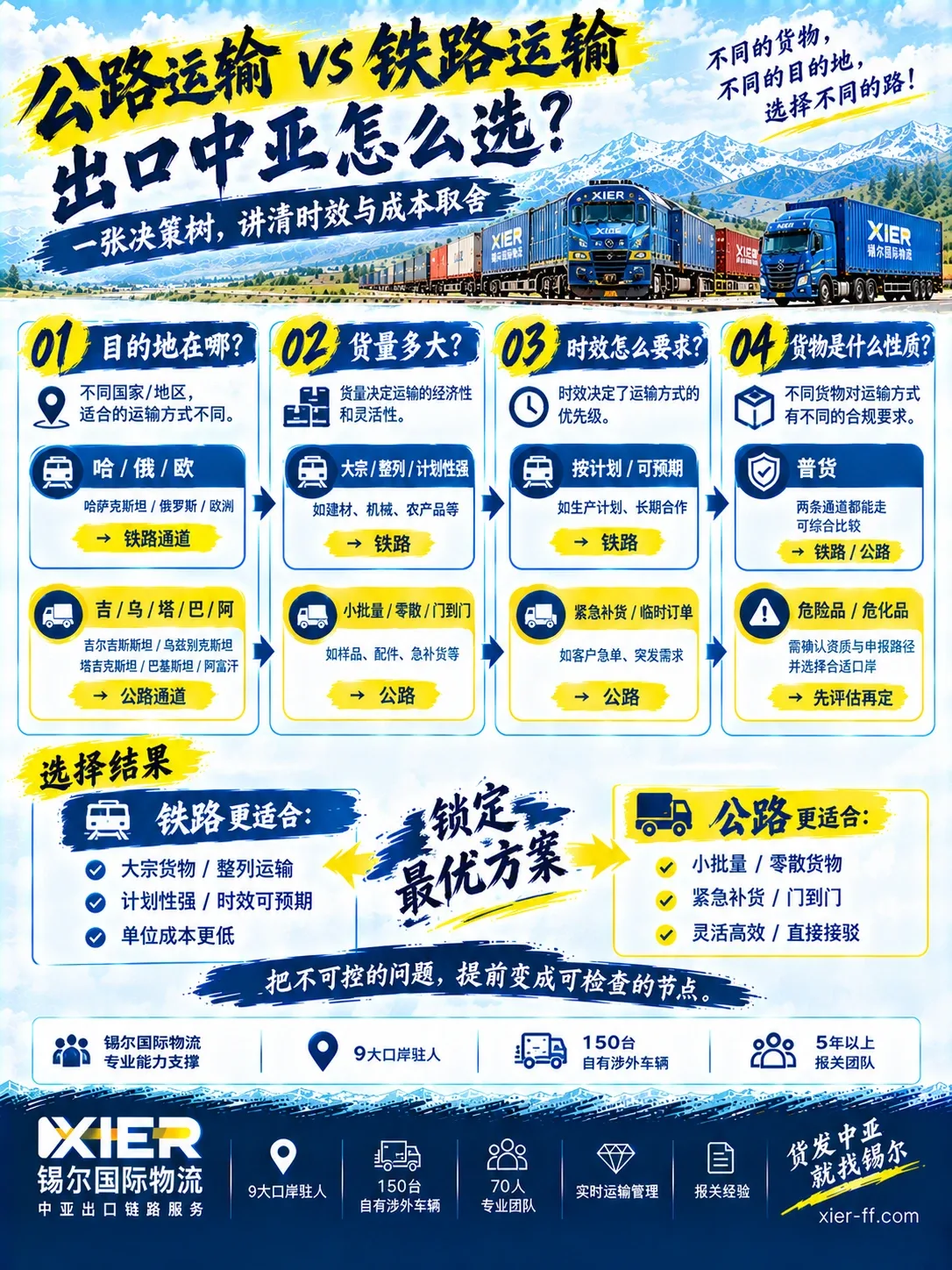 图1:出货前依次问目的地、货量、时效、货物性质四个问题,叠加答案即可锁定公路或铁路
The decision tree gives direction; real implementation depends on port resources. Xier's layout covers southern Xinjiang, northern Xinjiang, and the Urumqi hub, able to match the most suitable exit port by cargo direction.
For the Kyrgyz / Uzbek / Tajik / Pakistan / Afghanistan directions, the core is the Wuqia Irkeshtam Port — this is Xier's core advantage port with long-term on-site presence; the field team tracks the order on goods arrival and handles inspection immediately, making operations more stable and port detention risk lower than hiring agents on a temporary basis; combined with southern Xinjiang road ports such as Torugart, Karasu (to Tajikistan), and Khunjerab (to Pakistan), it forms a road network covering South Asia and the Central Asian heartland. For the Kazakhstan / Russia / Europe directions, it uses the northern Xinjiang Alashankou (main railway corridor) and Khorgos (rail + road dual corridor), connecting with the Urumqi multimodal hub for consolidation and distribution. For dangerous goods and hazardous chemical transport, Xier has the corresponding qualifications and declaration capability, able to handle the niche lines that large platforms are unwilling to touch. For export enterprises, choosing the right port means less short-haul, less document revision, less vehicle hold — which is precisely why transport mode decisions must reach the "port" level.
V. Two Practical Cases
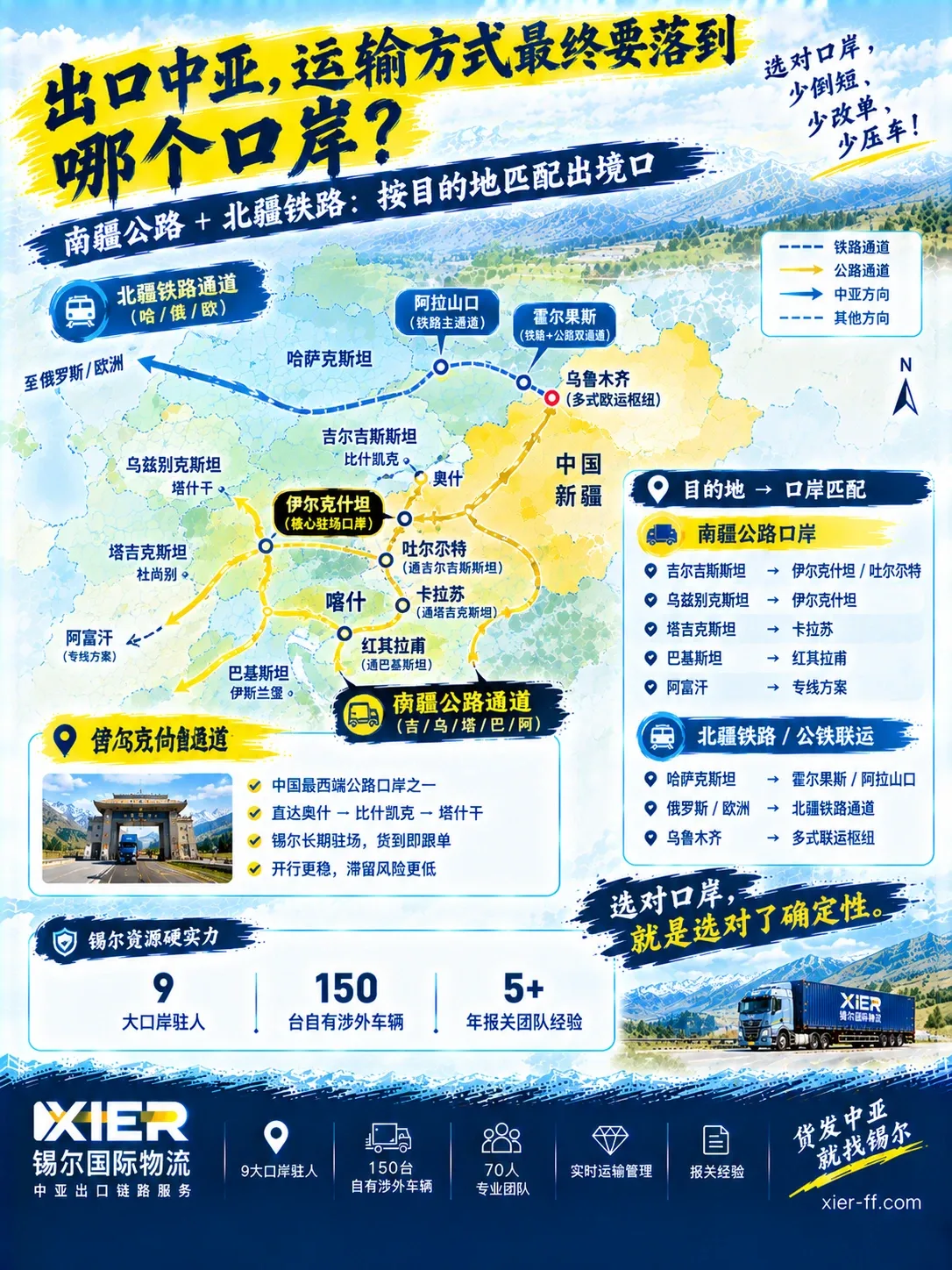 图2:南疆伊尔克什坦为核心、北疆阿拉山口/霍尔果斯双通道、乌鲁木齐多式联运——按方向匹配出境口
Case 1: Small-batch machinery parts replenishment to Tashkent. A equipment factory sent a batch of after-sales parts to an Uzbekistan customer, less than one truck per shipment, with the customer requiring arrival within two weeks. Going by rail would require waiting for train schedule and filling a whole train, with uncontrollable transit time; eventually it exited via Irkeshtam road, with door-to-door connection, and Xier's on-site field staff followed up on declaration and inspection at the port, delivering on time. For this type of "small-batch + clear transit time" goods, road is the better solution.
Case 2: Full train of building materials to Almaty. A building materials merchant fixedly ships hundreds of tons of goods to Kazakhstan every month, with the transit time requirement of "stable arrival by monthly plan." Using Alashankou's main railway corridor, full-train shipping has the lowest unit cost, with certain schedule and full-process traceability. For this type of "large-volume + planned" goods, rail captures both cost and certainty. The two cases show: the decision tree is not armchair theory but directly determines freight and service experience.
Frequently Asked Questions
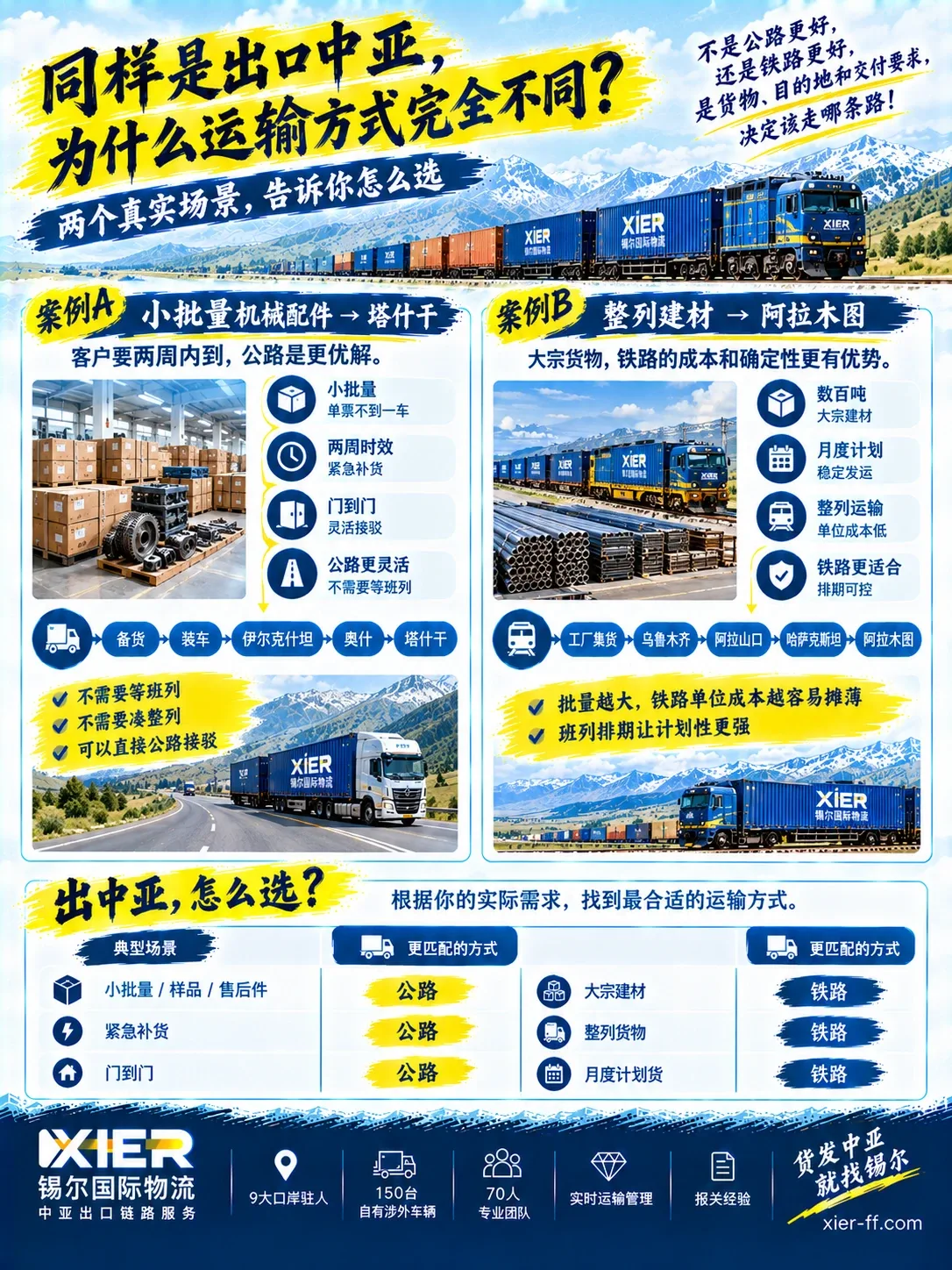 图3:两个实操场景对比——小批量配件走公路直达塔什干,整列建材走铁路班列发阿拉木图
For small-batch samples to Central Asia, road or rail?
For samples or after-sales parts of less than one truck per shipment with clear transit time requirements, prioritize road, especially for the Kyrgyz / Uzbek direction via Irkeshtam exit which is more direct; rail requires filling a whole train and waiting for schedule, making small batches less flexible.
Can dangerous goods and hazardous chemicals go by rail?
Some dangerous goods have hard requirements on port qualifications and declaration, and not all ports can accept them. For goods involving chemicals, lithium batteries, etc., you should first confirm the qualifications and declaration path; these often fall to southern Xinjiang road dedicated lines with specialized capability, and Xier has the corresponding qualifications to undertake them.
Why is Irkeshtam the preferred road port for the Kyrgyz / Uzbek direction?
Irkeshtam is located in Wuqia and is one of China's westernmost road ports; after exit it directly reaches Osh in Kyrgyzstan and connects to Bishkek and Tashkent, being the shortest overland exit for the Kyrgyz / Uzbek direction; Xier has long-term on-site presence here, tracking orders on goods arrival and handling inspection immediately, making operations more stable.
For bulk goods on China-Europe trains, which port to exit from?
For bulk goods to the Kazakhstan / Russia / Europe directions, the main route is the northern Xinjiang Alashankou main railway corridor, and Khorgos can also use the rail + road dual corridor; front-end consolidation at the Urumqi multimodal hub, then full-train shipping, with the lowest unit cost.
How to get an accurate transit time and quote?
Transit time and quote depend on cargo volume, destination, cargo nature, and exit port; it is recommended to provide these four pieces of information to a team with port experience for calculation before shipment. Xier has staff at 9 major ports, 150 owned foreign-related vehicles, and a customs team with over 5 years of experience; contact 18195891000 for a dedicated plan.
About the Author: Xier International Logistics — focused on Central Asia logistics market analysis and digital solutions. Based on a decade of Xier's operational data and industry research, this article is for reference only; specific solutions must be tailored to your cargo.